Showing posts with label individual responsibility. Show all posts

Sunday, July 19, 2020

Choices for Troubled Times - 2. My Responsibility Matters

Like many Americans, I’m trying to distinguish between those who protest to call attention to injustices against Black Americans, and those who have crept in for the purpose of inciting division, resentment, hate, violence, and destruction of property.  I also want to distinguish legitimate accusations of racism and White supremacy from accusations based upon an individual or a group’s feeling that they have been offended or oppressed.  An individual’s perception that a person or group has acted in an offensive manner is not in itself evidence that an offense has actually occurred (Statement on Social Justice & the Gospel).

In the midst of the current divisiveness and turmoil, I must recognize the unity or "oneness" in Christ that God has offered to all persons by His selfless sacrifice on the Cross as the Apostle Paul outlines in Ephesians 4: 1-6 which in turn, is based on the Scripture in Ephesians 2 and 3.  There, we learn of the "mystery" that as Gentiles (every ethnicity outside of the Jews) we were once “dead in our sin” (Ephesians 2).  But now all of us who are in Christ share in Eternal Life with Him by a faith.  This Life is equally available to any individual who repents and accepts Christ’s sacrifice for their sin.  I already have written in some detail about the biblical basis for unity of all mankind in “Choices for Troubled Times - 1. A Perfect Union”).

As I pondered these points, it was helpful to receive an article from a former student with whom I have been privileged to dialog about these matters.  What follows is my response to him, slightly edited for brevity:

LETTER TO A FORMER STUDENT:
Thank you for referring me to the article, “My Letter to a Young White Friend,” by Alfred Turnipseed, who identifies as an African American Orthodox Christian.  I have been reading and thinking about his and other writings and have been reflecting at length on the assertions about ethnic injustice.  Mr. Turnipseed bases his letter upon the principle of equal dignity for all in a biblical framework.  Furthermore, he acknowledges the unity that all believers share as children of God, “joint-heirs” with Christ through faith in Him.  However, in the first paragraph of his article, Mr. Turnipseed expresses what he sees as a “fragmented unity” when he asserts that it is a “natural next step for us to broach the topic of the very particular predicament that only some of us must endure.”  I want to consider this “natural next step” carefully in view of biblical truth.

Blame versus Individual Responsibility
I want to understand the trouble and the burden of those who are unjustly treated.  Truly, they bear a real burden.   This burden often becomes more imposing when a Black life is affected by the long history of injustices of the past.  But we must realize that neither today’s victim nor today’s alleged perpetrator can change the past.  Each of us are responsible only for the present.  Each of us must decide between accepting individual responsibility to work toward better relationships with our neighbor through the love of God, or to adopt a tribalism that fuels hatred and blame between social groups.

God’s Word provides us with an objective and unequivocal justification for respecting both the sanctity and the equal dignity of all humankind.  For those of us who accept this truth through faith in God, the challenge is for us as individuals to understand how these truths can be implemented in our daily lives.  Major portions of the recorded teachings of Christ and the writings of the Apostles instruct each member of the body of Christ on how to practice the two Great Commandments—to love God, and to love our neighbor (Mark 12: 30-31).  Obedience to these commandments remains the responsibility of individuals, not groups or institutions.  The emphasis of the Gospel of Jesus Christ is upon individual responsibility before a holy and just God.  

Justice for “Each Bad Apple” Not “The Whole Barrel”
Having taken the “natural step” toward acknowledging that there is a subgroup within all of humanity that must endure racial injustice, Mr. Turnipseed assumes the role of defending them.  Unfortunately, he exercises his role by communicating to his White friend what I believe is a judgmental spirit ignited by his acquaintance with individuals and situations within his immediate sphere of experience.  Mr. Turnipseed then extrapolates his judgments to include the motives and values of others he knows from their writings, passions, and actions; and then, he expands to whole groups (e.g. people who “call themselves Christians,” those “resting in white privilege,” “the police force,” “unfairness of the criminal justice system,” “workers vs. capitalists (as if they are necessarily separable), etc.).  His generalizations lead to assertions like, “when the police murder, they do so “under the veil of the law.”

When individual unjust or unlawful incidents involving one or a few police officers are used to justify blanket statements that implicate whole groups of people, the accusations can become very inflammatory.  It is inaccurate, unfair, and unjust to use a murderous act by one or a couple of policemen either to incite whole crowds of people to chant slogans like “defund the police” or to rail against “White supremacy.”

Biblical Approaches to Challenging Authority
Certainly, there are “bad apples” on police forces, but rather than crying “White supremacy,” why not use the freedoms we have in the world’s greatest nation to address injustices with a spirit of good will even in the face of opposition from those individuals and groups that are filled with hate toward ethnic minorities?  Christians at the time of the early church did not rail or join mass protests against Roman injustices toward different “classes” or ethnic groups.  Instead, they advanced the cause of Christ under the banner of love which overcame such injustices.  Romans 13 and 1 Peter 2: 11-17 provide clear instruction in how Christ-followers are to respect those in authority.  The practice of using Christians as prey for lions for the purpose of entertainment in Roman culture was brought to an end by just such a nonviolent action.
The non-violent approach used in protests led by Dr. Martin Luther King Jr. in the 1950’s and 1960’s resulted in major advances in civil rights through passage of bi-partisan legislation.  In contrast, the Black Lives Matter movement doesn’t appear to have a constructive goal or plan.  They also appear to lack an understanding of and thankfulness for just how much American society has progressed toward equal justice under the law for all ethnic groups.  Indeed, those who cry “White supremacy” need to be careful lest they be exposed as misguided, “White-privileged” advocates who are nothing more than “noisy gongs” because they do not have a true, unconditional love-driven compassion for struggling individuals who need to be lifted up by acts of the love of Christ.

In some cases of injustice, the Bible allows that it may be necessary for citizens to appeal respectfully to higher authority.  In Acts 25: 1-12, the Apostle Paul provides an example of how Christians can legitimately make a respectful appeal to higher authority, in Paul’s case, to Caesar himself.  In America, while peaceful protests have been legitimate means of drawing attention to serious concerns, we are blessed with a representative government and excellent channels of communication via internet and phone to register our opinions and grievances.

Reconciliation through Love and Forgiveness
Above all, it is the responsibility of Christ-followers to exercise the virtues of love and forgiveness.  Writing in a culture filled with injustice toward minorities, the Apostle Peter encourages us to …keep loving one another earnestly, since love covers a multitude of sins (1 Peter 4: 8). 

A wonderful portrayal of the loving, compassionate, forgiving Spirit of Christ was shown in 2015 by members of Emanuel African Methodist Episcopal Church in Charleston, SC.  There, a man who came in as if to join their Bible study and prayer time, instead opened fire in a murderous rampage that led to the deaths of nine Christ-followers and injuries to three others.  While our nation watched, families of these victims freely offered their forgiveness to the murderer in the name of Jesus Christ.  Instead of allowing their grief from their horrendous losses of loved ones to spill over into hate, violence, and destruction, they threw themselves at the foot of Christ’s Cross.  Their act of forgiveness toward the murderer was a loving tribute to the crucified Christ because it embodied His true intent when he spoke from His Cross, “Father forgive them for they know not what they are doing (Luke 23: 34).” What would happen in our divided America if more of God’s people of faith would practice forgiveness, that unique virtue made possible through a personal relationship with a Forgiving God and Savior, Jesus Christ?

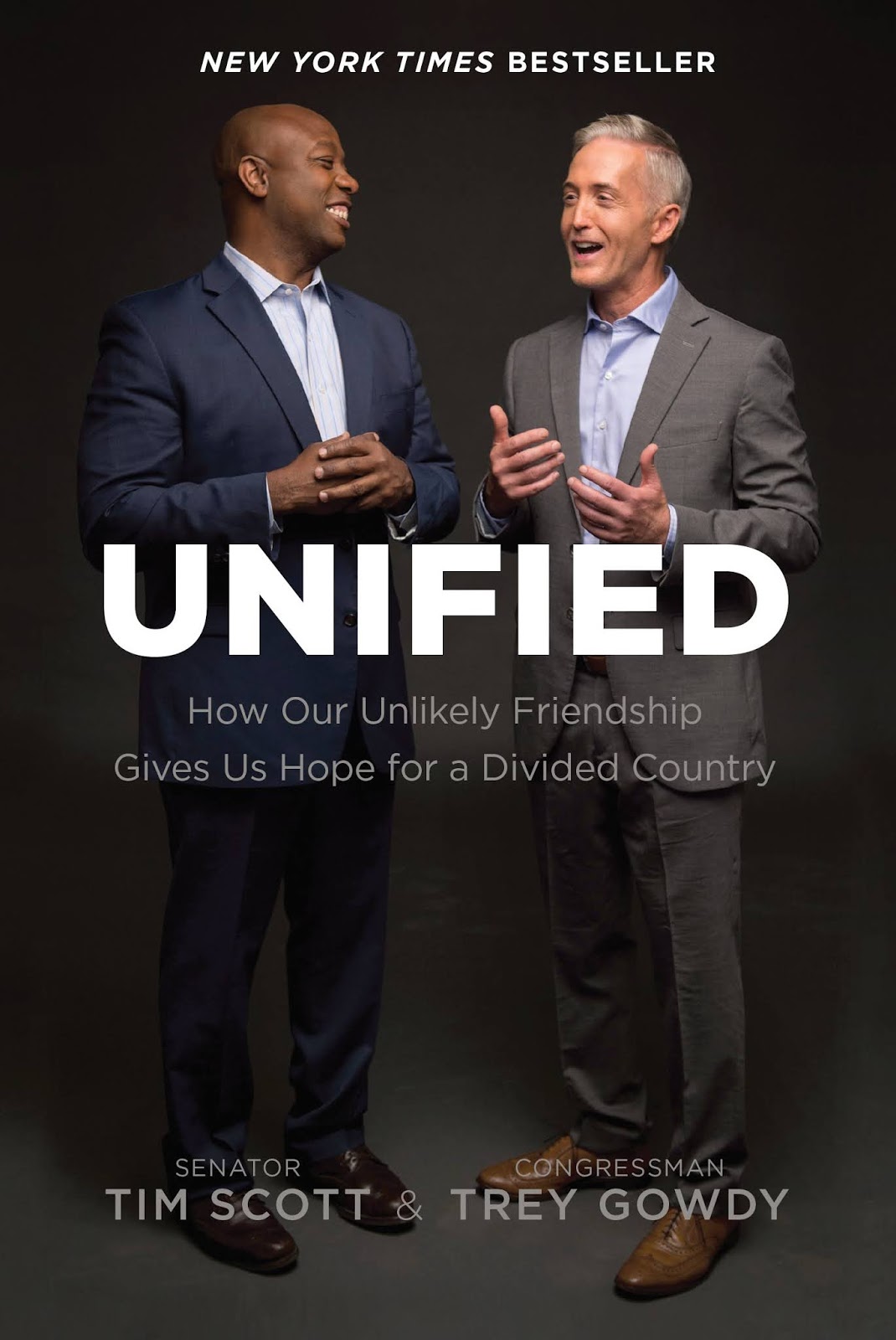
Related to the Charleston, SC incident, two notable political leaders from South Carolina, U.S. Senator Tim Scott and former U.S. Congressman, Trey Gowdy, recently appeared in a fascinating interview on the Mike Huckabee Show.  These two men are long-time friends and have written a very practical book, Unified: How Our Unlikely Friendship Gives Us Hope for a Divided Country.  During the interview with Gov. Huckabee, while referring to the tragic shooting and the forgiveness that America witnessed, Rep. Gowdy admitted that he could not have done that. 

I’m not sure if I could have forgiven a man who murdered members of my family either.  But it is this kind of unconditional love that God offers me—and, offers to all of us regardless of age, gender, ethnicity, church affiliation, political party, etc.  I want this love to motivate me to fulfill my individual responsibilities to love my wife, my family, friends, and all whom God considers “your neighbor.”  Beloved, if God so loved us, we also ought to love one another (1 John 4: 11).


How Would  You Respond?
I have written this article as a response to my friend and former student with the intention of sharing my current understanding of my personal responsibilities to my family, “my neighbor,” and to institutions—local community, church, and government.  I hope my friend and other readers will agree that I have done so in Christian love and with a humility that conveys that I am willing to learn from those who know more than I and who may disagree vehemently.  I welcome your “Comment” using the link below.


Thursday, September 21, 2017

Are There Lessons for America from the 1950’s?

Reminders of the era of the 1950's.
I am a member of the “baby boomers,” representing children born from roughly the end of World War II to the period of the early 1960’s.  While American culture in this era was not without need of moral and spiritual revival, many would consider the 1940’s and 1950’s as one of the most favorable times in which to grow up as a child in America.   For the sake of brevity, I will refer to this era, which encompassed my elementary school years, as “the 1950’s.”

So, I was interested to learn that two university professors have published an op-ed in The Philadelphia Inquirer entitled, “Paying the price for breakdown of the country's bourgeois culture.”  Amy Wax is the Robert Mundheim professor at the University of Pennsylvania Law School; and, Larry Alexander is the Warren distinguished professor at the University of San Diego School of Law.

Wax and Alexander open their article with what many of us would agree is a pretty accurate summary of the current state of socio-economic affairs in America today:

Too few Americans are qualified for the jobs available. Male working-age labor-force participation is at Depression-era lows. Opioid abuse is widespread. Homicidal violence plagues inner cities. Almost half of all children are born out of wedlock, and even more are raised by single mothers. Many college students lack basic skills, and high school students rank below those from two dozen other countries. 

"I don't shrink from the word 'superior'." -- Dr. Amy Wax 
The authors admit that the ”causes of these phenomena are multiple and complex, but implicated in these and other maladies is the breakdown of the country’s bourgeois culture.”  Although the term “bourgeois” generally means “middle class,” it can also suggest values of materialism, pro-capitalism, and anti-communism.  Wax and Alexander may be using the term “bourgeois” in their title to grab attention, but their intent is to call readers to consider the merits of “1950’s middle-class values” which they outline as follows:


Get married before you have children and strive to stay married for their sake. Get the education you need for gainful employment, work hard, and avoid idleness. Go the extra mile for your employer or client. Be a patriot, ready to serve the country. Be neighborly, civic-minded, and charitable. Avoid coarse language in public. Be respectful of authority. Eschew substance abuse and crime.
Evidence of moral decline in America.

According to the two law professors, these cultural values “reigned” in the era of the 1950’s for two reasons.  They “could be followed by people of all backgrounds and abilities,” and they were “backed up by almost universal endorsement.”  The principle assertion of the authors is that adherence to these values and disciplines “was a major contributor to the productivity, educational gains, and social coherence of that period.”

As if to anticipate the skepticism and pessimism of our divided culture, Wax and Alexander quickly admit that not everyone of the 1950’s era adhered to these values: 

There are always rebels--and hypocrites, those who publicly endorse the norms but transgress them. But…even the deviants rarely disavowed or openly disparaged the prevailing expectations.  Was everything perfect during the period of bourgeois cultural hegemony?  Of course not.  There was racial discrimination, limited sex roles, and pockets of anti-Semitism.  However, steady improvements for women and minorities were underway even when bourgeois norms reigned.  Banishing discrimination and expanding opportunity does not require the demise of bourgeois culture.  Quite the opposite: The loss of bourgeois habits seriously impeded the progress of disadvantaged groups.  That trend also accelerated the destructive consequences of the growing welfare state, which, by taking over financial support of families, reduced the need for two parents.  A strong pro-marriage norm might have blunted this effect. Instead, the number of single parents grew astronomically, producing children more prone to academic failure, addiction, idleness, crime, and poverty.

Whether or not you agree with Wax and Alexander, most readers will not be surprised at the harsh manner in which their article was received.  And if it were not enough for the authors to laud the values the values of the 1950’s, they also claim that “All cultures are not equal. Or at least they are not equal in preparing people to be productive in an advanced economy.” 

Note that the authors are not saying one culture is better than another--only better at preparing human beings to have productive lives in the cultural context within which they will live.  Nevertheless, in several articles, including articles in the U. Penn student newspaper, the Daily Pennsylvanian, the authors are accused of using “hate speech” and preaching “white supremacy.”  One of these articles, entitled “Notions of 'bourgeois' cultural superiority are based on bad history,” was written by five of Amy Wax’s own law faculty colleagues at U. Penn.  Imagine that occurring to you as a professor at the beginning of a new academic year. 

Professor Dorothy E. Roberts and colleagues consider Wax and Alexander’s “nostalgia for the 1950’s ‘bourgeois’ culture” to be “bad history” and compare it to a defense of Confederate statues that promote white supremacy.   They add that, “nostalgia for 1950’s ‘bourgeois’ culture erases its historical context and serves as a thinly veiled argument for… Anglo-Protestant superiority….”

In defense of Amy Wax and “1950’s values,” Heather Mac Donald, asks readers of National Review:

Were you planning to instruct your child about the value of hard work and civility?  Not so fast!  According to a current uproar at the University of Pennsylvania, advocacy of such bourgeois virtues is “hate speech.”  

Mac Donald then points out the flawed and biased approach of Roberts et al and other liberal progressives who view “1950’s values” with disdain and who accuse Wax and Alexander of promoting cultural bias and racial supremacy.  Mac Donald summarizes by putting her finger on what she calls the “primary sin” of Wax and Alexander—the need to change human behavior with emphasis on individual responsibility:

The op-ed’s primary sin was to talk about behavior. The founding idea of contemporary progressivism is that structural and individual racism lies behind socioeconomic inequalities. Discussing bad behavioral choices and maladaptive culture is out of bounds and will be punished mercilessly by slinging at the offender the usual fusillade of “isms” (to be supplemented, post-Charlottesville, with frequent mentions of “white supremacy”).  The fact that underclass behaviors are increasingly common among lower-class whites, and not at all limited to poor blacks and Hispanics, might have made it possible to address personal responsibility.  That does not appear to be the case.

Some of my readers will question the notion that America ought to consider returning to the values of the 1950’s.  Questioning is a good thing--if accompanied by an objective analysis.  I hope my article does not discourage readers from doing just that. 

Some of you who may be skeptical of the Wax-Alexander assertions are not “baby boomers.” Others, like me were not yet adults during the 1950’s.  I was an elementary schoolboy who had seen little of the wider world outside my rural, farm community.  I have great memories of those years, but I was not immune from learning of moral and ethical transgressions within our family and our community.  Thankfully, God was already showing me His provision through Christ to forgive my sin, make me His child, and teach me to understand the world and His plan for me.

So, let no reader think that I look back on the 1950’s with a fog of nostalgia or with colored glasses.  Rather, I believe the articles I have cited and others are affording our nation with the opportunity to have a polite discussion and debate about what is good and redeemable about American culture of past and present, and where changes are needed.  I hope you will read the assertions of the Wax-Alexander article and of opposing articles such as Roberts et al; and, critiques such as that of Mac Donald.  I am not optimistic that a “polite discussion” will or even can happen without a moral and spiritual revival.  As long as we choose to view our history with an arrogant disdain that refuses to acknowledge the importance of individual responsibility for moral and ethical choices, there is little hope.

The Book of Proverbs teaches the connection between wise discernment by the individual and the corporate benefit of individual righteousness to the nation as a whole:

Wisdom rests in the heart of the discerning;
 it is known even in the heart of fools.
Righteousness exalts a nation,
but sin is a disgrace to any people
.
                               Prov. 14: 33-34 (NET Bible)

We must realize that “individual righteousness” is not “self-righteousness.”  The Bible says that all of our self-righteousness is but filthy rags to God (Isaiah 64:6).  Therefore, God instructs us in Titus 2:  12-14 to deny ungodliness and worldly desires and to live sensibly, righteously and godly in the present age, looking for the blessed hope and the appearing of the glory of our great God and Savior, Christ Jesus, who gave Himself for us to redeem us [give us right standing before a Holy God] from every lawless deed, and to purify for Himself a people for His own possession, zealous for good deeds.”

Heather Mac Donald does not offer much optimism for American culture.  She concludes her article asking,

What if the progressive analysis of inequality is wrong, however, and a cultural analysis is closest to the truth?  If confronting the need to change behavior is punishable “hate speech,” then it is hard to see how the country can resolve its social problems.


When I read the progressive liberal critique that considers  the mention of timeless, multicultural values like hard work, moral uprightness, and civility as “hate speech,” I am reminded of the Prophet Isaiah’s warning of coming judgment:

Therefore My people go into exile for their lack of knowledge;
Woe to those who call evil good, and good evil;
Who substitute darkness for light and light for darkness;
Who substitute bitter for sweet and sweet for bitter!
                                                        -- Isaiah 5: 13a, 20

What About You?   Do you have good memories of the 1950’s or of reading about that era?  Do you agree with authors Amy Wax and Larry Alexander that America would benefit if we were to return to some of the values the 1950’s?   What is your answer to the hope for America as a nation, and more broadly for human civilization?

Saturday, July 5, 2014

High Court Defines & Defends Free Expression

The Supreme Court ruled this week that Hobby Lobby and Conestoga, two for-profit corporations, do not have to provide certain contraceptives to their employees pursuant to the Affordable Care Act (ACA) if such provision is deemed in violation of the employer’s faith convictions.  Less widely reported by the media was the fact that the two “closely held corporations” had already included sixteen other contraceptives in their employee health coverage.  In addition, the wages provided by these corporations are so generous (Hobby Lobby employees start at $14/hr and $9.50/hr, respectively, for full-time and part-time employees) that even a part-time employee could purchase a month’s supply of contraceptives (estimated, $9.00) on their own for approximately one hour’s work.
Supreme Court case was about more than "women's rights."
Nevertheless, the respective corporate owners, the Green Family and the Hahn family, were taken to court for refusing to include four additional contraceptives as mandated under the ACA.  Why?  These four products are known to destroy the human embryo.  Thus, including them along with the 16 products they had approved would compromise their faith position which holds that each human life begins at conception.

In the 5-4 opinion written by Justice Samuel Alito, the Court held that the ACA contraceptive mandate violates the Religious Freedom Restoration Act (RFRA).  Alito was joined by Chief Justice John Roberts and justices Scalia, Thomas, and Kennedy.   Monday’s close decision is now highly contested in the court of public opinion.  Opponents of the decision argue along the lines of Justice Ginsburg’s opposing decision.  Ginsburg claimed that the Court was wrong in denying free access to contraceptives to thousands of women employed by Hobby Lobby and Conestoga or dependents of persons those corporations employ...who do not share the corporation owners’ religious faith.  Thus, the case is being targeted by opponents as a “women’s rights” violation. 

Defenders of the Court’s decision do not see their victory as imposing unnecessarily on the rights of women. First, the two corporations had already been providing insurance coverage for all approved non-abortificient products.  Second, as noted above, both corporations are very generous with their hourly wage schedule.  Therefore, defenders of the court decision have honest reason for celebration which defends their deeply held conviction about the rights of the unborn.  More broadly, the decision affirms the right of people of faith to act upon their belief system outside church doors and in their workplaces.

Along with the Supreme Court Ruling, Justice Anthony Kennedy filed a concurring opinion which is a valuable reminder of the constitutional nature and intent of the founding fathers regarding religious expression under the First Amendment of the U.S. Constitution.  Justice Kennedy wrote (emphasis mine):
Justice Anthony Kennedy
In our constitutional tradition, freedom means that all persons have the right to believe or strive to believe in a divine creator and a divine law. For those who choose this course, free exercise is essential in preserving their own dignity and in striving for a self-definition shaped by their religious precepts. Free exercise in this sense implicates more than just freedom of belief. It means, too, the right to express those beliefs and to establish one’s religious (or nonreligious) self-definition in the political, civic, and economic life of our larger community.

Secularists applaud “tolerance” of differing views as a virtue.  However, the rules of tolerance do not apply to folks with “religious views” because they "force their views on others.”  This week the Supreme Court affirmed
the right of all Americans, whether “religious” or “non-religious,” to hold to a world-and-life view, or worldview.  Furthermore, the Court held that regardless of their worldview, free exercise is essential in preserving their own dignity and in striving for a self-definition shaped by their religious precepts as relates to their daily participation in our larger community.

When I read Justice Kennedy’s concurring decision affirming my right to express and practice my Christian faith in public, I said, “YES!”  But then it struck me.  The Constitution also guarantees free expression to those who hold very different beliefs from mine or who are enemies of America.  Then, I realized that “free expression” in this great “land of the free” will only be possible if we are willing to take individual responsibility to be respectful of differing views.  As the Apostle James writes, we must be quick to hear, slow to speak and slow to anger; for the anger of man does not achieve the righteousness of God. (James 1: 19-20).   

In a world that is increasingly divided over issues and resentful of Christians attempting to apply the salt and light of the Gospel to these issues, we will need to exercise gentleness and mercy.  As Os Guinness wrote in A Free People’s Suicide (emphasis mine),

It is possible to be free at the constitutional level in terms of the structures of liberty, but to lose freedom and become servile or anarchic at the citizens’ level in terms of the spirit of liberty.

When asked by Marvin Olasky (WORLD Magazine, June 29, 2013) if this is already happening in America, Guinness responded (emphasis mine):

It is happening.  Freedom is the greatest enemy of freedom.  We’ve got a permissiveness in almost every area, and Americans have lost the capacity to say “no” to things that are wrong.  A general ungluing, unraveling, permissive license leads to chaos.  Freedom requires and assumes you know who you are and who you’re to be.  It’s not just a formlessness; it’s the power to do what you ought, as Lord Acton used to put it.

How should God’s people function in a culture where the moral compass is being abandoned and where self-definition is lacking?  Guinness is critical of the Christian right for, in his words,
trusting politics to do more than politics can do.  He elaborates in the same interview:

To put it in the language of William Wilberforce, they did the Lord’s work, but in the world’s way.  Wilberforce had an incredible love for the people who hated him, mugged him, and attacked him physically twice—but he prevailed through love, and he wasn’t gushy in any sentimental way.  The Christian right often shamelessly demonized and stereotyped, and we’re paying for the bad ways they fought it.  But on the issues, I’m with them.

In response to Justice Kennedy’s decision, Jennifer Raught Brock, a Cedarville University graduate, expressed to me some of the hard challenges of true servants of Christ who exercise the right of free expression of their Christian faith in their public life for the glory of God and for the service to their neighbor.  Jennifer wrote:

For Christians, kingdom work includes redeeming culture. Loving one's neighbor involves promoting justice and freedom. It's not an earthly, political kingdom we seek; God never promised us religious freedom. Nor did God promise freedom from pain. Yet that shouldn't stop us from trying to alleviate suffering.  He never said we should expect financial stability, but that doesn't mean we don't work hard or give to those who are poor.  He informed us that we're all going to die someday, but that doesn't mean that we refuse medicine when we're sick or that we fail to care about the overall quality of medical care in our society.

Supporting free expression of faith in the "larger community."
Our “free expression” comes at a great price through the sacrifice of Christ Who laid the foundation for our spiritual freedom; and later, the sacrifices of American men and women who have fought and died to give birth and then defend this nation during more than two centuries.  Many did so because they believed
that all men are created equal, that they are endowed by their Creator with certain unalienable Rights, that among these are Life, Liberty and the pursuit of Happiness.  May God help us to exercise our freedom in a Christ-like manner with firmness and boldness, yet with gentleness and reverence.

If we are in Christ, the Apostle Paul states, we are new creatures (2 Corinthians 5: 17), no longer conformed to this world, but transformed by the renewing of our minds (Romans 12: 2).  Of all people, being set free from sin and self, now free in Christ and free under the Constitution, we ought to know who we are, who we’re to be, and have the power to do what we ought.  We ought to be “about” self-definition, but more basically, “all about” Christ-definition as we give witness to the fruit of His Spirit—love, joy, peace, patience, kindness, self-control as we participate in the broken and divided political, civic, and economic life of our larger community.

Wednesday, July 4, 2012

“Public Servants” and Citizens--Both Stewards of Freedom

We are a nation that has a government—not the other way around. And this makes us special among the nations of the Earth. Our Government has no power except that granted it by the people.
-- Ronald Reagan,  January 20, 1981

In his first inaugural address, President Reagan reminded us that government is to be a servant of the people.  That is, “civil servants” are to be “servants” of the people, and to exercise stewardship of the power granted to them.  At the same time, we as citizens have a responsibility as stewards of the freedom and opportunity afforded to us by our founders.   We exercise our stewardship by holding elected officials accountable as stewards of the privileges and responsibilities of their offices.  All of us are ultimately stewards of the rights endowed by our Creator.

On this Independence Day, 2011, one of my U.S. Senators from Ohio, Sen. Sherrod Brown, e-mailed a statement which prompted me to reply to him online.   His statement is below followed by my response to him:

Two hundred and thirty-seven years ago, farmers, merchants, laborers, and soldiers celebrated a new nation – fixed in freedom and equality. They faced tough odds, but they were armed with the vibrant American spirit and rock solid patriotism that has carried our nation forward since its founding.  – Sen. Sherrod Brown (D-Ohio)
Senator Brown,
Thank you for your e-mail reminding us to celebrate Independence Day.  In your opening statement, you have emphasized two important ingredients that have been valued by Americans for centuries--"freedom and equality."  Please allow me to respond in the spirit of the Founding Fathers as expressed in the Declaration of Independence which states (emphasis mine)

We hold these truths to be self-evident, that all men are created equal, that they are endowed by their Creator with certain unalienable Rights, that among these are Life, Liberty and the pursuit of Happiness. — That to secure these rights, Governments are instituted among Men, deriving their just powers from the consent of the governed, — That whenever any Form of Government becomes destructive of these ends, it is the Right of the People to alter or to abolish it, and to institute new Government, laying its foundation on such principles and organizing its powers in such form, as to them shall seem most likely to affect their Safety and Happiness.
The intent to our founders was to establish a nation in "freedom from" the tyranny of the King of England whose policies no longer respected individual freedoms.  To the Founding Fathers, "freedom" was based on "truths" that were "self-evident"; namely, that basic "rights" are "unalienable" and exist as an endowment from a Higher Power, not simply from man-made laws.   Based on this foundation, our Constitution encouraged individual initiative, entrepreneurial spirit, and investment in business and technology that has made possible a standard of living (including a health care system) unequaled in the world.

Senator Brown, you also used the word, "equality."  However, wouldn’t you agree that the Founding Fathers meant to give us a system of government that provides more than "equality?" Wasn’t their aim to assure "freedom" under the law so that each person would have "opportunity" for the "pursuit of happiness" as stewards of their individual abilities and opportunities?  The Founders understood what many of us have forgotten; namely, that each person is endowed genetically from his Creator and is nurtured by his environment (parents, family, and local community) to achieve at a given level in a vocation (or "calling") that fits his or her abilities. Not all can be doctors, or farmers, or NBA stars, or United States senators.   But as much as possible, each should have the opportunity to "earn" their way to a fulfilling way of life.

Yes, there are injustices in America today.  But these can be corrected by enforcement of the law, not by taking from those who have worked hard to gain an honest living and "giving" to those who have less as if to "create” equality.  This merely creates dependence and a dehumanized class of Americans that also happens to be a voting constituency for politicians who, like drug dealers, promise them another "fix" (at an ever increasing cost).   Those such as yourself who are in positions of power must steward that power by being protectors of individual freedom.  Government assistance is needed to meet acute needs, but government should also create an environment that constantly promotes individual self reliance.

As a U.S. Senator in our American culture that seems to have forgotten the importance of individual responsibility and initiative, you may soon have an opportunity to vote for or against the Patient Protection and Affordable Care Act.  In the spirit of offering “a fair share” of “affordable health coverage” to all Americans, this legislation fails on at least four counts. 

First, it is “unaffordable” by our nation which is already trillions of dollars in debt.  Second, as far as I can tell it does not provide health and nutritional incentives to Americans, many of whom have undisciplined lifestyles and eating habits.  Thus, it would require those of us who are individually responsible for a healthy lifestyle to subsidize those who make bad nutritional choices, or who unfairly take advantage of health care because it is “affordable.”

Third, it will further “shelter” health services from a “free market” environment wherein healthy competition could both improve quality of care and reduce costs.  However, if enacted, the proposed legislation would promote the same deterioration in health care that we have witnessed in our public educational system.  Can we not learn from the failed attempts of government-managed education as well as Social Security and Medicare (both deeply in debt)?   Government has been unable to “compete” with “free market” approaches to providing goods and services—whether it be transportation (recall Amtrack), postal service (U.S. Postal Service versus FedEx), or recent attempts at “green energy” in which taxpayer dollars were poorly invested (Solyndra).

Finally, it appears that the Patient Protection and Affordable Care Act will further erode the doctor-patient relationship which has been historically crucial to the quality of health care in America.  As Ronald Reagan stated in a radio address, July 6, 1977, “…wouldn’t it violate everything we believe in to adopt a system based on the idea that the patients have a right to a doctor’s services without regard for his right to say how and on what terms those services will be delivered?”

And so, today, as my U.S. Senator and “public servant”, I invite you to join me in celebration of “freedom from tyranny” and celebration of the fact that “all men are created equal, that they are endowed by their Creator with certain unalienable Rights, that among these are Life, Liberty and the pursuit of Happiness.”  I also commit to pray that you and your colleagues in the U.S. Senate will reexamine these principles and recommit to enacting legislation that will respect the limits of government and protect the rights of the individual and local community.  After all, human health in America has historically rested upon a Judeo-Christian moral code that has guided our families, communities, and institutions; and inspired our health care professionals who need the freedom from bureaucracy to provide for the health care needs of their patients.

Respectfully,
John Silvius
Cedarville, Ohio