Showing posts with label love. Show all posts

Saturday, February 14, 2026

Love: 'Medicine' for Both Soul and Body

[Modified from a February 13, 2018 blog, “Valentines and a Better Love.”  Click HERE.]

On Valentine’s Day, I served breakfast and a colorful bouquet to “my Valentine.”
But, before you think I must be a great husband, there are two things you should know.  First, during our 57 years as a married couple, I haven’t been very creative and generous on Valentine’s Day and other special occasions.  Second, our generous monetary expenditures are only one way to express love that is so important to our spouses and significant others.  (You can ask Abby how well I do in other ways between the holidays.)

Expressing True Love

Expressions of human love are measured in a currency more enduring than silver and gold.  As an indication of how hard it is to maintain good marriages and keep wedding vows, consider the annual monetary expenditures in the “divorce industry.” Pew Research estimates that economic cost of divorce in the U.S. including lost wealth and legal costs are on the order of $50 billion per year.  Interestingly, according to the National Retail Federation, Americans will spend an estimated $29.1 billion on Valentine’s Day, in 2026.  Thankfully, true love builds an enduring “capital” and stability into relationships—a love that is freely and generously given without thought of return.  This is unconditional love, or (in Greek) agape love.

As we approached Valentine’s Day, 1 Corinthians 13 challenged me as a husband.  For example, I can possess great stores of knowledge but if I am arrogant (v. 4), easily upset, rude, insisting on my rights, and remembering all the wrongs that my beloved commits against me (v. 5), then I’m not agape loving her.  Furthermore, I can have great faith (v. 2), but if I lose hope and stop believing in the person I love (v. 7), then I’m not showing God’s love.  I can even give all my possessions to feed the poor, and deliver my body to be burned (v. 3), but if I am jealous or distrustful of her; or, if I focus on her bad qualities and consider giving up on the one whom I say that I love, then I am surely not showing God’s unconditional love.

When a man and a woman exchange wedding vows, they enter a special relationship God has ordained from the beginning, one that will not reach its potential unless they both continually rely on the bread of God’s Word and His love poured into their hearts by His Holy Spirit (Romans 5: 5).  One Christian leader has said that in creating marriage, God created a relationship which is clearly beyond man’s ability to achieve unless they both respect and heed His loving authority.  When a man and woman cleave to one another and become one flesh in marriage (Genesis 2: 24), they become one in spirit when each one reaches for God’s love, “the glue” for the marriage.

Incidentally, Abby and I would be amiss if we didn't mention how much our son, Bradley, and daughter, Mindy, have meant to us as they have matured in love and marriage with their spouses, Raquel and Steve, respectively.  We are thankful for their love, example, and accountability we experience from them.

God’s manual for married lovers on Valentine’s Day and throughout the year continues in 1 John 4 where we learn that our ultimate source of agape love is from God (v. 7).  Indeed, God is love (v. 8) and God shows His love to us in that God has sent His only begotten Son into the world so that we might live through Him (v. 9).  Therefore, the wellspring of my love for my wife must be replenished continually by my willingness to abide in God’s love through the Spirit and the Word (v. 12, 16).  In turn, when I love my wife, His love is perfected in me (v. 12).  Amazing!  Challenging!  Possible only in Christ!

Love As ‘Virtue Medicine’
The Scriptures have much more to say about how God fulfills us in mind, body, and spirit through healthy marriage relationships.  [Go HERE for continuation of the 2018 Oikonomia Valentine blog.]  But God’s Word also gives “life” and fulfillment to those who are single, whether or not your goal is to be married; or to those once married that are now single.  Relationships whether or not we are married are more fulfilling because agape love demonstrates its power so clearly that it has been called “virtue medicine.” How is that true?

Consider the wisdom of King Solomon as expressed in the Book of Proverbs.  Several proverbs include Solomon’s repeated references to the relationship between godly virtues and our mental, emotional, and spiritual health.  Consider the following Scriptures, Proverbs 3: 3-4; 20-23 (Amplified Bible, emphasis added):

When I was a son of my father (David)
and the only son in the sight of my mother (Bathsheba),
He taught me and said to me...

My son, pay attention to my words and be willing to learn;

Open your ears to my sayings.

Do not let them escape from your sight;

Keep them in the center of your heart.

For they are life to those who find them,

And healing and health to all their flesh.
Watch over your heart with all diligence
,
For from it flow the springs of life.

In contrast, when Solomon’s father (David) was bearing unconfessed sin against God, he described the physical, emotional, and spiritual toll it was taking on his physical and spiritual vitality
(Psalm 32: 3-4) (emphasis added):
When I kept silent about my sin,
my body wasted away

Through my groaning all day long.
For day and night Your hand was heavy upon me;
My vitality was drained away
as with the fever heat of summer.


Again, Solomon who had his own struggles with pride and its consequences spoke of the blessing of walking in obedience to God (Proverbs 3: 7-8) (emphasis added):
Do not be wise in your own eyes;
Fear the LORD and turn away from evil.
It will be healing to your body
And refreshment to your bones.

Science of ‘Virtue Medicine’
Makal Albert, a health writer with experience in biomedical research at the University of Maryland, has written that love between individuals produces scientifically measurable physiological and neurological changes.  In his blog, “Love Changes the Heart—More Than Metaphorically” [See HERE.], Mr. Albert wrote,
“Love for others, as research shows, can be intentionally cultivated.  A
study in the journal Mental Health, Religion & Culture found that if individuals silently repeat a phrase embodying love and patience, such as “love your neighbor as yourself,” it fosters compassionate love. Additionally, practicing selflessness and performing acts of kindness can strengthen our ability to act from love rather than ego, according to the study.

Makal Albert's blog [See HERE.] cites numerous scientific studies that document the physical and emotional benefits of the expression of love in friendship, marriage, and family relationships.  He also has provided a video on his YouTube channel, The Upgrade, entitled “Your Heart Literally Changes Shape Because of Love” [See HERE.]  In it, Albert describes how love acts as what he calls “virtue medicine” for our body, mind, and spirit.  [We also include a link to this video along with other articles in our February Oikonomia issue.  Free subscription, go HERE.]

There is much we do not understand about both our own life functions and how God’s love influences our vitality and relationships.  But we are learning enough from God’s Word and from scientific studies to realize that reverent fear of the LORD, a delight in His Word, and expressions of unconditional love to God and to our neighbor are healing to [the] body, and refreshment to [our] bones.

We hope this blog has encouraged your walk with God and in your effort to cultivate the fruit of His Spirit in you—i.e. love, joy, peace, patience, and more (Galatians 5: 22-23), and that your Valentines Day weekend will find you giving and receiving much love.
 

Sunday, September 28, 2025

Winsome Witness 4. Overcoming Hate with Love

On September 10, the disunity within the United States of America was highlighted once again by the assassination of Charlie Kirk.  The life of this young husband, father, and founder of Turning Point, USA was taken by an assassin’s bullet while Charlie was engaging in public dialog with college students at Utah Valley University.  Since that day, many who knew Charlie have been honoring him with praise for his bold witness for Jesus Christ and his love for America, and especially for the youth on our college campuses.

When we began this series of blogs on a “Winsome Witness” in July, we discussed our calling as “the salt of the earth” [Part 1 HERE.] and in August, “Being Salt in Controversy” [Part 2 HERE.].  Little did we know that we would be remembering the life and “winsome witness” of Dwayne Frank who went home to Heaven on September 7 [Part 3 HERE.].  And then, three days later, we mourned the assassination of God’s witness for the Gospel, Charlie Kirk.  So, in Part 4, we will consider how the love of God inspires Christ-followers to be “winsome witnesses” of the love of Christ in the face of hate and death.

The Gospel: 
Harsh Truth?

Charlie Kirk was a lover of God, His Word, and everyone he tried to reach with Truth.  Still, many are criticizing Kirk’s approach as having been too harsh and disrespectful.  Granted,  Charlie repeatedly made clear that his primary intention was to present his witness for Christ and the Gospel (“good news”) of salvation in a genuine and encouraging way.  However, his application of the Gospel message to various moral and social issues was not always favorably received by everyone across the diverse political and ethnic landscape of America.   

Charlie would have been the first to admit he was not perfect.  One can find recordings in which, during the heat of the moment, his words appeared inappropriate and may have hurt some of his listeners.  Add to these the snippets of Charlies speeches, often taken out of context and propagated in social media.  Regardless, it is easy to resort to fault-finding to evade a convicting message.  We believe that most of Charlie’s critics who judged his words as “hate speech” did so, not because they have reason to reject Charlie, but because they have not found justification and peace in their relationship to God.  To them in their broken spiritual and emotional state, even loving words of moral truth can appear hurtful and hateful. 

“Good News,
“Hate Speech?”

How can we account for the fact that what Almighty God and His children intend to be a witness for “Good News” is labeled by some as “hate speech?” The history of Christianity according to the Bible account helps us answer this perplexing question.  For example, the Apostle Peter who just days earlier had denied Christ and had run away in fear, suddenly began to boldly proclaim the Gospel of the Cross to the Jews and people of different nations and ethnic groups (Book of Acts, Ch. 2).  Some considered Peter's message as "hate speech." However, about three thousand in the crowd repented of their sin and were saved! 

It is no surprise that the Gospel is considered by many as hate speech.  The Apostle Paul who was hated, persecuted, and eventually martyred for his faith wrote, For the word of the cross is foolishness to those who are perishing, but to us who are being saved it is the power of God (1 Corinthians 1: 18).  And, within hours of His crucifixion, Jesus prepared His followers with these words (John 15:18-19):  If the world hates you, keep in mind that it hated me first.  If you belonged to the world, it would love you as its own.  As it is, you do not belong to the world, but I have chosen you out of the world.  That is why the world hates you.

Had Charlie simply preached a more “user-friendly Gospel” that “God is love, and God wants us to be happy in what we choose to do for ourselves,” few would have heard and responded in hate and violence.  But Charlie’s message was like the message of Stephen, the first Christian martyr (Acts 7).  According to Acts 7: 54, when Stephen’s audience heard him say they were disobedient to God, they were enraged and they gnashed their teeth at him. Then, they covered their ears and, yelling at the top of their voices, they all rushed at him (v. 57).  Finally, they drove Stephen out of the city and stoned him to death. 

Like Stephen, Charlie boldly confronted his listeners and urged them to evaluate their personal beliefs in light of God’s Word.  As we noted in Part 2 of this series [Click HERE to read.], when Christ-followers take a firm stand against immoral or unethical claims or actions, they are acting as the "salt" that preserves our culture against decay.  However, they also risk being misunderstood and even under threat of violence and death.

Murder of God’s Messengers
Ultimately, like so many historic Christian martyrs, and like many more around the world today, Charlie was hated because of the Gospel message he presented.  His message was that God came in human flesh as Jesus Christ to reconcile rebellious, sinful mankind regardless of their socioeconomic status, ethnicity, religion, or political party (John 3: 14-21).  This Jesus lived a sinless life, died in our place as a substitutionary sacrifice for sinners, and rose again from the dead in victory over sin and death.  All who accept Jesus’s death and resurrection by faith and reason as payment for their sin can be saved from eternal separation from God (Romans 10: 8-13).  When a person submits to God in this way and is enlightened by God’s Word through His Spirit, he or she begins to put off the old person and lifestyle.  The Bible describes this transformation in mind, body, and spirit in Galatians 5: 19-23:

Now the deeds of the flesh [the old, sinful nature] are evident, which are: sexual immorality, impurity, indecent behavior, idolatry, witchcraft, hostilities, strife, jealousy, outbursts of anger, selfish ambition, dissensions, factions,  envy, drunkenness, carousing, and things like these, of which I forewarn you, just as I have forewarned you, that those who practice such things will not inherit the kingdom of God. But the fruit of the [new life in the] Spirit is love, joy, peace, patience, kindness, goodness, faithfulness, gentleness, self-control; against such things there is no law.

Hatred Is Rooted in Our Hearts

Charlie Kirk recognized that he was engaged in a war, …not against flesh and blood, but against… the spiritual forces of wickedness in the heavenly places (Ephesians 6: 12).”  The weapons, or “flaming darts,” of spiritual darkness include hate, lies, deception, accusation, isolation, doubt, distraction, masquerade, pleasure, unforgiveness, and fear.  If we allow these weapons of Satan to penetrate the spiritual armor God provides and commands us to put on (Ephesians 6: 10-18), our minds become confused about who we really are and who our enemy really is.  Then, we mistakenly turn against others—our brother or sister in Christ, our spouse, our neighbor, our pastor, or our president and other leaders.  Sound familiar?  Sound close to home?

Let’s be honest!  (I’ll admit, I am speaking from experience.)  The inner attitudes and thoughts that I battle are the seeds that could grow into actions that make the daily news—hateful rhetoric, riots, and murder.  James 1: 14-15 describes
a progression that occurs when we are “carried away” by our passions which, when they have conceived, give birth to sin which leads to death.  In Matthew 5: 22, we read Jesus’s claim: whoever says, 'You fool,' shall be guilty enough to go into the fiery hell.  Notice that Jesus takes the sixth commandment, “Thou shall not murder,” and goes to the source within the human heart where the underlying sins of pride, hate, and envy are rooted.  Sin within the heart if unchecked leads to hateful speech and even murder.  To this we should cry, “God help us!”  And He will.

Choosing Better Weapons
But God through Christ and His Gospel pleads with us:
“Please don’t think that way.
Turn from your selfish, sinful ways.
They will destroy you. 
I have something better and
I want you to have it because I love you.”

In our culture where hateful hearts, violent rhetoric, guns, knives, and bombs are subjects of our daily news, true Christ-followers have access to three more powerful “weapons”—thankfulness, repentance, and forgiveness.  Each of these “weapons” are necessary if we are to gain victory against our fleshly passions and the flaming darts of spiritual wickedness hurled at us.

Thankfulness is our weapon or prescription against our tendency toward discontent, envy, boasting, and covetousness.  Thankfulness for what God has already provided frees our minds to realize the blessings of freedom and material provisions we have in Christ and in our country; and, for those both living and dead who have made these blessings possible.

Repentance is our second weapon.  When a disposition of fear, envy, or covetousness threatens our outlook, we need to be quick to repent—i.e. to confess (say what God says about) our lack of faith and any sin, and turn from it toward faith in our loving God.  Not easy, but in every circumstance, by prayer …[we are to let our requests] be made known to God, and the peace of God which surpasses all comprehension, will guard [our] hearts and [our] minds in Christ Jesus (Philippians 4: 7).

Forgiveness and a forgiving spirit may be the most powerful weapon of all.  It is the pure expression of God’s love, spoken through His Son while nailed to a Roman cross when He said, Father forgive them, for they don’t know what they are doing (Luke 23: 34).  Charlie’s wife, Erika, chose to forgive Tyler Robinson who shot and killed her beloved husband.  Her statement of forgiveness is a powerful testimony and “winsome witness” of God’s love.


Charlie Kirk’s assassination on September 10 escorted him into the presence of an estimated 70 million Christians 
believed to have been martyred for their faith since the death of Stephen.

Charlie is quoted as saying, “What God wants from me is a life fighting for truth.  I want to be remembered for courage for my faith.”  He certainly fought hard for truth, and we fondly remember him for his outstanding courage and “winsome witness” right up to the moment God took him home to Heaven.

Further Encouragement:
The month of September has seen many challenging events, both encouraging and disheartening.  Thankfully, when our souls become frustrated and fearful, God stands ready with a three-part prescription from His Word.  During a similar time of turmoil in 2019, I shared my basic “three R’s” as an encouragement—not “Readin’, ‘Ritin’, and ‘Rithmetic;” but instead, REPENT, REJOICE, and RECONCILE.   [Read more HERE.]

Sunday, July 19, 2020

Choices for Troubled Times - 2. My Responsibility Matters

Like many Americans, I’m trying to distinguish between those who protest to call attention to injustices against Black Americans, and those who have crept in for the purpose of inciting division, resentment, hate, violence, and destruction of property.  I also want to distinguish legitimate accusations of racism and White supremacy from accusations based upon an individual or a group’s feeling that they have been offended or oppressed.  An individual’s perception that a person or group has acted in an offensive manner is not in itself evidence that an offense has actually occurred (Statement on Social Justice & the Gospel).

In the midst of the current divisiveness and turmoil, I must recognize the unity or "oneness" in Christ that God has offered to all persons by His selfless sacrifice on the Cross as the Apostle Paul outlines in Ephesians 4: 1-6 which in turn, is based on the Scripture in Ephesians 2 and 3.  There, we learn of the "mystery" that as Gentiles (every ethnicity outside of the Jews) we were once “dead in our sin” (Ephesians 2).  But now all of us who are in Christ share in Eternal Life with Him by a faith.  This Life is equally available to any individual who repents and accepts Christ’s sacrifice for their sin.  I already have written in some detail about the biblical basis for unity of all mankind in “Choices for Troubled Times - 1. A Perfect Union”).

As I pondered these points, it was helpful to receive an article from a former student with whom I have been privileged to dialog about these matters.  What follows is my response to him, slightly edited for brevity:

LETTER TO A FORMER STUDENT:
Thank you for referring me to the article, “My Letter to a Young White Friend,” by Alfred Turnipseed, who identifies as an African American Orthodox Christian.  I have been reading and thinking about his and other writings and have been reflecting at length on the assertions about ethnic injustice.  Mr. Turnipseed bases his letter upon the principle of equal dignity for all in a biblical framework.  Furthermore, he acknowledges the unity that all believers share as children of God, “joint-heirs” with Christ through faith in Him.  However, in the first paragraph of his article, Mr. Turnipseed expresses what he sees as a “fragmented unity” when he asserts that it is a “natural next step for us to broach the topic of the very particular predicament that only some of us must endure.”  I want to consider this “natural next step” carefully in view of biblical truth.

Blame versus Individual Responsibility
I want to understand the trouble and the burden of those who are unjustly treated.  Truly, they bear a real burden.   This burden often becomes more imposing when a Black life is affected by the long history of injustices of the past.  But we must realize that neither today’s victim nor today’s alleged perpetrator can change the past.  Each of us are responsible only for the present.  Each of us must decide between accepting individual responsibility to work toward better relationships with our neighbor through the love of God, or to adopt a tribalism that fuels hatred and blame between social groups.

God’s Word provides us with an objective and unequivocal justification for respecting both the sanctity and the equal dignity of all humankind.  For those of us who accept this truth through faith in God, the challenge is for us as individuals to understand how these truths can be implemented in our daily lives.  Major portions of the recorded teachings of Christ and the writings of the Apostles instruct each member of the body of Christ on how to practice the two Great Commandments—to love God, and to love our neighbor (Mark 12: 30-31).  Obedience to these commandments remains the responsibility of individuals, not groups or institutions.  The emphasis of the Gospel of Jesus Christ is upon individual responsibility before a holy and just God.  

Justice for “Each Bad Apple” Not “The Whole Barrel”
Having taken the “natural step” toward acknowledging that there is a subgroup within all of humanity that must endure racial injustice, Mr. Turnipseed assumes the role of defending them.  Unfortunately, he exercises his role by communicating to his White friend what I believe is a judgmental spirit ignited by his acquaintance with individuals and situations within his immediate sphere of experience.  Mr. Turnipseed then extrapolates his judgments to include the motives and values of others he knows from their writings, passions, and actions; and then, he expands to whole groups (e.g. people who “call themselves Christians,” those “resting in white privilege,” “the police force,” “unfairness of the criminal justice system,” “workers vs. capitalists (as if they are necessarily separable), etc.).  His generalizations lead to assertions like, “when the police murder, they do so “under the veil of the law.”

When individual unjust or unlawful incidents involving one or a few police officers are used to justify blanket statements that implicate whole groups of people, the accusations can become very inflammatory.  It is inaccurate, unfair, and unjust to use a murderous act by one or a couple of policemen either to incite whole crowds of people to chant slogans like “defund the police” or to rail against “White supremacy.”

Biblical Approaches to Challenging Authority
Certainly, there are “bad apples” on police forces, but rather than crying “White supremacy,” why not use the freedoms we have in the world’s greatest nation to address injustices with a spirit of good will even in the face of opposition from those individuals and groups that are filled with hate toward ethnic minorities?  Christians at the time of the early church did not rail or join mass protests against Roman injustices toward different “classes” or ethnic groups.  Instead, they advanced the cause of Christ under the banner of love which overcame such injustices.  Romans 13 and 1 Peter 2: 11-17 provide clear instruction in how Christ-followers are to respect those in authority.  The practice of using Christians as prey for lions for the purpose of entertainment in Roman culture was brought to an end by just such a nonviolent action.
The non-violent approach used in protests led by Dr. Martin Luther King Jr. in the 1950’s and 1960’s resulted in major advances in civil rights through passage of bi-partisan legislation.  In contrast, the Black Lives Matter movement doesn’t appear to have a constructive goal or plan.  They also appear to lack an understanding of and thankfulness for just how much American society has progressed toward equal justice under the law for all ethnic groups.  Indeed, those who cry “White supremacy” need to be careful lest they be exposed as misguided, “White-privileged” advocates who are nothing more than “noisy gongs” because they do not have a true, unconditional love-driven compassion for struggling individuals who need to be lifted up by acts of the love of Christ.

In some cases of injustice, the Bible allows that it may be necessary for citizens to appeal respectfully to higher authority.  In Acts 25: 1-12, the Apostle Paul provides an example of how Christians can legitimately make a respectful appeal to higher authority, in Paul’s case, to Caesar himself.  In America, while peaceful protests have been legitimate means of drawing attention to serious concerns, we are blessed with a representative government and excellent channels of communication via internet and phone to register our opinions and grievances.

Reconciliation through Love and Forgiveness
Above all, it is the responsibility of Christ-followers to exercise the virtues of love and forgiveness.  Writing in a culture filled with injustice toward minorities, the Apostle Peter encourages us to …keep loving one another earnestly, since love covers a multitude of sins (1 Peter 4: 8). 

A wonderful portrayal of the loving, compassionate, forgiving Spirit of Christ was shown in 2015 by members of Emanuel African Methodist Episcopal Church in Charleston, SC.  There, a man who came in as if to join their Bible study and prayer time, instead opened fire in a murderous rampage that led to the deaths of nine Christ-followers and injuries to three others.  While our nation watched, families of these victims freely offered their forgiveness to the murderer in the name of Jesus Christ.  Instead of allowing their grief from their horrendous losses of loved ones to spill over into hate, violence, and destruction, they threw themselves at the foot of Christ’s Cross.  Their act of forgiveness toward the murderer was a loving tribute to the crucified Christ because it embodied His true intent when he spoke from His Cross, “Father forgive them for they know not what they are doing (Luke 23: 34).” What would happen in our divided America if more of God’s people of faith would practice forgiveness, that unique virtue made possible through a personal relationship with a Forgiving God and Savior, Jesus Christ?

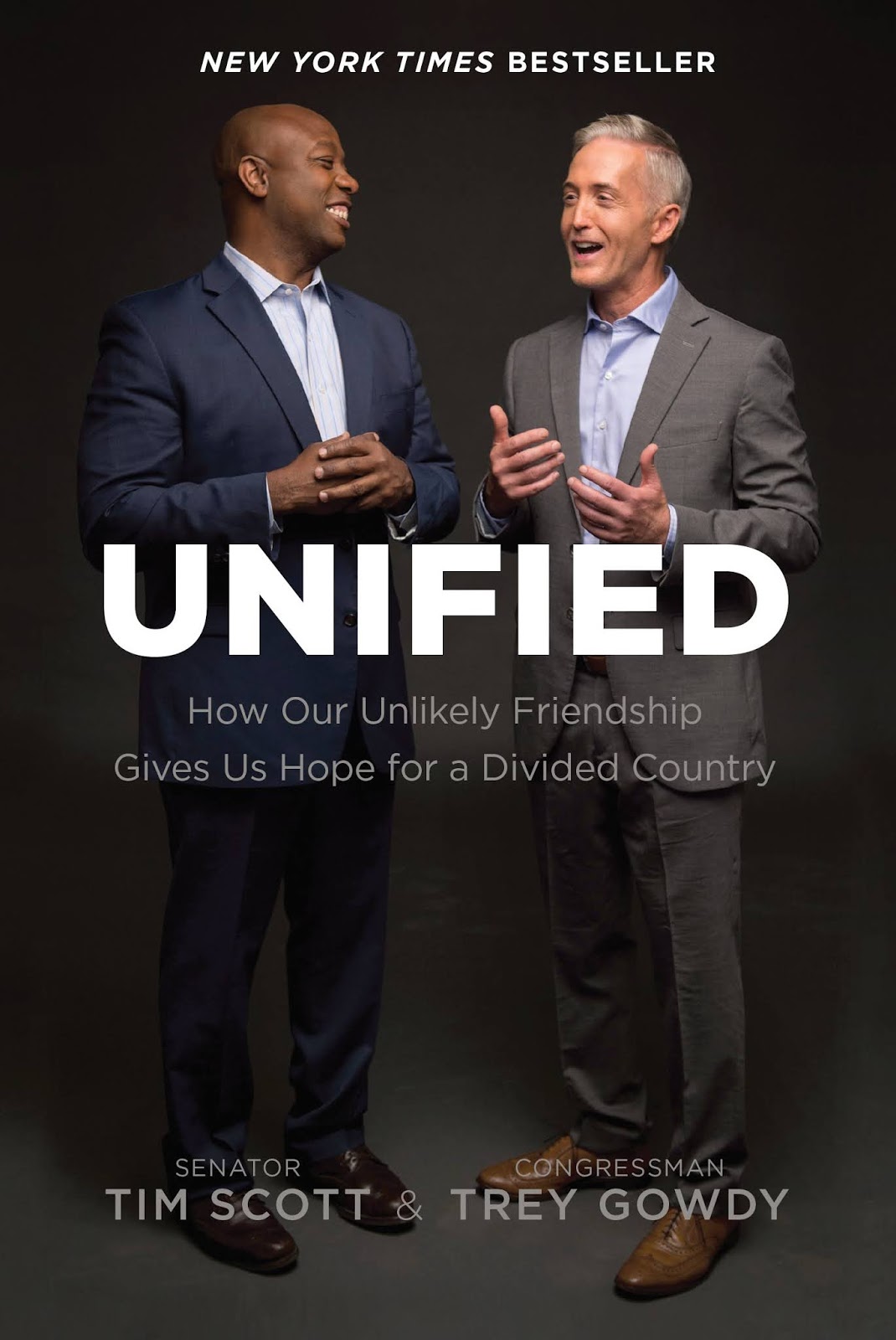
Related to the Charleston, SC incident, two notable political leaders from South Carolina, U.S. Senator Tim Scott and former U.S. Congressman, Trey Gowdy, recently appeared in a fascinating interview on the Mike Huckabee Show.  These two men are long-time friends and have written a very practical book, Unified: How Our Unlikely Friendship Gives Us Hope for a Divided Country.  During the interview with Gov. Huckabee, while referring to the tragic shooting and the forgiveness that America witnessed, Rep. Gowdy admitted that he could not have done that. 

I’m not sure if I could have forgiven a man who murdered members of my family either.  But it is this kind of unconditional love that God offers me—and, offers to all of us regardless of age, gender, ethnicity, church affiliation, political party, etc.  I want this love to motivate me to fulfill my individual responsibilities to love my wife, my family, friends, and all whom God considers “your neighbor.”  Beloved, if God so loved us, we also ought to love one another (1 John 4: 11).


How Would  You Respond?
I have written this article as a response to my friend and former student with the intention of sharing my current understanding of my personal responsibilities to my family, “my neighbor,” and to institutions—local community, church, and government.  I hope my friend and other readers will agree that I have done so in Christian love and with a humility that conveys that I am willing to learn from those who know more than I and who may disagree vehemently.  I welcome your “Comment” using the link below.


Tuesday, June 2, 2020

Love and Forgiveness Can Overcome Injustice

Just when many of us thought we were beginning to emerge from the separation of the pandemic and gaining a sense of “normal” again, we heard the tragic report from Minneapolis on Monday, May 25.  George Floyd, also known as “Big Floyd,” was mercilessly asphyxiated under the knee of a Minneapolis police officer, Derek Chauvin, while other officers stood idly by and bystanders begged Chauvin to stop.  Floyd, who was described as “always cheerful” and “the gentle giant,”  had been laid off from his job as a bouncer at Conga Latin Bistro when Minnesota was placed under the pandemic lock down.

The report of George Floyd’s murder spread faster than Chauvin was charged for his alleged crime.  Within hours demonstrations began in Minneapolis, eventually spreading to other major cities.  Now, over a week after this senseless murder, America is embroiled in yet another national tragedy, piled on top of our continuing anxiety over the COVID-19 pandemic. 

Law and Order Is Needed for Reconciliation
We should note that lawful demonstrations to express grief and grievances is a legitimate and historic part of our First Amendment rights.  Unfortunately, this precious freedom of expression comes with a responsibility to respect both law and order and those who seek to enforce it.  When this responsibility is dismissed for the selfish pursuit of material gain, then the looting and destruction of property begins and the original cause for the demonstration is lost in violence and destruction.  In addition, far left, anarchist groups have crept in to incite legitimate protesters to join in destructive behavior for the purpose of destroying the foundation of American government and society. 

It is clear from a biblical understanding of the nature of man that there can be no meaningful expressions of grief, compassion, repentance, or forgiveness unless human communities are maintained with law and order.  Yet, while destructive behavior can be forcibly quelled, police strong-arming can only provide the structure within which the emotional and spiritual roots of violence can be addressed.  The widespread violence and destruction of property suggest that many Americans simply do not know what to do with their anger over what they perceive as yet another grave injustice toward a Black American at the hands of a law enforcement official. 

Biblical Meaning of Justice
According to Scripture, all of us have a God-given sense of right and wrong, and a desire to see justice done for wrong committed.  Even when we were children, we sensed when we were unjustly (and justly) accused.  And, while it was unpleasant at the time, when discipline was applied and we recovered emotionally, we were relieved at having paid for our wrong and experienced restoration.

The Bible reveals what God says about law, law-breaking, our conscience, and just judgment.  The Apostle Paul reminded the Jews that, although they were favored by God by being given the Law in the Ten Commandments written by the finger of God on tablets of stone (Exodus 31: 18), God wants to write His law on the hearts of all mankind, both Jew and Gentile (“non-Jew”).  In Romans 2: 14-16, Paul writes (emphasis mine):

For when Gentiles who do not have the Law do instinctively the things of the Law, these, not having the Law, are a law to themselves, in that they show the work of the Law written in their hearts, their conscience bearing witness and their thoughts alternately accusing or else defending them, on the day when, according to my gospel, God will judge the secrets of men through Christ Jesus.

When Derek Chauvin saw what he had done to the life of George Floyd, assuming his conscience was not totally seared, he knew something terrible (which God’s Word calls sin), had caused his horrible action.  The same sense of guilt and shame was there in the heart of Cain when murdered his own brother, Abel (Genesis 4: 8-13).  Cain’s sin was so grievous that the Scripture says God heard “the voice of [Abel’s] blood crying to Me from the ground (v. 10).”  From that time on, every time Cain looked at the ground from which he earned his livelihood, he would think of his brother’s blood spilled there.  His response to God, “My punishment is too great to bear (v. 13)!”

God’s Answer to Hate and Violence
For every murderer since Cain right down to Derek Chauvin, and for those who have become murderers during the recent riots in protest of George Floyd’s murder, the same is true—“the punishment is too great to bear.”  It is also too great for all of us who have not murdered outright but who have responded in anger—perhaps toward Derek Chauvin or another person who has aroused our sense of right and wrong.  Jesus said, “You have heard that the ancients were told, ‘YOU SHALL NOT COMMIT MURDER’ and ‘Whoever commits murder shall be liable to the court.’ “But I say to you that everyone who is angry with his brother shall be guilty [of murder] before the court… (Matthew 5: 21-22a).” 

By God’s standard, we have already committed murder in our hearts when we are angry at our neighbor.  My anger against Derek Chauvin or against the masses who have risen up to plunder and destroy lives and property puts me right there among those who actually commit murder.  Indeed, I was also there among the jeering crowd at the Cross of Christ, angrily accusing Him of being just another sinful criminal.  My heart was full of anger, hate, and murder when I once thought that Jesus Christ was no different.  The Prophet Isaiah wrote the following description of Christ on the Cross 500 years before the coming of Christ (Isaiah 53: 4-6, emphasis mine):

Yet it was our weaknesses he carried;
it was our sorrows that weighed him down.
And we thought his troubles
were a punishment from God,
a punishment for his own sins!
But he was pierced for our rebellion,
crushed for our sins.
He was beaten so we could be whole.
He was whipped so we could be healed.
All of us, like sheep, have strayed away.
We have left God’s paths to follow our own.
Yet the LORD laid on him the sins of us all.


Jesus Christ’s death was the most unjust murder of all because He was totally sinless and blameless.  Who knew?  We thought He was getting what was coming to Him!  Yet, He yielded up His life as an atoning sacrifice, bearing the penalty of our sin that He might bring to God all of those of us who will repent of our sin and ask in faith that His blood cleanse us of our sin and cover us in His righteousness (1 John 1: 9). 

Love and Forgiveness:  Unique to Christ-Followers

Our conscience is too unrelenting of an accuser to allow us peace as long as our sin is unconfessed and unatoned.  And the punishment is too great for us to bear.  Only Jesus, the sinless, spotless Lamb of God, can take away or sin and cleanse even our “conscience from dead works to serve the living God (Hebrews 9: 14).”  Only by the love of God can the sinner be forgiven (John 3: 16).  And, once forgiven, we ought to have a new compulsion to love God and love our neighbor.  Just hours before His brutal death on the Cross, Jesus spoke the following intimate words to His disciples (and to us):

A new commandment I give to you,
that you love one another:
just as I have loved you,
you also are to love one another.
By this all people will know
that you are my disciples,
if you have love for one another
.
                 Jesus (John 13: 34-35)

In these few words, according to Ellicott (Ellicott’s Commentary), Jesus gives His disciples “a bond of union, by which they should always be linked to Him and to each other in the principle of love.  The followers of great Teachers and Rabbis had their distinctive marks. Here was the distinctive Christian mark, which all men should be able to read…, not in any formulary or signs, but in the love which asserts the brotherhood of man.  The Pulpit Commentary adds that this love “…is new to the human race: and it is the power which has revolutionized thought, society, and life.”

But how do we express the love of Christ in us?  One distinctively Christian way is through forgiveness.  When we are wronged by someone else, we ought to remember the love of Christ expressed on His Cross when He said, “Father, forgive them for they know not what they do (Luke 23: 24).”  Before His death, Jesus taught His disciples to pray like this, "Forgive us our sins, for we ourselves also forgive everyone who fails in his duty to us (Luke 11: 4, Weymouth)."  There is no greater power on Earth than the love of God expressed through forgiveness on the part of dedicated Christ-followers.

F. B. Meyer wrote, in Our Daily Walk (May 7),
Forgiveness is the exclusive prerogative of Christianity. The schools of ancient morality had four cardinal virtues—justice in human relations; prudence in the direction of affairs; fortitude in bearing trouble or sorrow; temperance or self-restraint. But they knew nothing of mercy or forgiveness, which is not natural to the human heart.  Forgiveness is an exotic, which Christ brought with Him from Heaven. As long as He abode on earth, He forgave, and He left it as an injunction and example that His people were to forgive even as they had been forgiven.
 
Neither the grieving Floyd family, nor the protesters, nor those trying to maintain law and order can ultimately bring peace of mind and conscience to us as individuals or to our divided America.
 

However, maintaining law and order is essential to healthy communities where people can express grief, compassion, repentance, and forgiveness as appropriate.  We need restored human communities and especially Bible-based churches because our struggle is ultimately in our hearts (James 4: 1-10).  Jack Brewer has rightly pinpointed the source of our current struggle in America as a spiritual battle because of the evil in our hearts (video clip).  Only if we yield to the love and forgiveness of Christ and then express His love and forgiveness to one another will we gain the victory and bring many sons to glory (Hebrews 2: 10).

How About You?
While we all observe the unfolding of demonstrations and associated violence, each of us face the same challenges as the any of the participants we observe.  How do you and I deal with perceived injustice, our need to control anger, offer forgiveness, seek forgiveness, or just plain understand people that are difficult to get along with?  As for myself, today is the birthday of a family member very dear to me, a person with whom I have sought reconciliation for several years.  I mention this person only to emphasize that we all need God’s love and forgiveness and to be channels of this love and forgiveness to others.  How about you?   Your “Comments” are always welcome.  

Helpful Resource:
The Risk of Forgiveness:  What It Means to Forgive   by Gary Inrig.  Discovery Series, Our Daily Bread Ministries.   Available at the above link or in booklet form.

Wednesday, February 13, 2019

LOVE: Part 6 – Humbly Received, Graciously Given

Valentine’s Day helps us focus on the love we share with special people in our lives.  We express our love by sending cards, candy, flowers, or more extravagant gifts.  In most cases we do not create the gifts.  We purchase them, add a few tender words, and share them with our love.  In doing this, we are acting out the meaning of stewardship—i.e. handling things which we didn’t create and which ultimately do not belong to us.

If we agree that buying and giving gifts is a form of stewardship, we might say that being loved and loving others is the ultimate core of stewardship .  As explained in LOVE Part 2: “It’s Out of This World”, love does not originate from us.  Like a Valentine gift that we didn’t create, love enters our lives and relationships from God.
 God’s love (agapeo and phileo), like the sweet fragrance from a flower, is the central essence of His character. As 1 John 4: 8 states, God is love.  God’s inspired Word and His actions continually express His limitless love for His creation and humankind--expressed ultimately through the Life, death, and resurrection of Jesus Christ.  Since Christ’s resurrection some 2,000 years ago,  His Spirit has been transforming sinners into Christ-followers who submit to the authority of God’s Word.  These who follow Christ, do so as stewards of the gifts of His Spirit, including love—or, as 1 Peter 4: 10 states, we are stewards of the manifold grace of God.

Reverential Fear of God, Repentance, Forgiveness
Christ-followers demonstrate by their love for God and for one another that they have died to self, have submitted to the Word of God, and have yielded to the rule of Christ as Lord of their lives.  This submission begins a life of repentance, humble confession and rejection of sin and selfishness.  These spiritual disciplines are motivated by our reverential fear of God our Supreme Judge, and by our emersion (baptism) into His love.  [See LOVE: Part 2 – It’s “Out of this World.”]  In love and mercy, God responds to our repentance, cancels our “sin debt,” and withholds His harsh judgment of us as rebellious, undeserving sinners.

The psalmist understood the relationship among three elements: 
(a) God’s holiness and justice,
(b) His mercy and forgiveness, and
(c) our reverential fear of God.  In Psalm 130: 3-4, we read (emphasis mine),

LORD, if you kept a record of our sins,
who, O Lord, could ever survive?
But you offer forgiveness,
that we might learn to fear you
.

But, how is that?  How do Christ-followers "fear” a loving, forgiving God?  If this seems contradictory, see
LOVE: Part 5 - Is God-Fearing Love a Contradiction?

Our Motivation to Love:  God Has Canceled Our Debt.
Forgiven sinners, freed from the burden of their sin, in reverent fear and submission to God’s Spirit, offer the sweet aroma of God’s love (fruit of the Spirit, Galatians 5: 22) back to God.  They also extend this love to their neighbor.  If we truly love God, then according to 1 John 4: 21, …he who loves God loves his brother also.  Christ-followers are empowered to love God and neighbor out of a spirit of thankfulness for all God has done and continues to do.  Their remembrance of God's forgiveness causes them to extend mercy and forgiveness toward others, even their "enemies." 

Love originates from God and transforms humans and
our relationships to God, neighbor, and creation.
Loving God and loving our neighbor falls short unless we love what God also loves.  God loves our neighbor, but also His creation (Genesis 1: 31).  As I have explained in Fundamentals of Conservation, Part 1, our stewardship of creation is an integral part of our obedience to God’s plan.  Thus, loving our neighbor should include adopting a lifestyle that rejects materialism, needless consumption, and waste that can adversely affect soil, groundwater, air, community health, and conservation of creature habitats.   That said, Christ-followers must be wise in evaluating current assessments of human impacts on the environment, or creation. Thankfully, God has lovingly commanded that we observe a weekly Sabbath rest to enjoy His provisions and to take stock of our purpose and place in His plan for us.  [See Creation Care– Doing It Our Way?]

God’s love calls us to remember the Cross on which Jesus died.  Our regular focus on the Cross of Christ serves to impact and so permanently mark His followers that we become forever grateful.  Juanita Byrum’s song, “Forever Grateful,” should express our response:

And I'm forever grateful, Lord, to You
And I'm forever grateful for the cross
And I'm forever grateful to You
That You came to seek and save the lost


Still, I’ve been asking myself how it is that God’s love can become more real to me each day. 
God’s Spirit answers my question through His inspired Word—Man shall not live by bread alone but on every word that proceeds from the  mouth of God (Matthew 4: 4).  We “feed” the life of Christ in us by “eating” (reading, studying, meditating, memorizing) God’s Word which reveals the Life of Christ and His teachings.  Through both His Life in us and His teachings, we learn how to love others.  For example, a parable of Jesus known as the “Parable of the Unforgiving Servant,” recorded in Matthew 18: 21-35, teaches me three things: 
(a) the infinite magnitude of my sin debt
(b) the infinite mercy shown when God cancelled my sin debt
(c) the proper response—my love shown by thankfulness and forgiveness of others

The parable tells of a servant who owed him the equivalent of several million dollars in today’s market (Matt. 18: 24).  Jesus wanted us to understand that this debt was larger than the servant could ever hope to pay off.  The master …commanded him to be sold, and his wife, and children, and all that he had, and payment to be made (v. 25).  The servant’s response was to fall down and beg his master for mercy, 'Please, be patient with me, and I will pay it all (v. 26).'  He was so desperate and fearful of the consequences of not being able to pay that he promised more than he could ever do.  Jesus wants sinners to realize from this story of the unpayable debt that we are great debtors facing a similar fate. 

Our Motivation to Forgive:  Realizing the Magnitude of Our Debt
Psalm 49: 7-9 helps us realize the human impossibility of paying our “sin debt” to God: 

Yet they cannot redeem themselves from death
by paying a ransom to God.
Redemption does not come so easily,
for no one can ever pay enough
to live forever and never see the grave. 


Now, back to my question—“How can God’s love become more real to me each day?”  I must focus on the Cross of Christ where I realize the great love and mercy of a Holy God who made possible the cancellation of my sin debt, thus sparing me of eternal judgment.  In light of this realization, my love for God and my neighbor ought to flow freely—loving God in return, and loving others through patience, mercy, and forgiveness.  This is not a small task for me in day-to-day human relationships with spouse, family, friends, and frustrating world and national news—especially, because relationship challenges reveal my own lingering selfishness.

Beloved pastor-teacher, Timothy Keller, refers to a scene from his favorite novel, Lord of the Rings, to illustrate the habit of remembering the costly suffering and death of Christ for our salvation.  Keller asks us to picture Pippin, a Hobbit, standing at the gate of the city which is about to be attacked and destroyed by the demon king.  But then, there is the sound of horns from the Riders of Rohan who arrive in the nick of time to save the city.   But the cost was great. The King of Rohan gave his very life in the battle.   Pippin’s greatful reaction is a model for us:

Pippin remembered the sound of the horn.
“For the rest of his life, Pippin could never hear a horn off in the distance without bursting into tears. Why?  Because every time he heard a horn in the distance it reawakened the memory of his salvation and the memory of the one who died for him.”  Keller then asks his audience (and all Christ-followers): 

“How do you listen to a distant horn?   What are your distant horns?”  What music, people, places, activities, or Scriptures helps reawaken in you the memory of the victory that Christ purchased for you there on that rugged hill?

Back to Jesus’s parable, the unforgiving servant represents those who forget the King and the sound of His horn.  The unforgiving servant’s desperate plea melted the heart of his master who then forgave his multimillion-dollar debt—entirely!  Jesus does not describe the response of the servant to this life-changing show of mercy and forgiveness.  If the forgiven servant had any gratitude, it was shallow and soon forgotten because we read that the unforgiving servant immediately went out, and found one of his fellowservants, which owed him [a few thousand dollars]: and he laid hands on him, and took him by the throat, saying, Pay me that thou owest.

Just that quick, the unforgiving servant had forgotten the love and mercy his master had shown him.  So, he suddenly became unforgiving and merciless to his fellowservant.  Jesus ends the parable, warning us
that we will not receive mercy and joy of forgiveness if we refuse to forgive our brothers and sisters from our heart (v. 35).  Genuine repentance and acceptance of God’s mercy ought to give us true joy and make us loving and forgiving of others.  Matthew Henry writes, “How justly will those be condemned, who, though they bear the Christian name, persist in unmerciful treatment of their brethren!  The humbled sinner relies only on free, abounding mercy, through the ransom of the death of Christ.  Let us seek more and more for the renewing grace of God, to teach us to forgive others as we hope for forgiveness from him.”

I am thankful for God’s provisions that help us remember what He has done for us:  His commands (really, loving invitations) to worship together on the first day of each week (Acts 20: 7; Hebrews 10: 25) and to regularly observe the sacrament of Lord’s Supper.  These are essential disciplines that bring us into communion with our Savior and with fellow blood-bought brothers and sisters in remembrance of the wonderful Cross.

Of course, Valentine’s Day provides an annual reminder to express love to God and to our friends (and enemies).  Since Valentine’s Day last year when I wrote about love and marriage, in
Valentines and a Better Love, I have been reading and thinking much about “true love,” hopefully from a Christian worldview.  As I conclude this sixth part in my series on LOVE, I confess that I haven’t even scratched the surface.  Nor has my stewardship of sharing God’s gift of love reached anything like the fragrant love that emanates from Jesus.  But, my prayer is that you and I, and all who come across these writings will be drawn closer to Jesus the Source of this Love and to the Cross where Love met God’s judgment of sin, and prevailed! 

Oh, the overwhelming, never-ending, reckless love of God
Oh, it chases me down, fights 'til I'm found, leaves the ninety-nine
I couldn't earn it, and I don't deserve it, still, You give Yourself away
Oh, the overwhelming, never-ending, reckless love of God, yeah
.
-- From Reckless Love, by Cory Asbury

How About You…and I?
This Valentine’s Day, I am asking myself:  Do I truly love God, my Creator and Savior, even though at times He seems distant?  Do I love my wife as God’s gift for nearly 50 years, even when one of us is grumpy?  Do I love my family, my friends, many of whom pray for us and encourage us every day?  Do I love and pray for our leaders and for Christians living under very hard, dangerous conditions; and for the millions who are homeless, both locally and internationally?  The answer rests not on me alone but on Christ alone, by faith alone, in His Word alone, by His grace alone.  For it is not that we loved Him but that He loved us while we were yet sinners (Romans 5: 8).  Christ demonstrated His love through His death, resurrection, and promises of His return.  Until that time or until He takes me home, I want to be a good steward of His love.