Showing posts with label reconciliation. Show all posts

Friday, November 21, 2025

Thanksgiving, Part 1: Squanto, a Human Mediator

This month, Jeff Bezos's space firm Blue Origin launched a pair of NASA spacecraft on a mission to Mars.  The firm hopes this mission will be a giant step toward landing humans on the “red planet.”

Imagine if you are among the first humans to set foot on Martian soil.  Within the hour, you are stunned to see another human being approaching you.  He looks human but appears to have an other-world ethnicity.  Then, to your amazement, he smiles reluctantly and greets you in your own language.  Sound far-fetched?  Certainly!  But it is not unlike the experience of the Pilgrims who met Native Americans when they arrived at Plymouth Rock, having sailed 3,000 miles from Europe, in 1621. 

“An Instrument Sent of God”

After their grueling ocean voyage, the Pilgrims set foot on North American soil, not knowing what to expect or whether they would survive.  To their surprise, their party met another human being who differed only in ethnicity and who greeted them in the English language!  They would come to know their English-speaking friend as Tisquantum, or “Squanto,” a member of the Patuxent tribe of the Wampanoag confederation.

Our tradition of celebrating Thanksgiving, often with a lavish abundance of food and comfort, is rooted in a history in which a widespread loss of human lives was averted by the providential hand of God.  Only 53 Pilgrims had survived their treacherous voyage across the Atlantic.  They faced harsh weather and limited food, and many of them died.  But providentially, those who reached Plymouth Rock were saved because of the kindness of Squanto.  

Squanto graciously assisted the Pilgrims as an interpreter to establish communication and peace with the Wampanoag’s including its chief, Massasoit.  Then, Squanto and his tribesmen assisted the Pilgrims in hunting game from the forest, obtaining seafood from the Atlantic, and growing corn and other crops.  It is truly a marvelous show of God’s providential care that Squanto had been equipped at just the right time to serve as a mediator to forge peaceful relationships between people of two very different cultures.
 

A mediator is a neutral third party who stands between two individuals or groups that are at odds in order to assist in bringing conflict resolution and a mutually acceptable settlement.  Squanto’s mediation of peaceful relations between the Native American majority and the European Pilgrim minority was certainly a cause for thankfulness on that first Thanksgiving.  But the backstory which centers on Squanto’s life is even more amazing.

Squanto explained how he had been captured by English sailors and taken to Europe (circa. 1614) where he and other captured Native Americans were taught to speak English as preparation for them to be guides for explorers of the North American frontier.  Here Squanto lived with John Slaney, a Christian merchant.  Squanto learned English, worked for Slaney, and worshiped with English Christians where he must have been regularly exposed to Christian teaching.  According to a more complete account of Squanto’s life (See HERE), he was captured a second time and transported to Europe.  But this time, he was providentially purchased from the slave auction block and set free by brothers of a local monastery.

As a free man who may or may not have ever professed faith in Christ, Squanto eventually returned again to his North American homeland where he became an instrument of God’s saving grace as a mediator between the Pilgrims and the Native Americans.  Governor William Bradford recognized Squanto’s miraculous role and later wrote that he was “a special instrument sent of God for their good.”  For additional details on the spiritual context of how God worked among the lives of the Pilgrims, see our 2024 Oikonomia from which part of the above content was taken [Click HERE].

The way in which God prepared and used Squanto to foster peace between Native Americans and Europeans and save the Pilgrims from starvation  and death illustrates what is required of a
successful mediator.  Here are a few character traits and abilities Squanto possessed as a mediator:


1)  Knowledge of Language and Cultures
2)  Vision of a “Higher Purpose”
3)  Showed Empathy and Compassion
4)  Built the Trust of Both Adversaries
5)  Provided for Their Future

Other Human Mediators
Since the time of Squanto, other men and women of character have served as human mediators.  Benjamin Franklin served as a diplomatic mediator between America and Europe during the crucial period of the birth of the United States.  Fast forward to the 1950’s, we were intrigued by the name, Dag Hammerskjold, a man of deep faith in God whose quiet diplomacy provided mediation during the early years of the United Nations. 

Among U.S. presidents, Theodore Roosevelt is regarded as “one of the most influential international mediators” (ChatGPT).  More recently, Presidents Jimmy Carter and Donald Trump have been instrumental in promoting Arab-Israeli peace.  President Carter negotiated peace between Israel and Egypt in the 1970’s.  President Trump continues to expand the Middle East peace efforts which he began in his first term through the Abraham Accord.

Among professing Christians is David Augsburger, an American Mennonite pastor known for his cross-cultural counseling and conflict mediation; and Gary R. Collins, former President of the American Assn. of Christian Counselors, well known for his pioneering approach to Christian counseling.  Corrie ten Boom of Dutch descent mediated for reconciliation between victims and their former German persecutors who served under the Third Reich.  Mother Teresa who served in India and Albania is recognized as a “mediator of personal and community conflict through humanitarian service (ChatGPT).”

Readers who conduct their own internet searches will turn up names of other men and women who have served as human mediators.  But all human mediators have one thing in common: they are humans who are imperfect and the durability of their accomplishments last only as long as other fallen humans agree to honor their treaties and agreements.   Perfect, lasting mediation requires a Mediator infinitely superior to any human being.  That Person is the perfect God-Man, Jesus Christ.

One True Mediator
Overshadowing imperfect human mediation is the infinitely greater mediation inaugurated and sustained through the life, death, resurrection, and intercession of God’s Messiah, Jesus Christ.  In 1 Timothy 2: 5-6a (NLT), we read

For, there is one God and one Mediator
who can reconcile God and humanity
—the man Christ Jesus.
He gave His life
to purchase freedom for everyone.

The Book of Genesis reveals our need for a “Mediator between God and man.” Early in the Creation narrative, we learn that the first man and woman walked and talked with God in the Garden of Eden.  Imagine that!  No blemish existed between them and God to interrupt their perfect fellowship with God—that is, until sin entered, causing Adam and Eve to hide from each other (Genesis 3: 7) and from God (v. 8-10).  Sin corrupted their minds and created feelings of shame, doubt, suspicion, fear, and alienation from each other and from God.

Every human being is made to worship and enjoy God as the central purpose of being (Ecclesiastes 12: 13).  Although God’s once-perfect image bearers forfeited their fellowship with God, they did not lose their nature as God’s image bearers (Genesis 1: 27).  Worse than that, under sin’s curse and without God, all mankind is pronounced “dead in [our] trespasses and sins” (Ephesians 2: 1).  As such, we are spiritually separated from God who is Holy and cannot be in fellowship with sinful mankind. 

Being “dead in our sin” and possessing corrupt minds (Romans 1: 28), we became like blind people walking in darkness.  Yet, pathetically, God’s once-perfect image bearers still seek Him, if perhaps they might grope for Him and find Him, though He is not far from each one of us; for in Him we live and move and exist… (Acts 17: 27b-28a).  The Apostle Paul spoke these words to Greek philosophers in Athens while standing with them in the midst of many stone images of pagan gods from whom they were seeking to gain justification and merit.  They listened to Paul as he elegantly described the One true God, Jehovah, the One in whom all men and women “live and move” and owe their very existence:

Being then the children of God, we ought not to think that the Divine Nature is like gold or silver or stone, an image formed by the art and thought of man. Therefore, having overlooked the times of ignorance, God is now declaring to men that all people everywhere should repent, because He has fixed a day in which He will judge the world in righteousness through a Man whom He has appointed, having furnished proof to all men by raising Him from the dead (Acts 17: 29-31.”

These words stunned the Greek philosophers.  Pause a moment and meditate on them.  Some wanted to hear more (v. 32).  Could it be that this “UNKNOWN GOD” (v. 23) who was not represented among their pagan images was the One true God for whom their souls had longed?  Was it possible that this “Unknown God” would call them to give an account of their lives “in righteousness through a Man whom He has appointed as judge”— shockingly, a Man whom this God had raised from the dead!?  The answers to these questions are all YES!  This is the “Man” whom Paul would later declare as the one Mediator also between God and men, the Man Christ Jesus, who gave Himself as a ransom for all…(1 Timothy 2: 5-6a).

In “Thanksgiving, Part 2: Jesus, Divine Mediator,”
we compare the human mediation of Squanto with the divine mediation of Jesus Christ. Specifically, we will cite five marks of an effective mediator, each with Scriptures and commentary suitable for a daily meditation leading up to Thanksgiving.  [Click HERE for Part 2.]

Saturday, March 23, 2024

Is Light Dimming and Darkness Winning? 3. No! Because of Easter!

Now from the sixth hour darkness fell upon all the land until the ninth hour. And about the ninth hour Jesus cried out with a loud voice, saying,

“ELI, ELI, LAMA SABACHTHANI?” that is,
“MY GOD, MY GOD, WHY HAVE YOU FORSAKEN ME?”
(Matthew 27: 45-46)

Jesus Christ uttered this mournful cry from His Cross on that first “Good Friday.”  The Apostle John standing with Jesus’s mother Mary a foot of the Cross heard Jesus’s words.  Later, the Apostle Matthew, once a hated tax collector, recorded the words.  Before Jesus gave up His life, John and Mary would hear His final words, “It is finished” (John 19: 30, 33).  Having witnessed the crucifixion, suffering, and death of Christ on a Roman Cross, John later wrote, these words have been written so that you may believe that Jesus is the Christ, the Son of God; and that believing you may have life in His name (John 20: 31).

At the foot of the Cross, John must have been tempted to agree with Satan and the powers of darkness.  Indeed, darkness seemed to have overtaken the light.  God the Father had forsaken His Holy Son, the Lord Jesus Christ, and Christ’s death was the end, accomplishing nothing.  But this great error in thinking lies in the promise God made thousands of years earlier as recorded in Genesis, the first book of the Bible. 

Genesis 3 reveals the beginning of the story of Easter, the Cross, and the Resurrection of Christ.  The rest of the Bible is the unfolding account of a perfect creation, the fall of man into sin, an infinite separation between holy God and sinful man, and reconciliation by the sacrificial death and resurrection of the Holy Son of God.  This is the account of the Gospel, the “Good News” that Jesus came as fully God and fully human, lived a sinless life, was crucified and rose again to open the way to Eternal Life in Heaven to all who call upon Him by faith in Jesus’s atoning sacrifice for sin.   Far from dimming the light on that first “Good Friday,” Christ’s death opened the Way to Eternal Life and Light.

Below is a series of seven daily readings that reveal elements of the “Good News.”  Our theme is “From Alienation and Separation to Reconciliation.”  We hope you will understand even more clearly the significance of Christ’s crucifixion, death, and resurrection to your life personally.  This is the real reason for celebrating Easter.

Day 1:  
God Is Good
Scripture:  Genesis 2: 7-9
Interpretation:  In the beginning, God created the heavens and the Earth for His glory and pleasure.  He created the first man, Adam, from the dust of the ground and placed him in a perfect environment, the Garden of Eden.  Out of His goodness, God saw that it was “not good” for the man to be alone.  So, God created woman from bone taken from Adam’s side so the she could be his helpmate (Genesis 2: 18-25).  When God had finished His creation, He took pleasure in it and saw everything that he had made, and, behold, it was very good (Genesis 1: 31).  God had created numerous kinds of trees bearing fruit for Adam and Eve to enjoy (v. 16).  But He also set a boundary around one of the many trees, saying, from the tree of the knowledge of good and evil you shall not eat, for on the day that you eat from it you will certainly die (v. 17).  As long as they followed His command, Adam and Eve enjoyed sinless communion with God and walked with Him in the Garden of Eden (Genesis 3: 8). 

Application:  We have seen that the goodness of God was obvious in His Creation and its overflowing benefits to Adam and Eve.  Centuries later, God revealed Himself to Moses at Mount Saini with these words, “The LORD, the LORD God, compassionate and gracious, slow to anger, and abounding in lovingkindness and truth; who keeps lovingkindness for thousands… (Exodus 34” 6-7a).  God reveals His goodness both in His Word and in His creation. 
Ask Yourself:  Do you believe God is good?  Was God any less good for commanding man not to eat of one of the trees?

Day 2: God’s Goodness Questioned
Scripture: 
Genesis 3: 1-6
Interpretation
:  Adam and Eve had enjoyed perfect communion with God and walked with Him in the Garden of Eden (Genesis 3: 8).  That is, until Satan came questioning God’s integrity and authority: Indeed, has God said, ‘You shall not eat from any tree of the garden (Genesis 3: 1)’?  And when the woman saw that the tree was good for food, and that it was pleasant to the eyes, and a tree to be desired to make one wise, she took of the fruit thereof, and did eat, and gave also unto her husband with her; and he did eat (Genesis 3: 6).  Satan had successfully appealed to the “cravings of the flesh, the longing of the eyes, and the pride of life (1 John 2: 16).”  First, he tempted the woman; then the man.  Both succumbed to Satan’s temptations and they chose to eat.
Application:  When God had commanded Adam not to eat of the tree of the knowledge of good and evil, He warned, for in the day that you eat from it you will surely die (Genesis 2: 17).  But in spite of this stern warning intended out of the goodness of God’s nature and for the protection of His human image bearer, Adam took and ate the forbidden fruit.  Satan had convinced Adam that God was not good.   Otherwise, why would God keep Adam from enjoying something so inviting to him?
Ask Yourself:  Can you remember thinking that God is keeping something better from you?  Do you question God’s goodness at times?  To be tempted is not sin.  It’s only when we yield to it that we sin.  What is James’s solution?   See James 4: 6-10.

Day 3:  Religion: The Human Solution
Scripture:  Genesis 3: 6-8
Interpretation
:  When Adam and Eve had eaten of the forbidden fruit, their eyes were opened.  They became conscious that something had changed.  They had changed!  Their consciences were awakened to realize they had violated a moral standard of God.  They responded by hiding from God among the trees and hiding their bodies from each other by clothing themselves with fig leaves.  Their intimacy with a holy God and with each other were destroyed and replaced by guilt, shame, and alienation.  
Application:  Adam and Eve’s answer to their guilt and shame reveals to us their choice of religioni.e. their approach to gain right-standing with a holy God.  They chose a “hands on approach,” trying to be presentable to God in their “fig leaf clothes.”  Their approach was the beginning of what we now call “good works salvation.”  Justification by works rather than yielding through faith to receive God’s forgiveness and reconciliation.  Thankfully, God is good, and He has a better plan for our reconciliation.
Ask Yourself:  Can you relate to Adam and Eve’s fear and shame when you recall a time when you rebelled against the authority of a parent, teacher, employer, or government?  Romans 5: 12 describes how we were all born with Adam’s sin nature.  But we have hope in Christ (Romans 5: 1).

Day 4:
Relationship: God’s Solution
Scripture:  Genesis 3: 8-24
Interpretation:  Adam and Eve, God’s image-bearers, had rebelled against His moral guidelines—i.e. they had committed sin.  Consequently, their intimate communion with God and between each other was replaced by guilt, shame, and alienation.  What’s more, Adam and Eve were hiding, wanting to be free of God and the consequences of His standards.  Does that sound familiar to you?  Today, many have rejected God, and the increasing lawlessness and chaos in our land shows what happens when God and His standards are not upheld.  Adam and Eve were the first humans to experience the consequences of violating God’s standards, and yet they sinned even more by blaming each other (v. 12-13).  But God’s goodness showed forth again.  He went seeking the sinners!  God called to Adam, “Where are you?”  What a profound, soul-searching question.  God already knew the answer, but Adam and Eve felt guilty and afraid!  

Application:  You may recall times when you have acted badly, perhaps even as a child.  You felt the guilt and separation from your parent or parents. Hopefully, you can also remember the stern but loving discipline you received, sometimes with a spanking; and then, how their correction brought peace to your soul.  But how could God who is Holy, and therefore cannot let sin go unpunished, atone (“make reparation for, cleanse, cover the sin”) for sinful humans without compromising His own integrity?  First, God followed the chain of blame from the husband to his wife who then blamed the Tempter (v. 12-13), and then, He pronounced the curse and consequences of sin upon each party (v. 14-19).  God wanted Adam and Eve to admit their sin.  But in His perfect love, God also wanted to redeem (“buy back”) His broken image-bearers and all of His creation from an infinite separation.  He also wanted to judge Satan.  But how could God do this?  The answer is in the Gospel of Jesus Christ. 
Ask Yourself:   Many believe that if we could eliminate the notion of God and His absolutes of right and wrong, there would be no sin—no consequences of guilt and shame when we think or act badly?  But wouldn’t the result be lawlessness and chaos?   Thankfully, there is a God who loves us.   Each of us must give an account and answer God’s question to Adam, “Where are you?”  Where you are in relation to God?  Without forgiveness of sin, we are infinitely separated from God.

Day 5: Covered by Blood, Not Fig Leaves
Scripture: 
Genesis 3: 17-21; Romans 5: 12; John 1: 29
Interpretation
:  We left you somewhat hanging yesterday with “holy dilemma.”  How could God who is Holy and cannot let sin go unpunished, atone (“make reparation for, cleanse, cover the sin”) for sinful humans without compromising His own integrity?  After confronting Adam and Eve with their sin, the LORD God made clothing from animal skins for Adam and his wife (Genesis 3: 21).  God would offer a far more costly sacrifice than a religious, fig leaf covering.  The Creator of animals had to sacrifice innocent animals—innocent because they were not morally accountable like the humans were!  God’s covering of Adam and Eve’s nakedness required the shedding blood.  This first blood sacrifice, and then all of the animal sacrifices offered by the Jewish temple priests in the nation of Israel were a foreshadowing of the Man who would come as the Perfect Lamb of God and offer Himself to atone for the sin of mankind.
ApplicationAdam’s sin had great consequences.  Back on Day 3, we referred to Romans 5: 12 which states that as by one man (Adam) sin entered into the world, and death by sin; and so death passed upon all men, for all have sinned…  The stark truth from God is, “ALL have sinned!”  If this is true, could any of Adam’s descendants dare offer himself as a sinless sacrifice?
Psalm 49: 7-8 reveals,  
No man can by any means redeem his brother
    Or give to God a ransom for him—
For the redemption of his soul is costly,
   And he should cease trying forever

Ask Yourself:  Would you deny your standing before God as a child of Adam who bears the curse of sin worthy of death (Romans 5: 12)?  Or would you dare to offer yourself as a sinless sacrifice to redeem others as Jesus did?  Unless we trust in the redemption of the perfect sacrificial Lamb of God we remain in darkness and in infinite alienation from God.  Do you know Him personally?

Day 6: Our Creator Became the Lamb
Scripture: 
John 1: 1-5; 10-14; Luke 4: 1-13 Hebrews 9: 13-14; Genesis 3: 14-15;
Interpretation
:  Who is this Man called “the Lamb of God?”  Chapter 1 of the Gospel of John identifies the Lamb as Jesus Christ, “the Word of God” who “was God.”  This “Word became flesh and dwelt among us…full of grace and truth.”  John the Baptist, Jesus’s forerunner who preached repentance of sin, pointed to Jesus and said, “Behold the Lamb of God who takes away the sin of the world (John 1: 29).”  Jesus Christ was fully God and fully human.  He was born the “seed of the woman,” but not from the seed of His earthly father, Joseph (Genesis 3: 15; Matthew 1: 20).  In 1 Corinthians 15: 47, we read, Adam, the first man, was made from the dust of the earth, while Christ, the second man, came from heaven.  Christ was fully God, the Creator of the first Adam; yet He was fully human, born of Mary, as the “second Adam.”
Application:  Christ, the second Adam, came as a perfect Man, but He constantly battled horrendous temptations from the Tempter, and physical and emotional sufferings, aimed to cause Him to sin and fail like the first Adam.  The Gospel accounts tell of the many ways Jesus was attacked.  But He continually depended on His Father in Heaven and remained the sinless Lamb.  The Jewish priests had offered sacrificial lambs for over 1,500 years, but they were not sufficient to fully cleanse from sin.  In Hebrews 9: 13-14, we read:  For if the blood of goats and bulls and the ashes of a heifer sprinkling those who have been defiled sanctify for the cleansing of the flesh, how much more will the blood of Christ, who through the eternal Spirit offered Himself without blemish to God, cleanse your conscience from dead works to serve the living God? 
Ask Yourself:   According to the Jewish calendar, they selected a “lamb without blemish” five days before offering it in the sacrifices of their Passover celebration.  In order to fulfill God’s prophetic calendar, Jesus, God’s perfect Lamb, entered Jerusalem riding on a lowly donkey, on “lamb selection day.”  During the Jewish Passover, God’s Lamb was slain for the sins of the world, including for you and for me.  Take time to read beginning in John 12 and respond as appropriate in repentance and in worship of the Lamb who gave His life redeem us from sin and death.

Day 7:  Darkness Breaks into Dawn’s Brightness
Scripture: 
John 18-20; Luke 24: 1-35
Interpretation
:  John 12-17 gives us an inspiring account of Jesus’s final days.  They were filled with drama, hateful accusations met with His gracious manner, and intimate times alone with His disciples to prepare them for His suffering and death.  Our Scriptures for today tell of Jesus’s arrest, trials, Peter’s denial, and Jesus’s sentence to be crucified (John 18).  Jesus was mocked, brutally beaten, and eventually sentenced to carry His Cross to Golgotha.  There He was crucified according to a method of the Romans designed to cause excruciating suffering on the way to death (John 19).  In Philippians 2: 6-8 we read, Christ Jesus, who, although He existed in the form of God, did not regard equality with God a thing to be grasped, but emptied Himself, taking the form of a bond-servant, and being made in the likeness of men.  Being found in appearance as a man, He humbled Himself by becoming obedient to the point of death, even death on a cross.  Jesus who was infinitely Holy experienced humanly the infinite alienation from God that is our condition without God’s redemption.
Application
:  Our theme, “Is Light Dimming and Darkness Winning?” may have been the question of Jesus’s followers during the succession of terrible events of “Passion Week.”  The death and burial of Christ appeared to be a victory for Satan and the powers of darkness.  But we read in John 20 that on what we now call Resurrection Sunday, Mary Magdalene found the stone rolled away from Jesus’s tomb and His body was not there.  Matthew 28: 6 reports that an angel had told Mary, He is not here, for He has risen, just as He said.  As the good news spread, the darkness of doubt and despair gave way to the bright light of hope.  The Risen Christ showed Himself to His disciples and hundreds of followers.  He also explained at length to two men who were “slow of heart to believe” how His life, death, and resurrection fulfilled the Old Testament Scriptures (Luke 24: 25-27). 
Ask Yourself:  Are you a “fool, slow of heart to believe?”  If you have never trusted Christ and developed a personal relationship with Him, we hope this series of devotionals has made the Gospel (“Good News”) clearer to you.  For believers, we hope these readings have been an inspiring part of your commemoration of this Easter season.

Easter:  Celebrating the Resurrection of a Loved One
Easter morning, or better “Resurrection Sunday,” carries a special significance to all who realize that the Empty Tomb is evidence that there is hope beyond the grave.  Although Christ-followers still grieve when loved ones die in Christ, we do not “grieve as those who have no hope” in life after the grave (1 Thessalonians 4: 13).   Proof of our faith is the wellspring of hope that helps us bear the sting of death of a loved one.

This Easter season, God gave us reason to claim our hope in the Resurrection and the reality of life after death.  Yesterday, March 21, our dear sister (-in-law), Donna Kohler Moore, said “Good-bye” to her husband, Larry, her daughter, Stacey, her son, Keith, their families, plus six sisters (Alvadell “Abby”, Shirley, Betty, Mary, Audrey, and Verna), and nieces and nephews.  Her life was a shining testimony of the Life of Christ in her.  Donna loved and respected her first husband, Roy.  Following Roy’s death to cancer, she loved and respected her second husband, Larry.  Her impact upon her children, grandchildren, great-grandchildren, and over three decades of students in her elementary school and Sunday School classes will be evident in their lives for years to come.

After battling cancer for over 10 months, a few days ago became Donna’s “graduation day” to Heaven.  Many loving family members gathered around her bed and celebrated her life by singing some of her favorite hymns, including “In the Garden” and “Amazing Grace.”  Even in her largely unresponsive state, Donna’s lips moved as if to sing along.  Minutes later, alone in her bedroom, Donna took the hand of Jesus her Savior who lead her into the glorious presence of God where she joined her loved ones who have gone before.  

In a twinkling of an eye, Donna was gone from us but we will see her again because Jesus gave His life to close an infinite gap of our separation from God by faith in His shed blood on His Cross.  When we simply look in faith to the Cross as Donna did, darkness gives way to the light of the dawn of the Resurrection of the Risen Christ.


Care to Comment?
If you have questions or comments, we’d love to hear from you.  Maybe you would like to share a spiritual insight or recommend a devotional source.  Just post a “Comment” below or e-mail to silviusj@gmail.com 

If you have never encountered the “Good News” or Gospel, let us help.   The “Good News” is summarized in an outline called “Steps to Peace with God” (Click HERE.).  It explains God’s love, our predicament (sin and separation from God), what Jesus has done to address our predicament, and what you can do by faith to receive God’s righteousness (right standing with a Holy God).  Hope you will have the Joy of Easter!


Sunday, July 19, 2020

Choices for Troubled Times - 2. My Responsibility Matters

Like many Americans, I’m trying to distinguish between those who protest to call attention to injustices against Black Americans, and those who have crept in for the purpose of inciting division, resentment, hate, violence, and destruction of property.  I also want to distinguish legitimate accusations of racism and White supremacy from accusations based upon an individual or a group’s feeling that they have been offended or oppressed.  An individual’s perception that a person or group has acted in an offensive manner is not in itself evidence that an offense has actually occurred (Statement on Social Justice & the Gospel).

In the midst of the current divisiveness and turmoil, I must recognize the unity or "oneness" in Christ that God has offered to all persons by His selfless sacrifice on the Cross as the Apostle Paul outlines in Ephesians 4: 1-6 which in turn, is based on the Scripture in Ephesians 2 and 3.  There, we learn of the "mystery" that as Gentiles (every ethnicity outside of the Jews) we were once “dead in our sin” (Ephesians 2).  But now all of us who are in Christ share in Eternal Life with Him by a faith.  This Life is equally available to any individual who repents and accepts Christ’s sacrifice for their sin.  I already have written in some detail about the biblical basis for unity of all mankind in “Choices for Troubled Times - 1. A Perfect Union”).

As I pondered these points, it was helpful to receive an article from a former student with whom I have been privileged to dialog about these matters.  What follows is my response to him, slightly edited for brevity:

LETTER TO A FORMER STUDENT:
Thank you for referring me to the article, “My Letter to a Young White Friend,” by Alfred Turnipseed, who identifies as an African American Orthodox Christian.  I have been reading and thinking about his and other writings and have been reflecting at length on the assertions about ethnic injustice.  Mr. Turnipseed bases his letter upon the principle of equal dignity for all in a biblical framework.  Furthermore, he acknowledges the unity that all believers share as children of God, “joint-heirs” with Christ through faith in Him.  However, in the first paragraph of his article, Mr. Turnipseed expresses what he sees as a “fragmented unity” when he asserts that it is a “natural next step for us to broach the topic of the very particular predicament that only some of us must endure.”  I want to consider this “natural next step” carefully in view of biblical truth.

Blame versus Individual Responsibility
I want to understand the trouble and the burden of those who are unjustly treated.  Truly, they bear a real burden.   This burden often becomes more imposing when a Black life is affected by the long history of injustices of the past.  But we must realize that neither today’s victim nor today’s alleged perpetrator can change the past.  Each of us are responsible only for the present.  Each of us must decide between accepting individual responsibility to work toward better relationships with our neighbor through the love of God, or to adopt a tribalism that fuels hatred and blame between social groups.

God’s Word provides us with an objective and unequivocal justification for respecting both the sanctity and the equal dignity of all humankind.  For those of us who accept this truth through faith in God, the challenge is for us as individuals to understand how these truths can be implemented in our daily lives.  Major portions of the recorded teachings of Christ and the writings of the Apostles instruct each member of the body of Christ on how to practice the two Great Commandments—to love God, and to love our neighbor (Mark 12: 30-31).  Obedience to these commandments remains the responsibility of individuals, not groups or institutions.  The emphasis of the Gospel of Jesus Christ is upon individual responsibility before a holy and just God.  

Justice for “Each Bad Apple” Not “The Whole Barrel”
Having taken the “natural step” toward acknowledging that there is a subgroup within all of humanity that must endure racial injustice, Mr. Turnipseed assumes the role of defending them.  Unfortunately, he exercises his role by communicating to his White friend what I believe is a judgmental spirit ignited by his acquaintance with individuals and situations within his immediate sphere of experience.  Mr. Turnipseed then extrapolates his judgments to include the motives and values of others he knows from their writings, passions, and actions; and then, he expands to whole groups (e.g. people who “call themselves Christians,” those “resting in white privilege,” “the police force,” “unfairness of the criminal justice system,” “workers vs. capitalists (as if they are necessarily separable), etc.).  His generalizations lead to assertions like, “when the police murder, they do so “under the veil of the law.”

When individual unjust or unlawful incidents involving one or a few police officers are used to justify blanket statements that implicate whole groups of people, the accusations can become very inflammatory.  It is inaccurate, unfair, and unjust to use a murderous act by one or a couple of policemen either to incite whole crowds of people to chant slogans like “defund the police” or to rail against “White supremacy.”

Biblical Approaches to Challenging Authority
Certainly, there are “bad apples” on police forces, but rather than crying “White supremacy,” why not use the freedoms we have in the world’s greatest nation to address injustices with a spirit of good will even in the face of opposition from those individuals and groups that are filled with hate toward ethnic minorities?  Christians at the time of the early church did not rail or join mass protests against Roman injustices toward different “classes” or ethnic groups.  Instead, they advanced the cause of Christ under the banner of love which overcame such injustices.  Romans 13 and 1 Peter 2: 11-17 provide clear instruction in how Christ-followers are to respect those in authority.  The practice of using Christians as prey for lions for the purpose of entertainment in Roman culture was brought to an end by just such a nonviolent action.
The non-violent approach used in protests led by Dr. Martin Luther King Jr. in the 1950’s and 1960’s resulted in major advances in civil rights through passage of bi-partisan legislation.  In contrast, the Black Lives Matter movement doesn’t appear to have a constructive goal or plan.  They also appear to lack an understanding of and thankfulness for just how much American society has progressed toward equal justice under the law for all ethnic groups.  Indeed, those who cry “White supremacy” need to be careful lest they be exposed as misguided, “White-privileged” advocates who are nothing more than “noisy gongs” because they do not have a true, unconditional love-driven compassion for struggling individuals who need to be lifted up by acts of the love of Christ.

In some cases of injustice, the Bible allows that it may be necessary for citizens to appeal respectfully to higher authority.  In Acts 25: 1-12, the Apostle Paul provides an example of how Christians can legitimately make a respectful appeal to higher authority, in Paul’s case, to Caesar himself.  In America, while peaceful protests have been legitimate means of drawing attention to serious concerns, we are blessed with a representative government and excellent channels of communication via internet and phone to register our opinions and grievances.

Reconciliation through Love and Forgiveness
Above all, it is the responsibility of Christ-followers to exercise the virtues of love and forgiveness.  Writing in a culture filled with injustice toward minorities, the Apostle Peter encourages us to …keep loving one another earnestly, since love covers a multitude of sins (1 Peter 4: 8). 

A wonderful portrayal of the loving, compassionate, forgiving Spirit of Christ was shown in 2015 by members of Emanuel African Methodist Episcopal Church in Charleston, SC.  There, a man who came in as if to join their Bible study and prayer time, instead opened fire in a murderous rampage that led to the deaths of nine Christ-followers and injuries to three others.  While our nation watched, families of these victims freely offered their forgiveness to the murderer in the name of Jesus Christ.  Instead of allowing their grief from their horrendous losses of loved ones to spill over into hate, violence, and destruction, they threw themselves at the foot of Christ’s Cross.  Their act of forgiveness toward the murderer was a loving tribute to the crucified Christ because it embodied His true intent when he spoke from His Cross, “Father forgive them for they know not what they are doing (Luke 23: 34).” What would happen in our divided America if more of God’s people of faith would practice forgiveness, that unique virtue made possible through a personal relationship with a Forgiving God and Savior, Jesus Christ?

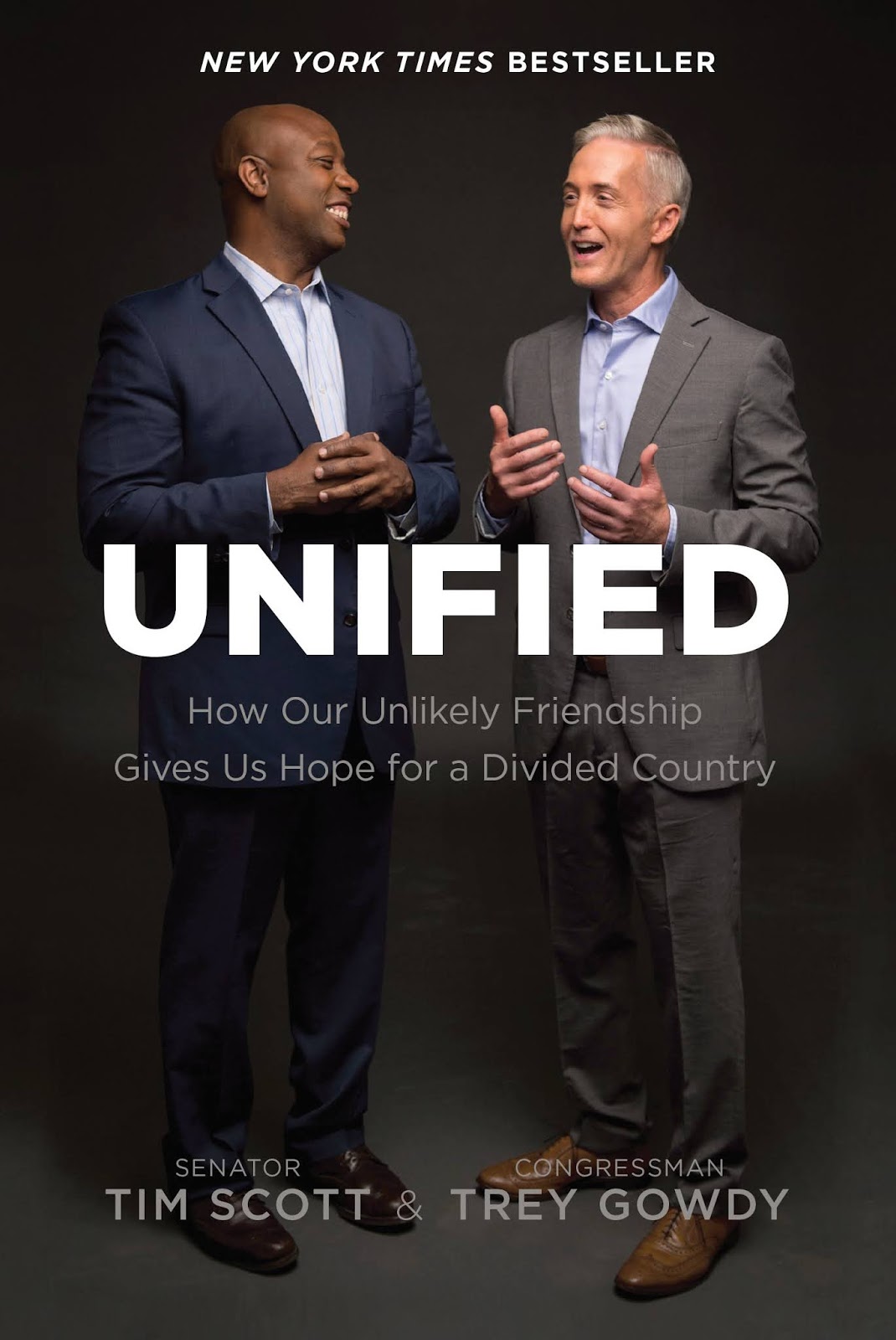
Related to the Charleston, SC incident, two notable political leaders from South Carolina, U.S. Senator Tim Scott and former U.S. Congressman, Trey Gowdy, recently appeared in a fascinating interview on the Mike Huckabee Show.  These two men are long-time friends and have written a very practical book, Unified: How Our Unlikely Friendship Gives Us Hope for a Divided Country.  During the interview with Gov. Huckabee, while referring to the tragic shooting and the forgiveness that America witnessed, Rep. Gowdy admitted that he could not have done that. 

I’m not sure if I could have forgiven a man who murdered members of my family either.  But it is this kind of unconditional love that God offers me—and, offers to all of us regardless of age, gender, ethnicity, church affiliation, political party, etc.  I want this love to motivate me to fulfill my individual responsibilities to love my wife, my family, friends, and all whom God considers “your neighbor.”  Beloved, if God so loved us, we also ought to love one another (1 John 4: 11).


How Would  You Respond?
I have written this article as a response to my friend and former student with the intention of sharing my current understanding of my personal responsibilities to my family, “my neighbor,” and to institutions—local community, church, and government.  I hope my friend and other readers will agree that I have done so in Christian love and with a humility that conveys that I am willing to learn from those who know more than I and who may disagree vehemently.  I welcome your “Comment” using the link below.


Wednesday, January 1, 2020

Regrets and Resolutions

The arrival of another year’s end and the New Year holiday is an important transition in time.  The Romans worshiped Janus as the god of beginnings and transitions.  Janus, from whom we get the name of the first month of each year, was depicted with two faces, one looking backward, the other looking forward.   

The image of Janus represents me today.  I’m thinking about the past and wondering about the future.  My natural tendency to look backward with regrets, and to look forward with a combination of doubt, fear, and determination to “do better.”  But today, I’m seeking a clearer understanding of how to “look both directions” in an emotionally and spiritually healthy way.  First off, I’m especially concerned about regrets from the past.

Last Sunday, our senior pastor, Zach Swift, in his message, "Immeasurably More," cited an interesting study.  A large chalk board was placed in lower Manhattan’s Petrosino Square with an invitation to passersby to “Write Your Biggest Regret.”  A camera was positioned to make a video recording of the interesting responses.  As you can see from the video, most respondents expressed various regrets including:
        Not getting involved
        Not being a better friend
        Never going after my dreams
        Not saying “I love you.”
        Not making the most of every day
        Not staying in touch
        All the self-hatred I put myself through


For every publicly admissible regret like these, there are dozens we tend to keep to ourselves.  Regrets emerge within us when we look backward into the silence of time gone by.

How do we dispel the regret, loneliness, helplessness, self-loathing, and even despair that erupt in our sad memories?  As time-bound humans, we are no match for the accusing voices from our past or the uncertain future that looms ahead.  Yet, it is during our low points that we must face a fundamental question: “Is there really a God who loves us and has shown His love and plan of redemption from our sins through His Gift of Jesus Christ?”  Each of us have already answered this question, if not by deliberate faith response, at least by the way we think and live.  Either we have believed in God and are learning to put our trust in Him, or we have rejected Him out of disbelief and have placed ourselves on the throne of our lives.  If we have “enthroned ourselves” as “god,” we are “on our own” in a stark, physical world governed by chance encounters and purposeless outcomes?  At one time, I experienced this reality.


King Solomon is noted for his outstanding wisdom (1 Kings 4: 30-34).  But later in life, Solomon fell into despair when he failed to find meaning and purpose in any of his wealth, pursuits, and pleasures “under the sun” (apart from a God-centered worldview).  He repeatedly cried, Vanity of vanities, all is vanity (Ecclesiastes 12: 8)!  However, when Solomon viewed time and eternity from God’s point of view, he wrote, Yet God has made everything beautiful for its own time. He has planted eternity in the human heart, but even so, people cannot see the whole scope of God’s work from beginning to end (Ecclesiastes 3: 11).

The Eternal God has created us to live in a time-bound world but He has also enabled us to imagine eternity.  At Christmas, many celebrate God becoming incarnate man in the bodily form of Jesus Christ.  God became man and stepped from Eternity into our finite world of time.  According to the Bible, our only hope against sin and regrets of the past is to accept Christ, God’s Gift of salvation from sin and death.  Then, we can develop a personal relationship with Christ through daily communion with Him by prayer and reading His Word, the Bible. 


When I abide in Christ (obey His commands for my good; John 15: 1-10), I can look backward and face my “chalk board of regrets.” Then, I can take each regret to God through a humble prayer of repentance where sin was involved (1 John 1: 9; Romans 7: 14-25).  Christ can also give me the humility, grace, and power to go to a person I have offended (Matthew 5: 23-26) or to a person who has offended me (Matthew 18: 15-17) to seek or give forgiveness and become reconciled.  Christ can also help me to forget my failings or turn them into lessons for victory in the future.  In these ways, as I appropriate the provisions of my loving Heavenly Father, my chalk board of past regrets can become a “clean slate.”

Returning to my “Janus” metaphor, when my backward-looking face (and my heart) sees real progress and victory over regret from my past, my forward-looking face (and heart) is encouraged.  With God as my strength and guide, I am encouraged to press on with purpose and courage. 

The Apostle Paul’s life is a testimony of how we can deal with past regrets and make resolutions for a victorious future.  In Philippians 3: 4-6, Paul “looks backward” and reveals his legalistic past as a Pharisee of the Jewish faith which included zealous persecution and imprisonment of Christians.  Then, in verses 7-11, Paul boldly contrasts the reputation he had treasured in his old life with the greater treasure of knowing Christ and the power of his resurrection, and the fellowship of his sufferings, being made conformable unto his death….  In case his readers would think that he had arrived at perfection, Paul hastens to say (v. 12), Not that I have already obtained it or have already become perfect, but I press on so that I may lay hold of that for which also I was laid hold of by Christ Jesus.

From my study of Paul’s experience, humility, and balance, I find real encouragement to look back into 2019 at my regrets, to repent of my sin, and seek reconciliation where necessary.  Then, I can look ahead into 2020 with particular resolutions, or better yet, spiritual goals.  I have written out my spiritual goals on a file card as a ready reminder, and I share them here in case you may benefit from them.  Please realize that I share them very much in the spirit of Paul expressed in Philippians 3: 12 above.  


If you think I am overdoing it, “overly spiritual,” or in any way high-minded, just realize that the more I become aware of my own bent toward sin and rejection of God’s rule in my life, the more I find the need to be “filled with His Spirit” (Ephesians 5: 15-21) and deliberate about feeding on God’s Word (Psalm 119: 9-12).  May you too, find joy, inspiration, and a real sense that God is abiding in you and using you through the power of His Spirit as you abide in His Word, commune with Him, and fellowship with God’s people in 2020.

How About You?  If you have never surrendered to the claims of Christ and asked Him to forgive you and be your Savior, I refer you to Steps to Peace with God which will explain how you can become a Christ-follower.  Without Christ, you are dead in sin and are facing eternal separation from God.  Romans 8: 6-7 states that without making peace with God, you remain hostile toward God [and your mind is not "tuned" to the Spirit of God].  In fact, according to Romans 8: 7-8, you are not even able to do so... With Christ on the thone of your life, and the hunger He can give you for His Word and fellowship with His Spirit, you can gain a new and clear perspective on your past (triumphs and regrets) and set fruitful spiritual goals for your future.  If you have questions, I'd be glad to communicate with you.  Just post a “Comment” below or e-mail me at silviusj@cedarville.edu

Tuesday, August 13, 2019

"Three R’s:” God’s Rx for Heart Health

The recent mass shootings in El Paso and Dayton deeply saddened me and stirred my sympathy for all who were affected.  Admittedly, this news also made me angry at the shooters.  Then, I began to reflect on the depravity that exists in my own heart.  Times of tragedy serve to remind us all of our need for repentance and forgiveness.  But sadly, our necessary reflection on universal human depravity is quickly interrupted by personal distractions and the noisy clamor and rancor of our culture in response to yet another tragedy.


On a social and political level, some argue that hate speech and racism incite mass shooters to act.  Others point to guns as the responsible tools that should be banned.  Still others point out that guns only fire when angry persons pull the trigger.  And anger arises from personal turmoil from within the hearts of shooters, often promoted by mental illness and/or drug addiction.  Violent tendencies are particularly common among young men who grow up without fathers and without supportive networks provided by good schools, churches, and community organizations.

Reasons for horrific tragedies are complex and multifaceted, so I don’t mean to oversimplify.  However, it should be obvious that finger-pointing and hateful rhetoric will not solve the deeper problems.  Nor will it be easy to “Red Flag” potential threats without an understanding of the origin and growth of anger, hate, and murder.  Therefore, I must begin by addressing the potential for hate and hateful responses within my own heart. 


From God’s Word, I am learning that the only difference between horrific atrocities and the “hidden sins” of hate and pride in my heart is a matter of scale.  Jesus alludes to this in His teaching as recorded in Matthew 5: 22 (emphasis mine):  But I say to you that everyone who is angry with his brother shall be guilty before the court; and whoever says to his brother, 'You good-for-nothing,' shall be guilty before the supreme court; and whoever says, 'You fool,' shall be guilty enough to go into the fiery hell.  Notice that Jesus takes the sixth commandment, “Thou shall not murder,” and goes to the source within the human heart where the underlying sins of pride, hate, and envy are rooted.  Sin within the heart triggers the sins of the tongue such as hateful name-calling.  And one who speaks hatefully is capable of murder.  Christ takes very seriously this outward progression from the sinful heart to hateful words to murder.  So seriously that He considers sins of the heart as equivalent to murder.

Thankfully, when our souls become frustrated and fearful, God stands ready with a three-part prescription from His Word.   I am now considering them as my basic “three R’s”—not “Readin’, ‘Ritin’, and ‘Rithmetic;” but instead, REPENT, REJOICE, and RECONCILE.

REPENT
When I am becoming frustrated, fearful or angry toward others or in response to the daily news, I must look within my own heart, the seat of my personality.  There, I will find the cause of my unkind words and actions.  And there I should stop and repent. 

According to Charles Spurgeon,
Repentance is a discovery of the evil of sin,
a mourning that we have committed it,
and a resolution to forsake it.
It is, in fact, a change of mind of a very deep and practical character, which makes the man love what once he hated, and hate what once he loved.”

Notice the emphasis on permanence in Spurgeon’s definition:  “resolution to forsake...change of mind…very deep and practical….”  Along the same lines, my former pastor, Dan Wingate calls us to adopt a “lifestyle of repentance.”  Such a humble, daily disposition helps us to recognize our own depravity and our tendency to wander like sheep away from God our Shepherd (Isaiah 53: 6).  Until we as individuals and as a society realize that sin is ultimately a rebellion against God who created us and therefore, owns us, we will not realize the seriousness of sin as the primary cause of our problems—individually and institutionally.  We will go on hating others instead of hating our own sin.

Don’t Substitute “Religion” for Repentance
Instead of recognizing that we are prideful rebels, we tend to focus on external problems that are not the primary cause of our broken world.  For example, the religious leaders of Jesus’s day criticized Jesus an

d His followers for not ceremonially washing their hands before they ate.  But Jesus said the primary problem is not what we do with our hands or even our tongues—but out of our heart come evil thoughts, murder, adultery, sexual immorality, theft, false witness, slander. These are what defile a person.  But to eat with unwashed hands does not defile anyone (Matthew 15: 18-20).

Emphasis on the externals leads to a religion of ceremony and legalism.  Rather than cultivating a love relationship with God, we rely on check-lists of our good deeds.  Both Christian and non-Christian alike can fall into this error.  Going to church, tithing, and abstaining from alcohol or meat, or rejecting plastic straws and gas-guzzling cars—none of these can make one person any more righteous in God’s eyes than another. The Apostle Paul condemned external comparisons as selfish and prideful when he wrote: When they measure themselves by themselves and compare themselves with themselves, they are not wise (2 Corinthians 10: 12)

Our Strongholds to Resist Repentance

The alternative to a repentant heart is a heart that becomes increasingly calloused with thick walls reinforced by pride and self-righteousness.  Calloused hearts become insensitive, cold, and hateful toward others.  When we watch the news, I see anxious and fearful people and hear angry words.  Unrepentant, prideful people make arrogant and woeful predictions that the sky is falling and despise anyone who disagrees with their philosophy of government, ethnic relations, economics, and energy usage.  Of course, we should exercise morality and good stewardship in all of these areas.  But our pursuit of happiness is a fruitless effort unless we submit to God’s plan and purpose through repentance.  Repentance frees us from the wages of sin and moves our focus from a life of pride, comparison, envy, and fear to a focus on God who alone is perfect and judges rightly.  When the eyes of repentant souls are focused on God, He brings rest to their souls.


Repentance must be my “first stop” before I can experience the other two R’s, rejoicing and reconciliation.  Yet it is hard for me to read the Gospel accounts and imagine the ugly spectacle of the bleeding, sinless Jesus Christ I helped to nail to a Roman cross.  It was my sin that did this to Jesus!   Yet my pride—our pride as humans can cause us to turn away.  We avoid godly counsel, church, and God’s Word when we know they can help us.  The prophet Isaiah, over 500 years before Christ, prophesied how we would “despise and reject” the Suffering Servant whose sacrifice in our place would cast a spotlight on our sin and depravity.

So, I have a choice, and you have as well.  Either we focus on justifying ourselves before God and others by the good works we do, or we focus on what Christ did for us, dying in our place so we can claim His righteousness (right standing before God).  If we individually choose to reject God’s “love gift” of salvation through repentance, then God can offer neither of the other two R’s-- rejoicing and reconciliation.  Jesus warned: Unless you repent, you will all likewise perish (be separated from God for eternity) (Luke 13: 3).  In 2 Corinthians 7: 10, Paul describes repentance that leads to salvation.  The Apostle Peter summarized the Gospel when he wrote, For Christ also died for sins once for all, the just for the unjust, so that He might bring us to God, having been put to death in the flesh, but made alive in the spirit…  And, again Paul wrote that he was not ashamed of the Gospel because it is the power of God at work, saving everyone who believes—the Jew first and also the Gentile (Romans 1: 16).  That is “Good News” indeed; enough to bring rejoicing!

REJOICE

To rejoice is to express joy and delight.   True joy comes from within our hearts.  Joy is one facet of the fruit of the Holy Spirit who comes to abide in the repentant sinner.  The Apostle Paul wrote, Now He who prepared us for this very purpose [to live for eternity in resurrection bodies] is God, who gave to us the Spirit as a pledge (2 Corinthians 5: 5).  Salvation from sin (John 3: 16), freedom from the condemnation of sin (Romans 8: 1), and the gift of God’s Spirit to abide within us (Ezekiel 36: 27) is reason for rejoicing.  The psalmist wrote, The LORD has done great things for us; we are filled with joy (Psalm 126: 3).  The Spirit-filled, Christ-follower cannot help but rejoice!  What’s more, according to the prophet Zephaniah, God our Creator and Savior rejoices over us as His redeemed children!  Imagine that!  The LORD your God is among you; He is mighty to save. He will rejoice over you with gladness; He will quiet you with His love; He will rejoice over you with singing.

As a sinner saved by God’s grace, I experience joy and consolation when I reflect on God’s presence within me though His Holy Spirit.  The contrast of what I was before I came into a personal relationship with God through repentance and faith in Christ’s substitutionary death and who I am afterwards is described accurately by the Apostle Paul.   In Galatians 5: 16-18, we learn how our sinful nature (“the flesh”) sets itself against the work of the Holy Spirit in us.  After these words, Paul describes our lives “before” (5: 19-21) and “after” we submit to the Holy Spirit’s work in our lives (vv. 22-23).

Repentant Hearts Exude Joy in a Troubled World
Repentance prepares us to humbly invite God’s Holy Spirit to enter our lives.  The Spirit’s presence enables us to bear the fruit of love, joy, peace, patience, kindness, goodness, faithfulness, and self-control.   But you may ask, how can I be joyful when so many bad things happen?  Answer— we must remember that Joy and its expression of rejoicing springs from within and is independent of things that happen to us.  Bad happenings in our culture of hate and violence will not overcome the Christ-follower who relies on God’s Spirit and His Word.

After Jesus instructed His disciples about things that would happen in the future, He said, These things I have spoken to you, so that in Me you may have peace. In the world you have tribulation, but take courage; I have overcome the world (John 16:33).  Jesus promised not only joy in the midst of a troubled world, but also that He would empower His followers to be ambassadors of reconciliation.

RECONCILE
By now, the importance the sequence of the three R’s, REPENT, REJOICE, RECONCILE, should be evident.  Repentance is the gateway to salvation and Eternal Life.  Where sin had once reigned within our unrepentant hearts, now God’s Spirit enables us to overcome sin and have victory.  Anger, hate, fear, envy, and lust are replaced by love, joy, peace, patience, kindness, and self-control.

We Are Reconciled… to Be Reconcilers 
The Apostle Paul wrote (emphasis mine), Therefore if anyone is in Christ, he is a new creature; the old things passed away; behold, new things have come. Now all these things are from God, who reconciled us to Himself through Christ and gave us the ministry of reconciliation, namely, that God was in Christ reconciling the world to Himself, not counting their trespasses against them, and He has committed to us the word of reconciliation.  Therefore, we are ambassadors for Christ, as though God were making an appeal through us; we beg you on behalf of Christ, be reconciled to God (2 Corinthians 5: 17-20).


This Scripture makes it clear that reconciliation between the sinner and God through faith in Christ gives birth to a new creation that in turn can become a force for reconciliation among the hurting and rejected of this world.  But you might say, how does the Bible address my friend or family member who is trapped in addiction or mental illness as a result of emotional and physiological problems.  Please realize that there is no human condition that cannot be helped by the care of loving friends and family combined with professional counseling and medical care.  Counseling and medications alone are weak and ineffective.  However, biblical witness and counseling by loving family, friends, and professionals are necessary to give purpose and desire within the hurting person, helping them to want to change. 

In conclusion, if you have chosen the path marked with the signs of REPENT, REJOICE, and RECONCILE, you know from experience how this sequence brings joy and reconciliation with God and other people.  You know from experience what it means to have victory over the sins of anger, hate, fear, and envy that once infected your heart and soul.  You may also be serving as an ambassador of reconciliation to hurting people around you as you humbly remember your struggles without Christ. 

Reconciliation Involves Both Spiritual with Mental Health
On the other hand, if you are hurting and in despair, feeling trapped in addiction and emotional turmoil, you can find help and hope.  For example, you may be familiar with the “Twelve-Step Program” of Alcoholics Anonymous.  This program is consistent with biblical teaching and the “three R’s” beginning with REPENT. 

Please check out the link to the
Twelve-Step Program and notice how the first seven steps can provide instruction on how to acknowledge God and come to Him in a spirit of repentance.  This program is very effective when used in the presence of loving family and friends.   If you are hurting emotionally or struggling with addiction, I hope you will seek help from trusted individuals or organizations that can point you onto the path to recovery through the “three R.’s.”  If you wish to contact me with questions, I would be glad to assist you:  silviusj@gmail.com