Showing posts with label government. Show all posts

Sunday, July 19, 2020

Choices for Troubled Times - 2. My Responsibility Matters

Like many Americans, I’m trying to distinguish between those who protest to call attention to injustices against Black Americans, and those who have crept in for the purpose of inciting division, resentment, hate, violence, and destruction of property.  I also want to distinguish legitimate accusations of racism and White supremacy from accusations based upon an individual or a group’s feeling that they have been offended or oppressed.  An individual’s perception that a person or group has acted in an offensive manner is not in itself evidence that an offense has actually occurred (Statement on Social Justice & the Gospel).

In the midst of the current divisiveness and turmoil, I must recognize the unity or "oneness" in Christ that God has offered to all persons by His selfless sacrifice on the Cross as the Apostle Paul outlines in Ephesians 4: 1-6 which in turn, is based on the Scripture in Ephesians 2 and 3.  There, we learn of the "mystery" that as Gentiles (every ethnicity outside of the Jews) we were once “dead in our sin” (Ephesians 2).  But now all of us who are in Christ share in Eternal Life with Him by a faith.  This Life is equally available to any individual who repents and accepts Christ’s sacrifice for their sin.  I already have written in some detail about the biblical basis for unity of all mankind in “Choices for Troubled Times - 1. A Perfect Union”).

As I pondered these points, it was helpful to receive an article from a former student with whom I have been privileged to dialog about these matters.  What follows is my response to him, slightly edited for brevity:

LETTER TO A FORMER STUDENT:
Thank you for referring me to the article, “My Letter to a Young White Friend,” by Alfred Turnipseed, who identifies as an African American Orthodox Christian.  I have been reading and thinking about his and other writings and have been reflecting at length on the assertions about ethnic injustice.  Mr. Turnipseed bases his letter upon the principle of equal dignity for all in a biblical framework.  Furthermore, he acknowledges the unity that all believers share as children of God, “joint-heirs” with Christ through faith in Him.  However, in the first paragraph of his article, Mr. Turnipseed expresses what he sees as a “fragmented unity” when he asserts that it is a “natural next step for us to broach the topic of the very particular predicament that only some of us must endure.”  I want to consider this “natural next step” carefully in view of biblical truth.

Blame versus Individual Responsibility
I want to understand the trouble and the burden of those who are unjustly treated.  Truly, they bear a real burden.   This burden often becomes more imposing when a Black life is affected by the long history of injustices of the past.  But we must realize that neither today’s victim nor today’s alleged perpetrator can change the past.  Each of us are responsible only for the present.  Each of us must decide between accepting individual responsibility to work toward better relationships with our neighbor through the love of God, or to adopt a tribalism that fuels hatred and blame between social groups.

God’s Word provides us with an objective and unequivocal justification for respecting both the sanctity and the equal dignity of all humankind.  For those of us who accept this truth through faith in God, the challenge is for us as individuals to understand how these truths can be implemented in our daily lives.  Major portions of the recorded teachings of Christ and the writings of the Apostles instruct each member of the body of Christ on how to practice the two Great Commandments—to love God, and to love our neighbor (Mark 12: 30-31).  Obedience to these commandments remains the responsibility of individuals, not groups or institutions.  The emphasis of the Gospel of Jesus Christ is upon individual responsibility before a holy and just God.  

Justice for “Each Bad Apple” Not “The Whole Barrel”
Having taken the “natural step” toward acknowledging that there is a subgroup within all of humanity that must endure racial injustice, Mr. Turnipseed assumes the role of defending them.  Unfortunately, he exercises his role by communicating to his White friend what I believe is a judgmental spirit ignited by his acquaintance with individuals and situations within his immediate sphere of experience.  Mr. Turnipseed then extrapolates his judgments to include the motives and values of others he knows from their writings, passions, and actions; and then, he expands to whole groups (e.g. people who “call themselves Christians,” those “resting in white privilege,” “the police force,” “unfairness of the criminal justice system,” “workers vs. capitalists (as if they are necessarily separable), etc.).  His generalizations lead to assertions like, “when the police murder, they do so “under the veil of the law.”

When individual unjust or unlawful incidents involving one or a few police officers are used to justify blanket statements that implicate whole groups of people, the accusations can become very inflammatory.  It is inaccurate, unfair, and unjust to use a murderous act by one or a couple of policemen either to incite whole crowds of people to chant slogans like “defund the police” or to rail against “White supremacy.”

Biblical Approaches to Challenging Authority
Certainly, there are “bad apples” on police forces, but rather than crying “White supremacy,” why not use the freedoms we have in the world’s greatest nation to address injustices with a spirit of good will even in the face of opposition from those individuals and groups that are filled with hate toward ethnic minorities?  Christians at the time of the early church did not rail or join mass protests against Roman injustices toward different “classes” or ethnic groups.  Instead, they advanced the cause of Christ under the banner of love which overcame such injustices.  Romans 13 and 1 Peter 2: 11-17 provide clear instruction in how Christ-followers are to respect those in authority.  The practice of using Christians as prey for lions for the purpose of entertainment in Roman culture was brought to an end by just such a nonviolent action.
The non-violent approach used in protests led by Dr. Martin Luther King Jr. in the 1950’s and 1960’s resulted in major advances in civil rights through passage of bi-partisan legislation.  In contrast, the Black Lives Matter movement doesn’t appear to have a constructive goal or plan.  They also appear to lack an understanding of and thankfulness for just how much American society has progressed toward equal justice under the law for all ethnic groups.  Indeed, those who cry “White supremacy” need to be careful lest they be exposed as misguided, “White-privileged” advocates who are nothing more than “noisy gongs” because they do not have a true, unconditional love-driven compassion for struggling individuals who need to be lifted up by acts of the love of Christ.

In some cases of injustice, the Bible allows that it may be necessary for citizens to appeal respectfully to higher authority.  In Acts 25: 1-12, the Apostle Paul provides an example of how Christians can legitimately make a respectful appeal to higher authority, in Paul’s case, to Caesar himself.  In America, while peaceful protests have been legitimate means of drawing attention to serious concerns, we are blessed with a representative government and excellent channels of communication via internet and phone to register our opinions and grievances.

Reconciliation through Love and Forgiveness
Above all, it is the responsibility of Christ-followers to exercise the virtues of love and forgiveness.  Writing in a culture filled with injustice toward minorities, the Apostle Peter encourages us to …keep loving one another earnestly, since love covers a multitude of sins (1 Peter 4: 8). 

A wonderful portrayal of the loving, compassionate, forgiving Spirit of Christ was shown in 2015 by members of Emanuel African Methodist Episcopal Church in Charleston, SC.  There, a man who came in as if to join their Bible study and prayer time, instead opened fire in a murderous rampage that led to the deaths of nine Christ-followers and injuries to three others.  While our nation watched, families of these victims freely offered their forgiveness to the murderer in the name of Jesus Christ.  Instead of allowing their grief from their horrendous losses of loved ones to spill over into hate, violence, and destruction, they threw themselves at the foot of Christ’s Cross.  Their act of forgiveness toward the murderer was a loving tribute to the crucified Christ because it embodied His true intent when he spoke from His Cross, “Father forgive them for they know not what they are doing (Luke 23: 34).” What would happen in our divided America if more of God’s people of faith would practice forgiveness, that unique virtue made possible through a personal relationship with a Forgiving God and Savior, Jesus Christ?

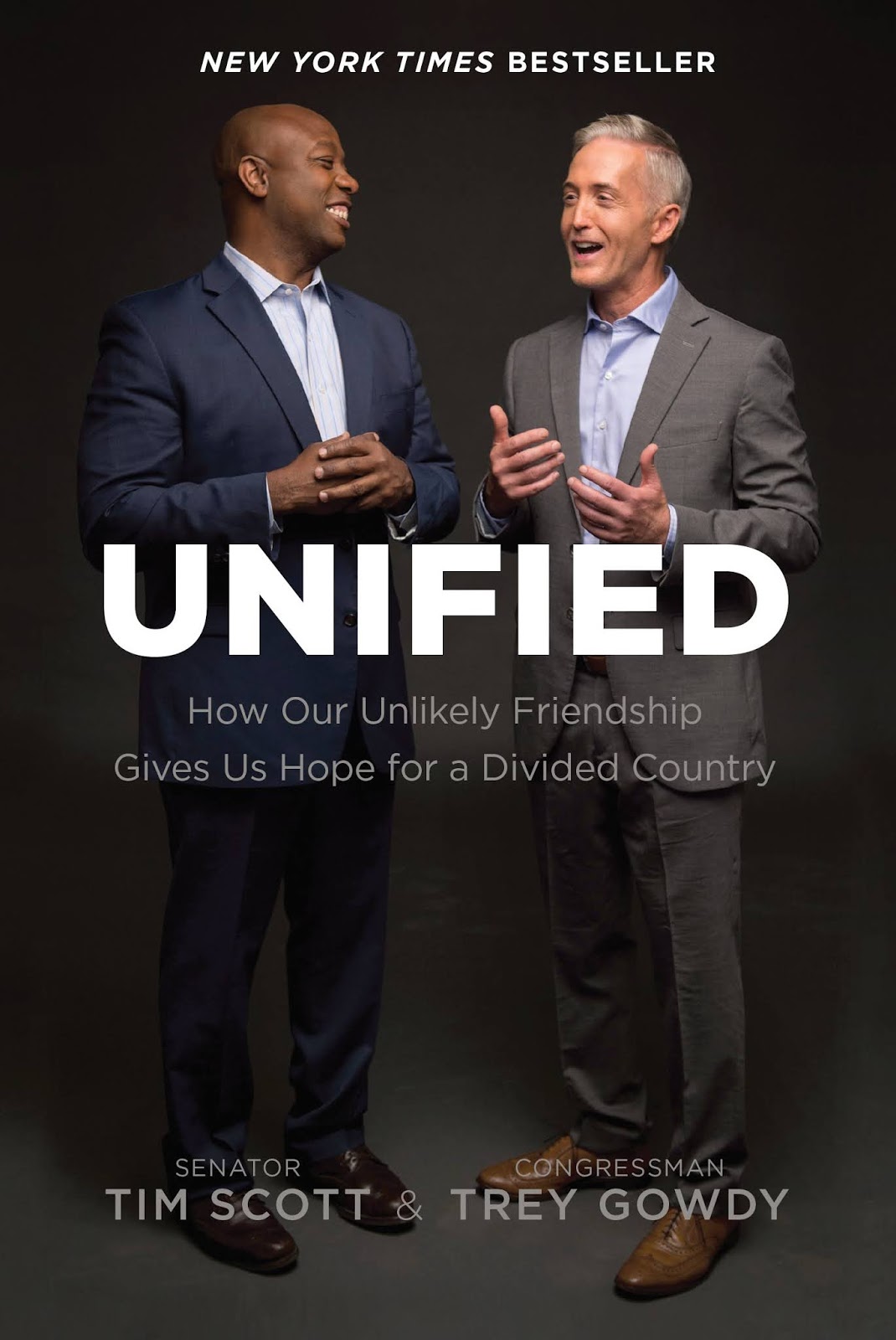
Related to the Charleston, SC incident, two notable political leaders from South Carolina, U.S. Senator Tim Scott and former U.S. Congressman, Trey Gowdy, recently appeared in a fascinating interview on the Mike Huckabee Show.  These two men are long-time friends and have written a very practical book, Unified: How Our Unlikely Friendship Gives Us Hope for a Divided Country.  During the interview with Gov. Huckabee, while referring to the tragic shooting and the forgiveness that America witnessed, Rep. Gowdy admitted that he could not have done that. 

I’m not sure if I could have forgiven a man who murdered members of my family either.  But it is this kind of unconditional love that God offers me—and, offers to all of us regardless of age, gender, ethnicity, church affiliation, political party, etc.  I want this love to motivate me to fulfill my individual responsibilities to love my wife, my family, friends, and all whom God considers “your neighbor.”  Beloved, if God so loved us, we also ought to love one another (1 John 4: 11).


How Would  You Respond?
I have written this article as a response to my friend and former student with the intention of sharing my current understanding of my personal responsibilities to my family, “my neighbor,” and to institutions—local community, church, and government.  I hope my friend and other readers will agree that I have done so in Christian love and with a humility that conveys that I am willing to learn from those who know more than I and who may disagree vehemently.  I welcome your “Comment” using the link below.


Sunday, April 9, 2017

Palm Sunday: Don’t Miss Jesus Today!

It’s Palm Sunday, the day many will once again celebrate an event approximately 2,000 years ago when Jesus rode on a donkey from the Mount of Olives down and across the Kidron Valley and up into the city of Jerusalem.   Crowds gathered along the rocky road to watch the spectacle of One Who had become known by many as a prophet.    Others saw Jesus as a miracle worker; and, still others as a heretic and trouble-maker within the Jewish religious establishment. 

Jesus, humbly riding on a donkey's colt
Sadly, most who gathered to watch the strange parade missed the significance of this special day; and, many misidentified the man riding humbly on the young donkey.  Some thought Jesus might be the One sent by God, the Messiah, to deliver Israel from oppressive Roman rule.  To them, this procession signaled that a political revolution was about to begin.  John 12: 13 records that many grabbed branches from nearby palm trees and began waving them.  Matthew, Jesus’ disciple who had been a tax collector for the Roman government records in his gospel that many in the crowd began crying

‘Hosanna to the Son of David!
Blessed is he who comes in the name of the Lord!
 Hosanna in the highest heaven!’
(Matthew 21:9)

As Jesus rode by, some took off their outer garments and placed them on the road in front of the donkey and rider as they would for a king.

Others in the crowd, especially the religious leaders, heard the “Hosanna’s,” saw the royal treatment and viewed it as a threat to the Jewish establishment which was already on shaky ground under the Roman rule.  They realized that this song, recorded in Psalm 118: 26, had been sung on many occasions over the past centuries of Jewish history as pilgrims made their way into Jerusalem.  Under Roman rule, such gatherings were viewed as attempted insurrections and were sometimes addressed with a violent show of force.  Therefore, the Jewish leaders called out, ‘Teacher, rebuke your disciples!’ (Luke 19:39).  But, Jesus replied, I tell you . . . if they keep quiet, the stones will cry out.(Luke 19:40).

How silly!  Who would dream that a man humbly dressed, riding on a donkey, could bring a new era of freedom from oppression?  Yet how many times in recent history have Christ-followers made the same mistake?  Many in the “Moral Majority” a few decades ago and others within the more recent “Tea Party” movement have placed their hopes for righteousness and peace in the rule of a political party, or in candidates who professed to be Christ-followers.  But, Jesus said within a few days of His triumphal ride into Jerusalem, My kingdom is not of this realm (John 18:36). 

Jesus had come to set up a spiritual kingdom within human hearts and minds—a kingdom in which we would worship and serve Him out of love for Him and for what He has done as the One Who died for sins once for all, the just for the unjust, so that He might bring us to God, having been put to death in the flesh, but made alive in the spirit… (I Peter 3: 18).  Jesus came to deliver, not from political oppression but from spiritual oppression caused by the rule of the god of this world (i.e. Satan who) has blinded the minds of the unbelieving so that they might not see the light of the gospel of the glory of Christ, who is the image of God (2 Corinthians 4: 4).

Jesus Christ came to Earth as Messiah, the “sent one” to become the ruling king of our very lives.  To accomplish that, Jesus came as the Lamb of God Who takes away the sin of the world, just as John the Baptist had proclaimed when he introduced Jesus before His baptism (John 1: 29).

This Palm Sunday, let’s not miss Jesus for Who He really is—the coming King.  Jesus came seated on a donkey’s colt on that first Palm Sunday, just as the prophet Zechariah had prophesied centuries earlier (Zechariah 9: 9).   The crowd waving palm branches didn’t realize that they were watching the Lamb of God coming on “lamb selection day,” the day in which faithful Jew would select their spotless lambs to offer as a sacrifice for their sin.  His timing was perfect!   After all of these centuries of Jewish history and all of the blood of lambs, bulls, and goats that were offered to take away the sin of the world, we must now realize that, as Hebrews 10: 3-4 states,

in those sacrifices there is a reminder of sins year by year.
For it is impossible for the blood of bulls and goats to take away sins.

As the familiar song asks, and then answers,

“What can wash away my sins? 
Nothing but the blood of Jesus.”

This Palm Sunday, let us not be as so many in Jerusalem were on the first Palm Sunday, causing Jesus to pause along the procession, and from His humble donkey say through His tears,   Luke 19:41–47).

Jesus is still tenderly calling us.  Don't miss Jesus today!  Don't miss Him this Easter Season!

How About You?  If you would like to know more about the“Good News” or Gospel of Jesus Christ, let me help.   The “Good News” is summarized in an outline called “Steps to Peace with God” which explains God’s love, our predicament (sin and separation from God), what Jesus has done to address our predicament, and what you can do by faith to receive God’s righteousness (right standing with a Holy God).  If you have additional questions or comments, I’d love to hear from you.  Just post a “Comment” below or e-mail me at silviusj@cedarville.edu


Monday, May 30, 2016

Memorial Day: Time to Remember…and Realize

Somewhere in France
June 20, 1944

Dear folks,                              
Glen Silvius (R), somewhere in France (1944)
Will write you a few lines from my fox hole position to let you know everything is going as well as can be expected.  We have plenty to eat and plenty of time that there is nothing moving, but the din of battle is always present.  I am limited as to what I can say but just the same this is war and I have seen some action.  I got mail twice since I have been in France.  We will have no trouble receiving mail but you may not get so much so don’t let it cause you any worry.

Letters such as this from my Uncle Glen Silvius to my grandparents and family in the days following the Normandy Invasion, in June, 1944, cause me to consider the great sacrifice by both members of the armed services and by their loved ones during World War II.  Even though communications between the battlefield and home were more primitive at that time than they are on this Memorial Day, many believe that Americans today tend to be more disconnected from those who serve in our military.
Gala True, a medical anthropologist and folklorist with the Department of Veterans Affairs and contributor to the Library of Congress’ Veterans History Project was interviewed by Megan Rigger and Laura Santhanam of PBS News HourMs. True noted that whereas 12% of the population were in military service during World War II, now “less than 1% of our population has served.”  She adds,

The experience of going to war and coming home—we don’t have as much awareness.  We have a disconnect in our society about what’s going on, [about] who has served and what they experienced. In many ways, Americans today feel removed from the Global War on Terror and military conflict. So few have served, and [so] it’s very easy for people say now that ‘I didn’t want these wars,’ but that doesn’t mean that we aren’t all part of this.

On this Memorial Day, as I remember the millions who have served and are now serving our country in uniform, I am gaining a new appreciation of the importance of “remembering” and being thankful.  Unlike the 1940’s, we have almost instantaneous communication from battlefield to the home front in a war that has extended over three times as long as WW II.  If what Gala True has said it true, we need to be more devoted to making connections with current military personnel and their families as well as to our veterans and their families, many of whom face physical and emotional scars of war.
And so, I’m asking myself, “Am I thankful for the political freedom I enjoy today, purchased at great price?”  And, perhaps more importantly, “Am I thankful for the spiritual freedom purchased by God’s provision of the Divine Son, Jesus Christ, Who is God come to Earth in the flesh to live an exemplary human life, and to die on a Roman cross to provide a way of reconciliation between sinful humanity and a holy God?”  After all, it is Jesus Christ Who, more than any other single Person, has changed history.  His death and resurrection launched the Gospel message that the war between God and each sinful human being can come to an end through confession of sin and surrender to God’s loving invitation to peace (Romans 6: 23).

The light of the Gospel of Christ has shown in the hearts of men and women down through the centuries, reflected in the formation of representative governments based on rule of law designed to protect individual freedom and reward individual responsibility. Consequently, although America has fought in many wars, there has been a general understanding that war is a last result, something to be avoided if possible, and not an occasion to conquer other lands but to bring freedom and restoration to people otherwise destined for enslavement and/or death. 

We can all point to morally questionable actions of America in war.   The Vietnam War comes to mind in this context.  When civilian or military leaders deviate from the biblical foundation upon which America was founded, our nation risks losing her distinction from terrorists and other warring groups who have no moral foundation.

In America and in the world, Christianity is being marginalized by those who deny biblical authority and place their faith in human reason.  American leadership in the world is losing its distinction and justification in both war and peace.  This Memorial Day, we need to REMEMBER, but also REALIZE our role in preserving freedom through responsibility. 

So, as I remember those who have sacrificed for our political freedom today, I must also realize that our political freedom is fragile and is being threatened by those who “preach” a “freedom” instituted by human efforts alone apart from the Gospel of Christ.  This is true because true freedom and America’s exceptionalism has been possible because of the moral and spiritual foundation that Christianity has provided through its influence upon our Founding Fathers and the founding documents such as the Declaration of Independence and the U.S. Constitution.

On this Memorial Day, I remember my Uncle Glen and many like him who served, with over a million Americans giving their lives for the cause of freedom.  Won’t you join me in thanking God for over 1.3 million Americans in active duty military, plus another 1 million serving in the reserves (by Department of Defense estimates).  Also, please join me in praying for our military chaplains who have an increasingly difficult job of providing spiritual leadership and guidance in the midst of stressful situations no matter where they are serving.  Most of all, let us pray for peace in the many war torn parts of the world today where whole ethnic groups are being threatened with destruction or being displaced from their homes and way of life.

We need holidays such as Memorial Day, Thanksgiving, Christmas, and Easter to REMEMBER and to REALIZE how much we have to be thankful for, and how important it is that we have responded to God’s offer of His Peace through the Cross of Christ.   Peace begins when we surrender to the great Peacemaker.  In Christ, we can gain a correct view of past history, a realistic view of our present world, and a positive outlook for the future. 

In Colossians 1: 19-20, the Apostle Paul writes, For it was the Father's good pleasure for all the fullness to dwell in Him, and through Him to reconcile all things to Himself, having made peace through the blood of His cross; through Him, I say, whether things on earth or things in heaven.

According to the Bible, one day, all wars will cease. The Apostle John wrote in Revelation 21: 4-5a about the future time when Christ’s kingdom will come,

There will no longer be any death; there will no longer be any mourning, or crying, or pain; the first things have passed away. And He who sits on the throne said, "Behold, I am making all things new."

Saturday, July 11, 2015

Christianity Shines in Dark Places

One year ago, we were receiving daily reports of the devastating effects of the Ebola virus on the people of Liberia and surrounding nations.  Now that the worst is over, experts are raising concerns about the quality of the local and global response to this crisis.  Consider an excerpt from the not-to-flattering “Report of the Ebola Interim Assessment Panel” of the World Health Organization (WHO):


Poor communication and messaging were a big hindrance.
WHO failed in establishing itself as the authoritative body on communicating about the Ebola crisis.  Although an emergency media team was put in place to manage WHO’s messaging and content, the communication strategy was not able to counteract the very critical reporting on the work of the Organization.  …The Panel is clear that WHO failed to engage proactively with high-level media and was unable to gain command over the narrative of the outbreak.

As suggested by the Panel, ineffectiveness of WHO in facilitating accurate messaging among government and nongovernmental organizations and media outlets resulted in disorganization, false narratives, uninformed local communities, widespread fear, and distrust.  The Panel’s report summarizes some of the consequences of the ineffectiveness of WHO (emphasis mine):

Owing to a lack of involvement on the part of the broader humanitarian systems, many of the resources of nongovernmental organizations from the countries and communities themselves were not mobilized in the early stages.  Had other partners been involved, it would have enabled community engagement because nongovernmental organizations with considerable experience in communities, including in health campaigns would have been brought in.

Included with its critical evaluation of how the WHO functioned in the 2014 Ebola crisis, are recommendations by the Panel to address the causes.  One key recommendation was as follows (emphasis mine):

WHO should establish the WHO Centre for Emergency Preparedness and Response, which will be based on the currently separate outbreak control and humanitarian areas of work.  This WHO Centre will need to develop new organizational structures and procedures to achieve full preparedness and response capacity.

Forgive my pessimism, but when I read about the inept performance by yet another in a long list of large bureaucratic organizations (Think Veterans Administration, Medicaid, and Internal Revenue Service to name a few.), I am not too optimistic when I read a recommendation to fund yet another layer of bureaucracy; especially one charged with making the existing bureaucracy do what it was already charged to do.  Although nongovernmental organizations (NGO’s) are not immune from such ineptness, many NGO’s deliver excellent outcomes with much more efficient use of funds.

One NGO among several that were responsible for combating the Ebola outbreak is Samaritan’s Purse, a Christian organization that has been ministering in Liberia since 2004.  Samaritan’s Purse’s online report entitled “Recovering from the Ebola Crisis in West Africa” includes the following encouraging claims:

In May 2015, more than a year since the deadly virus first surfaced in Liberia, the country was declared Ebola-free. The unprecedented outbreak claimed thousands of lives across West Africa.  Samaritan’s Purse responded aggressively in Liberia, where we have had a country office for more than a decade, through our Ebola Community Protection Program. Now that the virus has been contained, our office is starting programming to help the country recover.

Samaritan’s Purse has demonstrated competence in the face of the Ebola crisis based on its decade-long, trusted relationships and networking in local communities.   Consequently, this NGO, led by Franklin Graham, provides comprehensive help while using donor funds very efficiently.  For example, their Christian faith-based approach has enabled Samaritan’s Purse to provide community health education integrated with a message of hope to dispel centuries-old superstitions and false religious beliefs.  The Telegraph (London, July 30, 2014) commented on the way in which the grip of false beliefs hindered efforts to contain the Ebola virus:

There is a section of population here who simply don’t believe Ebola is real, they think it is witchcraft and so they don’t come to the treatment centres.

The Daily Kos, a liberal blog, reported as politely as possible (July 30, 2014):

Many rural western Africans have no formal schooling at all, and are accustomed to using village "witch doctors.”  I apologize if this seems rude, I am not trying to be insensitive to traditions, but one such doctor seems responsible for infecting nearly everyone in a village after suggesting Ebola was spread by snakes, and conducted a ritual involving group touching.  [Note: A Daily Kos reader suggested the use of “traditional healers” instead of “witch doctors”].

Samaritan's Purse provided health care, education, and hope.
Overcoming the deadly threat of Ebola requires a coordinated and decisive effort to combat ignorance, superstition, demonic influence, and fear.   Organizations like Samaritan’s Purse assist whole communities by offering education in community health and hygiene, and provide medical care.  But Christian faith-based organizations have an even greater advantage over secular and governmental organizations.  They rely on the power of God’s Word and His Spirit to pierce the spiritual darkness that prevents many Africans from knowing how to achieve and maintain their physical health and spiritual life in Christ.  

In order to foster Christian growth and maturity, Samaritan’s Purse emphasizes the importance of believers, both new and old, being regularly involved in a local church.  Their website states:

Through a massive public education campaign, which included thousands of church leaders, we provided potentially life-saving information to more than 1 million people, directly or indirectly, through a variety of events and media.


Dr. Kent Brantly of Samaritan's Purse contracted Ebola
and drew worldwide respect for faith-based efforts.
In our last Oikonomia article, “Censoring Vocabulary, But Not Virtue,” we emphasized that even where Christians are increasingly forbidden to speak words of truth to convey God’s good news it is still possible to convey the biblical message through a Christ-like testimony of love and forgiveness.  Those who ridicule and reject Christianity are often overwhelmed by the dedication of servants of God who have given their lives for the sake of Christ’s love to serve in “hard places.”  A visit to the website of Samaritan’s Purse, or better, a short-term ministry with Samaritan’s Purse to witness one of their field projects will reveal God’s love and its transformational power at work where words alone are often not possible.

Christian organizations like Samaritans’ Purse that serve in hard places must be encouraged as they follow the teaching of the  Apostle Peter’s letter to Christians living in hard places in the first century AD.  May Peter’s words encourage you also as you face challenges to your faith in a world that rejects much of what they see of Christianity:

Who is there to harm you if you prove zealous for what is good?
But even if you should suffer for the sake of righteousness,
you are blessed.
AND DO NOT FEAR THEIR INTIMIDATION,
AND DO NOT BE TROUBLED,
but sanctify Christ as Lord in your hearts,
always being ready to make a defense to everyone
who asks you to give an account for the hope that is in you,
yet with gentleness and reverence;
and keep a good conscience
so that in the thing in which you are slandered,
those who revile your good behavior in Christ will be put to shame.
For it is better, if God should will it so, that you suffer
for doing what is right rather than for doing what is wrong.
   – 1 Peter 3: 13-17

Saturday, March 28, 2015

There’s No Such Thing as Private Property

As the title suggests, I am calling for the demise of “private property” as we generally define it.  But you can relax.  I haven’t joined those who are singing the praises of socialism.  Instead, I am offering a biblical definition of private property; one that is essential for a free market, capitalist economy to operate in a just and moral fashion.  But first, let’s consider some context.

Western culture is steadily evolving; or perhaps more accurately, devolving.  At the heart of this devolution is the crumbling moral foundation of institutions that have supported civilization for several millennia.  The institutions of marriage, family, and citizenship are all being redefined based on moral relativism in place of objective truth claims from the Bible.  For purposes of this article, allow me to suggest that the definition of private property has also changed.  And I contend that this change in how we view “private property” explains why many have become disgruntled and critical of capitalism.

Replacing Capitalism with Socialism

During the past decade, the call for social justice has focused attention upon the plight of the poor, the ethnic minorities, and other groups who are considered disenfranchised.  Meanwhile, there has been a growing sense that social justice cannot be complete without major changes in two aspects that form the context of the injustices. 

First, there is the perceived need to change how material wealth is distributed.  Liberal scholars and leaders call for a shift away from free market capitalism toward some form of socialism to assure that each person gets their “fair share.”  Second, there is a perceived need to change the way in which humans interact with the environment of planet Earth.  According to this view, the Earth’s limited natural resources are too overtaxed to support the growing human population.  What’s more, natural resources are being consumed disproportionately by the rich and powerful.  To remedy these perceived duel injustices, one against the disenfranchised and the other against the Earth, the social planners have a solution which is summarized by Ralph Chaplin,
(1887–1961), American writer, artist and labor activist:

It seems the most logical thing in the world to believe that the natural resources of the Earth, upon which the race depends for food, clothing and shelter, should be owned collectively by the race instead of being the private property of a few social parasites.  

Chaplin speaks for many today who believe the answer to injustice toward people, animals, and the Earth is to move from individual to collective ownership of property—i.e. to “spread the wealth evenly.”  Never mind that to bring about this massive transition and then to maintain the collective in a just manner would be a difficult task, even with strong coercion and tyranny.  Furthermore, based on the history of socialism, how can we assume that those placed in charge of managing the collective would be any more just and fair toward people, animals, and the Earth than the so-called “social parasites” they now condemn?   Ben Shapiro points out that socialism has its own moral flaws:

Socialism violates at least three of the Ten Commandments: It turns government into God, it legalizes thievery and it elevates covetousness. Discussions of income inequality, after all, aren't about prosperity but about petty spite. Why should you care how much money I make, so long as you are happy?

On the other hand, capitalism offers the promise of freedom, but also a two-edged sword.  It depends upon individuals owning private property which in turn motivates a strong work ethic and entrepreneurial spirit which often paves the road to prosperity.  But there is also the temptation toward greed and unjust practices that earn some capitalists the name “social parasites.”   As Shirley Chisholm states, “When morality comes up against profit, it is seldom that profit loses.”

Although capitalism invites injustice, it is also true that greed and injustice thrive in both the private and public sectors.  It doesn’t matter whether the material resources of Earth are privately or collectively held; corruption has no favorites.  The source of trouble is not the material resources or the sector of the economy in which they are managed.  We must go deeper to find the cause.  The trouble comes from the depraved human heart.  Two writers, one a prophet of God and the other a Russian novelist and historian, expose the truth about the nature of the human heart:

The heart is more deceitful than all else and is desperately sick; Who can understand it?  -- The Prophet Jeremiah (17: 9)

the line dividing good and evil cuts through the heart of every human being. -- Alexander Solzhenitzyn

Reviving Our Concept of Private Property

Because moral depravity is rooted deep within the heart of man, if free market capitalism is to be moral, I believe we must also dig deep to identify and extract the cause of injustice; and then, revive the heart with a biblical concept of private property.  In Scripture, we discover the basis for the title of this article.  According to Scripture, “There is no such thing as private property.”  Although it is possible in America and some other countries to hold legal title to property, Scripture teaches that we do not own anything.  “The Earth is the Lord’s (Psalm 24: 1) and He has given humans dominion over creation (Genesis 1: 26-28) to manage it on His behalf as His servants or stewards (Genesis 2: 15).  We are stewards but not owners of “private property.”  Therefore, biblically speaking, private property is any portion of the Earth over which an individual has responsibility to God to manage for His glory.  In this definition, “private” refers to our individual responsibility.  And although we may hold temporary legal title, the property belongs to God.

The “stewardship view” of private property is a key by which humans can open the door and allow intimate relationship with God.  We can see this truth throughout Scripture from Adam and Eve all the way to the Apostle John in Revelation.  For example, Abel’s offering was a pleasing aroma to God, but Cain’s wasn’t (Genesis 4: 3-5).  This distinction rested at least partly on how these two men submitted themselves and their “property” in their worship of God.  Later, Noah worshipped and obeyed God; and God gave him dominion over the living creatures resulting in their salvation from the flood by means of the ark he had built (Genesis 6-9).  Abraham, the father of the Jewish nation, was a nomad.  Although he had great wealth, Abraham’s grasp upon it, even upon his beloved son Isaac, was very loose compared to his tenacious pursuit of God (Genesis 12-25). 

Remembering God Is Our Provider

Four centuries after Abraham, King David typified the same stewardship view that he learned from the patriarchs, but adds an additional principle.  King David not only understood that his kingship or dominion was a stewardship granted by God, but he also understood that even his ability to acquire material wealth was from God.  Listen as David prays before the people at the dedication of the material resources for the temple that Solomon would later build (1 Chronicles 29: 11b-14):

Yours is the dominion, O LORD,
and You exalt Yourself as head over all.
Both riches and honor come from You,
and You rule over all, and in Your hand is power and might;
and it lies in Your hand to make great and to strengthen everyone.
Now therefore, our God, we thank You, and praise Your glorious name.
But who am I and who are my people that we should be able
to offer as generously as this?
For all things come from You,
and from Your hand we have given You.

King David wanted his worship of God to be a picture of how all God’s people ought to exercise stewardship of the material resources of Earth day in and day out—managing “property” as that which comes from God’s hand and which, by God’s grace, He enables us to give back to Him or to our neighbor.  The Apostle Paul reiterates this principle in 1 Corinthians 4: 7:

For who regards you as superior?
What do you have that you did not receive?
And if you did receive it,
why do you boast as if you had not received it?

The Scriptural view of private property means we view the “property” as God’s, the “private” as our individual responsibility to work and manage it as unto Him, seasoned with an attitude of humility that recognizes all we have is ultimately a gift from God.   Elsewhere, in 1 Corinthians 7: 29-31, Paul teaches us that having a continual awareness of the eminence of Christ’s return will help us to “possess property as though we didn’t possess it” (emphasis mine):

But this I say, brethren, the time has been shortened, so that from now on those who have wives should be as though they had none;  and those who weep, as though they did not weep; and those who rejoice, as though they did not rejoice; and those who buy, as though they did not possess;  and those who use the world, as though they did not make full use of it; for the form of this world is passing away.

Notice Paul cites the relationship of husbands to wives, and the relationship of humans toward material property (ultimately the Earth) in a similar sense.  Husbands are responsible to love and nurture their wives as unto the Lord; likewise, those who buy are responsible as stewards to act as “husbandmen” to care for their property as unto the Lord.  Here, Paul teaches that God’s people are to undertake both responsibilities with a “stewardship view”—a view that aims to glorify God as Christ’s return draws near, rather than an “ownership view” that aims to multiply wealth without regard to moral and ethical responsibilities toward God and our neighbor.

Realizing Even Our Bodies Are Not Private Property

But there is a third principle that deepens the biblical meaning of private property even further.  God’s redeemed not only do not own their spouses, cars, houses, and land; they don’t even own their bodies.  The redeemed are bought by Christ’s blood from the slave block of sin.  Paul wrote,” …you are not your own?  For you have been bought with a price: therefore glorify God in your body” (1 Corinthians 6: 19b-20).  Paul summarizes the biblical responsibility of the Christian toward God in a comprehensive manner in Colossians 3: 17:

Whatever you do in word or deed, do all in the name of the Lord Jesus, giving thanks through Him to God the Father.

But how do we know whether we are actually “possessing as though we do not possess?”  Thankfully, God has instituted two routine tests by which we can check our attitudes and priorities when it comes to our “property”—our regular responsibility to give back to God our tithes and extra offerings; and, our weekly responsibility to set aside a day in which we celebrate God through our worship and rest from routine labor.  These observances provide a routine check on the tightness of how unselfish we are with material resources and time.

Renewed Hope for the “Free Market?”

I have provided a brief sketch of a biblical definition of private property. Now, if free market capitalists were to adopt this definition of private property, do you think they would still be considered “social parasites” by many who are disgruntled with capitalism?   The second question is, does this “stewardship view” of private property address the accusation by many that capitalism and its biblical roots are to blame for our insensitivity to disenfranchised people and to the deterioration of planet Earth?  I believe the answer to both questions is “yes” based on the account of the early church in Acts 4: 31-35 (emphasis mine):

And when they had prayed, the place where they had gathered together was shaken, and they were all filled with the Holy Spirit and began to speak the word of God with boldness.   And the congregation of those who believed were of one heart and soul; and not one of them claimed that anything belonging to him was his own, but all things were common property to them.   And with great power the apostles were giving testimony to the resurrection of the Lord Jesus, and abundant grace was upon them all.  For there was not a needy person among them, for all who were owners of land or houses would sell them and bring the proceeds of the sales and lay them at the apostles' feet, and they would be distributed to each as any had need.

Although some who advocate social justice and socialism interpret the sharing of property in common by the early church as an advocacy of socialism by Christianity, the passage does not support that notion.  Instead, notice first that these folks were born-again believers on the basis of having trusted in Christ’s redemption from their sins through His death and resurrection.  As “new creatures” in Christ, they submitted their wills in obedience to His Word under the power of the Holy Spirit.  The resultant unity of Spirit enabled them to view their material possessions as “common property to them.”  From their perspective of “possessing as though not possessing,” they were able to see with eyes of compassion the physical needs among their number and therefore to voluntarily share generously.   Many acted upon their concerns by selling their “private property” and making the moneys available to the leadership to distribute funds to those in need.

At the time of the events recorded in Acts, persecution and ostracism often severely impoverished Christian converts and their families.  Therefore, the outpouring of generous sharing among these people of faith was nothing less than an essential, voluntary expression of the compassion of the Risen Christ toward those in need.  The expression of charity (agape love) by the 1st century church has been reproduced in countless congregations throughout the world, often going unnoticed except by the recipients.  Note also that this “voluntary sharing” distinguishes this biblical economy from a socialist model.

Yet, the Christian church is not immune from selfishness and greed as we have noted previously in “Greed, Charity, and Capitalism.”  Therefore, one of the challenges of today’s evangelical church is to provide the setting in which God’s Word is taught under the direction of His Holy Spirit to believers who are Spirit-filled and receptive to Christ’s example as One Who had “nowhere to lay His head” (Luke 9: 58).   Christ lived as an example of “possessing as though He did not possess” and cautioned against attitudes that would oppose this “stewardship view” of private property.  For example, he warned against the love of money (e.g. Matthew 19: 16-25) and contrasted those who give out of their surplus with the poor widow who freely gave all she had (Mark 12: 38-44). 

Revival by Church and Civic Institutions

The evangelical church must function as a counterculture in which individuals and families learn to implement biblical stewardship of private property.   Local schools and the local community have historically contributed to this lifestyle as I have explained in Environmental Stewards Are ‘Grown’ within a Moral Community.” Historian Thomas Woods comments on the importance of individual responsibility and other virtues in a free market economy:

One of the market's virtues, and the reason it enables so much peaceful interaction and cooperation among such a great variety of peoples, is that it demands of its participants only that they observe a relatively few basic principles, among them honesty, the sanctity of contracts, and respect for private property. 

Arthur Brooks noted, “what America needs is not less capitalism but better capitalists.”  In my view, better capitalists are those that adopt a “stewardship view” of material possessions, one that is taught in the context of family, church, and community.  But as explained in “Dominion 101 - Spheres of Responsibility” government has the important role of maintaining the rule of law.  Rep. Paul Ryan makes this point well:

We believe that the government has an important role to create the conditions that promote entrepreneurship, upward mobility, and individual responsibility.

Our Founding Fathers understood the depravity of mankind and the danger of power in the hands of one or a few.  Therefore, the U.S. Constitution calls for a system of checks and balances, and includes a justice system to maintain accountability and rule of law.  Today, greed and corruption are common at every level of both public and private sectors.   Many are asking, “Is capitalism moral”?   Arthur Brooks answers, “Of course not. Only people can be moral.  We're not asking the right questions."  Instead, we should ask, “What economic system will most likely encourage moral behavior in us?”  For me, that system is capitalism in which individuals have a “stewardship view” that sees private property as a temporary trust to which God holds title.   As temporary title-holder, the “owner” is responsible to use it for the glory of God and for the benefit of his or her neighbor.  A free market economy in the hands of such responsible stewards will address both of the concerns of social justice advocates—provision of assistance to the poor and disenfranchised that respects the dignity of human beings, and good stewardship of the environment of planet Earth.

I welcome your comments.  The following questions may stimulate your thinking further:

1.   How would the “Rich Young Ruler” in Matthew 19: 16-25 define private property? 
2.   Does Jesus’ condemnation of the “Barn Builder” in Luke 12: 16-21 suggest that it is immoral to be rich?
3.   What does the following quote from Lewis Black tell you about Christianity versus socialism? 
Socialism appeals to me.  It's like imposed Christianity. You've got to share.
4.   In what sense do advocates of socialism express a different view of humankind than advocates of capitalism?
5.   Is a free market economy really a better system to address the needs of the poor and disenfranchised than socialism?   Which one better addresses environmental problems?
6.   How would you grade your attitude toward your “property” based on your material giving and your observance of “Sabbath rest?”