Wednesday, October 5, 2016

Tim Kaine Offers Trump a Key to Victory

While most vice-presidential debates have made little more than a small ripple among raging waves of a presidential election year, history may record that last night’s debate between Senator Tim Kaine (D-VA) and Governor Mike Pence (R-IN) was a major exception.  Most of the 90-minute match produced the typical bantering back and forth involving punches and counterpunches aimed at the qualifications of their presidential running mates—Hillary Clinton (D) and Donald Trump (R).
Sen. Tim Kaine (D-VA) and Gov.  Mike Pence (R-IN)
Governor Pence pointed to the lack of candidate Clinton’s qualifications based on her failed policies as Secretary of State under President Obama regarding Syria, Libya, Iran, and Russia; and the fact that she was handling classified information on an e-mail server housed in a basement while using the Clinton Foundation in a “pay for play” with influential world leaders.   Senator Kaine countered with accusations that Trump must be hiding fraudulent tax returns and would conduct his presidency discriminating against Muslims whom he views as evil without exception, against ethnic minorities whom he views as lawbreakers, rapists, etc., and against women who apparently Trump doesn’t trust to make decisions about their bodies.

Were the above accusations and rebuttals the entire substance of this vice-presidential debate, I think nothing historic will have come from it.   However, the Kaine-Pence debate was unique in that each candidate chose to invoke the authority of the Judeo-Christian Scriptures on at least one occasion to question the ethics and character of their opponent’s running mate.

Governor Pence challenged the American electorate to consider what kind of nation we have become when we continue to refuse the right of unborn babies to live.  Pence questioned how Senator Kaine who is pro-life could compromise his own stand against abortion by agreeing to run on the ticket with Secretary Clinton.  Clinton supports late-term abortion up until the time when birth is imminent.  Her campaign also calls for repeal of the Hyde Amendment that respects the moral conscience of those who defend the unborn.  Hyde opposes the use of taxpayer funds for abortion services.  In his opposition to abortion, Pence criticized the Democrat party’s pro-abortion platform by appealing to the authority of the Bible which teaches that unborn babies are already persons with rights.  He stated:

I would tell you that for me the sanctity of life proceeds out of the belief that -- that ancient principle that -- where God says, ‘before you were formed in the womb, I knew you,’ and so from my first time in public life, I sought to stand with great compassion for the sanctity of life. Pence added:  Society will be judged by how it defends its most vulnerable – the aged, the infirm, the disabled, and the unborn.

Sen. Kaine countered that Gov. Pence and Donald Trump have no regard for women’s right to choose, and that they would reinstate laws that would punish women who seek abortion.  However, Pence denied this charge by saying,

The state of Indiana has also sought to make sure that we expand alternatives in health care counseling for women, non-abortion alternatives. I'm also very pleased at the fact we're well on our way in Indiana to becoming the most pro-adoption state in America. I think if you're going to be pro-life, you should -- you should be pro- adoption.

Senator Tim Kaine, who considers himself a devout Catholic, also appealed to the Scriptures when he questioned the character of Donald Trump.  Kaine’s criticism of Trump’s character came following repeated quotations of derogatory statements Trump has made toward women including Hillary Clinton, and toward Muslims, Hispanics, and individuals who Trump deems unworthy of his respect.  Kaine said, there is “a great line from the gospel of Matthew. From the fullness of the heart, the mouth speaks.  By referring to this tiny quote from Matthew 12: 34, in my estimation, Tim Kaine earned the prize for one of the greatest zingers of any presidential debate in American history.

The Judeo-Christian Scriptures reinforce in many passages this principle that our mouth reveals the nature of our hearts, or our character.  Proverbs 23:7 states, For as he thinks within himself, so he is.  Luke 6: 45 expands on Matthew 12: 34 quoted by Tim Kaine,  The good man out of the good treasure of his heart brings forth what is good; and the evil man out of the evil treasure brings forth what is evil; for his mouth speaks from that which fills his heart.  Matthew 7: 16-17 records a claim of Jesus followed by His question, and then an application in regard to the character of false prophets:

You will know them by their fruits.
Grapes are not gathered from thorn bushes nor figs from thistles, are they?

So every good tree bears good fruit, but the bad tree bears bad fruit.

Donald Trump and Mike Pence
Whether or not candidate Kaine understood the power of his use of the Scriptures in last night’s vice-presidential debate, I believe he placed his finger on the key to the success (or failure) of the man, Donald Trump, in his bid for the presidency of the United States.  I believe Donald Trump’s greatest opponent both in years past and during the entire 2016 presidential race has been none other than himself.  Trump’s biography is laced with rude and downright immoral expressions that are indefensible.  Even while his running mate was defending many of Trump’s utterances last night, Trump himself was busily tweeting additional words that do not represent him well as a presidential candidate.

But, the truth is that you will know a person by his or her fruit.  The real problem is not Trump’s tongue.  It is his heart.  Nor can any of us be expected to “bear grapes” if our DNA matches that of a “thorn bush” (Matthew 7:16).   None of us can bring forth good treasures with our tongues if our hearts are plagued by evil.

Thankfully, there is hope for Donald Trump just as there is hope for all who, according to Romans 3: 23, …have sinned and fall short of the glory of GodThere is none righteous, no not one, Romans 3: 10 adds.  But, God has not ceased in His pursuit of us.   Centuries before God sent His Son, full of grace and truth (John 1:14) to seek and to save the lost (Luke 19:10), He spoke through the prophet that He would send a Savior.  In Ezekiel 36:26, God promised He would change our hearts so that we can personally know Him and bear the fruit of His righteousness, and not the bad fruit of our own self-righteousness. 

Moreover, I will give you a new heart and put a new spirit within you; and I will remove the heart of stone from your flesh and give you a heart of flesh.

Ezekiel is speaking of the transformation that is possible thanks to the incarnation, sinless life, death, and resurrection of Jesus Christ Who opened the way for salvation from sin and the new birth of Christ’s life within.  Romans 10: 17 states, So faith comes from hearing, and hearing by the word of Christ, and verses 9 and 10, just prior, explain that if you

confess with your mouth Jesus as Lord, and believe in your heart that God raised Him from the dead, you will be saved; for with the heart a person believes, resulting in righteousness, and with the mouth he confesses, resulting in salvation.


Although we are all concerned about Election 2016, and many wonder which candidate is most qualified, there is a more important “election” that all of us must consider.  Not by our own righteousness, but by putting aside our pride and looking to the cross of Christ where God gave His very life to redeem us from the slavery of sin and death (separation from God). 

And so, we ought to pray for our nation, and pray for the candidates.  For reasons I have written
elsewhere, I am leaning toward voting for Donald Trump.  But, more importantly, I am now praying that he will grasp onto the “key truth from Scripture” quoted by Senator Kaine.  I pray that Trump will take to heart his need to surrender in repentance to God and receive the gift of a new heart and…a new spirit.  From such a heart, godly character can grow, and it is such character that America now needs in leadership like never before.

Monday, October 3, 2016

Did LeBron Miss a Critical Shot?

In his recent endorsement of Hillary Clinton for president, LeBron James, Cleveland Cavaliers basketball superstar wrote:

LeBron James uses his success for the benefit of others.
As a kid, I didn't have much money. It was just my mom and me, and things were rough at times. But I had basketball. That gave me a family, a community, and an education. That’s more than a lot of children in Akron can say. There are a lot of people who want to tell kids who grew up like me and looked like me that they just don’t have anything to look forward to.


I respect LeBron James for his character and generous commitment to helping disadvantaged children through the LeBron James Family Foundation.  But, with all due respect, I wonder if will disappointed by Mrs. Clinton and her Democrat party if she is elected.  Although it may sound very partisan of me, the statistics are very clear--major US cities that have fallen into corruption, loss of jobs, failing schools, and (most recently) undermining of law and order have been managed by Democrat mayors for decades.

My hat is off to LeBron and many formerly disadvantaged people like him who nonetheless succeeded in spite of having grown up in many cases in a single-parent family in a ravaged inner city.  However, LeBron credits his success to the support from family and his local community, and not from Washington politicians.

What is needed from Washington is not more failed policies or neglect.  Instead, what is needed is competent local leadership in support of inner city communities so that children can live safely, find quality education through school choice, and live in homes with parents who are employed in adequately paying jobs.  In many cities, there will need to be a deliberate effort to rebuild the infrastructure of family and community, including transportation, education, and social services that respect the dignity of mankind.  Perhaps Mrs. Clinton can accomplish these if given the presidency, but I have yet to learn of a significant positive accomplishment by her as either US Senator or Sec. of State.  On the other hand, candidate Trump promises safety for inner cities through wise enforcement of law and order, education through school choice, better employment opportunities, lower taxes, better health care, and better child care for working parents.

As I have written earlier in Oikonomia, I am disappointed that America doesn't have a better choice of candidate for president. However, I believe a President Trump would be superior in defending the Constitution, providing sound Supreme Court nominees, protecting America globally, protecting our borders without which America will cease to be a nation, lifting the federal government out of the basement of inefficiency and corruption, improving American education through school choice and teacher accountability, and promoting economic growth through wise investment in infrastructure and appropriate technology.

I cannot vote today; and for that I am glad.  But for now, I am praying that Mr. Trump, Mrs. Clinton, and all of our elected officials will realize that unless they come to believe, speak out boldly, and make decisions from a strong moral foundation, America will not be able to address the forces from abroad and within our borders that threaten to undermine our nation.

Saturday, September 17, 2016

“Out, Damn Spot!”-- Injustice in America


Colin Kaepernick
Colin Kaepernick, second string quarterback for the San Francisco 49’ers, has been protesting police injustice toward minorities by remaining seated for the playing of the National Anthem prior to the opening of each preseason game.   In August, Kaepernick said in an interview with NFL Media:

I am not going to stand up to show pride in a flag for a country that oppresses black people and people of color.  To me, this is bigger than football and it would be selfish on my part to look the other way. There are bodies in the street and people getting paid leave and getting away with murder.

Of course, the First Amendment to the U.S. Constitution affords Mr. Kaepernick the right to freedom of expression.  The Constitution affords the same right to a growing number of NFL players and high school football players who are following in step with Kaepernick’s protest.

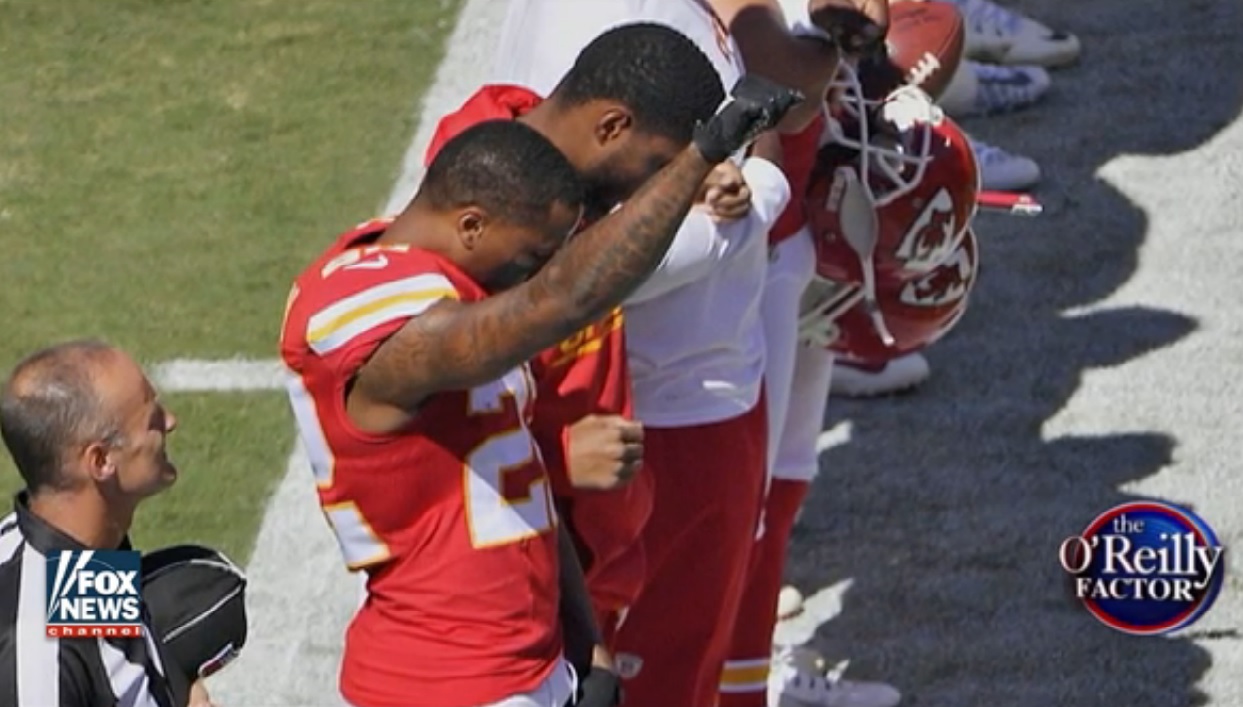
Marcus Peters raises fist in protest.
As I have watched the news reports and commentaries, I am reminded of the long history of protests against civil authorities and unjust practices in America.  Seeing Marcus Peters of the Kansas City Chiefs raise his fist during the National Anthem, on September 11, reminded me of how I felt upon seeing the raised fists of sprinters Tommie Smith and John Carlos in the 1968 Olympics as they stood on the blocks after receiving their medals.

American Olympians  vs. America, 1968
The headline-grabbing protests of recent years and my study of American history remind me that nonviolent protests have had a significant and positive role in drawing attention to injustices. The nonviolent protests led by the Rev. Martin Luther King, Jr. on behalf of minority rights transformed America in a positive way.  But
Dr. King's leadership as a Baptist minister of the Gospel was based on his commitment to the teachings of Jesus Christ, especially His fundamental command to love your neighbor as yourself (Matthew 19: 19) and when necessary, to turn the other cheek (Matthew 5: 39).  Dr. King’s focus on Christian love, character, and individual responsibility was an essential ingredient in the success of the civil rights movement.  

Although nonviolent protests have seldom been without at least some violence, several recent protests have boiled over into demonstrations of hate and mob rule.  For example, movements like Black Lives Matter claim that “Black lives matter” but fail to conduct themselves in a way that both respects all human life and property and presents a vision (e.g. Dr. King’s “dream”) for a better society.   Instead, there seems to be an unawareness or ignorance of the gains we have made in civil rights and racial reconciliation in America.  Protesters stir up social unrest by bringing up past injustices while interfering with the justice system by prejudging police actions. 

It is obvious that injustices exist in America.  But it is also true that many who make headlines through protest have been poorly educated in American history.  From elementary school upward, many of our children have been taught to view America through the lens of liberal progressivism.  The educational experience for many occurs within a constant stream of “news” provided by a liberal-dominated media that uses every opportunity to emphasize inequality.  Dissatisfaction among the poor and middle classes is fueled by the message that they have been mistreated by a system that favors the rich and dishonest.  While many press for “social justice” they ignore the fact that the disintegration of the American family hinders proper development of character which causes poor educational performance.   The result is a lack of competitiveness in the job market, resulting in unemployment, poverty, and proneness to join movements that foment protest.

Family breakdown and poor education impacts future generations.  Increasing numbers of poorly educated Americans become helpless pawns in a system that emphasizes groupthink instead of individual responsibility and accountability.  Instead of emphasizing human dignity, hope, and a pathway to achievement of joy and happiness as expressed in America’s founding documents, the liberal progressive message is, “See what you’re missing-- you’ve been cheated.  Look what you could have--just vote us into power.”

Janie Cheaney, in a WORLD article this month entitled, “Free and Equal,” writes,
Equality and inequality sound like complementary opposites, but they’re driven by non-complementary impulses.  Equality is about climbing up—a political principle written into our founding documents. It’s the theme when people feel empowered, or find empowerment within their grasp. Its primary emotion is hope.

Cheaney continues:
“I’m as good as you” backs up demands for equality: It may reveal a chip on the shoulder, but could also indicate a healthy desire to improve one’s condition. The complementary statement “You’re no better than me” hints at smoldering resentment. Inequality is about tearing down
.

Cheaney concludes that, Few if any political figures today are calling for more equality. Instead, they rail against inequality.  In the name of social justice they not only highlight contemporary inequality, but also condemn America because of the injustices she committed against minorities and the powerless throughout our history.   Social justice purveyors condemn the failures of the past based on current norms as if no moral gains have been made in respect to the rights of minorities.  Charles Krauthammer, conservative columnist, condemns this presentism, the practice of applying contemporary moral standards to actions committed in the past, and then posthumously condemning all who were involved.  For example, Colin Kaepernick’s protest has led some to condemn both Francis Scott Key and  our National Anthem, the lyrics of which he wrote, because Key was a slaveholder.


The events surrounding slavery and the Civil War represent a dark time in American history, and perhaps removal of all vestiges of the Confederate Flag is a respectful practice.  But as Shakespeare's Lady Macbeth learned, none of the attempts no matter how well meaning will purge away the “damn spot” represented in each sinful act of the past.   How then should America proceed in the midst of an era of media bias, misrepresentation of history, presentism, and collective guilt over past sins?

First, there is a great need for honest and accurate reporting by those responsible for conveying each day’s news and commentary.  And, we as watchers and listeners, and users of social media need to seek out all sides of the story.  We need to recognize the difference between news and commentary, and between objective journalists and political water boys or girls.


When we fail to get accurately reported news and perhaps are hampered by having only an elementary understanding of American history we end up like Colin Caepernick.  The 49ers quarterback and those who follow in his steps do not seem to have an accurate picture of either American history or of the current statistics on police actions toward young black men.  According to Charles Campisi, author of Blue on Blue: An Insider’s Story of Good Cops Catching Bad Cops, “In [New York City] a city of 8.4 million people…NYPD officers shot and killed 8 people in 2013—all males, all of whom were carrying guns or knives, 7 of whom had criminal histories….”  These statistics are not atypical of many of our cities.  Nor do they justify Kaepernick’s claim that police are oppressing black people and people of color…[while] …getting paid leave and getting away with murder.  People who wish to lead protests must have their facts straight—both from American history and from current events.


Second, we must recognize that no amount of group protest, collective condemnation of historical personalities and their unjust actions, or purging of our landscape and history books of names and symbols will atone for past sins.  There is only one way to account for past injustices.  That way requires that we recognize the Truth of the Christian Gospel (Good News) which does not deal primarily in group consensus or actions of either the past or present.  Our founding fathers understood that freedom and the pursuit of happiness can only flourish in a nation which recognizes that God is the Giver of opportunity.  Each individual is responsible for how he or she uses the opportunities God affords—i.e. exercises stewardship of the time, talents, and treasures entrusted to him or her.   The great commandments to love God with all of our being, and to love our neighbor as ourselves (Luke 10: 27) are the basis for a moral code.  The injustices throughout human history and up until our present day result when individuals fall short of these standards—i.e. what God calls sin.  How then should we respond?

The social justice approach is to point out injustices and then enlist followers into the business of correcting the injustice through protests, court actions, legislation, and coercion.  But social groups and governments do not sin.  Nor are these groups of well meaning individuals able to rid our nation of the “spots” left from past history or current injustice.  It is the individual who sins.  According to the Bible, no individual can make amends or atone for his or her own sins; or the sins of others.  In Psalm 49: 8-9 we read,

No man can by any means redeem his brother Or give to God a ransom for him--
For the redemption of his soul is costly, And he should cease trying forever--

Romans 3: 23 adds that all have sinned and fall short of the glory of God…  Romans 6: 23 explains how God, not mankind, has made provision for each sinner who recognizes his sin,  confesses, repents, and receives God’s Gift of atonement through faith in the death and resurrection of His Son, Jesus Christ:  The wages of sin is death, but the gift of God is eternal life through Jesus Christ our Lord.  Jesus Christ is the only Way to rid our souls of the “spots” of sin.  He said, …if the Son [Jesus] makes you free, you will be free indeed (John 8: 36).

Suppose we allow that Colin Kaepernick means well in protesting injustices of police toward black men.  Still, it doesn’t appear that he has either his present facts or past history correct.  Nor does he appear to realize that we are all plagued by sin, the tendency to rebel against God’s plan for true freedom and justice.  Furthermore, does Kaepernick know that each individual including himself needs a new heart through Christ’s atoning work on the cross.  God’s forgiveness and empowering through His Holy Spirit can help us put away the anger, resentment, envy, and a host of other sins that plague our souls.  The Apostle Paul admonishes Christians to live by this command:

Let all bitterness and wrath and anger and clamor and slander be put away from you, along with all malice. Be kind to one another, tender-hearted, forgiving each other, just as God in Christ also has forgiven you.

Only God can transform lives and set individuals free.  These individuals have opportunity and inspiration to love God and their neighbor and contribute toward building strong families, schools, communities, and civil government.   But if Americans continue to reject God’s justice and mercy, and refuse to own up to our individual responsibility for sin, we will continue to wander blindly about, biting and devouring one another.  On the other hand, if Americans realize that laws and their enforcers are for our good, and if punishment is justly given and received, then the guilty can be placed on a path to redemption, forgiveness, and freedom.

Although it is easy to point to the Kaepernick’s and other protesters of this world, I must first be sure that God’s justice and righteousness does its work in my own heart.  If you and I are  “born again” believers, this closing challenge is for us and for all who claim faith in Christ:

For it is time for judgment to begin with the household of God; and if it begins with us first, [then we may ask] what will be the outcome for those who do not obey the gospel of God? -- 1 Peter_4:17

Friday, September 2, 2016

Pondering and Praying, then Picking a President

Candidates Clinton (top) and Trump.
Our presidential election is less than two months away.  While many Americans now reside in the land of #NeverTrump, I do not believe American voters should be residing in that land, or in the land of #NeverHillary.  I have considered being a citizen of “#NoVote,” but history teaches that people who choose not to vote can determine election outcomes as much as voters.  Therefore, I’ve decided to pull up stakes and move to #MaybeTrump.  Although my final decision must wait, let me share a few points I am considering.  [I invite you to use the “Comment” box below to respond.  I am not offended by polite disagreement.]

First, we can be thankful that there are still two months until Election Day, and a lot can happen during this time to influence our voting.  Therefore, I am joining what I hope is a host of American voters who are thinking carefully and discussing how to vote in this difficult, presidential election year.

 The wisdom books of the Bible have much to say about making wise decisions.  Proverbs 15:22 states, Without consultation, plans are frustrated, but with many counselors they succeed.   Proverbs 18:13 adds, He who gives an answer before he hears, It is folly and shame to him.   Regardless of political party or religious affiliation, voters should apply the principles of these proverbs and use the time remaining to stay informed and become well prepared to exercise our freedom to vote.  Based on these Scriptures, voting early in this election could be your first bad decision.


Dr. C. Fred Smith of Southwestern Baptist Seminary has written a blog article entitled “How to Really Choose the Best Candidate!”.  Here is an edited summary of his “basic principles for becoming an informed and biblically grounded voter:”

1.      Study what the Bible says about character and leadership--Key concepts: virtuecharacter, vice, wisdom, behavior of Kingsetc.
2.      Read one or two good books on Christian Leadership principles.
3.      Read Article One and Article Two of the U.S. Constitution often enough to get familiar with them.
4.      Evaluate candidates in light of Biblical and Constitutional teaching, knowing that no candidate has ever been perfect. 
5.      Ignore most of the media circus.  Instead look at full transcripts of their speeches for evidences of their leadership style, vision for the country, moral character, virtues, etc.
6.      Ignore extremist websites–especially those that focus on tearing down the candidates.
7.      Look up the candidates’ resumes–What have they accomplished in the past? How does that relate to the office they are seeking?
8.  About a week before the election, decide who will get your vote–and again, do this with the knowledge that the candidate you choose will not be perfect.

     My second consideration before voting-- Americans who profess Christianity have an obligation to do more than vote wisely.  Scripture commands us to pray.  The primary season allowed Americans to chose two candidates for president of the United States—Hillary Clinton and Donald Trump.  Many agree that both candidates have moral and ethical deficiencies.  But as such, they reflect much of what is endemic to the majority of Americans who elevated them to victory.  In fact, if we are honest when we look in the mirror, we may see some of our own values and character flaws in one or both Donald Trump and Hillary Clinton.

I believe Christians must choose how they will respond to a weak field of candidates.  We can continue to highlight their character flaws as if God is powerless to transform them by Election Day.  Or, we can pray that God will work mightily in the lives of the candidates through people and circumstances surrounding them between now and Election Day.  Furthermore, we ought to pray that our hearts and minds as American voters will be honest, humble, and discerning.  Have we made this presidential election a prayer priority?


Franklin Graham emphasizes the importance of a praying electorate in Decision Magazine, saying, “When the Scripture says that the king’s heart is in the hand of the Lord, like the rivers of water (Proverbs 21:1), it means that a Sovereign God can turn the heart of a king at any time and in any way.  If there are policies and platforms that don’t conform to biblical ethics, the intercession of Christians can be used in a powerful, transforming way.”  Grahams’ point applies not only to those currently holding high office but also candidates running for office.  He notes further that “… the ultimate reason the Bible instructs us to intercede on behalf of our leaders is so that they might come to the saving knowledge of Jesus Christ.” Graham cites Paul’s words in 1 Timothy 2:3-4:

This (our intercession for those in authority) is good and acceptable in the sight of God our Savior, who desires all men to be saved and to come to the knowledge of the truth.

That is right!  The Bible not only commands us to pray, but that we intercede for the souls of our leaders and candidates for office so that, in the words of Franklin Graham, “…our leadership would personally know God and the salvation found through faith in Jesus Christ alone.”   Graham solemnly adds,  “I can’t help but ask myself if all Christians had fulfilled this admonition and been faithful to pray for our leaders, would our nation—even our world—be different today?  Can our diligent, heartfelt prayers make a difference for the future?  Most certainly.”

Therefore, while we wait for Election Day, why not pray fervently and expectantly?  This question is only partly rhetorical.  I say this because I am facing two obstacles against my effort to pray fervently before I vote.

First, my faith is often too small to believe that God could intervene to transform the life of one or both of the presidential candidates. But then, I follow Dr. Smith’s principle #1 above and open my Bible. There, I find encouragement in the historical and prophetic books like Daniel.  In Daniel 4, we read the account of how God transformed prideful, pagan King Nebuchadnezzar of Babylon into a humble leader who afterwards spoke these words publically:  Now I, Nebuchadnezzar, praise, exalt and honor the King of heaven, for all His works are true and His ways just, and He is able to humble those who walk in pride (Daniel 4: 37).  What an amazing change of heart!

We can also read in Daniel 9 how this prophet interceded by fasting and prayer in sackcloth and ashes for his nation in exile. Daniel’s prayer is a model for those of us today who strive to understand the power of fasting and prayer.  God eventually turned the hearts of, not one, but several pagan kings who amazingly allowed the release of the Jewish nation from captivity. These pagan kings even assisted in the return of the Jews to Israel.  For example, in Nehemiah 1: 4, we read that when the prophet heard of the deplorable state of the city of Jerusalem during the Jewish exile (445 BC), he sat down and wept and mourned for days… fasting and praying before the God of heaven.  Then, Nehemiah appealed to the heart of the Persian King Artaxerxes I.  Amazingly, Artazerxes granted him permission to rebuild the ruined walls of Jerusalem.  Then this pagan king willingly supplied Nehemiah with the resources and protection to accomplish the mission!  Truly, the king’s heart is in the hand of the Lord…and God can direct that path a king takes like the rivers of water (Proverbs 21:1).

Daniel and Nehemiah are only two examples of how God worked in history through great men of prayer and faith.  The author of Hebrews 11 lists many other men and women who by faith conquered kingdoms, performed acts of righteousness, obtained promises, shut the mouths of lions….  Accounts like these from Scripture ought to encourage us today to fast and pray fervently and expectantly.  

Perhaps like me, you face a second obstacle against praying for our leaders and the candidates for office.  Suppose even if one or both of the candidates were miraculously transformed spiritually before November.  Can we trust that they would have the moral and spiritual maturity necessary for the office of president?  After all, look at their habits and past reputations—liar, adulterer, pro-abortion ‘murderer,’ proud, boastful, rash, brash, etc.  It’s no wonder many Americans are tempted to reside in the land of #NeverTrump, #NeverHillary, or #NoVote.  But then, was there ever a presidential candidate the all voters agreed would make a  good president?

For now, my focus for prayer is upon my personal attitude, my proneness toward sin, and the sin so prevalent in the American electorate.  As a born again believer in the incarnation, sinless life, death, resurrection, and imminent return of Jesus Christ, I am thankful that God did not look at my life and declare, “#NeverJohn.”  Instead, as the old hymn declares, God sought me, and bought me with His redeeming blood.  And God is still working to transform this stiff-necked rebel by the renewing of my mind (Romans 12: 2) through learning from people, experiences, and the Scriptures which are intended for reproof, for correction, for training in righteousness…(2 Timothy 3: 15).

Or have we as believers in Christ’s atonement forgotten how terribly unsuited we were for an “office” in God’s kingdom?  Have we come to the point in the recognition of our spiritual poverty that we can see ourselves in the center of the crowd of Jewish Pharisees, each ready to stone us until Jesus defends us, and says to our accusers, He that is without sin among you, let him cast the first stone (John 8: 7)?  Or instead, do I see myself among the accusers surrounding a Donald Trump or a Hillary Clinton lying on the ground while shouting out accusing words? ADULTERER! “LIAR!” 

Thankfully, many of God's people are humbly praying for our nation, for the person God will allow to assume leadership in January, and for a new resurgence of moral clarity and integrity in America.  Many Christians are concerned about their own personal walk with God so that their eyes are clear to identify candidates with integrity.  Perhaps if the spiritual eyes of God’s people had been more “clear” (Luke 11:  34) in 2012, fewer Christians would have abandoned presidential candidate Mitt Romney, a decent, moral man, who then narrowly lost to Barack Obama.  Romney had campaigned as a social and fiscal conservative, so there is reason to believe that the past four years could have been different under his stronger moral and ethical leadership and prior experience as a governor.

In this year’s election, many moral and fiscal conservatives view Donald Trump as a weaker candidate than Romney because of Trump’s lack of moral and spiritual maturity.  However, I am encouraged that Trump campaigns as both a fiscal and a social conservative (e.g. support for sanctity of life, and for maintaining law and order).  Trump’s choice of Gov. Mike Pence, a man of proven character and leadership, for vice president suggests that he knows the importance of making responsible choices of men and women to serve in government.  Trump also recently demonstrated some humility when he expressed regret that some of his words have been hurtful.  Willingness to admit error is an important trait of a leader.  I am thankful for small indications that God is at work in the life of candidate Trump.  As he receives classified briefings, I pray that Mr. Trump will sense more clearly the weight of the presidency and call upon God for wisdom and strength as other presidents have done.

I am also praying that God will use one of Trump's advisers just as He used Barnabas as recorded in Acts 11: 22-26 to encourage Saul, a former persecutor of Christians.  In spite of much fear and resistance by the first century church to the acceptance of Saul, Barnabas recommended him to the church based on his genuine profession of faith in Jesus Christ for the forgiveness of his sins.  Saul was eventually accepted by the church and became Paul the Apostle, one of the great early church evangelists and church planters.

Come November 8, some of us will remain in the land of #NoVote, being unable to vote in good conscience for either candidate. But, when neither candidate is deemed morally and spiritually qualified, does that justify abstaining?  Anyone may choose not to vote, but we should remember that the outcome of elections is decided by both voters and non-voters. In 2012, many, including Christians, were among residents of #NoVote because they refused support Mitt Romney. The resultant reelection of Barack Obama suggests that choosing not to vote doesn’t prevent us from leaving our fingerprints on the outcome.  Also, residents of #NoVote must consider how much they are dismissing the importance of substantial differences in the platforms of Trump and Clinton.  Careful reading and listening to the candidates reveals stark differences in their vision for America with respect to the following:

1.   Respect for “rule of law” vs. extending “compassion” arbitrarily
2.   Sanctity of human life
3.   Respect for U.S. Constitution (e.g. 1st and 2nd Amendments; “separation of powers”)
4.   Responsibility of government to protect from foreign invasion
5.   Solution to urban and rural poverty
6.   Support for marriage and family
7.   Education—school choice, improving teacher effectiveness
8.   Protection of religious freedom
9.   Rights and dignity of women
10. Fiscal responsibility of government
11. Importance of character and integrity for those in “public service”

To the shame of the Christian community in America, our nation has become more like ancient Greece and Rome. But unlike the Greeks and Romans, thanks to God’s grace working through the Founding Fathers, we have the freedom to vote.  Unfortunately, more and more we are faced with a choice between candidates with character qualities not unlike a Roman Caesar or a Babylonian King Nebuchadnezzar.  Yet God still works through pagan authorities; and, He continues to command Christians to pray for those in authority and to be salt and light in the public arena.  By “Spirit-led, Scripture-fed prayer,” we can develop more closely the mind of Christ and we can see more clearly what God is doing in our lives and in our nation as we participate as “salt and light” (Matthew 5: 13-16) while we anticipate Christ’s return. 

I do not know yet how I will vote in November, but I’m glad there is still more time to get acquainted with the candidates and their respective platforms.  Meanwhile, we ought to pray for them and for ourselves as voters that God will spiritually revive us, and revive America as God desires.  The prayer of Daniel, in Daniel 9, is a great place to begin praying in a "Scripture-fed, Spirit-led" fashion as you enter a time of quiet prayer, and perhaps even fasting for your relationship to God, and for revival in America and the World.  For more on prayer and fasting, see "How Do You P-R-A-Y This Thanksgiving?"

[I welcome your comments. Please click on “Comment” below if you care to respond.]

Friday, August 5, 2016

Remembering My Mother

On Monday, August 8, we will gather to remember my mother’s life.  Esther Silvius died, August 4, at the age of 94.  When we gather there in Sugarcreek, Ohio, all will recognize one thing that no one can escape – death!  As the Bible implies in 1 Corinthians 15: 56, death has a painful “sting.” And today, as I write this, the sting hurts.


Esther M. Silvius (1922-2016)
But on Monday, I hope the focus will be upon LIFE—Eternal Life which is a gift to all who put their trust in Christ.  My sister Margie, my brother Dan, and I have lots of memories of our mom—some are joyful; and some, not so much. 

My mother not only gave Margie, Dan, and I our physical LIFE.  She gave us each something else--something she never had–siblings.  Many have said that growing up as an only child can be hard—both as a child and during one’s adult life.  But Dan and I each had the blessing of both a sister and a brother.  Margie was stuck between two brothers!

I am thankful for my mom for three reasons.   First, she gave me life which began when I was conceived, in August, 1946.  That was exactly 7 decades ago this month!

But mom gave me a second gift:  As a boy, she and my dad, Bert Silvius, gave me a love for learning. Mom’s love for wildflowers and trees was contagious and, as a little boy, she led me on my first “field trips.” Sometimes, she had to carry me, especially when we encountered a thick patch of Mayapple (Podophyllum peltatum) in the woods.  I was afraid because I couldn’t see what lie under the thick stands of umbrella-like leaves.  Nevertheless, my growing love of plants resulted in a career in science teaching and research spanning 50 good years.

But the third gift I received from mom and dad is the most valuable and enduring. From the farm, the natural landscape, and science—I learned about the wisdom and provision of God through His “natural revelation.”  But, because mom and dad took us to church faithfully, I also learned about God’s “special revelation”—His Word of truth in the Bible.

As a growing boy, I was anything but a saint.  I “lived” in the Old Testament, tried to keep the 10 Commandments—and failed every day.  I was the Prodigal Son--the one who stayed home and tried to be good--and failed!  Case in point: My mom had a tradition when my birthday rolled around each May.  She would mail in a request to radio station WJER the week before my birthday to have it announced on the air, on May 9.  Then, on my birthday she would call me to the radio around noon to hear my name announced.

One year, when I was romping in the yard with my cousins, mom called me in to listen.
She had made the request, and had looked forward to our tradition.  But this time, I said,
“I’m busy, I don’t want to hear it this year.”
I don’t remember her reaction, but my independent spirit must have hurt her.  When I became a man, I apologized for my insensitivity.  There was a reason for this-- My heart, my values and my character were changing.   As a young man, I came to realize another invitation to “come in and listen.”  It was from God Himself Who had created the world that I had learned to love all around me. 
With my parents, Bert and Esther Silvius (~1963)
He said, “Listen, I am your Creator, and I have prepared an invitation to you at great cost--
The cost of my only Son, Jesus Christ, Who paid the ultimate price by dying on a Roman cross to buy you from the slave market of sin as manifested in your pride, selfishness, and self-righteousness (Romans 5: 8; Ephesians 2: 1-8).

I had hurt my mom by rejecting her invitation to come and listen.  Now, I realized that I had been doing the same thing to God every day, rejecting His even greater invitation.  Jesus invites us all:

Come unto me, all of you who are weary and heavy laden.  Take my yoke upon you and learn from me (pull together with Me in my yoke), for I am gentle and humble in heart; And, you will find rest for your souls.  For My yoke is easy, and my burden is light.  – Matthew 11: 28-30.

I’ve borne some heavy yokes in my life because of my stubborn pride and self-righteousness. 
I am prone to take up other heavy yokes, and I need to practice daily the spiritual disciplines of prayer and reading/study of God’s Word in the Bible. 

Today, multitudes of people bear heavy yokes – socially, financially, and medically.  Many have turned to substance abuse to help lighten their load.  In fact, so many are on drugs today that employers are struggling to fill positions with drug-free applicants.
How about you?  Are you bearing a heavy yoke?  Jesus offers us an easier yoke with Him, because He has already born the ugly yoke of a Roman cross.


With Mom (2003)
For God so loved the world that He gave His unique Son, that whoever believes in Him [recognizes their “poverty of spirit” and comes humbly to the Cross] should not perish [be separated from God forever], but have everlasting life. – John 3: 16

I have felt sting in my mother’s deterioration and death.  But, I am thankful for the comfort from friends and from God’s Word that speaks through His Spirit so that we don’t have to grieve as do the rest who have no hope (1 Thessalonians 4: 13).  Comfort and hope are part of the blessed gift of salvation, possible only when we surrender our pride, confess our need of forgiveness of sin, and trust in Christ Who will wrap His arms around us, enveloping us in His Eternal Life.

Faith in God through Christ can take the fear and the sting out of death.  Thank You, God for my mom.  And, thank you mom for pointing me to God.

Sunday, July 31, 2016

Considering the Flowers... and Fruit

Royal Catchfly (Silene regia) [Click to enlarge.]
This month, our garden has displayed the brilliant red flowers of the Royal Catchfly (Silene regia). We enjoy the regal flowers and their colorful avian visitor, the Ruby-throated Hummingbird.

Ruby-Throated Hummingbird visiting flowers.

The Royal Catchfly is named for its habit of “catching” flies and other small insects that visit to feed on its nectar.  The calyx or floral tube of the Royal Catchfly is covered with tiny glandular hairs.  These glandular hairs secrete a sticky fluid that traps flies and other small would-be pollinators that are too weak to escape.  However, the Ruby-throated Hummingbird does not land on the flower but instead it hovers as it draws sugary nectar from each flower to support its high metabolic rate.  This relationship illustrates how different plant species can “select” which animal species they will attract (and release) in order to allow pollination necessary to complete sexual reproduction through fruit and seeds.


Royal Catchfly:  Note green, sticky floral tubes
As I sat admiring the array of lovely Royal Catchfly flowers, I was reminded of how God’s creation often reveals or underscores valuable spiritual lessons.  There is one lesson for us in the beauty of the flowers.  In Matthew 6: 28-33, Jesus  points to the wildflowers in a nearby meadow and notes that, though they do not “toil and spin” they are more spectacular than King Solomon in all of his glory.  Hence, the flowers teach us the lesson not to be like unbelievers who tend to view the material world as their total reality, and therefore, are often anxious about accumulating wealth and having security.  Instead, we are to seek after the eternal priorities of our Heavenly Father Who already knows our needs and will supply them as we wisely do our part.

Our main focus will be upon a second lesson from the flowers; namely, that flowers are always very dependent on the leaves in order to acquire their attractiveness necessary to produce fruit and seeds.  Although leaves can make a garden flower or tree look lovely, leaves and stems are only a means to the end that each plant is able to reproduce itself lest it become locally or totally extinct.

The Royal Catchfly is a perennial plant, meaning that it can live year after year because roots and sometimes parts of the stem can survive during an unfavorable season like winter.  Each Spring, when the new growths emerge from the ground, energy stores from the rootstalk are used to launch the leaves and stems.  The plants become self-sufficient through photosynthesis as long as sunlight, water, soil nutrients, and carbon dioxide are available.  During this “vegetative” phase, perennial plants give priority to growth of leaves supported on stems that can hoist the leaves high enough to insure sunlight absorption and gas exchange.  For Royal Catchfly, this height is from 2 to 5 feet.

Once the leafy stalks differentiate to produce flowers in July, the priorities shift.  Now, the vegetative parts of the plant actually become “sources” of nutrients, water, and organic constituents.  Fruitful plants are those in which the leaves and stems transport food to the reproductive parts so that flowers can flourish and attract pollinators by means of visual appeal, release of fragrant compounds, and provision of nectar as food.   After flowering is completed, the leaves will begin to turn yellow and then brown as chlorophyll-protein compounds are broken down and resultant amino acids and other organic constituents are transported from the leaves to the growing fruit and seeds.  This pattern is particularly noticeable in crop plants like soybean and corn which have been enhanced genetically so that the economically valuable seeds (soybeans) contain as much nutrient value as possible rather than allow these nutrients to be lost in the crop residue, the resulting brown leaves, stalks, and chaff.
Evidence of flowers being preferred over leaves (arrows)
Of special interest this year was my observation that one of the Catchfly’s flowery stalks was partly severed from its roots. The severed condition obviously limits the supply of water and nutrients available to both the leaves and the flowers.  But, interestingly, the damaged stalk responded with an earlier than usual shift in priorities in order to favor the flowers at the expense of the leaves. Notice the wilting leaves (arrows) in stark contrast to the firmly opened Catchfly flowers.  Considering the importance of fruit-bearing and the spreading of seeds, we can infer a logical benefit to the Royal Catchfly in how the damaged stalk hastened its shift tp favor flowers and fruit/seed production at the expense of the leafy part of the plant.

The second lesson, teaching the importance of being fruitful, is underscored from Scripture.  Matthew 21:19 records an instance in which Jesus encounters a tree with lush leaves but no fruit:

Seeing a lone fig tree by the road, He came to it and found nothing on it except leaves only; and He said to it, "No longer shall there ever be any fruit from you." And at once the fig tree withered.

Fruits (capsules) of Royal Catchfly at time to collect seeds
Jesus intended this particular fruitless tree to represent the nation of Israel which He regarded as fruitless in their role of representing His glory on Earth.  Adam and Eve had already rejected God’s authority and His plan that they, along with all creation, would be fruitful, multiply, and fill the Earth (Genesis 1: 22, 28).  Now, God’s chosen people, Israel, had refused to live as a glorious testimony of His goodness in a fallen Earth.

Like the nation Israel, and the fruitless fig tree, no plant can be fruitful unless the leaves become subservient to the flower, fruit, and seeds.  Instead, the leaves must have the same relationship with the flowers and fruit that John the Baptist had with God’s Son, Jesus Christ.

The Apostle John tells us about the mission of John the Baptist, in John 1: 6-7,

There came a man sent from God, whose name was John.  He came as a witness, to testify about the Light
(Jesus Christ), so that all might believe through him.

John the Baptist was preaching a baptism of repentance for the forgiveness of sins, and all the country of Judea was going out to him (Mark 1: 4-5a).  We know from modern experience how pride and corruption can plague the lives of preachers who acquire large followings.  But in spite of his great following, John the Baptist remained faithful and directed the “spotlight” onto the Bridegroom, Jesus Christ.  John 3: 39-30 records John’s stewardship as “friend of the bridegroom” (emphasis mine):

He who has the bride is the bridegroom; but the friend of the bridegroom, who stands and hears him, rejoices greatly because of the bridegroom's voice. So this joy of mine has been made full.  He must increase, but I must decrease.

After John pointed his followers to “the Lamb of God” (John 1: 29), many of John’s followers followed Jesus.  John eventually ended up in prison and was later beheaded (Matthew 14: 3, 10).  Like leaves and shoots that spring up in the good soil and flourish for a time, their glory must give away to another, greater purpose—the nourishing of flowers which produce fruit with seeds in them to ensure future growth and reproduction.

Combining the biology of how leaves must submit and give up their life in support of flowers, fruit, and seeds with the example of John the Baptist who “decreased that Jesus might increase,” we have a major principle:  biblical leadership requires “submissive steward leadership.”  In other words, LEADERSHIP without STEWARDSHIP will SINK the SHIP.”  Pursuit of power and glory at the expense of submissive steward leadership does not accomplish an enduring result, but can end in ruin.   Instead, a disciples of Christ must be so in love with Him through the power of His Spirit that he or she can deny himself, take up His cross, and follow” Him (Luke 9: 23).

How about you?   How about me?   Are we all leaves and little fruit, like the fig tree that Jesus rejected?   Leaves make great hedges to divide property and hide people from one another.  But submissive stewardship honors God, family, community, and nation.  It begins in a child who honors his father and mother, the first commandment with a promise (Ephesians 6: 2), and is a basic foundation for social behavior.  The child who learns to submit his or her desires to the authority of parents and siblings within the family, and enters a personal relationship with Jesus Christ, is preparing to be a steward leader as an adult in marriage and family, church ministry, civic responsibility, and place of employment.

Like the leaves that literally “give up” their organic constituents to supply the fruit and seeds, and like John the Baptist, the “friend of the Bridegroom” who lived and died while casting the bright light of hope on Jesus, so our Father in Heaven calls us as His beloved children to deny self and to sanctify Christ as Lord in your hearts, always being ready to make a defense to everyone who asks you to give an account for the hope that is in you, yet with gentleness and reverence… (1 Peter 3: 15).  But, unlike leaves of Royal Catchfly or Soybean that eventually wither and die, we can live on as submissive stewards and friends of the Bridegroom, perpetually drawing our sustenance through our obedience by abiding in the vine which is Christ.  For he who abides in Me and I in him, he bears much fruit, for apart from Me you can do nothing (John 15: 5).

Thursday, June 30, 2016

When an Atheist Longs for a “Higher Love”


Atheists reason, and some profess, that God and other deities do not exist.  Maybe I’m wrong, but I have a hunch that many self-proclaimed atheists remember being offended and perhaps deeply hurt by one or more well meaning persons of faith.  Some Christians may act toward unbelievers out of ignorance, others out of arrogance, and yet others out of a sincere but carnal desire to “win” a God-denier to faith in order to claim the atheist as a trophy of a hard-to-win pagan.  By the way, I have probably already unintentionally offended at least some atheistic readers who argue that their belief is based on sound logic, not emotional scars.  No offense intended as you will hopefully see by reading on.

The Bible teaches that those who deny God are on the road to eternal judgment (John 3: 16; Romans 3: 10,23; 6: 23).   God does not “clear the guilty” (Numbers 14: 18) just because they can point to a Christian who offended them sometime in their life.  Yet, it ought to be true that every sinner saved by God’s grace is constrained by Calvary’s love and desirous of sharing the Gospel of God’s love with unbelievers—and, in a way that is not disrespectful (2 Corinthians 5: 14-15; 1 Peter 3: 15).

I cannot deny that there has been selfishness in my motivation to communicate with atheists in recent years.  Therefore, it has been good medicine for me to read The Faith of Christopher Hitchens (Nelson, 2016).  I discovered this title in a book review by Benjamin Wiker, Senior Fellow at the Veritas Center for Ethics and Public Life, Franciscan University.   The book’s author, Larry Taunton, director of Fixed Point Foundation, refers to Hitchens in his subtitle as “the World’s Most Notorious Atheist.”  I was immediately intrigued upon learning that Taunton is an evangelical Christian who writes from his experience as a close friend of Hitchens between 2007 and 2011 when Hitchens died of cancer.

Readers of The Faith of Christopher Hitchens are humbly and respectfully introduced to the man whom reviewer Benjamin Wiker describes as “a real, lovable, cantankerous, flawed, hilarious, foolish, brilliant, sinful, and multi-faceted human being.”  But more fascinating and valuable is the way in which an evangelical Christian, Larry Taunton, respectfully and lovingly earns the right to become a friend of Hitchens.  Though reluctant to publish many aspects of their unusual friendship, Taunton finally agrees with a publisher that he should write the book.  What resulted is a captivating narrative that recounts the tumultuous boyhood of Christopher Hitchens in England during the 1950’s, his rejection of the notion of God as a teen, and his development of a separate public and private “set of books” that governed his thinking, communication, and behavior in his adult life.  As Taunton explains, the growing chasm between the public and the private Christopher Hitchens is a key to understanding how an atheist could drastically change his allegiance from the Left to the Right following the 9/11 attack on America, and eventually gain new respect and friendships with evangelical Christians.

Christopher Hitchens and brother, Peter Hitchens
As further incentive for you to read The Faith of Christopher Hitchens, I will provide a list of questions the book has caused me to ask, each one dealing with a facet of the larger question, What can I as an evangelical Christian learn from Larry Taunton about building a friendship of mutual trust and respect with those who have a different view than I of the natural world and beyond (if they acknowledge such?  Hopefully, this article will motivate you to read The Faith of Christopher Hitchens.  And better yet, maybe some of my questions will promote  a more in-depth reflection and discussion.  If so, I’d love to read comments posted to me from the link below.

1.   Am I cultivating friendships with people who deny the existence of God, or reject His claim on their lives?  If so, how well am I representing the love of Christ to them?

2.   Hitchens’ favorite song was Steve Winwood’s, “Higher Love.”  He admitted to Larry Taunton’s son, Michael, “I do long for a higher love (p. 4).”  With all humility, do I recognize that within the heart of every man and woman is the need to experience God’s redemptive love, and that God might use me in some way as an important channel of His love?

3.   What can I learn from the accounts of the boarding school experience of two English boys—one, Christopher Hitchens who found in its harsh and often unreasonable discipline what became for him “metaphors for rejection of God and church;” the other, C.S. Lewis, who found an equally harsh experience what became for him “a metaphor for how faith, patience, and anticipation is built into life.” (p. 12-13)

4.   How many pre-adolescent and adolescent children today experience a roadblock to conversion to faith in God, often resulting in a hatred of God and Christianity, because of a failure of parents and teachers to help them acquire a truly Christian view of God’s gift of   sexuality?  
Michelangelo's "The Awakening Slave"

5.  Is each human being “self-made” as illustrated in Michelangelo’s The Awakening Slave, pictured 
as a man writhing to get free of the marble block restraining him?  Hitchens denied that his father’s lack of faith had anything to do with his own becoming an atheist; instead, seeing himself as a “self-made man” who came to atheism purely out of rational means.  But, Hitchens’ father had two sons, both “Bible-burning atheists and communists.”  The fact that God works in the affairs of fathers and sons is evidenced by what eventually happened--one of the sons becomes a Christian (p. 48)!

6.   Is it possible that many atheists do not embrace atheism so much because it is logical and intellectually fulfilling as because it allows them the opportunity to legitimize their rejection of moral claims upon the lifestyle they choose?


7.   Hitchens embraced atheism because it allowed him to square the public and private “sets of books” that he kept.  And, he chose words as his weapons to defend his position, “rather than loving words insofar as they lead to truth (p. 22-23).”  Do I fall into the same trap when I give priority to eloquence and scholarship over pursuit of truth, understanding, and respectful discourse with those who do not share my beliefs?

8.   For Hitchens the atheist, the logical political allegiance was to socialism which is antithetical to Christianity.  As Dostoevsky wrote, “Socialism is not merely the labor question, it is before all things the atheistic question….”  Do we realize why socialism today is increasingly popular in spite of its dismal history of economic failure and the deaths of millions of people?  Socialism is increasingly popular because many are deceived into believing that “our generation” will avoid the “Stalinist perversion of an otherwise perfect system” and will “get it right” in the attempt to “set up heaven on earth?” (p. 24)

9.   Do some atheists see Christian attempts to relate to them as trophy-hunting expeditions?  Taunton suggests that Hitchens often found the efforts of Christians who sought to “convert” him as intellectually stimulating and entertaining.  But, he also loathingly considered other professing Christians like Rev. Al Sharpton as “intellectual frauds” when he learned that they held little or no allegiance to the authority of the Bible.  Read how Hitchens exemplifies a God-denier or God-hater who warms to some conservative evangelicals who displayed intellectual competence integrated with warmth and respect.

10.  What happens when an atheist like Christopher Hitchens is confronted with a horrific event like 9/11?  Hitchens could not help but judge the terrorist act as “simply evil” and not, as liberal progressives often claim, the result of some outside injustice--economic, social, political, or cultural?  If instead, murderous acts originate by “human free will” out of an evil heart, it becomes “freely chosen evil.” It follows that our whole “human family” is morally corrupt and in need of an outside Deliverer—the God an atheist claims does not exist!  Read how Hitchens came to see the contradiction.  Psalm 49: 7-9:  No man can by any means redeem his brother, or give to God a ransom for him-- For the redemption of his soul is costly, and he should cease trying forever--that he should live on eternally, that he should not undergo decay.
Christopher Hitchens (1949-2011)

11.  How did the gradual warming of Christopher Hitchens toward Christianity come about by a Gospel witness grounded in the authority of Scripture as the sole arbiter of what defines Christianity, and not (as Hitchens often encountered) personal testimonials and human opinions?   How many times does my witness for Christ become diluted by too much emphasis on “my experience” as opposed to presenting the objective claims of the Gospel message?

12.  How did Larry Taunton, upon first meeting Hitchens, in 2007, avoid getting stuck in a “cart-before-the-horse” misunderstanding over how their lifestyles differed (e.g. smoking, drinking), allowing Taunton to say, from almost the beginning, “I knew I liked him…our rapport was immediate (p. 96).”

13.  How does a Christian friend of an atheist locate the moral limits (if any) beyond which the atheist will not go?  For example, was Hitchens’ atheism consistent enough (as was Peter Singer’s atheism) that he was comfortable with the Godless conclusion that there is no moral basis for treating human babies any differently than piglets or peeps?

14.  How did the adoption of a Russian girl, Sasha, by Larry and Lauri Taunton; and, Sasha’s vibrant Christian testimony to Christopher provide him with a glimpse of the “higher love” which he longed (see #? Above)?  Therefore the LORD longs to be gracious to you, and therefore He waits on high to have compassion on you. For the LORD is a God of justice; How blessed are all those who long for Him (Isaiah 30:18 ).

15.  Finally, does an increasingly warm and tender friendship of mutual trust and respect between an evangelical Christian and a professing atheist lead the latter to bow his knees at the altar of repentance and faith in God, and to take hold of that “higher love” he had longed to find?  You’ll have to read The Faith of Christopher Hitchens, but please don’t start with the last chapter.