Showing posts with label justice. Show all posts

Wednesday, February 1, 2017

Shaping the Future of America

 
Last night another history-making announcement came to us when President Trump announced his nomination of Neil Gorsuch to fill the vacant position on the U.S. Supreme Court.  Thus begins what may be weeks or months of deliberation and bantering between those who approve and those who oppose his nomination.  

As I have thought about President Trump’s pick, I began to wonder if there are any points on which most supporters and opponents could agree.  Here is what I have come up with so far, and feel free to add or comment:

1.   Americans should agree that President Trump’s pick is really his attempt to keep his promise to voters who elected him to the presidency in November.  NOTE:  Those who still deny Trump’s legitimacy to hold the office of the presidency because he did not garner a majority of the popular vote should remember that he was legitimately elected according to the Constitution.

2.  Americans should not be surprised by the president’s nominee because Justice Gorsuch’s name was on Trump’s list of possible nominees which he provided early in the campaign.  Indeed, President Trump’s promise was to nominate a justice like the late Justice Antonin Scalia  who would interpret the Constitution and not legislate new law from the bench.

3.   Americans who take time to read up on the education and experience of Justice Gorsuch ought to agree that he is imminently qualified to serve on the High Court.  If you agree, you are joining the ranks of U.S. senators including Democratic senators Biden, Clinton, Schumer, Feinstein, and Obama who participated in a unanimous confirmation of Gorsuch to serve on the 10th Circuit Court of Appeals, in 2006.

4.   Americans who have studied the history of our nation’s founding and who understand the importance, even the brilliance, of having a separation of powers among the executive, legislative, and judicial branches of the federal government, ought to agree that in recent years we have witnessed an erosion of the intended authority of the Supreme Court.  Justices of the High Court are supposed to objectively interpret the Constitution and not be swayed by personal preference or the will of the people.  Instead, our Founding Fathers intended that the will of the people be expressed through elected legislators and senators.   But in recent  years, liberal justices on the Supreme Court have viewed the Constitution as an evolving document that ought to be subject to the changing morality of American society.  Result: rulings from the Court have foisted moral and social changes upon American culture against the will of the majority of Americans.  These include rulings that affirmed the right of the mother to dismiss the rights of her unborn child through abortion (Roe v. Wade, 1973) and the ruling in 2015 that redefined marriage to include marriage between two individuals of the same gender (Obergefell v. Hodges).  In both cases, the Court decision left behind the muddy, stormy waters of division and angry protests across our land.

5.   Americans ought to agree that the notion of “legislating from the bench” is not always easy to define or detect.  While conservatives who usually support “legislating from the bench” generally define it as overriding the will of democratically elected representatives in the legislative and executive branches, Mark Bennett, Houston criminal defense lawyer and author of the blog, Defending People claims he has a more objective test when he writes:

The test for real judicial activism is this: absent judicial review, would the result have been different? This definition and this test have the virtue of not being in the eye of the beholder. Whether the courts have allowed the other branches to do what they want is easy to determine.

Bennett goes on to evaluate landmark Supreme Court cases such as Roe v. Wade and Dred Scott v. Sanford using his definition.   Although the tone of his 2009 blog article, “Legislating Policy from the Bench: Five Examples” was a bit harsh to me, I found it instructive, which leads me to my sixth (the number signifying “incomplete;” I know--and so is this analysis) and final point.

6.  Americans ought to agree that the U.S. Senate decision on whether or not to appoint Justice Neil Gorsuch to the U.S. Supreme Court will have major influence on the landscape of American culture.  We ought also to agree that this time of senate deliberation ought to be a time for serious study of both the man and the role he is being appointed to play in our justice system.  We all ought to ask, “What kind of America do we want for the future?”  Furthermore, those of us who believe in the sovereignty of God Who is the Author of all rights and all authority ought to commit to regular and reverent prayer.  

Personally, as I consider our desperate need for integrity in all of our halls of government, I must recognize that my own heart is deceitfully flawed (Jeremiah 17: 9), rebellious by default, and in need of constant reproof, correction, and training in righteousness through the Word of God (2 Timothy 3: 16) and the instruction of godly friends, teachers, and mentors (2 Timothy 2: 2). 

As we pray for wisdom for our leaders and for ourselves, what better place to go than to the Book of Proverbs.  Here is just one relevant sample from Proverbs 14: 33-35:

Wisdom rests in the heart of one who has understanding,
But in the hearts of fools it is made known.
Righteousness exalts a nation,
But sin is a disgrace to any people.
The king's favor is toward a servant who acts wisely,
But his anger is toward him who acts shamefully.


When I consider our need for wisdom as a nation of diverse ethnic groups and socioeconomic backgrounds, I want to try to empathize with those whose life is very different from mine; but who also seek representation in our great nation.  Here are some particular examples of those I want to remember and learn to possess more compassion toward:

1.    I want to remember those who are devastated because their presidential candidate did not win the November election and who are fearful of what their future holds. 

2.   I want to understand how many who feel forgotten in “the American dream” would see the need to change America into a society where they can have another chance at life, but possibly themselves forgetting that with rights come responsibilities to family, neighbor, and to God. 

3.   I want to try to empathize with the woman who has chosen to abort at least one child, or the father of that child, both of whom may bear a weight of guilt. 

4.  I want to love and encourage those who have never known the love of two parents, many of whom may be very confused about their sexuality either because they have not had mom and dad to love them into maturity or because they have been sexually abused.  

5.   I also want to understand more of the hate that weighs upon those who hate people of faith, including Christian leaders in our churches, schools, and government whom they blame for the guilt they bear.

In order to be more compassionate toward others and  “practice what I preach,” I must remember Micah 6: 8 (emphasis mine),

He [God[has told you, O man, what is good; And what does the LORD require of you But to do justice, to love kindness, And to walk humbly with your God?

How about You?  What about this article has helped you think more clearly about this momentous time?   Where do you disagree or wish to add your thoughts?   I’d love to read your responses—just  use the “Comment” box.

Saturday, September 17, 2016

“Out, Damn Spot!”-- Injustice in America


Colin Kaepernick
Colin Kaepernick, second string quarterback for the San Francisco 49’ers, has been protesting police injustice toward minorities by remaining seated for the playing of the National Anthem prior to the opening of each preseason game.   In August, Kaepernick said in an interview with NFL Media:

I am not going to stand up to show pride in a flag for a country that oppresses black people and people of color.  To me, this is bigger than football and it would be selfish on my part to look the other way. There are bodies in the street and people getting paid leave and getting away with murder.

Of course, the First Amendment to the U.S. Constitution affords Mr. Kaepernick the right to freedom of expression.  The Constitution affords the same right to a growing number of NFL players and high school football players who are following in step with Kaepernick’s protest.

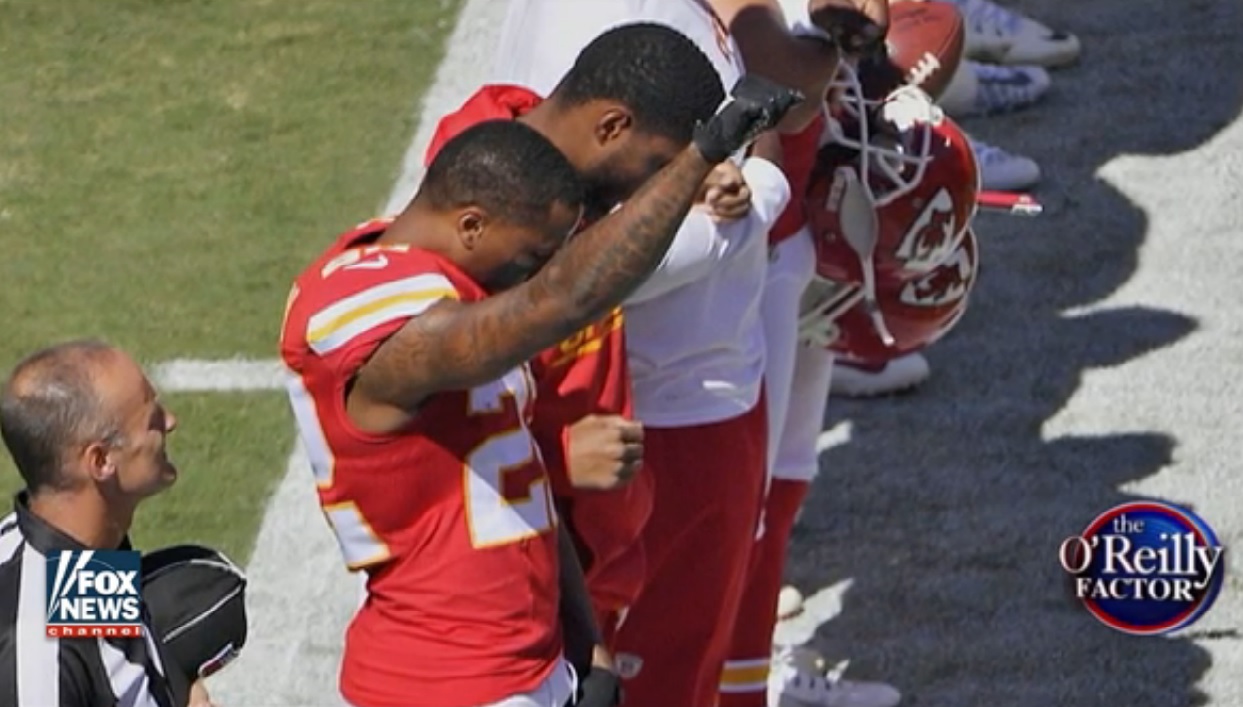
Marcus Peters raises fist in protest.
As I have watched the news reports and commentaries, I am reminded of the long history of protests against civil authorities and unjust practices in America.  Seeing Marcus Peters of the Kansas City Chiefs raise his fist during the National Anthem, on September 11, reminded me of how I felt upon seeing the raised fists of sprinters Tommie Smith and John Carlos in the 1968 Olympics as they stood on the blocks after receiving their medals.

American Olympians  vs. America, 1968
The headline-grabbing protests of recent years and my study of American history remind me that nonviolent protests have had a significant and positive role in drawing attention to injustices. The nonviolent protests led by the Rev. Martin Luther King, Jr. on behalf of minority rights transformed America in a positive way.  But
Dr. King's leadership as a Baptist minister of the Gospel was based on his commitment to the teachings of Jesus Christ, especially His fundamental command to love your neighbor as yourself (Matthew 19: 19) and when necessary, to turn the other cheek (Matthew 5: 39).  Dr. King’s focus on Christian love, character, and individual responsibility was an essential ingredient in the success of the civil rights movement.  

Although nonviolent protests have seldom been without at least some violence, several recent protests have boiled over into demonstrations of hate and mob rule.  For example, movements like Black Lives Matter claim that “Black lives matter” but fail to conduct themselves in a way that both respects all human life and property and presents a vision (e.g. Dr. King’s “dream”) for a better society.   Instead, there seems to be an unawareness or ignorance of the gains we have made in civil rights and racial reconciliation in America.  Protesters stir up social unrest by bringing up past injustices while interfering with the justice system by prejudging police actions. 

It is obvious that injustices exist in America.  But it is also true that many who make headlines through protest have been poorly educated in American history.  From elementary school upward, many of our children have been taught to view America through the lens of liberal progressivism.  The educational experience for many occurs within a constant stream of “news” provided by a liberal-dominated media that uses every opportunity to emphasize inequality.  Dissatisfaction among the poor and middle classes is fueled by the message that they have been mistreated by a system that favors the rich and dishonest.  While many press for “social justice” they ignore the fact that the disintegration of the American family hinders proper development of character which causes poor educational performance.   The result is a lack of competitiveness in the job market, resulting in unemployment, poverty, and proneness to join movements that foment protest.

Family breakdown and poor education impacts future generations.  Increasing numbers of poorly educated Americans become helpless pawns in a system that emphasizes groupthink instead of individual responsibility and accountability.  Instead of emphasizing human dignity, hope, and a pathway to achievement of joy and happiness as expressed in America’s founding documents, the liberal progressive message is, “See what you’re missing-- you’ve been cheated.  Look what you could have--just vote us into power.”

Janie Cheaney, in a WORLD article this month entitled, “Free and Equal,” writes,
Equality and inequality sound like complementary opposites, but they’re driven by non-complementary impulses.  Equality is about climbing up—a political principle written into our founding documents. It’s the theme when people feel empowered, or find empowerment within their grasp. Its primary emotion is hope.

Cheaney continues:
“I’m as good as you” backs up demands for equality: It may reveal a chip on the shoulder, but could also indicate a healthy desire to improve one’s condition. The complementary statement “You’re no better than me” hints at smoldering resentment. Inequality is about tearing down
.

Cheaney concludes that, Few if any political figures today are calling for more equality. Instead, they rail against inequality.  In the name of social justice they not only highlight contemporary inequality, but also condemn America because of the injustices she committed against minorities and the powerless throughout our history.   Social justice purveyors condemn the failures of the past based on current norms as if no moral gains have been made in respect to the rights of minorities.  Charles Krauthammer, conservative columnist, condemns this presentism, the practice of applying contemporary moral standards to actions committed in the past, and then posthumously condemning all who were involved.  For example, Colin Kaepernick’s protest has led some to condemn both Francis Scott Key and  our National Anthem, the lyrics of which he wrote, because Key was a slaveholder.


The events surrounding slavery and the Civil War represent a dark time in American history, and perhaps removal of all vestiges of the Confederate Flag is a respectful practice.  But as Shakespeare's Lady Macbeth learned, none of the attempts no matter how well meaning will purge away the “damn spot” represented in each sinful act of the past.   How then should America proceed in the midst of an era of media bias, misrepresentation of history, presentism, and collective guilt over past sins?

First, there is a great need for honest and accurate reporting by those responsible for conveying each day’s news and commentary.  And, we as watchers and listeners, and users of social media need to seek out all sides of the story.  We need to recognize the difference between news and commentary, and between objective journalists and political water boys or girls.


When we fail to get accurately reported news and perhaps are hampered by having only an elementary understanding of American history we end up like Colin Caepernick.  The 49ers quarterback and those who follow in his steps do not seem to have an accurate picture of either American history or of the current statistics on police actions toward young black men.  According to Charles Campisi, author of Blue on Blue: An Insider’s Story of Good Cops Catching Bad Cops, “In [New York City] a city of 8.4 million people…NYPD officers shot and killed 8 people in 2013—all males, all of whom were carrying guns or knives, 7 of whom had criminal histories….”  These statistics are not atypical of many of our cities.  Nor do they justify Kaepernick’s claim that police are oppressing black people and people of color…[while] …getting paid leave and getting away with murder.  People who wish to lead protests must have their facts straight—both from American history and from current events.


Second, we must recognize that no amount of group protest, collective condemnation of historical personalities and their unjust actions, or purging of our landscape and history books of names and symbols will atone for past sins.  There is only one way to account for past injustices.  That way requires that we recognize the Truth of the Christian Gospel (Good News) which does not deal primarily in group consensus or actions of either the past or present.  Our founding fathers understood that freedom and the pursuit of happiness can only flourish in a nation which recognizes that God is the Giver of opportunity.  Each individual is responsible for how he or she uses the opportunities God affords—i.e. exercises stewardship of the time, talents, and treasures entrusted to him or her.   The great commandments to love God with all of our being, and to love our neighbor as ourselves (Luke 10: 27) are the basis for a moral code.  The injustices throughout human history and up until our present day result when individuals fall short of these standards—i.e. what God calls sin.  How then should we respond?

The social justice approach is to point out injustices and then enlist followers into the business of correcting the injustice through protests, court actions, legislation, and coercion.  But social groups and governments do not sin.  Nor are these groups of well meaning individuals able to rid our nation of the “spots” left from past history or current injustice.  It is the individual who sins.  According to the Bible, no individual can make amends or atone for his or her own sins; or the sins of others.  In Psalm 49: 8-9 we read,

No man can by any means redeem his brother Or give to God a ransom for him--
For the redemption of his soul is costly, And he should cease trying forever--

Romans 3: 23 adds that all have sinned and fall short of the glory of God…  Romans 6: 23 explains how God, not mankind, has made provision for each sinner who recognizes his sin,  confesses, repents, and receives God’s Gift of atonement through faith in the death and resurrection of His Son, Jesus Christ:  The wages of sin is death, but the gift of God is eternal life through Jesus Christ our Lord.  Jesus Christ is the only Way to rid our souls of the “spots” of sin.  He said, …if the Son [Jesus] makes you free, you will be free indeed (John 8: 36).

Suppose we allow that Colin Kaepernick means well in protesting injustices of police toward black men.  Still, it doesn’t appear that he has either his present facts or past history correct.  Nor does he appear to realize that we are all plagued by sin, the tendency to rebel against God’s plan for true freedom and justice.  Furthermore, does Kaepernick know that each individual including himself needs a new heart through Christ’s atoning work on the cross.  God’s forgiveness and empowering through His Holy Spirit can help us put away the anger, resentment, envy, and a host of other sins that plague our souls.  The Apostle Paul admonishes Christians to live by this command:

Let all bitterness and wrath and anger and clamor and slander be put away from you, along with all malice. Be kind to one another, tender-hearted, forgiving each other, just as God in Christ also has forgiven you.

Only God can transform lives and set individuals free.  These individuals have opportunity and inspiration to love God and their neighbor and contribute toward building strong families, schools, communities, and civil government.   But if Americans continue to reject God’s justice and mercy, and refuse to own up to our individual responsibility for sin, we will continue to wander blindly about, biting and devouring one another.  On the other hand, if Americans realize that laws and their enforcers are for our good, and if punishment is justly given and received, then the guilty can be placed on a path to redemption, forgiveness, and freedom.

Although it is easy to point to the Kaepernick’s and other protesters of this world, I must first be sure that God’s justice and righteousness does its work in my own heart.  If you and I are  “born again” believers, this closing challenge is for us and for all who claim faith in Christ:

For it is time for judgment to begin with the household of God; and if it begins with us first, [then we may ask] what will be the outcome for those who do not obey the gospel of God? -- 1 Peter_4:17

Friday, January 29, 2016

World History Without HIS Story

It is estimated that approximately 93 percent of Europe’s Jewish children younger than age 16 were exterminated in the Holocaust orchestrated by Adolph Hitler’s Third Reich.  Approximately 1.5 million children of age 12 or younger were murdered in Nazi concentration camps.  Most Americans either cannot fathom the Jewish Holocaust or simply regard it as one more tragic historical event.  However, astute Americans have taken note that Holocaust history may be repeating itself, this time in the form of radical Islamic extremists who are waging genocide against Christians in Iraq and Syria, executing thousands and driving tens of thousands from their homes.   Could this be a case in which failure to learn a lesson from history dooms us to watch history being repeated?


John Koenigsberg, Jewish Holocaust survivor
According to a newspaper report in the Newark (Ohio) Advocate, John Koenigsberg considers himself one of the lucky Jewish boys who avoided death in the Jewish Holocaust during WW II.  John was graciously taken in by a loving Catholic family, the Snijckers, who provided him shelter from the Nazis during the war by welcoming him to their southern Holland home.  After the war, John was able to reunite with his mother, father, and aunt.  But 90 percent of his family had died in concentration camps.  He and his parents lived in Holland until his sophomore year of high school when they immigrated to the U.S. and settled in Cincinnati.  His business career led him to Central Ohio in 1972.

Now, as he nears 80, Mr. Koenigsberg lives in the Columbus, Ohio area and he has devoted his life to what he considers an important cause in addition to being a successful businessman.  He has made dozens of presentations to citizen groups over the years to remind the younger generations of the horrors of the Holocaust so that it will serve as a lesson from history not to be repeated.

In May, 2015, Abby and I were invited by her sister, Mary, to attend one of John Koenigsberg’s presentations.  This one was held in the New Philadelphia, Ohio Library. 

Mr. Koenigsberg began his presentation with a statement of his testimony and purpose. “I am very fortunate to be here,” he said. “I believe the lessons of the Holocaust must not be diminished to just a footnote in history.”

Koenigsberg proceeded to deliver a very stirring and interesting presentation of his experience of being spared the unspeakable horror of falling into the hands of the Nazis.  His passion for telling his story, complete with visual aids and Holocaust memorabilia, made it seem as though it had just happened.  The account also provided a striking contrast between unspeakable evil on the one hand, and the overflowing love and generosity that provided John with a safe and loving haven in the Snijckers’ home.

During the Q and A session at the end of the presentation, I thanked Mr. Koenigsberg for his commitment to teach the realities of the Holocaust.  I also allowed that it must have been a very difficult experience for this gracious Holocaust survivor to reconcile the trauma of this chapter of his life with his maturing outlook in the post-war years.  Then, I asked if he had come to an explanation for how humankind is at once capable of such atrocities and yet, such kindness?"  Mr. Koenigsberg paused and looked at me as if he were slowly gathering his thoughts.  Then, he said, “I wish I knew.”

My reaction to Mr. Koenigsberg’s inability to answer my question was one of disappointment but not surprise.  He had not mentioned God or religious faith specifically in his presentation, although the evidence of God’s providence was written all over the story, particularly in the unselfish risk his protectors took to conceal him.  Furthermore, I had to allow for the possibility that he had simply chosen not emphasize God and religion.  Yet, it seems clear to me that unless Mr. Koenigsberg presents at least some explanation of the origin of good and evil that spawns many bloody chapters in human history, his presentation will have missed its mark.

Several days later, I was able to communicate again with John Koenigsberg by phone.  Perhaps in a more private conversation he would answer my question about the existence of good and evil in humanity.  I greeted him, thanked him again for his presentation, and then repeated my question.  His answer was the same.  I thanked him for taking my call and we said, “Good-bye.” A few days later, I wrote a lengthy e-mail to Mr. Koenigsberg explaining as best I could my understanding of the origin of good and evil in mankind, but did not receive a reply.

During the months that followed, I mentally replayed the experience of Mr. Koenigsberg’s Holocaust presentation and his inability to account for the good and bad in human beings.  I debated whether it would be appropriate to publicly share my encounter with Mr. Koenigsberg.  After all, who was I to question this man who had lived through such a horrendous chapter of world history?  How would I have processed this experience myself?  Would I have had the same passion to share my story with the aim of making a difference in the lives of others? 

An entrance to the crematoria at Auschwitz, Germany
Regardless of Mr. Koenigsberg’s reasons for not offering an explanation for the evil represented in the Holocaust, I do not want to be critical of this dear man or minimize the significance of his experience and his passionate attempt to retell the history of the Holocaust.  However, I now believe it is appropriate to present a valid basis for why such horrors occur and recur throughout human history.   In fact, I hope readers will see this article as contributing at least a bit to Koenigsberg’s cause.

Two worldviews vie for human acceptance and each offers a lens through which to view the world.  Each of us holds to one or the other of these two worldviews that determines our understanding of reality and the human condition.  One of these worldviews denies that reality exists outside of the realm of matter-energy and random chance events.  In this naturalistic worldview, there is no supernatural reality and no God; nor is there any purpose or any objective foundation upon which to base law and justice.

The other worldview allows that reality includes not only the realm of energy-matter and time but also the existence of a Supreme Being, a personal God Who created and sustains the realm of energy-matter.  This God has revealed and continues to reveal knowable Truth through divine revelation and through the “natural” order and operation of His creation. 

Throughout history, all human cultures have demonstrated an ability to honor God and give thanks (Romans 1: 20-21) or at least to acknowledge the existence of some “higher being” or beings in their definition of reality.  The Judeo-Christian Scriptures of the Bible, regarded as divinely inspired revelation, teach that God specially and uniquely created the first man and woman in His image with “personality” and the ability to worship, exercise rational thought and behavior, and do meaningful work as part of the dominion-stewardship mandate (Genesis 1: 26-28; 2: 15). 

But the first man and woman rebelled (sinned) against God’s command not to eat of the Tree of the Knowledge of Good and Evil (Genesis 3). Instead, they chose to believe that God had withheld knowledge and better things from them.  So, they ate the forbidden fruit in pursuit of the better things, being the first humans to worship at the altar of human reason.  But their sin separated them from God. “Professing to be wise, they became fools (Romans 1: 22).” The rest of the account in Romans 1 explains how the seeds from the fruit of human rebellion by fallen mankind and their descendents have sprouted and produced a harvest of more fruit that permeates our culture today:

…being filled with all unrighteousness, wickedness, greed, evil; full of envy, murder, strife, deceit, malice; they are gossips, slanderers, haters of God, insolent, arrogant, boastful, inventors of evil, disobedient to parents, without understanding, untrustworthy, unloving, unmerciful… (Rom. 1: 29-31).

Francis Schaeffer in his “The Abolition of Truth and Morality” (From: A Christian Manifesto, 1980, Crossway Books) explains the inevitability of different outcomes (“fruit”) of these two different worldviews, the Judeo-Christian worldview and the impersonal, matter-energy, random chance worldview (emphasis mine):

It is not that these two world views are different only in how they understand the nature of reality and existence. They also inevitably produce totally different results. The operative word here is inevitably. It is not just that they happen to bring forth different results, but it is absolutely inevitable that they will bring forth different results.

Schaeffer points out that Christians have tended to view the implications of their faith in pieces rather than realizing that “Christianity is Truth—Truth about all of reality.”  God’s Truth should transform individual lives but also impact the moral and ethical standards in every area of culture—science, education, the arts, government, etc.  Christians and others who have not developed a comprehensive worldview will not connect the dots among a host of social upheavals like the sexual revolution, the undermining of biblical marriage, the breakdown of the family, and the disregard for law and order.  All of these and more are inevitable results of the disregard for the Truth claims of Christianity by both the church and the secular world.   And, these social changes have contributed to an even larger “holocaust” than the Jewish Holocaust; namely, the “abortion holocaust” that is responsible for nearly 60 million abortions since Roe v. Wade, in 1973. 

Returning to Mr. Koenigsberg, we can now see that he is not unique in his apparent inability to connect the pieces.  Like so many, he apparently mistakenly views the Jewish Holocaust as a separate piece and not one of many consequences of the evil that can result from rejection of Judeo-Christian Truth claims in favor of a worldview of material-energy and chance.  But how exactly does this emergence of evil occur?

As Schaeffer predicted, there is an ensuing inevitability that follows rejection of the Christian worldview in favor of the material-energy and chance worldview which lacks any objective basis for ethical and moral guidelines.  Humans are devalued and relegated to the level of animal populations in competition according to the Darwinian theory of survival of the fittest.  Without objective truth, survival belongs to those who weld enough power to survive.  For example, Darwinian evolution provided the basis for Nazi Germany’s eugenics experiment involving the Holocaust to deliberately exterminate Jews and favor the Aryan race.  Likewise, without respect for moral values such as the sanctity of human life, the rights of the mother over her unborn child are used to justify abortion.   Legal definition of marriage, religious freedom, right to bear arms, and many more legal protections are all under assault because the U.S. Constitution is no longer viewed in objective terms.  After all, a worldview that rejects the ultimate reality, God, does not recognize “inalienable rights” that come from above.

Holocaust survivor prays at 71st Anniversary of liberation.
This week, dozens of Holocaust survivors lit candles commemorating the 71st anniversary of the closing of the death camps at Auschwitz.  Certainly, news reports of this commemoration as well as the presentations by survivors like John Koenigsberg ought to remind us of this horrible chapter in human history.  Yet, if you consider my logic in the previous paragraph, doesn’t it seem that the lessons of history are being lost on many in America and the Western World today?  Again, I believe Francis Schaeffer offers the answers to how then we as Christians ought to think and live today. 

First, we must recognize that God’s Truth is powerful and comprehensive enough to address all of reality.  The Gospel of Jesus Christ can not only transform our individual lives in Christ, but also they empower the outworking of our servant stewardship as Christian ambassadors to transform culture.  Second, Schaeffer reminds us, as it were, to present [ourselves] approved unto God as a workman who [do] not need to be ashamed, accurately handling the word of truth (2 Timothy 2: 15).  In so doing, we can see the current culture through a robust Christian worldview and accurately assess the causes and effects of when Scriptural truth is or is not represented in the marketplace of ideas.  

Third, Schaeffer challenges Americans to realize how unique our democratic republic is in all of world history.  The United States, Canada, and a few other nations of the West are unique in having achieved a form-freedom balance in government—that is, a balance that acknowledges the obligations of the individual to society while also protecting the rights of the individual.  It is this form-freedom balance that characterizes our constitutional system of government that enables America to withstand mass demonstrations, even recent, violent ones such as that in Ferguson and in Baltimore, provided our law enforcement and judicial system function as intended.  Without this form-freedom balance, American governance would wobble back and forth between anarchy and tyranny like an airplane without a stabilizing gyroscope.  

John Witherspoon (seated 2nd from right, facing table)
among signers of the Declaration of Independence (1776)
What we must recognize, according to Schaeffer, is that America’s democratic republic came about by an historical progression heavily influenced by men who stood in the stream of the Judeo-Christian worldview.  These included British judge Henry de Bracton (1210-1268), Scottish Presbyterian pastor Samuel Rutherford (1600-1661), Presbyterian minister and president of what is now Princeton University, John Witherspoon (1723-1794).  In 1644, Rutherford’s Lex Rex gave the bold assertion that “law is king” which stood against the tide of history marked by rex lex (“king is law”).   Lex Rex opened the door wider to what became our constitutional heritage of “rule of law.”  In our system of government, “the king” was transformed into “the president” who is supposed to serve America as an executive, who like any citizen is subject to the law. 

Yet, the form-freedom balance also respects the rights of each individual living under the law.  Each possesses “certain inalienable rights”—rights from above, not rights that the state can take away, but rights granted because the constitutional framers believed there is Someone there—the God Who is full of justice and mercy.  British judge Henry de Bracton, centuries before America’s founding pointed out that God has ultimate power to crush wrongdoers, but the true mercy of God chose this most powerful way to destroy the devil’s work, He would not use the power of force but the reason of justice.”  Schaeffer explains, “…Christ died that justice, rooted in what God is, would be the solution.”  Henry de Bracton’s emphasis on the authority of Scripture was influential in the Reformation three centuries later.

Jewish children and mothers walking to the gas chambers.
Is it possible to feel the heat from the pit of Hell amid the darkened world of the Jewish Holocaust and yet not be able to account for how that evil originates and causes men to do what they do?   The answer is “yes.”  And apparently there are multitudes today including John Koenigsberg in that camp.  Indeed, today, thanks to the materialist, time-chance worldview and its liberal, humanist following, we are led to believe that truth is relative, laws should be enforced subjectively, the U.S. Constitution should evolve, and there is no such thing as “evil.” 

History without HIStory of perfect creation, fall of mankind, and Christ’s death to redeem fallen man is leaving our culture helpless and adrift.  Adrift without  moral clarity in the face of the evil and lawlessness being manifested in events like the “Christian Holocaust” in the Middle East today, mass murder in San Bernardino,  and riots in Ferguson and Baltimore.  The old saying, “Those who fail to learn from history are doomed to repeat it” should better be stated, “Those who fail to study history that includes HIStory are doomed to repeat it.”

We thank John Koenigsberg and others for standing against those who would deny the Jewish Holocaust and even dismiss “evil.”  Today, more than ever, we need to be reminded of past atrocities under Lenin, Hitler, and Pol Pot.  And, let’s also pray for those who are enduring hardship today for their faith living under totalitarian governments like Iran, Syria, and the ISIS Caliphate.  Finally, we ought also to pray  for the multitudes around the world in whose case the god of this world has blinded the minds of the unbelieving so that they might not see the light of the Gospel of the glory of Christ, who is the image of God (2 Corinthians 4: 4). 

Dedication and special thanks to my sister-in-law, Mary Johnson, Dennison, Ohio.

Your Comments Welcomed:  And I’d like to hear your thoughts particularly on one or more of the following:
1.   In his A Christian Manifesto, written 36 years ago, Schaeffer noted, “The humanists push for ‘freedom,’ but having no Christian consensus to contain it, that ‘freedom’ leads to chaos or to slavery under the state (or under an elite).”  What indications if any do you see that Schaeffer’s scenario is becoming reality once again America?
2.  According to A Christian Manifesto, a culture must have a Judeo-Christian worldview in order to successfully establish a form-freedom balance of government so rare in world history.  Is there support for this claim in the difficulty the United States has had in establishing democracy in Iraq from the top down?
3.  Does the message of this article, and particularly, the message of A Christian Manifesto, serve to warn those who, in the name of compassion, would support the alteration or bending of U.S. constitutional law so as to aid the oppressed—e.g. illegal immigrants, unwed pregnant women, those who cannot earn an income above poverty level, or those who “are offended” when they encounter Christian truth claims or symbols?

Friday, November 9, 2012

Post-Election -- Guarded Optimism


Regardless of whether your pick for president won or lost, you are likely in camp with many Americans who are experiencing a “post-election hangover.”   I decided to wait at least 24 hours before ‘penning’ any thoughts.  Meanwhile, I’ve been thinking a lot, reading, and watching news reports and commentaries.

President Barack Obama celebrates election victory 2012
Whether you are discouraged by the Romney-Ryan loss, or by the current downturn in the stock market and looming “fiscal cliff”, here are some reasons for optimism.  I am…

·         Thankful that we have been allowed the freedom to vote for a clear choice representing two very different paths, and I hope that those who have placed their trust in an even larger government will not be undone by the consequences.

·         Thankful for candidate Romney who was acknowledged by many mature adults on both sides to be a decent and honest man who was reluctant to “toot his own horn,” almost to a fault; in spite of how he was misrepresented during the campaign.

·         Looking with hope and expectation that President Obama and the legislative branch will work together to use the “check and balance system” of our representative government to do its work.  If not, then hopefully our legislators will remember the 2010 election as they face 2014.

·         Thankful for the “laboratories” of sound fiscal management that exist in states like Wisconsin, Indiana, Ohio, and New Jersey which should provide clues to the Obama Administration as they begin to provide leadership to Congress in efforts to address our fiscal crisis.

Greek protest against government austerity
·         Hoping that the negative examples of California and other states along with European nations like Greece will be a heeded challenge that America must curb her growing debt and stop excessive governmental intrusion and  provision of “free stuff” that we can no longer afford.

·         Opportunity for conservatives to reassess how to clarify and convey the message of how social and fiscal conservatism has been and still is the essential hope for Americans who which live free politically and spiritually.

·         Hopeful that when the tension and frustration of the campaign season (or years?) finally ends, the disagreements can morph into honest dialog from all sides with respect to issues including the following

o   Revival of spirit in America that recognizes the moral foundation of objective truth that must be nurtured if we are to reaffirm what President Obama said in his recent victory speech when he praised the spirit that has triumphed over war and depression, the spirit that has lifted this country from the depths of despair to the great heights of hope, the belief that while each of us will pursue our own individual dreams, we are an American family and we rise or fall together as one nation and as one people.  [More on this in another blog entry.]
o   Religious freedom that supports individual moral convictions and polite expression in the workplace, the media, the academy, and in the marketplace of ideas
o   Policies for health care and welfare that balance “social justice” with individual responsibility and accountability
o   Funding for adequate national defense and other government programs that is balanced with commitment to eradication of waste and duplication
o   Stewardship of natural resources that balances the needs of humankind with wise conservation.  This stewardship should define “resources” as not only “finite reserves in the ground” but also “useful and renewable products of creative technology” yet to be developed in an entrepreneur-friendly economy.
o   Economic policies that promote small businesses and entrepreneurship with recognition that simply “taxing the rich” will not support a ballooning federal bureaucracy an more than simply raiding the henhouse while failing to “feed the hens.”
o   Recognizing that our educational system is increasingly bankrupt pedagogically and morally as shown by our declining rank among civilized nations in the world.

Finally, I am hopeful because of the following post-election e-mail from my son-in-law, Pastor Steve Salyers, who is part of the next generation in our family: 

Hey John, this is the day that the Lord has made, let us rejoice and be glad in It (Psalm 118: 24).

I was reminded this morning as I opened the Word that regardless of who’s in the White House this solemn instruction (warning) stands as the Church's 'street-corner' message to the government leaders of this country: 

Now therefore, O kings, show discernment;
Take warning, O judges of the earth.
 Worship the LORD with reverence And rejoice with trembling.
 Do homage to the Son, that He not become angry,
and you perish in the way, For His wrath may soon be kindled.
How blessed are all who take refuge in Him!   --
Psalm 2: 10-12  

However, more than living as prophets to the governmental leaders, the church stands as peacemaker as we're called to prayer and intercession: 

 [Instructions on Worship] I urge, then, first of all, that requests, prayers, intercession and thanksgiving be made for everyone— for kings and all those in authority, that we may live peaceful and quiet lives in all godliness and holiness.  -- 1 Timothy 2:1-2

NationalMonument to the Forefathers
Be at peace, for He is the God of the ages and our times are close to His heart!  I choose to pray along with the saints of Revelation, How long, O God...?  Even so, Lord Jesus, come!

Blessings,  Steve

In closing, the challenge remains for us, as implied in Steve’s reference to I Tim. 2, to take up our responsibility to pray for our leaders, to hold them accountable, and to be intentional and polite “witnesses” to a lifestyle that affirms the value of marriage, family, sanctity of life, love for ethnic diversity, generosity, etc.  Christianity in the USA and world will become even more secularized and marginalized if we don't deliberately look for opportunities from the pulpit and the pew to be intentional about our valuing of these things in word and in action.  We should welcome the day of Christ's return in balance with an awareness of the great compassion Jesus has for the lost, not being willing that any should perish.  And how will they see and hear without our profession of the Gospel both in lifestyle and in words fitly spoken.

Today, I hope you are hopeful!