Showing posts with label evil. Show all posts

Monday, October 2, 2017

“Pure Evil” Requires Moral Absolutes

This morning, we awakened to the news of a horrific massacre in Las Vegas. A presumed lone gunman, Stephen Paddock, had rained deadly bullets from a room high in the Mandalay Bay hotel.  At this time, we know that 59 attendees at a country music concert have died and hundreds have been wounded.

Las Vegas massacre brought compassion in the face of "evil."
We watched as President Trump spoke to the nation, calling the massacre “an act of pure evil.” He followed with an assurance based on Psalm 34:18, saying “Scripture teaches us the Lord is close to the brokenhearted and saves those who are crushed in spirit.  We seek comfort in those words, for we know that God lives in the hearts of those who grieve.”

To these obvious references to moral teachings of the Bible, the president added that, “In times such as these I know we are searching for some kind of meaning in the chaos, some kind of light in the darkness.”  Then, President Trump tried to assure a stunned America by saying, “The answers do not come easy. But we can take solace knowing that even the darkest space can be brightened by a single light, and even the most terrible despair can be illuminated by a single ray of hope.”

President Trump’s message was an effective encouragement this morning.  We were also encouraged to watch the reports of heroic efforts on the part of first responders and even average Americans who sprang into action to provide assistance to the wounded and dying.  Yet, horrific events like this one in Las Vegas are becoming all too common.  And each time, we see our leaders and law enforcement officials rise to the occasion to pronounce the acts as “evil” and “morally reprehensible.”  Yet, most do not attempt to answer the deeper question, “WHY do these things occur?”

Dr. Albert Mohler, president of the Southern Baptist Theological Seminary in Louisville, KY called today for a more reasoned explanation for the existence of “pure evil.” I will refer you to his well written blog article, “An Act of Pure Evil”--Searching for Meaning in Las Vegas, and conclude my article with excerpts from his article.  Mohler asks, “Why do we ask why?” and continues as follows:

We cannot help but ask why because, made in God’s image, we are moral creatures who cannot grasp or understand the world around us without moral categories. We are moral creatures inhabiting a moral universe and our moral sense of meaning is the faculty most perplexed when overwhelmed by horror and grief.

Dr. Mohler commended President Trump for classifying the massacre as “evil” and for directing us to consider the moral basis for the hope of finding solace in God’s sovereign purposes.  Mohler then went deeper to address the necessity of defining the moral absolutes necessary to define and explain the existence of “evil:”

Evil is a fact, too. And evil is a theological category. The secular worldview cannot use the word with coherence or sense. The acknowledgement of evil requires the affirmation of a moral judgment and a moral reality above human judgment. If we are just accidental beings in an accidental universe, nothing can really be evil. Evil points to a necessary moral judgment made by a moral authority greater than we are — a transcendent and supernatural moral authority: God.

College professors tell us that moral relativism has produced a generation of Americans who resist calling anything evil, and even deny the existence or moral facts. Justin P. McBrayer, who teaches at Fort Lewis College in Colorado, wrote in The New York Times that “many college-aged students don’t believe in moral facts.”

That’s truly frightening, but McBrayer argues that by the time students arrive at college, they have already been told over and over again that there are no moral facts — that nothing is objectively right or wrong.

Only the Christian worldview, based in the Bible, can explain why moral facts exist, and how we can know them. Only the biblical worldview explains why sinful humanity commits such horrible moral wrongs. The Christian worldview also promises that God will bring about a final act of moral judgment that will be the final word on right and wrong — as facts, not merely speculation. The Gospel of Christ points us to the only way of rescue from the fact of our own evil and guilt.

Our hearts break for the families and communities now grieving, and we pray for them and for those even now fighting for life.

It is both telling and reassuring that secular people, faced with moral horror as we see now in Las Vegas, can still speak of evil as a moral fact — even if they continue to deny moral facts in the classrooms and courtrooms. No one can deny that the horror in Las Vegas came about by an act that was evil, pure evil, and evil as a fact.


Dr. Mohler concludes his article with a quote from Isaiah 5: 20, ESV, the same passage of Scripture that I referenced in my September 21 article in which I discussed Lessons for America from the 1950’s?

Woe to those who call evil good and good evil, who put darkness for light, and light for darkness, who put bitter for sweet and sweet for bitter.” [Isaiah 5:20, ESV]

Thursday, June 30, 2016

When an Atheist Longs for a “Higher Love”


Atheists reason, and some profess, that God and other deities do not exist.  Maybe I’m wrong, but I have a hunch that many self-proclaimed atheists remember being offended and perhaps deeply hurt by one or more well meaning persons of faith.  Some Christians may act toward unbelievers out of ignorance, others out of arrogance, and yet others out of a sincere but carnal desire to “win” a God-denier to faith in order to claim the atheist as a trophy of a hard-to-win pagan.  By the way, I have probably already unintentionally offended at least some atheistic readers who argue that their belief is based on sound logic, not emotional scars.  No offense intended as you will hopefully see by reading on.

The Bible teaches that those who deny God are on the road to eternal judgment (John 3: 16; Romans 3: 10,23; 6: 23).   God does not “clear the guilty” (Numbers 14: 18) just because they can point to a Christian who offended them sometime in their life.  Yet, it ought to be true that every sinner saved by God’s grace is constrained by Calvary’s love and desirous of sharing the Gospel of God’s love with unbelievers—and, in a way that is not disrespectful (2 Corinthians 5: 14-15; 1 Peter 3: 15).

I cannot deny that there has been selfishness in my motivation to communicate with atheists in recent years.  Therefore, it has been good medicine for me to read The Faith of Christopher Hitchens (Nelson, 2016).  I discovered this title in a book review by Benjamin Wiker, Senior Fellow at the Veritas Center for Ethics and Public Life, Franciscan University.   The book’s author, Larry Taunton, director of Fixed Point Foundation, refers to Hitchens in his subtitle as “the World’s Most Notorious Atheist.”  I was immediately intrigued upon learning that Taunton is an evangelical Christian who writes from his experience as a close friend of Hitchens between 2007 and 2011 when Hitchens died of cancer.

Readers of The Faith of Christopher Hitchens are humbly and respectfully introduced to the man whom reviewer Benjamin Wiker describes as “a real, lovable, cantankerous, flawed, hilarious, foolish, brilliant, sinful, and multi-faceted human being.”  But more fascinating and valuable is the way in which an evangelical Christian, Larry Taunton, respectfully and lovingly earns the right to become a friend of Hitchens.  Though reluctant to publish many aspects of their unusual friendship, Taunton finally agrees with a publisher that he should write the book.  What resulted is a captivating narrative that recounts the tumultuous boyhood of Christopher Hitchens in England during the 1950’s, his rejection of the notion of God as a teen, and his development of a separate public and private “set of books” that governed his thinking, communication, and behavior in his adult life.  As Taunton explains, the growing chasm between the public and the private Christopher Hitchens is a key to understanding how an atheist could drastically change his allegiance from the Left to the Right following the 9/11 attack on America, and eventually gain new respect and friendships with evangelical Christians.

Christopher Hitchens and brother, Peter Hitchens
As further incentive for you to read The Faith of Christopher Hitchens, I will provide a list of questions the book has caused me to ask, each one dealing with a facet of the larger question, What can I as an evangelical Christian learn from Larry Taunton about building a friendship of mutual trust and respect with those who have a different view than I of the natural world and beyond (if they acknowledge such?  Hopefully, this article will motivate you to read The Faith of Christopher Hitchens.  And better yet, maybe some of my questions will promote  a more in-depth reflection and discussion.  If so, I’d love to read comments posted to me from the link below.

1.   Am I cultivating friendships with people who deny the existence of God, or reject His claim on their lives?  If so, how well am I representing the love of Christ to them?

2.   Hitchens’ favorite song was Steve Winwood’s, “Higher Love.”  He admitted to Larry Taunton’s son, Michael, “I do long for a higher love (p. 4).”  With all humility, do I recognize that within the heart of every man and woman is the need to experience God’s redemptive love, and that God might use me in some way as an important channel of His love?

3.   What can I learn from the accounts of the boarding school experience of two English boys—one, Christopher Hitchens who found in its harsh and often unreasonable discipline what became for him “metaphors for rejection of God and church;” the other, C.S. Lewis, who found an equally harsh experience what became for him “a metaphor for how faith, patience, and anticipation is built into life.” (p. 12-13)

4.   How many pre-adolescent and adolescent children today experience a roadblock to conversion to faith in God, often resulting in a hatred of God and Christianity, because of a failure of parents and teachers to help them acquire a truly Christian view of God’s gift of   sexuality?  
Michelangelo's "The Awakening Slave"

5.  Is each human being “self-made” as illustrated in Michelangelo’s The Awakening Slave, pictured 
as a man writhing to get free of the marble block restraining him?  Hitchens denied that his father’s lack of faith had anything to do with his own becoming an atheist; instead, seeing himself as a “self-made man” who came to atheism purely out of rational means.  But, Hitchens’ father had two sons, both “Bible-burning atheists and communists.”  The fact that God works in the affairs of fathers and sons is evidenced by what eventually happened--one of the sons becomes a Christian (p. 48)!

6.   Is it possible that many atheists do not embrace atheism so much because it is logical and intellectually fulfilling as because it allows them the opportunity to legitimize their rejection of moral claims upon the lifestyle they choose?


7.   Hitchens embraced atheism because it allowed him to square the public and private “sets of books” that he kept.  And, he chose words as his weapons to defend his position, “rather than loving words insofar as they lead to truth (p. 22-23).”  Do I fall into the same trap when I give priority to eloquence and scholarship over pursuit of truth, understanding, and respectful discourse with those who do not share my beliefs?

8.   For Hitchens the atheist, the logical political allegiance was to socialism which is antithetical to Christianity.  As Dostoevsky wrote, “Socialism is not merely the labor question, it is before all things the atheistic question….”  Do we realize why socialism today is increasingly popular in spite of its dismal history of economic failure and the deaths of millions of people?  Socialism is increasingly popular because many are deceived into believing that “our generation” will avoid the “Stalinist perversion of an otherwise perfect system” and will “get it right” in the attempt to “set up heaven on earth?” (p. 24)

9.   Do some atheists see Christian attempts to relate to them as trophy-hunting expeditions?  Taunton suggests that Hitchens often found the efforts of Christians who sought to “convert” him as intellectually stimulating and entertaining.  But, he also loathingly considered other professing Christians like Rev. Al Sharpton as “intellectual frauds” when he learned that they held little or no allegiance to the authority of the Bible.  Read how Hitchens exemplifies a God-denier or God-hater who warms to some conservative evangelicals who displayed intellectual competence integrated with warmth and respect.

10.  What happens when an atheist like Christopher Hitchens is confronted with a horrific event like 9/11?  Hitchens could not help but judge the terrorist act as “simply evil” and not, as liberal progressives often claim, the result of some outside injustice--economic, social, political, or cultural?  If instead, murderous acts originate by “human free will” out of an evil heart, it becomes “freely chosen evil.” It follows that our whole “human family” is morally corrupt and in need of an outside Deliverer—the God an atheist claims does not exist!  Read how Hitchens came to see the contradiction.  Psalm 49: 7-9:  No man can by any means redeem his brother, or give to God a ransom for him-- For the redemption of his soul is costly, and he should cease trying forever--that he should live on eternally, that he should not undergo decay.
Christopher Hitchens (1949-2011)

11.  How did the gradual warming of Christopher Hitchens toward Christianity come about by a Gospel witness grounded in the authority of Scripture as the sole arbiter of what defines Christianity, and not (as Hitchens often encountered) personal testimonials and human opinions?   How many times does my witness for Christ become diluted by too much emphasis on “my experience” as opposed to presenting the objective claims of the Gospel message?

12.  How did Larry Taunton, upon first meeting Hitchens, in 2007, avoid getting stuck in a “cart-before-the-horse” misunderstanding over how their lifestyles differed (e.g. smoking, drinking), allowing Taunton to say, from almost the beginning, “I knew I liked him…our rapport was immediate (p. 96).”

13.  How does a Christian friend of an atheist locate the moral limits (if any) beyond which the atheist will not go?  For example, was Hitchens’ atheism consistent enough (as was Peter Singer’s atheism) that he was comfortable with the Godless conclusion that there is no moral basis for treating human babies any differently than piglets or peeps?

14.  How did the adoption of a Russian girl, Sasha, by Larry and Lauri Taunton; and, Sasha’s vibrant Christian testimony to Christopher provide him with a glimpse of the “higher love” which he longed (see #? Above)?  Therefore the LORD longs to be gracious to you, and therefore He waits on high to have compassion on you. For the LORD is a God of justice; How blessed are all those who long for Him (Isaiah 30:18 ).

15.  Finally, does an increasingly warm and tender friendship of mutual trust and respect between an evangelical Christian and a professing atheist lead the latter to bow his knees at the altar of repentance and faith in God, and to take hold of that “higher love” he had longed to find?  You’ll have to read The Faith of Christopher Hitchens, but please don’t start with the last chapter.

Saturday, July 4, 2015

Censoring Vocabulary, But Not Virtue

During my boyhood years in the mid-20th century, I quickly learned that the English vocabulary could be sorted into two major groups -- “acceptable words” and “bad words.”  I encountered an unending stream of acceptable words on spelling lists, and I received many positive incentives to use them in polite conversation. I am now thankful for both the spelling lessons and the positive incentives.

I was also allured into using certain “bad words” that were expressed by unseemly characters who apparently felt bigger or more masculine when they spewed them out.  Fortunately, the positive examples and high expectations of men and women of godly character in my life won out over the more limited influence of “bad characters.”

Since the days of my boyhood, we have witnessed a major change in the realm of acceptable and unacceptable words.  For example, the code phrase for “sex” during my adolescence was “the birds and the bees.”  Although in retrospect, it would have been helpful to have had more instruction on sexuality as an adolescent; today we are exposed to a broad vocabulary complete with visual “aids” on the subject of sexuality including all manner of sexual perversions and classifications.  One would think that there are no longer any “bad words.”  But that is not true.  Instead we have a whole new class of “bad words” that represent the forbidden vocabulary in secular American culture.

Dylann Roof
Today, when anyone uses a “new bad word,” our secular culture is at least twice as perturbed as our mothers and grandmothers were when we let “bad words” slip out as adolescents.  Witness the current media discussion of what would lead Dylann Roof to burst into a South Carolina church and murder nine people meeting together for a Bible study.  “Acceptable words” in the current discussion of causation include gun access, drugs, video games, racism, negative talk radio, and Fox News.  These words have become code words for political agendas including the passage of gun control legislation, increased role of the federal government in local law enforcement, retaining support of minority voters, and the censorship of conservative media.  Taking the politics of gun control, for example, in an earlier article, No Gun Control Without Self-Control (March 30, 2013), I posited that violent crime is not simply a result of access to firearms.  Rather,
Whatever "weapon" Cain used, murder started in his heart.
"Our protection from both tongue and gun is rooted not in civil law but in the moral code.    The moral law is grounded in Jesus’ teaching that it is out of the heart [that] come evil     thoughts, murders, adulteries, fornications, thefts, false witness, slanders (Matthew 15:19).  Therefore, the answer to a safe and civil society is not found alone in “tighter controls” on guns and speech.  Instead, there must be a revival within institutions that nurture a godly disposition of the heart; namely, the family and the local church, both within the context of caring communities."

Many who reject “band-aid approaches” to reducing gun violence may wish not to hear the vocabulary of this argument-- “new bad words” like moral, evil, revival, heart, self-control, and church.  Add the words, sin and forgiveness, and the liberal media often turns a deaf ear or cries “foul!”  In fact, the word evil was already headed for “bad” in the 1980’s when President Reagan called the Soviet Union an “evil empire.”  Today, liberal progressive culture includes sin in the vocabulary of “hate speech.”

But occasionally, liberal media and the progressive culture are caught off guard as for example, at the events on June 17, in Charleston, SC.  On that Wednesday night, Dylann Roof, a 21-year-old allegedly entered Emanuel African Methodist Episcopal Church, attended a Bible Study for an hour, and then opened fire on those who had welcomed him.  Even before all the gruesome details were reported, the mantra began—the sour lamenting of “white-on-black” crime with all the expected vocabulary--
gun access, racism, negative talk radio, and the Confederate flag permeating the airwaves.  President Obama challenged the nation to confront the “terrible toll of gun violence.”

The AME church in Charleston, SC has had a long and troubled history beginning before the Civil War.  In the 1820’s, it survived its building being burned.  After the Civil War and during the Jim Crow era of racial segregation, AME church members worshipped in secret because all-black churches were outlawed.  But the June 17 shooting was not just another violent event in a region having a long history of racial unrest.  This time the media was faced with reporting a different message, complete with a vocabulary of “new bad words” like mercy, forgiveness, and enduring love.  Yes, in Charleston, SC, under the Confederate flag, and near historic Sullivan’s Island, the location where nearly half of the enslaved African people were brought ashore and auctioned to slave owners, came an eruption of an entirely different sort.

According to the
Washington Post, “There was no yelling. There were no accusations. Instead, people who had lost the loves of their lives blessed the accused murderer.” Felicia Sanders, a hair stylist whose son Tywanza was allegedly killed by Roof, expressed this unexpected tone with a different vocabulary.  As we stared at Roof’s face filling much of our TV screens, she spoke directly to Dylann saying,

Tywanza Sanders
We welcomed you Wednesday night in our Bible study with welcome arms.  You have killed some of the most beautifulest people that I know.  Every fiber in my body hurts, and I’ll never be the same. . . . But as we say in Bible study, ‘We enjoyed you, but may God have mercy on you.’ “Tywanza Sanders was my son. But Tywanza Sanders was my hero. Tywanza was my hero,’’ she said, her voice trembling. “May God have mercy on you.”

The vocabulary of love, mercy, and forgiveness of Christians is seldom applauded in our secular culture. However, the words of the Charleston believers were powerful because their virtuous behavior affirmed their words sacrificial love, mercy, and forgiveness to Dylann Roof.  The same open arms that welcomed young Dylann Roof before he unleashed his violent hatred were now open to him in Christian forgiveness and in prayers for God’s mercy upon him.


From where does this kind of strength and forgiveness come?   The prophet Isaiah uses the word strength over twenty times.  His words may resonate with the hearts of many black Americans, and all of us who are weary because of the curse of sin and its manifestations—selfishness, pride, divisiveness, anger, and violence.

You were tired out by the length of your road,
Yet you did not say, 'It is hopeless.'
You found renewed strength,
Therefore you did not faint.
– Isaiah 57: 10

Yet those who wait for the LORD Will gain new strength;
They will mount up with wings like eagles,
They will run and not get tired,
They will walk and not become weary.  
– Isaiah 40: 31

As America celebrates another 4th of July, instead of saying “God Bless America” many of us
want to say, “God Help America” or “God Bring Repentance, Humility, and Revival to America.”  Again, these “prayers” are filled with the “new bad words” in the view of many in our secular progressive culture.  But, until we individually acknowledge our sin and repent, and then pursue mercy, forgiveness, revival, and holiness, neither we nor our nation will be blessed by God and experience His forgiveness and blessing.  Only then will be able to love our neighbor regardless of his or her race or beliefs.  Only then will we respect authority and realize that violation of civil and moral laws begins with the pride-filled heart, not with weapons or even our words.   And finally, only then will Americans be able to do what black Christians in Charleston, SC did—look into the cold face of an alleged murderer and say words we so seldom hear, May God have mercy on you.

Perhaps America will soon enter a time when “word police” will prohibit the use of “the new bad words,” labeling them as “hate speech.”  Given prohibition of words like sin, repentance, Jesus, salvation, mercy, and forgiveness we may be left with no other recourse but to show the loving, forgiving, regenerated life that is possible in Christ.  Little children, let us not love with word or with tongue, but in deed and truth (1 John 3: 18).  Indeed, many Christians today have a powerful and transformative witness in very oppressive Muslim and other authoritarian countries.  There is much we can learn from Christians under more severe restrictions as we pray for them and become prepared for likely hard times ahead.

Friday, February 6, 2015

A Test for the West: Our Moral Response to Evil

Today, I am deeply concerned about the present direction of the world.  Although situations are complex, I'm noticing a troubling pattern.  First, the United States is withdrawing from the position of respected leadership and moral clarity which it had occupied for at least a century.  This American retreat, characterized by an ambiguous and often apologetic stance in foreign policy, seems to reflect ignorance or  misunderstanding of the role of the United States in world history.  Consequently, world axes of evil once restrained by a healthy respect for American moral and military might, are now raising their evil heads on the world scene.  For example, Islamic extremist groups are using the spotlight afforded by international news media to showcase their evil actions that seem like eruptions from the very pit of hell.

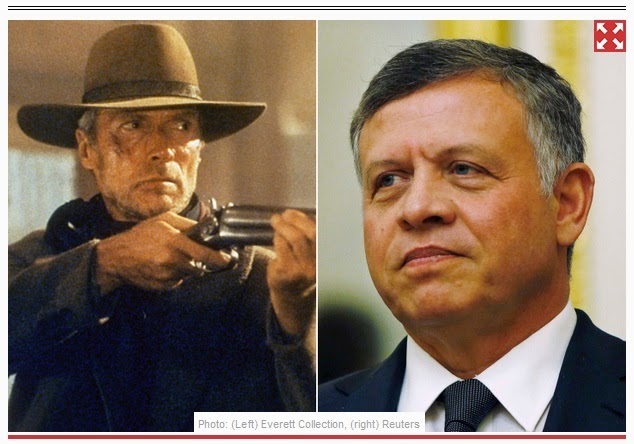
Abdullah (right) identified with a vengeful Eastwood character.
But perhaps the most disturbing of all to me are the growing reactions of many of us in the Western World.  Some react to beheadings, burnings, and crucifixions with cheers as if they have been mesmerized by this demonic contagion of evil.  Others are so enraged at the perpetrators of barbarism that they, like King Abdullah of Jordan, respond to the terrorists by promising swift acts of reprisal.  According to a New York Post article, an angry King Abdullah responded to ISIS’s barbarous act of burning a Jordanian citizen alive by quoting Clint Eastwood’s enraged, vengeful character, William Munny, in the movie, Unforgiven.  

It is here, the nexus of evil barbarism and morally restrained civilization, where my greatest concern lies, for it is here that civilized peoples must decide how they will react in the face of evil.  The choice is between reacting to execute justice against evil governed by a sense of moral indignation; or, reacting “in kind” with a zealous anger fueled by hatred and vengeance.  The Western World has plenty of its own unrighteousness to go around; and, the need for repentance ought to be obvious to us.  However, it seems to me that it is precisely the awareness of our own individual and collective depravity as a nation in the face of God’s standards of righteousness that ought to remind us that perfect judgment and vengeance is not ours, but the L
ORD’s (Romans 12:19).

If Western Civilization reacts out of a spirit of hatred and vengeance it will be pulled downward toward the very pit of hatred and despair that gives rise to this march of evil.  Therefore, the only hope for America and the West is rejection of moral relativism in favor of moral clarity based on the Judeo-Christian Scriptures.  The Scriptures clearly and repeatedly remind us that humans are fallen creatures with no hope apart from humble submission to the saving grace of God that brings redemption and reconciliation (Romans 3: 10, 23; 6: 23).  Those who confess their depravity and complete dependence justification by faith in God’s righteousness are equipped to love God, love their neighbor, and steward their time, talents, and treasures for God’s glory.   God’s redeemed stewards value all of human life and support safeguards against violation of the basic rights to free speech, freedom of worship, and access to protection afforded by just rule of law.  These objective standards for life and liberty based on Scripture are what today’s leaders have in mind when they call for America to respond to evil with moral clarity and righteous indignation. 

Having stated the basis for justifiable moral indignation, my question is, “Can America now exercise moral courage and unified leadership in the face of the lawless hoards on the world scene?”  I’m afraid because of the current moral climate in America, the answer may be, “No.”  How can America speak with one voice against evil when we are so deeply divided on moral issues such as the importance of religious faith in American culture?  How can America stand for the dignity of human life when her courts continue to violate the sanctity of human life, trivialize sexuality and the sanctity of marriage, castigate those of a different ethnic background, and disrespect America’s historic role in relieving human suffering and fostering world peace?

Today, I am remembering the birthday of President Ronald Reagan whose leadership rallied our nation so effectively because of his deep faith in God and respect for others regardless of their politics.  Reagan believed that America would not long survive if she didn’t hold to the moral standards and moral clarity that had made her “good” as well as “great.”  Reagan’s words to the nation in his presidential farewell, in 1989, demonstrated the qualities of his leadership that had revived America’s faith, restored America’s spirit, and made the world safer against the threat of Communism:

Reagan and Gorbachev: Leadership with firm moral resolve.
… we're about to enter the '90s, and some things have changed. Younger parents aren't sure that an unambivalent appreciation of America is the right thing to teach modern children.  And as for those who create the popular culture, well-grounded patriotism is no longer the style. Our spirit is back, but we haven't reinstitutionalized it. We've got to do a better job of getting across that America is freedom--freedom of speech, freedom of religion, freedom of enterprise.  And freedom is special and rare. It's fragile; it needs protection.  So, we've got to teach history based not on what's in fashion but what's important:  Why the Pilgrims came here….

The past few days when I've been at that window upstairs, I've thought a bit of the "shining city upon a hill." The phrase comes from John Winthrop, who wrote it to describe the America he imagined. What he imagined was important because he was an early Pilgrim, an early freedom man. He journeyed here on what today we'd call a little wooden boat; and like the other Pilgrims, he was looking for a home that would be free.

I've spoken of the shining city all my political life, but I don't know if I ever quite communicated what I saw when I said it. But in my mind it was a tall proud city built on rocks stronger than oceans, wind-swept, God-blessed, and teeming with people of all kinds living in harmony and peace, a city with free ports that hummed with commerce and creativity, and if there had to be city walls, the walls had doors and the doors were open to anyone with the will and the heart to get here. That's how I saw it and see it still.

As I reflect on President Reagan’s leadership, I ask again, “Can America now exercise moral courage and unified leadership in the face of lawless hoards on the world scene?”  The lack of moral clarity and resolve in our current leadership make me doubtful.   The longer America and its allies continue with a policy of token resistance, the greater will be the spread of this evil infection; and, the less likely America will respond out of moral indignation and not out of anger and vengeance –if America responds at all.  

Allow me to conclude with a current contrast in leadership that I believe justifies my concern. On the one hand are the leaders of two of America’s Middle East allies:  Abdullah II, King of Jordan, and Benjamin Netanyahu, Prime Minister of Israel.  Both men have clearly expressed their frustration and concern about the growing threat posed by terror groups and hostile nations such as Iran.  Netanyahu in particular has demonstrated much patience, a voice of reason, and a willingness to negotiate peace with neighbors who despise his nation.  On the other hand, President Obama seems unable or unwilling to stand in the tradition of previous American presidents as a voice for moral clarity.   Instead, he appears apologetic for the nation he leads perhaps because he sees America as an unjust intruder on the world scene; a nation that has attained her leadership dishonestly at the expense of other nations.  This line of reason, typical of many secular progressives, suggests that America must leave the stage as leader of the free world and blend into the landscape with other nations she has oppressed. 

We must admit that America’s history has many blemishes because Americans are, in God’s view, depraved people.  However, because of his unwillingness or inability to exercise decisive leadership, President Obama is creating frustration among Americans, confusion within our armed services, and doubt among our allies. 

King Abdullah’s angry reaction to the violent death of a Jordanian citizen this week illustrates what I have stated as perhaps the greatest challenge or test for Western civilization.  The test has one multiple-choice question:  “How will the West react to the current onslaught of evil that emerges from ISIS, Iran, Russia, and numerous terror groups on different continents?   Will the West react with (a) a resolve to confront evil with just retribution based on moral indignation ; or will the West react (b) “in kind” by committing more atrocities out of anger and vengeance? 

As I stated at the beginning, I am concerned about the direction of the world.  I am concerned for America, and for our children and grandchildren.  There is not much we can do as individuals.  But we can pray for our own leadership responsibilities and for our leaders.   I pray that President Obama will communicate in words and in actions the spirit conveyed by Ronald Reagan as he bid farewell to America as her president, in 1989: 

But I never thought it was my style or the words I used that made a difference: It was the content. I wasn't a great communicator, but I communicated great things, and they didn't spring full bloom from my brow, they came from the heart of a great nation--from our experience, our wisdom, and our belief in principles that have guided us for two centuries.

Both Barack Obama and Ronald Reagan are known as “great communicators.”   I pray that President Obama will take up the mantel of moral leadership and offer a clear message of hope and encouragement to the America he serves.  May he also send a clear message to the enemies of law and order that America is back and ready to lead its allies in defense of life, liberty, and justice.

Wednesday, October 16, 2013

Redeeming Halloween for a Higher Purpose

Recently, Inglewood Elementary School in Lansdale, a suburb of Philadelphia, PA decided to cancel a parade and other annual Halloween celebrations.   In a letter to parents, the school administration explained that celebrating Halloween promotes religious beliefs and therefore violates school policy. 

I am saddened at the prohibition of prayer, the Pledge of Allegiance, and other aspects of religious expression in the public classrooms of America.   However, the recognition of Halloween activities as being “religious” in nature is at least consistent with prohibition of Christmas and Easter celebrations in schools.  

New Yorkers celebrate Halloween in Greenwich Village.  
(Photo:  Emmanuel Dunand, AFP/Getty Images)
Halloween is indeed a holiday [“holy day” or “day set aside for religious observance”] with significant religious elements.  Like any other holiday, Halloween can be celebrated in a variety of ways, and it is not the purpose of this article to condemn the holiday in all of its manifestations. However, there are thematic elements in Halloween that are troublesome.  In his article, Christianity and the Dark Side—What About Halloween? Albert Mohler cites Harold L. Myra of Christianity Today who explains the pagan religious origin of Halloween:

More than a thousand years ago Christians confronted pagan rites appeasing the lord of death and evil spirits.  Halloween’s unsavory beginnings preceded Christ’s birth when the druids, in what is now Britain and France, observed the end of summer with sacrifices to the gods. It was the beginning of the Celtic year and they believed Samhain, the lord of death, sent evil spirits abroad to attack humans, who could escape only by assuming disguises and looking like evil spirits themselves.


Halloween not only focuses our attention on the “dark side” of the spirit world, but it also presents a materialistic philosophy dressed in the alluring appeal to all ages through candy, alcohol, exotic costumes, wild parties, and the like.  According to Bruce Horovitz, USA TODAY October 24, 2012, Halloween is second only to Christmas in consumer spending for decorations, and the increased spending is due in large part to the take-over of the holiday by adults.  Horovitz explains:

A decade ago, fewer than three in 10 costumes purchased for Halloween at Halloweenexpress.com were for adults. Now [2012], it's more than six in 10. It should be no surprise that consumers will spend an average of $123 this Halloween, more than twice the average $53 that they spent on it a year ago, reports American Express Saving & Spending Tracker.

Dr. Mohler assesses how Christians respond to the excesses of Halloween as follows:

The issue of Halloween presses itself annually upon the Christian conscience. Acutely aware of dangers new and old, many Christian parents choose to withdraw their children from the holiday altogether. Others choose to follow a strategic battle plan for engagement with the holiday. Still others have gone further, seeking to convert Halloween into an evangelistic opportunity. Is Halloween really that significant?

Della Rose picks out her pumpkin at Trabbic Farm
How should we then live in the October season of witches, goblins, corn mazes, and candy?  After all, many of us have good memories as kids and as parents of making our own “trick-or-treat” costumes, our own candy, our hot cider, and our own brand of fun during the chilly October nights.  I for one believe Halloween can be celebrated in ways that are wholesome (Hum! When have I last heard that word?); and, that create the blend of good fun, activities, and treats we all enjoy.  Allow me to share our story.

For several years, it has been our family tradition to take our grandchildren, Caleb, Kiara, and Della to the Trabbic Pumpkin Farm.  The experience is enjoyable, educational, and inspiring.  It is enjoyable, because there are lots of things for children (and adults) to do--petting animals, climbing on straw, corn maze, and refreshing cider and donuts, etc.  It is educational to learn fun facts about pumpkins, honeybees, chickens, and other farm topics.  And it is inspiring to hear Mr. Trabbic share how the labor of him, Mrs. Trabbic, and their sons is only part of what makes a good harvest possible.  It is God Who must provide the rain and weather conditions necessary for their crops including pumpkins.  They politely point out that God is not only Creator and Sustainer of Earth.  He is also the Author and Protector of human life including the unborn, and humans are stewards of both the land and life in all its forms. 
Creating a memory of fun at the Trabbic Farm

In spite of “comments” by readers of an excellent food blog, the Luna Pier Cook, regarding the Trabbic Farm warning of a possible “offensive religious message,” our annual visits to the Trabbic Farm are anything but offensive.  Indeed, such warnings seem much more appropriate for those who plan to attend Halloween events, which often promote a very dark and even demonic religious agenda.

Thank you, Trabbic family for inviting us to direct our thoughts toward "Whatsoever is true, honorable, right, and pure...lovely, of good repute...excellent and...worthy of praise...(Philippians 4: 8)"  Thank you for pointing our attention heavenward to our gracious Creator and Sustainer from Whose hand comes “every good and perfect gift” (James 1: 17) including the sun, rain, and weather conditions necessary for the food we eat.  Thank you, Trabbic family, for your hard work on the land God has entrusted to you, and for your positive testimony to visiting adults and children even in years when your crops do not turn out so well.  May your tribe increase.