Showing posts with label virtue. Show all posts

Sunday, May 6, 2018

Tribute to a Virtuous Mother

Marietta Moser, my mother by marriage, was born in Loudon, TN on August 9, 1926 to John E. and Alva Mae Bright.  She was “born again” at age 14 when she surrendered her life to become a follower of Jesus Christ.  After World War II, Marietta married Ralph Donald Moser, and bore him seven lovely daughters including the eldest, my wife, Alvadell “Abby” (Moser) Silvius.  

When Alvadell and I were married in 1969, “Mom” accepted me and influenced my life as if I was her own son.  For this reason, I soon found it fitting to call her "Mom."  She has been a steady, loving, encouragement to me for the past 50 years.


Ralph and Marietta Moser with seven daughters (~1963)
Marietta loved her husband, her seven daughters, her 41 grandchildren, and her 17 great-grandchildren.  Her life of 91 years was a virtuous life--full of the good fruit which resulted from her decision as a girl to invite Christ to be her Lord and Savior.  Her growth and maturity in Christ came as she learned to feed her soul from regular times in God's Word to participate in regular worship and service in her church, Amsterdam Community Church of God.  The best words I can find to describe Marietta are from Galatians 5: 22-23 which states, "...the Holy Spirit produces this kind of fruit in our lives-- love, joy, peace, patience, kindness, goodness, faithfulness, gentleness, and self-control."

Marietta was disciplined to feed upon God's Word daily.
Proverbs 31: 28-29 speaks of the virtuous woman as follows:

Her children rise up and bless her; Her husband also, and he praises her, saying:
Many daughters have done nobly, But you excel them all.

During the final week before her death, on Sunday, April 29,  we were blessed to be with her for two separate days.  On the prior Tuesday, we remained at her bedside, comforting her with lots of smiles, encouraging words, and the holding of her hands. Although she was very weak, at one point she looked squarely at the ceiling, raised her arm straight up, and held both her arm and her gaze fixed upward in peaceful expression.  Her actions were so determined yet undisturbed by our presence that, after a short while, it seemed natural for me to ask her, “Mom, are you seeing something that we don’t see?”  She gave no visible or audible response, but, God only knows, she may have received an assurance from her Creator along the lines of Psalm 23: 4 that she had just recited with my help earlier that day:

Even though I walk through the valley of the shadow of death, I fear no evil, for You are with me; Your rod and Your staff, they comfort me.

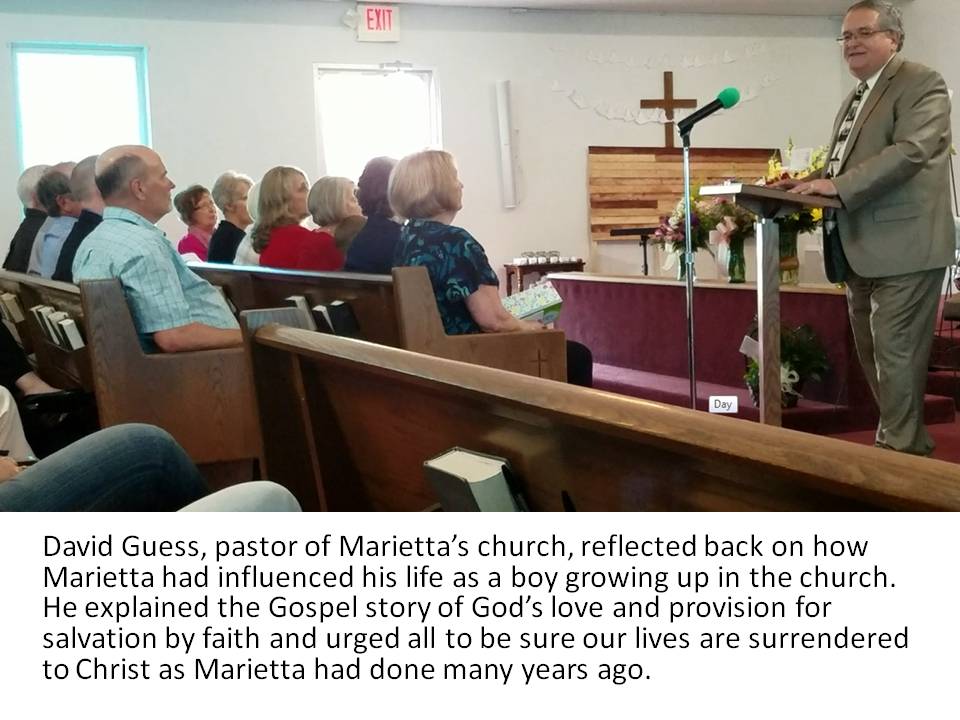
The memorial service for "Mom/Grandma Moser" was a time for tears but mostly a time for celebration of her life.  She was a wonderful woman, and we were blessed to remember her virtuous life in Christ as we gathered with family and friends at her church in Amsterdam, Ohio. 

We are glad to share two YouTube links which will allow those of you who wish to learn more of our tribute to Marietta Moser.  First, we provide the following link to a series of slides recounting Marietta's life and her love for God and family:  "Celebrating the Life of Marietta Moser."  Second, you may watch a video of a portion of Marietta's memorial service by clicking on the following link:  "Tributes to Marietta Moser, 1926-2018."

If you are unable to view the videos, or choose not to view them, you may wish to view the photos below which show family members giving tribute to Marietta.  E
ach photo has a brief explanatory caption.  You may click on each photo to enlarge it for better viewing.


Finally, I would like to dedicate this blog article to Marietta's three sisters whom she loved dearly: Mrs. Edna Sperry (below left behind Marietta), Mrs. Loretta (Ray) Noble (right front center with my wife, Alvadell), and Mrs. Norma (Lynn) Brumbaugh (rear center).


Saturday, July 4, 2015

Censoring Vocabulary, But Not Virtue

During my boyhood years in the mid-20th century, I quickly learned that the English vocabulary could be sorted into two major groups -- “acceptable words” and “bad words.”  I encountered an unending stream of acceptable words on spelling lists, and I received many positive incentives to use them in polite conversation. I am now thankful for both the spelling lessons and the positive incentives.

I was also allured into using certain “bad words” that were expressed by unseemly characters who apparently felt bigger or more masculine when they spewed them out.  Fortunately, the positive examples and high expectations of men and women of godly character in my life won out over the more limited influence of “bad characters.”

Since the days of my boyhood, we have witnessed a major change in the realm of acceptable and unacceptable words.  For example, the code phrase for “sex” during my adolescence was “the birds and the bees.”  Although in retrospect, it would have been helpful to have had more instruction on sexuality as an adolescent; today we are exposed to a broad vocabulary complete with visual “aids” on the subject of sexuality including all manner of sexual perversions and classifications.  One would think that there are no longer any “bad words.”  But that is not true.  Instead we have a whole new class of “bad words” that represent the forbidden vocabulary in secular American culture.

Dylann Roof
Today, when anyone uses a “new bad word,” our secular culture is at least twice as perturbed as our mothers and grandmothers were when we let “bad words” slip out as adolescents.  Witness the current media discussion of what would lead Dylann Roof to burst into a South Carolina church and murder nine people meeting together for a Bible study.  “Acceptable words” in the current discussion of causation include gun access, drugs, video games, racism, negative talk radio, and Fox News.  These words have become code words for political agendas including the passage of gun control legislation, increased role of the federal government in local law enforcement, retaining support of minority voters, and the censorship of conservative media.  Taking the politics of gun control, for example, in an earlier article, No Gun Control Without Self-Control (March 30, 2013), I posited that violent crime is not simply a result of access to firearms.  Rather,
Whatever "weapon" Cain used, murder started in his heart.
"Our protection from both tongue and gun is rooted not in civil law but in the moral code.    The moral law is grounded in Jesus’ teaching that it is out of the heart [that] come evil     thoughts, murders, adulteries, fornications, thefts, false witness, slanders (Matthew 15:19).  Therefore, the answer to a safe and civil society is not found alone in “tighter controls” on guns and speech.  Instead, there must be a revival within institutions that nurture a godly disposition of the heart; namely, the family and the local church, both within the context of caring communities."

Many who reject “band-aid approaches” to reducing gun violence may wish not to hear the vocabulary of this argument-- “new bad words” like moral, evil, revival, heart, self-control, and church.  Add the words, sin and forgiveness, and the liberal media often turns a deaf ear or cries “foul!”  In fact, the word evil was already headed for “bad” in the 1980’s when President Reagan called the Soviet Union an “evil empire.”  Today, liberal progressive culture includes sin in the vocabulary of “hate speech.”

But occasionally, liberal media and the progressive culture are caught off guard as for example, at the events on June 17, in Charleston, SC.  On that Wednesday night, Dylann Roof, a 21-year-old allegedly entered Emanuel African Methodist Episcopal Church, attended a Bible Study for an hour, and then opened fire on those who had welcomed him.  Even before all the gruesome details were reported, the mantra began—the sour lamenting of “white-on-black” crime with all the expected vocabulary--
gun access, racism, negative talk radio, and the Confederate flag permeating the airwaves.  President Obama challenged the nation to confront the “terrible toll of gun violence.”

The AME church in Charleston, SC has had a long and troubled history beginning before the Civil War.  In the 1820’s, it survived its building being burned.  After the Civil War and during the Jim Crow era of racial segregation, AME church members worshipped in secret because all-black churches were outlawed.  But the June 17 shooting was not just another violent event in a region having a long history of racial unrest.  This time the media was faced with reporting a different message, complete with a vocabulary of “new bad words” like mercy, forgiveness, and enduring love.  Yes, in Charleston, SC, under the Confederate flag, and near historic Sullivan’s Island, the location where nearly half of the enslaved African people were brought ashore and auctioned to slave owners, came an eruption of an entirely different sort.

According to the
Washington Post, “There was no yelling. There were no accusations. Instead, people who had lost the loves of their lives blessed the accused murderer.” Felicia Sanders, a hair stylist whose son Tywanza was allegedly killed by Roof, expressed this unexpected tone with a different vocabulary.  As we stared at Roof’s face filling much of our TV screens, she spoke directly to Dylann saying,

Tywanza Sanders
We welcomed you Wednesday night in our Bible study with welcome arms.  You have killed some of the most beautifulest people that I know.  Every fiber in my body hurts, and I’ll never be the same. . . . But as we say in Bible study, ‘We enjoyed you, but may God have mercy on you.’ “Tywanza Sanders was my son. But Tywanza Sanders was my hero. Tywanza was my hero,’’ she said, her voice trembling. “May God have mercy on you.”

The vocabulary of love, mercy, and forgiveness of Christians is seldom applauded in our secular culture. However, the words of the Charleston believers were powerful because their virtuous behavior affirmed their words sacrificial love, mercy, and forgiveness to Dylann Roof.  The same open arms that welcomed young Dylann Roof before he unleashed his violent hatred were now open to him in Christian forgiveness and in prayers for God’s mercy upon him.


From where does this kind of strength and forgiveness come?   The prophet Isaiah uses the word strength over twenty times.  His words may resonate with the hearts of many black Americans, and all of us who are weary because of the curse of sin and its manifestations—selfishness, pride, divisiveness, anger, and violence.

You were tired out by the length of your road,
Yet you did not say, 'It is hopeless.'
You found renewed strength,
Therefore you did not faint.
– Isaiah 57: 10

Yet those who wait for the LORD Will gain new strength;
They will mount up with wings like eagles,
They will run and not get tired,
They will walk and not become weary.  
– Isaiah 40: 31

As America celebrates another 4th of July, instead of saying “God Bless America” many of us
want to say, “God Help America” or “God Bring Repentance, Humility, and Revival to America.”  Again, these “prayers” are filled with the “new bad words” in the view of many in our secular progressive culture.  But, until we individually acknowledge our sin and repent, and then pursue mercy, forgiveness, revival, and holiness, neither we nor our nation will be blessed by God and experience His forgiveness and blessing.  Only then will be able to love our neighbor regardless of his or her race or beliefs.  Only then will we respect authority and realize that violation of civil and moral laws begins with the pride-filled heart, not with weapons or even our words.   And finally, only then will Americans be able to do what black Christians in Charleston, SC did—look into the cold face of an alleged murderer and say words we so seldom hear, May God have mercy on you.

Perhaps America will soon enter a time when “word police” will prohibit the use of “the new bad words,” labeling them as “hate speech.”  Given prohibition of words like sin, repentance, Jesus, salvation, mercy, and forgiveness we may be left with no other recourse but to show the loving, forgiving, regenerated life that is possible in Christ.  Little children, let us not love with word or with tongue, but in deed and truth (1 John 3: 18).  Indeed, many Christians today have a powerful and transformative witness in very oppressive Muslim and other authoritarian countries.  There is much we can learn from Christians under more severe restrictions as we pray for them and become prepared for likely hard times ahead.

Friday, November 25, 2011

Thanksgiving and Black Friday: Invitations to Develop Contentment

Thanksgiving is a unique holiday—one that invites us to reflect on the blessings we have received during the past year.  Christians have the special blessing of knowing personally the One True God from Whom all blessings flow.  An intimate relationship with God is made possible by faith in Jesus Christ, and nurtured properly through the spiritual disciplines of prayer, regular nourishment from the Word of God, and fellowship with the people of God. 

A healthy relationship with God produces, among other virtues, the virtue of contentment (Hebrews 13:5).  Contentment is an attitude that flows out of a thankful heart.  Our Thanksgiving holiday can be an occasion to enjoy the blessings of family, friends, and food; but, it is also a time to nurture a heart of thankfulness and contentment by reflecting on the Person and provision of God.  

As a Christian, at times I have experienced the joy of contentment; but I have also experienced periods of discontentment.   For me, and perhaps for many, discontentment is a “default attitude.”  Contentment must be forged and refreshed daily in the midst of a culture that promotes discontentment through media and social pressures.   Under the guise of maintaining social status, improving efficiency, staying current, or “treating ourselves to what we deserve”, we are urged to buy the newest editions, models, or styles “while they last.”  

How does a person find contentment?  The Apostle Paul states, If we have food and covering, with these we shall be content (1 Timothy 6:8).  Paul indicates that in Roman culture, like our contemporary culture, contentment was not a default condition.   He testifies, Not that I speak from want, for I have learned to be content in whatever circumstances I am  (Philippians 4:11).   Paul “learned contentment” by practicing submission to spiritual disciplines such as we have noted above.  This is not a contentment, as some have chosen to pursue, through an acetic lifestyle of abstinence from ‘pleasures’ that are seen as hindrances to reaching spiritual goals. 

So, how can we apply a Christian perspective to the holiday season? Traditionally, Thanksgiving holiday has been squeezed on either side by two commercialized holidays, Halloween and Christmas; but, at least the two adjacent holidays have been separated in time from Thanksgiving by a month or more.  However, with each passing year, increasing numbers of retail stores are opening earlier on “Black Friday” or in the late evening hours of Thanksgiving Day itself.   

Some are reacting to Black Friday by observing “Buy Nothing Day.”  Not a bad idea.  But, I wonder what the observers of “Buy Nothing” choose to do instead.   Maybe Maggi Dawn’s blog entry , “Black Friday: Buy Nothing Day points us in the right direction.   She writes:

Last Friday, just before we began Reading Week at the [Yale] Divinity School, my team and I organized a Cafe Eucharist, the theme of which was Thanksgiving and Giving Thanks. One of the threads in the service was the disconnect between gratitude (thanks for what we have) and consumerism (the goal to get more, more, more). It feels somewhat urgent to me this week to resist the temptation to go shopping over the next few days. Half price practically everything is really tempting, especially just before Christmas. But I feel I would be paying with my soul, not just my dollars. We are going shopping today for the food we need, and firewood, and a tank of petrol/gas. No more. Then we are going to spend four days playing, watching movies, walking up some hills, visiting friends, eating enough but not to excess, reading by the fire, and enjoying the luxury of sleeping late in the mornings. And giving thanks.  Anyone want to join us?
How about you?  How have you spent Thanksgiving, and then Black Friday this year?  I have enjoyed being with our daughter and family, and precious time with our grandson, Caleb, and granddaughters, Kiara and Della.   Of course, they were gracious to allow me to finish this blog entry while watching the West Virginia Mountaineers defeat the Pitt Panthers in the “Backyard Brawl” 21-20. 

In our October entry, “Our Stewardship Is about God, Not Us,” we emphasized that godly stewardship is grounded in an awareness that The reverent and worshipful fear of the Lord is the beginning and the principal and choice part of knowledge (Proverbs 1:7, Amplified Bible).   Celebrating Thanksgiving affords us the opportunity to apply the important ingredient of “giving thanks” to the a life of “reverent and worshipful fear of the Lord…”   May God help us to use both Thanksgiving and Black Friday to develop lives that honor God in a consumer culture every day of the year.