Some
baby-boomers like me remember a stressful part of our childhood: having to get a penicillin shot, or waiting
in line for “the needle” for vaccinations.
I’m not sure which was worse, the anticipation or the needle prick
itself. But afterwards, my fear and pain
were eased by a warm feeling that I was protected from becoming ill. Today, the results affirm the success of antibiotics
and vaccines. The anxiety and pain were a
small price for a good outcome.
But what if, in order to protect us and our nation from a mortal enemy, we were
required to surrender freedoms that we hold dear? Such a request or demand would have a much
more pervasive affect on our lives than the requirement to stand in line for a
vaccination?
Our COVID-19 Conundrum – Looking Back
As you know, my “what if” became a reality on March 15 of this year—the day that
65 Coronavirus deaths were reported in the US.
On that date, Dr. Anthony Fauci and the White House Task Force
instituted a 14-day “national shutdown” with “social distancing” and
limitations on our coming and going. The
purpose was to “flatten the curve” of daily hospitalizations and viral
infections so that hospitals would not be driven beyond capacity. But 14 days of shutdown was gradually extended
to 1 month. By that time, many voices in
the medical and epidemiological fields were questioning the wisdom of this policy.

With all due regard for any loss of life due to the Coronavirus, many of us asked
whether the national shutdown was actually saving lives. Or, was it simply flattening the curve of
infections and hospitalizations and delaying inevitable exposures and
infections with uncertain future consequences? By mid-April it had caused thousands of small
businesses to close, millions of people to be unemployed, delays in scheduling
of medical procedures, disruption of church worship and other human social
interactions, and resultant mental stresses and suicides due to social
isolation.
Because of my own personal skepticism, I began to research the science and
statistics related to the COVID-19 pandemic and shutdown. At the same time, I wanted to assess my own
attitude and faith in response to the pandemic threat on my life and family. About this time (April 17), after one month
of national shutdown, the US was approaching 40,000 deaths almost half of which
originated in New York state. I wrote a
blog article entitled “Considerations
for Our COVID-19 Conundrum” which outlines how I was personally responding
to the pandemic and shutdown. [I
believe this article still contains valuable recommendations for readers who want
to maintain their “health” in body, mind, and spirit.]
One week later (April 24), I had posted another article on COVID-19, entitled “COVID-19
Policies & Outcomes: Learning Online.” Here, I cited experts who were concerned that
the indirect effects of social distancing and the economic shutdown were having
more devastating long-term effects than the COVID-19 virus itself. The primary goal of “flattening the curve” had
been reached in most parts of the US. So,
the rationale for remaining locked down shifted to a seemingly trumped up fear
based on questionable predictive models and a philosophy that we ought to remain
shut down until a vaccination is developed.
Fortunately, in spite of these dire warnings, several state governors began
to aggressively follow the phase-in plan offered by President Trump and the
White House task force.
It’s Time to End the Shutdown
During the next two weeks, it became more and more obvious to those who
followed objective
media sources that the economic, social, and even medical costs of
prolonged partial lockdown were exceeding the benefits in saving of lives. Everywhere, hospital capacity and equipment to
treat COVID-19 patients were all much in excess of demand. As I wrote in “COVID-19
Policy Ignores ‘Good Science’,” “some experts such as Dr. Dolores
Cahill called the lockdown policy “anti-scientific” and “anti-nature” because
it has ignored the importance of the human immune system and how we need to
beef up our immunity through good nutrition and vitamins.” [Dr. Cahill’s informed logic is featured
in a video interview accessible in my article, “COVID-19
Policy Ignores ‘Good Science’.”]

Today, opposition to the lockdown from professionals is being joined by an
increasing chorus of Americans who want to get back to work. Dr. Scott Atlas,
MD. and senior fellow and experienced policymaker of the Hoover Institute, argues
that there is no reason not to move more quickly to reopen our society with proper
precautions for the elderly and other at-risk individuals. In his op ed article published May 18, in The
Hill, Dr. Atlas wrote,
The total lockdown may have been justified at the start of this pandemic,
but it must now end — smartly, without irrational, unnecessary requirements
contrary to medical science, common sense and logic. The goal of the strict
isolation was accomplished in the overwhelming majority of places. We have
direct data on risk and extensive experience, individually and as a nation,
with managing it, even as new cases arise. We know that gradually relaxing
total isolation will lead to more infections, but that’s acceptable, given that
we know whom to protect and this disease is not harmful to the vast majority of
infected people.
What Do COVID-19 Data-by-State Suggest?
Yesterday, I devoted many hours to pouring over data from multiple sources. I chose 15 states that represent 62% of the
US population but which are responsible for approximately 85% of the COVID-19
deaths in the US to date (see Table). The
data by state is ranked according to “% Recovery” from lowest (top) to highest—i.e.
the percentage of individuals who were “Reported Cases” who recovered and were
not tallied in “Deaths.” Note that
Michigan currently has the lowest percent recovery at 90.5%. All other states range above this percentage
and reach as high as 98.3% recovery in Tennessee.

The 7 states that make up the upper-half of the table account for
just over half (51%) of the total reported COVID-19 cases in the US to date but
account for 67% of the total US deaths. It is also noteworthy that nearly all of the 7
states in the upper half of the table have governors who have been slower in
opening up their state than most of the 8 states in the lower half. This suggests that governors who have been
more aggressive in opening their state have not been unwise. Both % recovery and mortality rates are lower
in these more aggressive states. More
comments on my Data Table will come below as they relate to several claims by Dr.
Atlas.
Supportive Data But Poor Communication
Dr. Atlas argues that neither policymakers nor the public have received several
key messages that are both critical in alleviating public fear and valuable as
a guide to safe reopening of society. In
his article Monday, in The Hill, Dr. Atlas lists four
policy failures at the state level, each with scientific data from the
CDC and other sources to support his claims.
The four policy failures he lists are as follows (emphasis mine):
1. There has been a failure to
remind everyone that the stated goal of the policy — total lockdown and
whole-population isolation — has been accomplished in most of the United
States, including the epicenter of New York.
2. There has been a failure to
reassure everyone that we fully anticipate more cases will occur,
whether we test or not, with continuing relaxation of today’s isolation.
Many Americans are gripped in fear when they hear that more reported cases
of COVID-19 are appearing daily with even more cases reported in some areas. But remember, we are doing more testing—more
testing means more reported cases! But
notice from my Data Table above that 90 to 98% of reported cases recover.
3. There has been a failure to
educate the public that the overall fatality rate is not only far
lower than previously thought but is extremely low in almost everyone other
than the elderly.

Allow me to elaborate on failure #3 as it relates to the relatively large
percentage of COVID-19 deaths among the elderly. According a New
York Times article, May 11, one-third of all US deaths to
Coronavirus (est. 26,000, May 18) are from nursing home residents and workers. Notice from my Data Table that nursing home
deaths vary widely in percentage of total deaths by state.

It is now believed that the large number of deaths
of nursing home residents and workers in several states including NY, MA, and PA
was due at least in part to the negligence or incompetence of state government officials
and nursing home administrators. The unfortunate
higher number of nursing home deaths in some of these states is reflected in
their higher “Mortality” rates (#Deaths/100K) (see Data Table). The clear implication is that we dropped the
ball in protecting our high-risk seniors while focusing instead on social
isolation of the rest of us who are at low-risk.
4. There has been a failure to
clarify to parents the truth about the extremely low risk to children,
and that has accompanied a gross failure to offer a rational medical
perspective regarding schools reopening.

The #4 failure on Dr. Atlas’s list is the unfortunate lack of clear information
provided to parents of young children—information which might have relieved
much anxiety, and hopefully still can.
According to a Journal
of the American Medical Association article cited by Dr. Atlas, “Of
the critically ill children with COVID-19, more than 80% had significant
long-term underlying medical conditions. Overall survival and outcomes from
critical illness in infants and children with COVID-19 in this series was far
better than reported for adult patients. At the present time, our data indicate that
children are at far greater risk of critical illness from influenza than from
COVID-19.”
Lack of good information and its dilution with misinformation threatens to
drive school and college administrators to consider delaying reopening of
classrooms in the fall of this year. Dr.
Robert Hamilton, pediatrician and founder Pacific Ocean Pediatrics, stated in
an interview
on The Ingraham Angle that only around 1.7% of people infected with Coronavirus
are children up to age 18. The majority
of these are asymptomatic and don’t even realize they have a virus. Meanwhile, we are learning about the negative
impacts of school shutdown on adolescents and on their parents as they adjust
to online courses while being deprived of spring sports and traditional
commencement observances.
Conclusion
Every human life is of great value to our Creator. Therefore, policies dealing with the pandemic
should be designed to do the greatest amount of good for the greatest number of
people. However, given that we live in a
culture where the definition of “good” is so often rigorously debated, policymakers
have a difficult time. This is
especially true when we allow our definition of “good” to selfishly dominate
our political agendas to the point where we allow biased interpretation of data
and media reporting to create an unreal world that is far from the truth.
While I have not escaped the world of pride, selfishness, error in
computations, and bias, I have tried to deal accurately and honestly in
compiling my Data Table and in presenting the arguments of notable scientists
and policymakers. Based on what I have
gleaned from my study, I cast my small vote with those who recommend opening our
culture as speedily as possible.
Returning to my analogy of the anxiety I felt while waiting in line for my
vaccination as a boy, I gladly remember that painful experience with no regrets. However, I believe we will all have great
regrets after our current painful pandemic if we don’t soon make it a priority
to reopen and restore our economy, health services, family togetherness
(especially with our beloved elderly), worship opportunities, education, and recreation. Death from disease is a reality, but life and
health depend on many aspects of our culture that have been restricted or ignored
all too long. As always, I welcome your “Comments.”
Acknowledgement:
This article is a joint effort between my wife, Alvadell ("Abby"), and I. I thank her for her patience, helpful research, and critical suggestions in the writing.
Indications are that the 3-month “war” on our “invisible enemy,”
the COVID-19 virus, is beginning to show signs of success in flattening the “curve.” Many states with minimal COVID-19 cases are
working on plans to reinstitute “normal” operations of services and the economy. However, there is much controversy over how
and when to proceed. Some medical
experts still favor delay of opening to avoid more serious spread of the virus. Others want to use personal tracking of the virus, a potential new invasion of our privacy.
While living under this very different experience, I am realizing that my disposition should be characterized by several attitudes or qualities. These include thankfulness, repentance, realistic
outlook, informed discernment, and intercession.
Thankfulness
In everything [even in a Coronavirus pandemic] give thanks for
this is God’s will for you in Christ Jesus (1 Thessalonians 5: 18). As of this writing, I am thankful for the
health of our family and friends, and for the following:
(a) recovery statistics are outpacing deaths by either direct causes
(presumably by an overactive-immune system) and indirect causes (through
pre-existing health factors in at-risk persons) causes.
(b) infections and hospitalizations are far fewer than that of the swine
flu (H1N1), in 2009-2010, and much smaller than other major causes of death
(see table below).
(c) wise leadership of our president and the Coronavirus Task Force led
by VP Pence, state governors, doctors and medical health care staffs, our armed
forces, law enforcement, and church and para-church organizations (e.g.
Samaritan’s Purse) deserves our thanks to God.
(d) alternative means of staying connected with our families and
churches abound. Meanwhile, we should recognize
that many Christians in places like the Middle East, in China, and in North
Korea cannot freely meet to worship even apart from the COVID-19.
Repentance
Repentance, confession of our sin, and worship should be an ongoing part of
the lifestyle of a dedicated Christ-follower.
How blessed are the poor in [their] spirit (Matthew 5:
3). We can be humbled to our knees when
we read again the accounts in Scripture of how people reacted in repentance and
worship when they bowed before the Living God.
Repentance and spiritual awakening often occurred when God’s people faced great challenges, opposition
from mighty armies, or threat from pandemics. Could it be that
God lovingly desires to draw America back to a greater trust and obedience to
Him through the pandemic?
God’s Spirit and His Word revealed in Scripture cause us to humbly repent of
our sin. Of course the invitation to
repentance stated in 2 Chronicles 7: 14 is very appropriate as we seek God’s
face on behalf of our nation at this troubled time: If my people, which are called by my name,
shall humble themselves, and pray, and seek my face, and turn from their wicked
ways; then will I hear from heaven, and will forgive their sin, and will heal
their land.
Realistic Outlook
Repentance leads to cleansing from confessed sin, restored fellowship with
God, and the clearer vision needed in difficult times. Every day, many lives are spared by the
herculean efforts of those listed in (c) above, functioning within an amazing
social structure and enabled by a sovereign God. However, in reality, people still die for
various causes including what we call “accidents” (est. 169,936
deaths/year). Nothing like a pandemic to
help us realize the limited human ability to produce perfect outcomes, even
when battling such a tiny, invisible enemy as a virus. Death is inevitable for us all.

The likelihood of a person dying from a COVID-19 infection depends upon his or
her health, particularly the condition of their immune system and respiratory
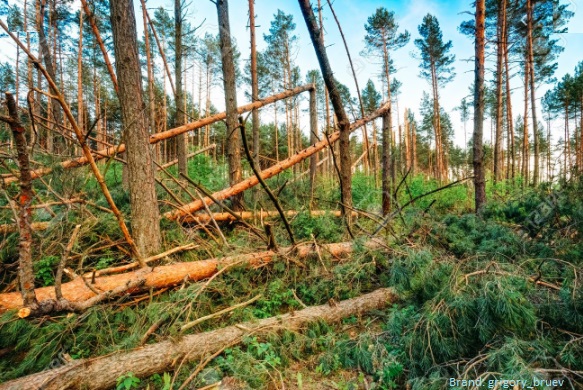
system. By analogy, violent wind passing
through a forest usually does not equally damage and fell all the trees. The older trees with weakened roots and trunks
due to prior storm or lightning damage, internal infection, or decay, are most
likely to be toppled or otherwise damaged.
Like the wind passing through a forest, every pandemic operates by natural
selection to cause greater mortality among those predisposed to the disease
because of their age, genetic deficiencies, nutritional deficiencies, prior accidental
injuries, or history of prior moral choices that had promoted or diminished physical
and emotional health. Some ethnic
minorities experience higher mortality due to a history of discrimination
and unfortunate moral choices that lead to disrupted family structure, poor
education, and lack of spiritual development.

Considering that death is inevitable and that any human population includes a
wide range of susceptibility to, in this case, COVID-19, the question should be
as follows: “In an attempt to protect as many people as possible from COVID-19
infection, how strict can a policy of social isolation be without weakening the
entire population by causing socioeconomic disruption and physical-emotional
effects that lead to increased addiction, crime, and deaths?
The table above reveals the seemingly inevitable high mortality due to influenza
during most years, and particularly from the Swine Flu (H1N1) in
2009-2010. Although Swine Flu caused a
much higher case load of infections and hospitalizations than COVID-19 has to
date, the response to the threat of Swine Flu did not include imposed social
isolation leading over 22 million jobless claims (to date).

As of this writing, it is clear that President Trump and his team, and the
nation’s governors need much discernment as they establish policy that limits
deaths from COVID-19 infections without increasing deaths indirectly resulting from
social isolation and disruption of our economy.
Informed Discernment
Difficult times test our faith. We need
to be informed of both current events and grounded in God’s Word. These two disciplines can help us to exercise
what I will call “informed discernment” to make wise decisions. When I was employed by the USDA-Agricultural
Research Service, my laboratory chief would say, “You will always make the best
decisions from the point of maximum information.” Now, I will add, “having the best quality
information.” Here are some areas
needing our discernment as American citizens in regard to policies on COVID-19:

(a) News sources should report
events with objectivity. They should
separate commentary from objective reporting of the news. With the rapidity of news cycles, good news
analysis includes timelines of unfolding events—e.g. the decisions and actions
toward COVID-19 from December, 2019 to the present. Who knew what, and said what, and when? How have opinions changed? Who was correct from the beginning, even when
receiving opposition.
(b) Scientific data and statistics: I have already written of the importance of “good science.”
(c) Responsible parties behind
the COVID-19 pandemic need to be identified.
Why did the World Health Organization (WHO) and Chinese Communist
leadership fail to lead with information that might have avoided the
pandemic? Some are recommending a stiff
economic retribution for China. But we need
to consider how any penalty aimed at the tyrannical Chinese Communist leaders will
indirectly affect the innocent Chinese people.
(d) Scriptural ethics and
understanding of the need to protect our 1st Amendment right to privacy in any strategy to defeat the virus. For example, should personal smartphone tracking be used to track the spread of COVID-91?
(e) Worship services been altered
by social distancing policies. What are we learning from alternative approaches
to “corporate worship” that can positively affect our worship afterwards? The same is true of how we educate, how we do
health care, and how we maintain our personal health. (e.g. preventive
medicine).
(f) Our view of death, pain, and
suffering (physical and emotional) needs to be brought under the authority and
insights of God’s Word. For example, Jesus
said, In the world, you will have trouble, but be of good cheer. I have overcome the world (John 16:
33). In 2 Corinthians 4, the Apostle
Paul wonderfully addresses the realities of the present world and the promise
of Eternal Life:
i. Ruler
of this world (Satan) has blinded us (1 Corinthians 4: 3-4).
ii. Christ-followers
are to be light and salt (v. 5-7).
iii. Christ-followers will suffer affliction (v. 8-15; Luke 21: 12-13).
iv.
But we do not lose heart for very good reason (v. 16-18).
Yet in all these things we are more than conquerors through Him who loved us
(Romans 8: 37).
Intercession in Prayer
If the foundations are destroyed,
What can the righteous do?”
The LORD is in His holy temple; the LORD’S throne is in heaven… - Psalm 11:
3-4a
Historically, during times of trouble, men and women of faith have prayed to God
on behalf of their own personal sin and the sin of their nation. Here are several examples from God’s Word: Psalm 51, Psalm 130, and Isaiah 6: 1-7 involve
individual repentance; Daniel 9: 1-19 which is Daniel’s intercessory prayer for
his nation; and the Apostle John’s call to repentance in 1 John 1: 5-10.
How should we pray? Here are some prayer
promptings that Abby and I are using, and that I have been using with a virtual
prayer “meeting” with several men of our church:
(a) Churches
and their Pastors as they lead efforts to proclaim Truth and maintain the local
body.
(b) People
– that their hearts will be open to God’s Word, active in ministering to the
needy.
(c) Missionaries—to
powerfully present the Gospel during times of opportunity
(d) Government leaders— for humble
submission to God’s wisdom in important decisions
(e) Medical professionals— for renewed
stamina, wisdom, professionalism, and compassion
(f) Personal opportunities to assist
materially, emotionally, and spiritually in this unique period.
What Do You Think?
If you’d like to leave a question or comment, please use the “Comment” link
below. Or, you may contact me at silviusj@cedarville.edu.
Part of human nature
is to fear things that are large, powerful, potentially deadly, and unpredictable. Hurricanes, tornadoes, global tyrants, and
wars come to mind. But our most recent
threat comes from none of the above---except that it is unpredictable and
potentially deadly. The Coronavirus
(COVID-19) is smaller than microscopic--it is sub-microscopic! We call it the “invisible enemy.”
It is easy to be anxious and even fearful now even though history records that
America has withstood great threats before.
World conquerors, including Napoleon, Hitler, Stalin, Khrushchev have
loomed large on the world horizon. Our
nation has also endured a Civil War, the Great Depression, nuclear
annihilation, the turmoil of the Vietnam War, and the 9-11 attacks. Given the recent revitalization of the economy,
some of us wondered if there was anything large and powerful enough to bring
our nation to its knees? Now we know the
answer is “Yes:” -- a tiny virus—our “invisible enemy.”

Americans who have known the fear of “large enemies” are now especially
unnerved by a tiny “army from the unseen world.” Our lives are threatened by infection and
death, and by radical changes we must now make in our lifestyle. Our fast-paced lives are slowed to a snail’s
pace and many have become increasingly isolated. Any one or all of these happenings are bringing
us face-to-face with the reality of an “unseen world,” and we are now looking beyond
our “invisible enemy” and toward the spiritual world to seek much-needed comfort,
meaning, and purpose.
Does God Have a Purpose for Viruses?
My previous article,
Coronavirus
Resistance: Biological and Spiritual, addressed how
we can respond to the virus pandemic in terms of “resistances” to two kinds—biological
and spiritual. However, I did not
address one important consideration that underlies these two “resistances.” When
tragedy strikes on a grand scale, God is often placed on trial. Sudden events like hurricanes, earthquakes,
and pandemics can make us question the nature and character of God in
two ways.

First, if He is a God of purpose, what possible good is served by
widespread suffering and death? Specifically, if we are to believe the account
in Genesis 1: 31 that “God saw all that He had made, and behold, it was very
good,” then what good is there in viruses that inflict suffering and death upon
humans and many forms of life? And second,
does God even see the sufferings and deaths of people supposedly created in His
very image? And even if God does see,
does He really care?
The answer to the first question, “What good is there in viruses?” is coming
through recent discoveries in the science of biology. Biologists who base their logic on biblical
revelation, may reason as follows:
1) God created the world for His purposes and pronounced it good.
2) God created viruses for a good purpose within His creation.
3) The fall of humans into sin corrupted creation (Genesis 3).
4) The nature and purpose of viruses was altered from what was originally “good.”
This line of thinking, that there is design and purpose in creation, may lead the
scientist in his or her approach to research.
The research of my friend and former colleague, Dr. Joe Francis, illustrates
this point.
Answers from Biology?
As a biology professor at The Master’s University, in Santa
Clarita, California, Dr. Francis approaches his research in microscopy,
cellular immunology, invertebrate biology, and microbiology from an intelligent
design (ID) perspective. Regarding
even pathogenic microbes like viruses, he deduces that if the biological realm
is the product of ID, and if the Designer is the benevolent Jehovah God (a
claim not held by all ID proponents), then there ought to be at least some
beneficial purpose for at least some viruses. Dr. Francis applies his biblical worldview to scientific
logic as follows:
We serve an amazing Creator who has established a life-supporting
microbial-based biomatrix that supports life on earth. So, it should not be surprising that our
Creator uses the smallest but most abundant creature on earth, the lowly
bacteriophage virus, to support life.
His ID-based hypothesis has prompted Dr. Francis to ask if and how viruses contribute
good in creation. A summary of his
findings is contained in his recent article, “COVID-19, Coronavirus, and Creation Virology.” Of particular interest are a group of viruses,
called bacteriophages, that reproduce on or within bacteria and cyanobacteria
(photosynthetic microbes, formerly called “blue-green algae”). To understand how important bacteriophages
are to cyanobacteria, and to life on Earth, we need to review what you may have
learned in your school days about geochemical cycling of carbon, particularly
the carbon cycle.

The carbon cycle may be portrayed as a picture or model tracing the flow of
carbon from reservoirs or “sinks” (in atmosphere, on land and in the oceans) into
organic molecules that are the “building blocks” of living organisms. This conversion
of carbon to organic molecules is accomplished by photosynthesis in green
plants and other autotrophs. Through
release of wastes and through death of living organisms, carbon eventually “cycles”
back to the sinks again.
Scientific
modeling of carbon dioxide (CO2) fixation into organic
compounds reveals that oceanic phytoplankton, including various groups of algae
and seaweeds, and cyanobacteria, convert as much CO2 into organic
form by photosynthesis as the total carbon fixed by all terrestrial green
plants combined. The CO2 fixation
by oceanic phytoplankton is a major reason why oceans are able to absorb a
significant part of human-generated (anthropogenic) CO2 and thus, to
lessen the increase in atmospheric CO2 that contributes to climate
warming. Researchers estimate that cyanobacteria alone may account for 25% of
the total uptake of CO2 by oceanic phytoplankton. Thus, cyanobacteria are very important
players in helping to counterbalance against rising CO2 levels associated
with climate warming.
Having established the significant role of cyanobacteria in global geochemical
cycling of carbon, it becomes significant that some bacteriophage viruses perform
a very important service for cyanobacteria.
Amazingly, bacteriophages can insert genes (segments of the DNA code)
into the cyanobacterial genome. The
benefit is life-saving for cyanobacteria that have been “sunburned” by excessive
rays of the sun. Instead of a
destructive effect on living cells, here we have viruses being “lifesavers.”

But there is another role that viruses play, this one directly affecting the path
of carbon in the oceanic part of the carbon cycle. According to Suttle, on average, a
liter of ocean water contains 3 billion viruses. Oceanic bacteriophage viruses facilitate the release
of organic carbon from phytoplankton, including cyanobacteria. When bacteriophages infect the cells of phytoplankton,
considered a form of particulate organic matter (POC), these viruses cause cells
to split open (lysis) and release C-containing molecules as dissolved organic
carbon (DOC). Ocean studies reveal that viral
lysing of cells (POC) to release DOC keeps more carbon in the shallow ocean layer
where it is more likely to be oxidized and returned to the atmosphere than if
it were to remain part of POC that can sink to greater depths. This “viral shunting” of carbon away from POC which
might otherwise have been eaten by zooplankton herbivores is being much researched by scientists. Their aim is to predict the influence of phytoplankton
photosynthesis and viral shunting on atmospheric CO2 levels and
climate change.
We can see that, based on the hypothesis that God’s creation is good but
groaning under sin’s domination, creationist scientists are not surprised that
viruses have beneficial functions, even in a groaning creation. Dr. Francis
predicts that further studies of viruses may reveal more about their originally
intended functions in creation.
Does God Know Me? Does He Care?
The fact that viruses contribute at least some “good” in this world may not be
very heartening to readers who are infected or wonder if they will be infected
with COVID-19. God may still be “on
trial” in your thinking. You may allow
that God created “good viruses,” but where is God when the whole world and my
life is in such turmoil? At times like
this, we easily tend to view the whole of humanity as tiny specs in the midst
of an expansive universe. Even some who
would give intellectual assent to the existence of God might say with one
writer, Put yourself in the planetary space, a mere dot, and do you think
that the Almighty Maker can have discernment of THEE? I’m afraid this expression of doubt,
aloneness, and hopelessness is increasingly common in our culture today?
F.B. Meyer contrasts the skeptic with the glorious praise of David who as a
shepherd had often marveled at the starry heavens: “How absolutely different is
the outlook of the Psalmist! He stands under the Eastern heavens, blazing at
midnight with myriads of resplendent constellations, and cries: O Jehovah, my Lord, how excellent is Thy
Name in all the earth, who has set Thy glory above the heavens! They are Thy
heavens, the work of Thy fingers; as for moon and stars, Thou has
ordained them. How great Thou art! Then he turns to think of man, and says: ‘There
must be something more in man than a superficial gaze is competent to discover. He must surely possess an unrealized dignity
and worth, since the great God, the Maker of these worlds, stoops to call him friend.” That David and God loved each other as passionate
friends is evident by reading the Psalms (Psalm 8 and 139 are good examples.).

But the faint-hearted might say, “Friendship with God may be for a David, or a
Moses, or an Elijah, but God is not mindful of me, nor would He visit me.” Please hear F.B. Meyer’s response to that notion,
based on Psalm 8: 4 and other Scripture:
What about “Zacchaeus, that the Son of Man should visit his house—is he not a
publican? Yes, but of late he has been
restoring his ill-gotten gains… (Luke 19). What of Simon Peter, that Christ should visit him
(a betrayer)? Ah, but he will one day
become the rock-man, the foremost leader of the Church (Matthew 16: 18)! So [also] does Christ our Lord see what we
may become, and he stands at the door of our life, seeking admission. Let us heed His knock and bid Him come in.”
How About You?
In the midst of this time of uncertainty because of the COVID-19 virus, are
you more inclined to look into the world of the unseen, not to find viruses, but
to pursue God’s rightful place in the center of your life. Maybe these days offer a perfect incentive to
evaluate your source of meaning and purpose.
If you’ve been ignoring, avoiding, doubting, or critically trying God in
your “court of law,” why are you really doing this? I pray that this article has given you
spiritual insight into the greatness and wisdom of God, the grandeur of His
creation, and the goodness of His character as reflected in both the biology of
viruses and the richness of Scripture which speaks of the God who gave His very
best through Christ in order to reconcile us from sin and, if we will respond
in faith. He did this to make us into
His friends. Before
you can be a friend of God you need to take Steps to Peace with God. I pray that you will take these steps. You may contact me at silviusj@cedarville.edu
or enter your questions or responses using "Post a Comment" below.
Acknowledgement:
Thanks to my brother in Christ and former colleague, Joe Francis, for his research on bacteriophages and cyanobacteria; and, thanks to my brother, Mike Naylor, for referring me to Joe's recent work.