Showing posts with label Ohio. Show all posts

Saturday, August 12, 2023

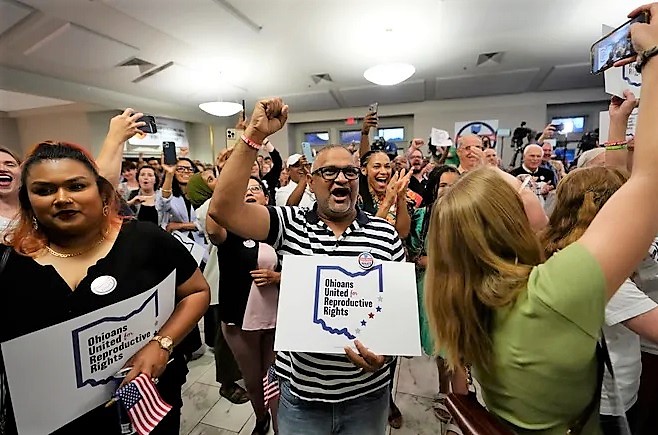
Ohio Issue 1 Defeated-- What Does It Mean?

The August 8 special election in Ohio produced a convincing victory for the opponents of Issue 1. If it had passed, Issue 1 would have increased the size of the majority necessary to amend the Ohio Constitution from the current 50% + 1 vote majority to a 60% majority.  In view of the steeper requirements of most other states, and the two-thirds majority necessary to amend our U.S. Constitution, the call for a 60% majority was certainly reasonable.

In addition to increasing the majority to 60%, Issue 1 would have required that any initiated petition to amend the Ohio Constitution after January 1, 2024 must contain the signatures of at least 5% of the population in each Ohio county.
 In this way, Issue 1 had aimed to ensure that all counties in Ohio, not just urban counties, can have a voice in the democratic process.  [Read more, click HERE.]

Were Ohio Voters Confused?
Admittedly, many of us were disappointed that Issue 1 failed by a wide margin, 57% to 43%.  Our first reaction was to believe that the vote did not reflect the values that a majority of Ohioans place on the sanctity of the life of unborn children, and of their mothers and fathers.  After all, both opponents and supporters focused their appeals on protecting the Ohio Constitution and suggested that, if we don’t vote their way, the will of Ohioans will cease to be represented. Because abortion was highlighted less by both sides, we thought the outcome might represent a confused electorate rather than their views on abortion.

However, when we looked at the polling data prior to the election, we discovered that the “confused voter theory” would not hold water.  Opinion polls taken prior to August 8 revealed that a majority of Ohioans had already declared their opposition to the Heartbeat Law.  In fact, a USA TODAY Network/Suffolk University poll (Click HERE.), conducted July 9-12, 2023 with a margin of error of + 4.4%, indicated that 58% of Ohio voters supported the abortion rights proposal that may be on the November, 2023 ballot, 32% opposed it, and 10% were undecided.   As noted earlier, an almost identical 57% of Ohioans voted against Issue 1.  Also, and Emerson College Poll (Click HERE.) conducted in October, 2022 registered a similar result with 54% opposed, 46% in support of the Heartbeat Law.

We might conclude that the defeat of Issue 1 was in fact reflective of Ohioan’s position on abortion law and not due to confusion from the campaign arguments.  But wait!  We ought to address three more questions that arise--one from the polling data, another from the distribution of the voting across the State of Ohio, and the third, “How Should We Respond?”

Are Polling Data Accurate?
The accuracy of any polling data depends upon how the sampling of public opinion was collected.  For example, how were the questions worded, how large was the sample size, and was the sampling representative, in this case, of the voting population of Ohio?  In our opinion, the USA TODAY Network/Suffolk University poll does not meet these standards.  The polling sample size was only 500 Ohio voters.  This number amounts to only one-half dozen voters per county, and it is unlikely that every Ohio county was represented.  Of the 500 voters questioned, only 46 people were registered voters!  So, the conclusions made from this poll was based largely on 454 individuals, many of whom may not have cared enough to invest the time to become informed and then actually vote.

Nevertheless, we might be tempted to accept the polling results based on the fact that, as we noted above, its results predicted very closely how the vote on Issue 1 would fall.  On the surface, this logic appears sound.  However, we must remember that while pre-election polls can predict the outcome, there is also the possibility that polls can influence an outcome.  For example, voters who have a weak moral foundation and/or who are easily swayed by the direction of the crowd or culture could be influenced by polling data favorable toward abortion.

We now turn to our third question:  Was the outcome of the special election representative of the opinion of Ohioans as a whole?   Just as polling data can fail to represent the opinion of a population at-large; so, a political issue can be decided without a large sector of the population being represented.  Let’s look at the distribution of the August 8 voter returns.

Did the Vote Represent All of Ohio?

Results of the election in each county suggest that the wishes of the rural population of Ohioans, spread over much of the area of the state and representing 67 counties, were not represented in the outcome.  Instead, the outcome was determined largely by urban voters in only 21 counties out of 88 Ohio counties.  Granted, Issue 1 failed on the basis of vote count.  But it is unfortunate that high population densities in relatively few Ohio cities can overpower the wishes of voters in hundreds of small cities, towns, and rural areas.

Perhaps there are at least two challenges given by the defeat of Issue 1.  First, the defeat is an example of the will of “urban Ohio culture” being exercised over the will of “rural Ohio culture.” This outcome emphasizes all the more the importance of the requirement stated within Issue 1.  Namely, if both cultures in Ohio are to be represented in major lawmaking decisions, then any constitutional amendment should require supporting signatures from all Ohio counties.  Second
Ohio will become further divided politically, culturally, and spiritually, unless we work to improve communication and understanding between urban and rural cultures.  If we do not, Ohio will join other states like Illinois, Michigan, and California where cultural values of the more conservative rural landscape are held hostage by deteriorating urban areas.

How can we accomplish bridging the “two Ohio’s?”  From a Christian viewpoint, we have many examples of how the church has been effective in bringing people out of hopelessness to salvation and restoration.  Throughout history and around the world, God’s people have given their love, treasures, and message of hope to urban dwellers.  Many urbanites have never traveled to a rural landscape or been exposed to rural culture and values.  Perhaps readers will join us in praying, seeking God’s leading on how to respond to this need which is increasing with the increase in urban lawlessness and the influx of migrants.  For example, we just published an article, “Community Caring for People and Land” (CLICK HERE.)  What if the example of community caring for people and land exercised in small town Ohio through parks and recreation organizations, churches, etc. could be expanded to build bridges into larger urban communities?  Please let us hear from you.  Use “Comments” below or contact us at silviusj@gmail.com.

How Should We Respond?
No one likes to lose, especially in an important election.  But we must press on realizing that the Heartbeat Law may be on the ballot in November.  We can be informed, advocate, and pray on behalf of lives of the unborn.  We can continue to use the 6-Week Prayer Guide for Ohio, the Unborn, and Women entitled More Than Conquerers, which is freely available for individuals, churches, or groups from the Center for Christian Virtue, an Ohio advocacy group (CLICK HERE for more information.).

Prayer reminds us that we serve on behalf of God’s purposes and His coming kingdom.  Prayer helps us develop a distinct hate and aversion to sin while loving the sinner as Christ loves all of us sinners, both the redeemed and those who still need to repent and receive Christ as their Savior.

Again, our readers should understand that we do not condemn mothers who elect to have an abortion, or the fathers who support or press for that decision.  Rather, we condemn the act of abortion and regret the sin and the judgment that follows this violation of God’s command not to murder (Genesis 9: 6:  Exodus 20: 13).  Isn’t it tragic when mothers who are alive because their mothers chose life decide that their babies have no right to live?  Even apart from the penalty of violating God’s law are the natural consequences of violating the “sowing and reaping principle (Galatians 6: 7-8)”:

Do not be deceived: God is not to be mocked.
Whatever a man sows, he will reap in return. 
The one who sows to please his flesh,
from the flesh will reap destruction;
but the one who sows to please the Spirit,
from the Spirit will reap eternal life.


We conclude with a challenging call from the six-week prayer booklet,
More Than Conquerers, cited above.  The call is to worship and lift our prayers to God on behalf of the unborn, mothers, and fathers:
 
“American culture is captivated by instant gratification. As our attention spans have waned, so has our ability to wait; to endure moments of discomfort and distress; even to understand why sometimes we shouldn't get everything we want the moment we want it.

In such a culture, patient and persistent prayer to the God of the universe is a radical idea. Prayer is stillness. Prayer takes time. Prayer requires honesty and, even sometimes, discomfort. Prayer acknowledges that we are not in control.

Through prayer, Christians are invited to "humble yourselves under the mighty hand of God so that at the proper time He may exalt you, casting all your anxieties on Him, because He cares for you" (1Peter 5: 7).

Not only is prayer counter-cultural to those outside the church; often it's misunderstood inside.  Prayer is not a moment that we decide to spend in God's presence, as if He lives in our world.  Rather, prayer is a moment in which we discipline our hearts to focus on God's constant presence.

Through prayer, we worship God.  Through that worship, we tune our hearts to His goodness.  We remind ourselves of who He is, and of the gift of knowing and trusting Him.  And yes, we bring Him our supplications-- because that is what Jesus told us to do when He said to pray for His Kingdom to come and His will to be done (Matthew 6: 10).

Praying for the protection of preborn babies in a culture captivated by instant gratification, the worship of "individualism," and a growing disdain for the value of human life can feel like a futile endeavor.  But let us remember, again, how God delivered His people from slavery in Egypt.  Exodus 3 contains five of the most radical words in all of Scripture: "I have heard their cries."  And because God heard those cries, with a "mighty hand and an outstretched arm (Deuteronomy 26: 8), He brought justice. 

Pray this week, with confidence in God's goodness and His deliverance, that He would hear the cries of His people for the protection of new life.   Pray that He would turn the hearts of mothers toward their children and away from fear, and that He would thwart all plans of the Enemy to persist in building a culture of death.  Pray that his justice would "roll down like waters" (Amos 5: 24).   
Pray that his Kingdom would come, where every human life no matter how new or small or "planned," is valued and protected. Pray that his will would be done.  (From:  More Than Conquerers, Center for Christian Virtue, pages 13-14.)

Comments:
As always, we welcome “Comment” from readers.   We are particularly interested in your thoughts about the “two Ohio’s,” one urban and the other rural as the Ohio map of Issue 1 voting clearly shows.  If you reside in another state, or in a smaller town or city, you may still experience this two-culture phenomenon.  How can we make a difference?  Please use the “Comment” link below for ideas or questions; or, contact us personally at silviusj@gmail.com

Tuesday, August 8, 2023

Reasons to Vote For or Against Ohio Issue 1

The Akron Beacon Journal Editorial Board, on July 19, 2023, published “8 Reasons for Why Issue 1 Is Wrong for All Ohioans, Even Conservatives.”  
We would like to respectfully respond to each of the 8 points.

1. The arguments are contradictory:  Reason #1 argues that August elections are wrong, if not illegal.  This reason is based on the claim that Ohio lawmakers “largely banned” August elections (but stopped short of doing so) on the basis of low voter turnout that can allow important decisions to be made by “a very small minority of Ohioans.”  But in what seems contradictory, their Reason #2 argues that “Ohio voters are smarter than politicians give us credit” and “can be trusted to do the right thing.”  If Ohio voters are “smart” and “can be trusted,” then why not encourage Ohio voters to turn out next week, vote according to their conscience, and respect the outcome to represent the will of smart Ohioans who cared enough to want what they think is best for Ohio?  After all, when we Ohioans are challenged, we rise to the occasion, don’t we?

2.  The arguments are biased:  Reason #3 rightly claims that “majority rules in a democracy.” And, Reason #4, claims that “citizens should preserve their power.”  The question is, “which side’s majority” will rule, and “which side’s power” will bring the best for Ohioans.  Voting YES on Issue #1 does not mean “one county could stop a petition campaign before it even begins.”  On the contrary, Issue 1 aims to ensure that all counties in Ohio, not just urban counties, can have a part in enlisting us smart, trustworthy Ohioans to “preserve their power” (Reason #4) by participating in the democratic process.  Issue 1 also would assure that the wishes of the rural counties of Ohio which can easily be ignored are given a voice in our constitutional process.

3.  Reason #5 to vote “NO” on Issue 1 is actually a reason to vote “YES:” Opponents of Issue 1 which largely represent a liberal-progressive vision for Ohio say, “Vote NO” because one day, their conservative opponents may be in the minority and have to face the 60% majority requirement if Issue 1 passes.  However, this logic actually favors voting “YES” on Issue 1.  Regardless of which political view occupies the majority, to change our Ohio constitution is a serious matter and should be decided by more than 1 vote more than the current 50% majority. I believe the conservative philosophy of government welcomes the caution exerted by steep majority requirements that can serve as a brake to slow unwise, ill considered changes.

4.  Reason #6—the claim that “supporters of Issue 1 are lying:”  Let’s be honest on both sides of Issue 1.  There is an “elephant in the room” (no pun intended) on both sides.  Opponents of Issue 1 wish to reinstate the right to abort up to a point far beyond when the heartbeat is first detected.  Some favor extending abortion to the point of birth.  On the other hand, supporters of Issue 1 want to raise the bar to change current Ohio law that currently protects the lives of unborn children.  Let’s be forthright on both sides of Issue 1.  Thousands of unborn lives are at stake, as well as the impact on mothers and fathers of these children.  If we honestly define what is at stake, perhaps voter turnout will improve.

5.  Reason #7 rightly claims “Ohioans deserve a fair ‘majority rules’ vote on abortion.”  Unfortunately, opponents of Issue 1 define “fair ‘majority rules vote” as the current “50% plus 1 vote” rather than the proposed, broader-based 60% majority vote which is not too much to ask for major Ohio constitutional changes.  Who of us would want to be the “1 vote” to decide on Ohio law, especially on issues in which thousands of lives are at stake?

6.  Finally, Reason #8 rightly claims that “one-party rule harms Ohio.”  Again, if we honestly admit that the August 8 special election vote on Issue 1 is about whether or not abortion rights are expanded, then it should not be a partisan issue.  When human lives of children and parents are at stake, we ought to vote on moral principle and moral conscience, not according to party affiliation!

Thank you for reading.  Let’s reason carefully, ask what kind of people we are and what kind of people we want to be as Ohioans.  Then, vote with conviction, compassion, and a moral conscience you will be proud to share with your children and grandchildren.

John Silvius
Wooster, Ohio

August 4, 2023

NOTE:  As of this morning, August 8, our “Letter to the Editor” to both the Akron Beacon Journal and the Wooster Daily Record, sister newspapers, has not been published.

COMMENTS are welcomed if you choose to clarify or rebut any point shared in this article.  Please vote today, August 8, if  you are an Ohio resident.

Tuesday, June 16, 2020

COVID-19 News: “Batteries Not Included”


“Batteries Not Included.” 

We’ve all read these disappointing words on the package of a newly purchased product.  It is especially unsettling when the package contains a toy, and your child or grandchild has just unwrapped it excitedly on Christmas morning.

Friday, I “opened” a different kind of “package”—an article reporting new COVID-19 cases in Ashland County here in Northeast Ohio.  With all due respect to its author(s), I selected this article because it resembles many other articles I could have chosen to illustrate the points I hope to make here. 

Like a toy that comes with “batteries not included,” this Ashland Source article comes without an important “power source”—good journalism.  But there’s also a second “battery” missing— “good science.”  The third “battery” must be supplied by educated readers who can exercise sound critical reasoning.

Good Journalism

I’m not an expert in journalism.  However, I located a list seven qualities of a good news story provided by pivotcomm.com.   A well written story should include good sources (e.g. data from “good science”) and provide the necessary focus and context that enables well-educated readers to reach accurate conclusions.  With these criteria in mind, note that the headline of our “example article” reports the occurrence of 5 new positive results of COVID-19 infection in Ashland Co.  This heading would grab attention and maybe even elicit fear among those who think a second wave of the virus is likely.

The Ashland Source article goes on to explain that 4 of the 5 COVID-19 cases “were exposed to the virus at mass gatherings – a wedding, church service, and auction – where safety precautions were not observed.”  Can you identify at least one “red flag” here?  If so, you may be asking how the 4 individuals could have known the exact place and person responsible for infecting them.  (My record at doing this is dismal.)  And finally, who verified that safety precautions were not observed at each of the events--wedding, worship service, and auction?

In spite of limited information, the article includes a stern reprimand from Heather Reffett, Ashland Co. Health Department (ACHD) Commissioner:  “If safety precautions had been in place…at least four of these new infections could likely have been avoided.”  There is no mention of how individual #5 was infected. 

Clearly, the ACHD is faithfully conducting its civil duty.  But in so doing their message through this article suggests that the citizens of the Ashland area should remain isolated and locked down much as they were in April.  But does the larger context of the pandemic in Ashland Co. support this policy?

The article would have been more helpful if it had informed the readers that the 5 new cases bring the total number of cases in Ashland Co. to 27 as of June 12.  According to the last paragraph of the article, of these 27 cases, 22 have recovered and 5 are still recovering.  Although the article dutifully lists the dates, beginning March 18, when each COVID-19 positive case was reported, it does not mention that there have been no deaths in Ashland Co. to date.  No deaths in Ashland Co!  This statistic is quite striking considering that, according to my research at the Johns Hopkins Coronavirus Resource Center, neighboring counties ranged from 1 to 61 deaths (average = 21) attributed to COVID-19.  And what about death rates statewide in Ohio?

We would expect the number of COVID-19 cases in Ohio to increase now that increased testing is occurring.  But if the virus is posing a threat to Ohioans sufficient to justify a total lockdown for nearly two months, we would expect to see a significant rise in total deaths in 2020 compared to deaths in previous years.  But, according to Dr. Mary Kate Francis, interim medical director at the Ohio Department of Health, quoted in the Akron Beacon Journal, “Despite the climbing death toll, though, total deaths are up by 1.2%, or 680 people, in 2020 compared to the previous five-year average, according to state mortality data.  It’s “hard to guess as to what could be the case or the cause” for a lack of an overall surge, though several factors have probably contributed, Francis said.

One factor to account for the absence of the predicted increase in deaths this year is the fact that epidemiological models were very misleading.  Based on modeling data, in early April, Gov. DeWine had predicted as many as 60,000 new cases in Ohio per day!  However, at the COVID-19 peak in Ohio, around April 19, less than 1,300 new cases were reported per day.  It is hard to account for this discrepancy (prediction was off by a factor of 46-to-1) based entirely on good public compliance to social distancing that “flattened the curve.”  Here is where we need “good science.”

“Good Science” Needed
I have been particularly interested in how the scientific data on COVID-19 is obtained and interpreted.  See “Pandemic—or Policy without “Good Science?” Our example article from Ashland Source refers to the basic reproduction number (or reproductive ratio, Ro) of a virus.  Please don’t panic here when you see the symbol, Ro. What follows is not beyond your ability to understand if you read slowly and stay with me.

In simply terms, Ro is the number of people that one infected person will infect in a population.  So, if one person develops the infection and passes it on to two others, the R0 is 2.  The “0,” or naught, indicates a reproductive number (R) for a new virus in a population with zero immunity. Jeffrey K. Aronson, et al. of the Centre for Evidence-Based Medicine , University of Oxford, explain in more detailed terms that Ro is “the number of cases that are expected to occur on average in a homogeneous population as a result of infection by a single individual, when the population is susceptible at the start of an epidemic, before widespread immunity starts to develop and before any attempt has been made at immunization.”

The article refers to estimates of Ro reported by Ohio Governor Mike DeWine.  According to the governor, “Ohio’s R0 number was as high as 1.9 in March but as of June 1, it was slightly lower than 1.”  Gov. DeWine has attributed the decrease to the interventions implemented by his administration to “flatten the curve.”  Ohio’s Region 5, which includes Ashland currently has an R0 of 0.72.

By this time, you may realize that, by definition, Ro applies only at the start of viral infection of a population.  In contrast, the  effective reproductive number, is the number of people that can be infected at a given time during the progression of the virus in a given population.
The Re “changes as the population becomes increasingly immunized, either by individual acquired immunity following infection or by vaccination, and also as people die.”  Gov. DeWine and the ACHD seem to be misusing the Ro value (applies only at the start of viral infection of a population).  As noted in the previous paragraph, where Gov. DeWine reports changes in Ro, in all likelihood he is referring to Re.

The estimated Ro for COVID-19 (or SARS-CoV-2) is given in the adjacent figure from CEBM.  Note that COVID-19 to date is not significantly more deadly than several prior influenza viruses.  Yet, because we adopted the policy of broad separation and economic lockdown, this pandemic may end up being much more devastating because of economic disruption, deaths from delayed health procedures, suicides, and drug abuse.

We should note that estimates of Ro, are based on complex mathematical modeling which incorporates estimates of susceptibility, infectivity, and rate of removal of individuals by either recovery through acquired immunity or through death.  As I have already stated, considerable variability has occurred among the epidemiological models largely because they are predictive and based on limited data.  Some of the modeling error may be attributed to the unexpected compliance of our culture to social distancing guidelines.  But there is still reason to doubt their accuracy.  George Box, the noted British statistician, has quipped: “Models, of course, are never true, but fortunately it is only necessary that they be useful. For this it is usually needful only that they not be grossly wrong.”  See “Pandemic—or Policy without “Good Science?

In conclusion, I have noted the importance of good journalism, good science, and an educated population that can think critically to read and analyze articles such as the one from Ashland Source on the topic of the COVID-19 pandemic in Ashland Co., Ohio.  So far in Ashland Co., there have been no deaths and only 27 reported cases as compared to over 5,000 cases and 303 deaths in Cuyahoga Co. (Cleveland).  Obviously, reported cases and deaths vary greatly among different Ohio counties depending on population density.  However, in no case did number of cases and deaths reach those predicted by the models used to justify the total lockdown. Today, a more recent report in Ashland Source hints that the county's low number of cases (28 as of today) and their very well executed Continuity of Operation Plan (COOP).

Nationwide, it remains to be seen whether broad isolation instead of protection of vulnerable individuals was worth the great cost of economic disruption, unemployment, interruption of routine health care, and termination of most social and cultural events, classroom education, and spiritual gatherings. 

It is not uncommon that both toys and news stories come with “batteries not included.” But let us pray that our nation doesn’t suffer from news reporting that is poorly communicated, lacking in “good science,” and even biased to serve dishonest political or economic gain.

More Questions to Consider:
1.  
Can you see how important it is that we exercise caution and think critically, especially when the journalism sometimes lacks sufficient accuracy, context, and helpful assistance to critical reasoning on the part its readers. 
2.  Ohio residents, how many COVID-19 cases have currently been recorded for your county.  You can go to various sources such as Akron Beacon Journal.  Here, scroll down to the Ohio map and click on your county for statistics.  Readers from outside Ohio can find similar data at the Coronavirus Resource Center under your state.
3.  How do deaths from COVID-19 compare to other causes of death?  You can look up a listing of DEATHS BY DIFFERENT CAUSES IN YOUR STATE.  Then, observe how the average deaths from each cause for the past few years compares to the deaths in 2020 (adjusted for the fact that we are only about six months into 2020).  Particularly, how do COVID-19 deaths compare to deaths from other influenza viruses?

Saturday, November 26, 2016

Let's Value the Team…and Our Opponent

Today is Saturday, but not just any Saturday in November.  Today is “Game Day” in one of America’s greatest football rivalries.  To the Michigan Woverines and Ohio State Buckeyes, and their fans across the nation and world, this is “the Game.”  The Michigan-OSU rivalry is immense not only because of the yearly anticipation but because of the long history that includes great coaching on both sides of the Michigan-Ohio border.  Who can forget the days of Woody Hayes (OSU, 1951-1978) and his former assistant coach, Bo Schembechler (U of M, 1969-1989), who became archrival head coaches when Bo crossed the line into Michigan to coach the Wolverines, in 1969?

Bo Schembechler, Michigan Head Coach,  1969-1989
On this Game Day, 2016, less than an hour to kickoff, Buckeye Head Coach Urban Meyer, and Wolverine Head Coach Jim Harbaugh are each probably giving their last minute challenges to their respective teams.   This morning, our son, Brad reminded me of another great motivational speech, now called “The Team Speech” given by Coach Schembechler to his Michigan Wolverines during the 1983 football season.  Here is an excerpt:

No man is more important than The Team. No coach is more important than The Team. The Team, The Team, The Team, and if we think that way, all of us, everything that you do, you take into consideration what effect does it have on my Team? Because you can go into professional football, you can go anywhere you want to play after you leave here. You will never play for a Team again. You’ll play for a contract. You’ll play for this. You’ll play for that. You’ll play for everything except the team, and think what a great thing it is to be a part of something that is, The Team.

As Brad noted, Schembechler’s words still ring true and valuable to us not only for sports teams, but for success in every human endeavor including marriage, family, the corporate world, government, and the military.  One of the great values of competitive sports is that it prepares men and women to be “team players” for life.

But there is a second great value from rivalries such as the Michigan-OSU rivalry.  There can be no rivalry without a team—and its rival opponent.   It’s “the Team, the Team, the Team,” for team success; but, each team and its fans must also respect the rival team and its fans.  Just as each individual player on a successful team must surrender his or her individual rights to the good of the team as a whole, so each of the rival teams and fans must recognize and defer to the hopes and dreams of the rival players and fans.


With son, Brad, and gandson, Caleb, 2009
One of the great memories I have shared with Brad was when we walked to the Big House, in Ann Arbor, to watch the Michigan-OSU game, in 2009.  We were accompanied by my grandson and Brad’s nephew, Caleb Salyers; and, by our mutual friend, Brian Flora.  What made it so special was not who won (OSU was the victor), but the fact that we as Wolverine fans could stand (Who could sit down?) next to Buckeye fans and treat one another with respect and have enjoyable conversation during an exciting game.

There is a lesson we can learn from respectful engagement between strong rivals in sports.  Just as healthy rivalries make better teams and better individuals, so respectful disagreements can strengthen marriages, family, the academic world, the corporate world, and the realm of politics.  Those who disagree with us are to be valued, not silenced, rejected, or destroyed.  We need to learn from the sports world how to have respectful disagreement in our homes, at work, at school, and in politics.  Those who respectfully disagree in a democratic society make is better citizens.

When we forget the importance of civility in political discourse.

University administrators who are providing “safe zones” for their students to protect them from “hate speech” may need to revisit the mission statement of their institution.  Of course "hate speech" ought to be addressed, but unfortunately many administrators seem   to be ignorant of even basic biblical principles like "love thy neighbor." Most mission statements will include words like community, commitment, exploration, ideas, critical thinking, academic, and freedom.  However, it seems that political correctness has overtaken polite consideration of differing opinions and ideas raised in a spirit of civility.   The Apostle Paul wrote in 1 Thessalonians 5: 15,

See that no one repays another with evil for evil, but always seek after that which is good for one another and for all people.

In conclusion, I thank Brad for “tossing me the morsel” about the importance of “the Team concept” in sports, but also in our respective marriages and in other areas of life. Thanks, Brad, and with that I will conclude lest I follow my tendency to write a too-long blog. 

It’s time for kick-off!   Go BLUE!  And to my Buckeye friends, I hope you enjoy the game.


Related Article:   Sports without Spirit

Tuesday, October 25, 2016

Does America “Have a Prayer?”

I’m just one among many Americans who are disappointed with the presidential candidates of both parties in Election 2016.  I’m also just one among those who have chosen not to vote early and who are praying for specific evidence that God will move in the hearts of both the American people and the candidates.  I have expressed some thoughts on the election in two previous articles in Oikonomia (See links below.).

Perhaps you are also disappointed and discouraged about the candidates.  It will not be the first time that we’ve had a choice between candidates that have been alleged to have had immoral relationships.  Both John F. Kennedy and Lyndon Johnson come to mind.  Nor will it be the first time that presidential campaigns have conducted unlawful acts to favor their election chances and then lied about it.  Both Richard Nixon and Barack Obama come to mind.  I should hasten to say that the misdeeds of previous presidential candidates is no justification for excusing the character flaws of Donald Trump and Hillary Clinton.  However, today Abby and I were blessed to attend a rally featuring a political leader who appears to have passed the character quality standards of all who know him well.


Vice Presidential Candidate, Mike Pence, in Ashland, Ohio
Speaking at a campaign rally at Ashland University, Ashland, OH, Indiana’s Governor Mike Pence, Vice Presidential candidate and running mate of Donald Trump, must have observed the expressions of concern and yet of hope on the faces of the over 700 people who had come to hear him speak.  Pence’s words were intended to encourage voters:  I encourage you to have faith. Have faith in the American people.

Then, Pence quoted Donald Trump’s words spoken earlier this week in Gettysburg, PA:  We need to rise above the noise and clutter of our broken politics and embrace the great faith and optimism that has always been central to the American character.

It seems that both Pence and Trump have been thinking much about faith.  But we were especially encouraged when the VP candidate addressed faith with these words:

If you have a mind to, exercise that other kind of faith.  You know, I recognize this is a challenging time in the life of our country.  It seems like we are more divided today than any time in my lifetime.  Seems there are so few great causes that unite us as they once did.  But, in much more challenging times, the American people have gone to a well to draw strength, and I think we ought to be going there again.


After a rousing applause, Pence gave a more personal appeal that seemed to resonate from deep in his own heart of faith:

So, if you are inclined to bow the head and bend the knee now, the next fourteen days is a good time to do it.  I’m grateful that some of the sweetest words I ever hear are when people say, “I’m praying for you.”  And, some of the sweetest words Donald Trump ever hears. 

Then, as if to answer a question in the minds of many in his audience and in the American electorate; namely, “How should we pray?” Mike Pence added:

But let me say, I’m not so much talking about praying for people or praying for an outcome.  I rather like what Abraham Lincoln said so many years ago during his time of trials when he was asked if he thought God was on his side.  He said I’d rather concern myself with whether we’re on God’s side as opposed to whether He is on our side. 

As if he understood another faith question that many Americans have today; namely, “Will our prayers make a difference?”  Pence continued:

So pray for our country, pray for this great nation, this last best hope of Earth [as Lincoln called America].  All the world looks with hope and aspiration to America.

What followed in Pence’s speech explains both his solid character and how his qualities as an American leader are nurtured through a strong faith in God, and in communion with God through prayer and through Scripture:

[And pray] for our strength for this time of decision.  And, when you do, pray with confidence.    Because what has been true for thousands of years is still true today—that if His people who are called by His name will humble themselves and pray, He’ll do like He has always done in much more challenging times, He’ll hear from heaven, and He’ll heal this land--this one nation under God, indivisible with liberty and justice for all.

Moral issues at stake in Election 2016
In conclusion, Mike Pence’s stump speech was devoted heavily to addressing issues that are crucial to the future direction of America and which demonstrate that Trump-Pence has a very different view of what America ought to become than Clinton-Kaine.  Many of these differences touch issues that are deeply rooted in the moral and ethical foundation of the Judeo-Christian Scriptures as explained by a voter guide prepared by the Ohio Christian Alliance.  

While it is true that both Trump and Clinton have raised questions in our minds as to their qualification for president, it is heartening to know that Governor Mike Pence is a man of solid faith and moral character.  It is also encouraging that both Pence and Trump are aware (perhaps becoming more aware each day) of the importance of faith in our nation’s affairs. And with these facts, we ought to be encouraged that in spite of our moral failings as Americans and as a nation, God is still working in the lives of at least some American leaders that are worthy of our respect, and even our vote in Election 2016.


How About You?  I welcome your "Comment."  Here are links to earlier articles on Election 2016: