Showing posts sorted by relevance for query black lives. Sort by date Show all posts

Saturday, June 6, 2020

#BlackHeartsMatter: Getting Our Hearts Right

This blog article originated partly from a social media exchange and partly from a phone conversation.  Both were related to our current national response to the tragic murder of George Floyd in Minneapolis, on May 25.  During the phone conversation, my friend noted that one or more of her friends had been called “racist” for not including #BlackLivesMatter in their social media posts.

Watching Our Words and Hashtags
My first thought was to remember my own current blend of emotions over Floyd’s death and the passion now on display across America—the mixture of grief, disgust, anger, hate, hopelessness, etc.  These emotions have also embroiled social media.  Even well-meaning posts can erupt into exchanges that express the dark side of our hearts. 

I hope not to add to the tensions that already exist among people online.  But I am trying to make sense of what is being reported in the media, and through conversations I have had recently.  Forgive me, but it helps to write out my thoughts—hopefully, I am not worthlessly “spewing.”

First off, we may agree that virtual conversations involving brief repeated exchanges can easily be misunderstood by our inaccurate wording.  Even well worded sentences do not convey the tone of voice or facial expressions we normally see in real-time, face-to-face conversations.  On top of this, add a “hashtag” and suddenly, a well-meaning statement can become a flaming arrow with a life of its own, ricocheting about and stabbing into hearts of readers.

Today, “#BlackLivesMatter” is a potentially incendiary hashtag that carries with it much of the hurt, grief, passion, anger, and disgust that is driving both peaceful demonstrations and accompanying looting and violence.  I am honestly trying to be sensitive to these emotions.  I also believe there is justification for prolonged expression of these emotions along with respectful, impassioned calls for justice and reform.  However, it is also evident from the instance I cited at the beginning of this article that the use of #BlackLivesMatter (or other similar expressions--e.g. #BLM, the phrase “Black Lives Matter”), because of the connotations it carries, can easily squelch constructive conversation as well as legitimate public demonstrations.

Evaluating #BlackLivesMatter
As I am trying to understand some of the incendiary nature of #BlackLifesMatter, it seems to me that some who use this slogan have given in to the temptation to appoint themselves as the standard for how all others ought to think and act toward “Blacks” (or other ethnic minorities).  With all due respect, they seem to be the self-appointed “high priests of ‘blackness’.”  Therefore, to them, because I am “White” (or “white”), nothing I am writing here carries value or authority.  Neither am I perceived as one who understands or empathizes with Blacks, Black cultural heritage, or the current struggles of Blacks.

Because of my ethic background and my personal experience, I will admit that I have trouble understanding and empathizing with Black Americans.  Nor do I currently experience the kinds of ongoing, subtle or outright emotional and physical causes of anxiety, suffering, and death that have been or are currently being experienced by Blacks.  But then, who is worthy to represent Black lives and to define its mission?  And who possesses the authority to decide when the #BlackLivesMatter mission is accomplished?  And what will the area now occupied by the United States of America look like when the mission is accomplished?  The answers to these questions are not obvious to me but they would appear to be at least somewhat elusive.  In fact, many people wonder whether the Black Lives Matter movement has any consensus as to its actual mission and desired outcome.  For example, here are several points I’ve been pondering.

Biology and Politics of “Black”
First, we would assume “the worthy” person or persons of #BlackLivesMatter ought to be “Black.”  But how “Black?”  Biologically speaking, I have explained elsewhere that humankind is of one race, not many.  How black must a person’s skin be in order to be “Black?”  Or how “White” in order to be disqualified?  According to D. J. Witherspoon, S. Wooding, et al. publishing in the journal, Genetics (176: 351–359 May, 2007), “…most human genetic variation is found within populations, not between them.”  Rob DeSalle and Ian Tattersall, both at the American Museum of Natural History, conclude, “race is a totally inadequate way of characterizing diverse humankind or even of helping understand humanity’s glorious variety.” [See “Black History 3:  Bible and Biology Erase Racism”].

 
There are many Blacks such as Ben Carson (@SecretaryCarson), Candace Owens (@RealCandaceO), and Jack Brewer (@JackBrewerBSI) who disagree with the tenants of Black Lives Matter.  Therefore, some in #BlackLivesMatter dismiss these Blacks because they are not really “Black.”  Legitimate voices from both “Blacks” and “Whites” are rejected or silenced, often by both #BlackLivesMatter and some media outlets, if they do not meet the standard of “the worthy.”  But what constitutes the “standard” for being among “the worthy?”

Individual versus Institutional Sin
Turning our attention to a major source of the passionate cry for justice, our law enforcement officials across the nation, it is clear in at least some cases that there is need for reform, greater accountability, and justice to those who are proven guilty of abuse of their authority.  George Floyd would likely be alive today if Derek Chauvin had been held accountable for multiple earlier violations of proper police guidelines.  But, while it seems clear that Chauvin and his colleagues who were complicit in the murder of George Floyd should be charged and sentenced for their grievous crime, some in #BlackLivesMatter claim that all police regardless of ethnicity, professional record, or character are unworthy to be our protectors or enforcers of the law.  In fact, #DisbandPolice movements are emerging in major cities on the premise that all police are unworthy. 

If Black Lives really Matter, how can anyone who cares about Black Lives support dismissal of entire police departments and leave some of the most vulnerable communities including Black communities vulnerable to what will undoubtedly become vigilante law?  Here we can see the illogic of “throwing out the whole barrel of apples” when one or two “bad apples” are discovered.  It is both biblically and legally justified to condemn individuals who commit acts that clearly stem from bigotry.  It is also right to identify and reform institutions guilty of “institutional racism”—i.e. where one or few “bad apples” have spread their “rot” to the point of corrupting the mission and purpose of the institution.  However, it cannot be either biblically or legally justified to condemn a whole institution for the actions of one or a few.  This point brings us to the social media exchange I noted at the beginning.

Church Discipline or Demolition?
The following is a Facebook post from my friend followed by a response from one of his/her friends:
FRIEND:  The decline of Christianity in Europe and North America, whatever its proximate causes may be, is ultimately God saving the Church from white supremacy.  God can, in his time, rebuild what he tears down. But now is a time for tearing down (Ecclesiastes 3:3).  Let us not be found opposing God’s will.  I’m sure others have already said this, and I confess I am late in seeing it clearly.

RESPONSE:  Yes!!  Thank you, __ (name)!  The church has been one of, if not THE main agent in perpetuating white supremacy.

I love my friend and his/her family.  We have been friends for many years.  I do not know his/her friend.  I also understand and respect his/her genuine concern and desire for the Church to flourish in all of her roles on Earth to proclaim the good news of salvation, release to the captives held by sin’s bonds, to bring man sons to glory, and to glorify our God and Savior, Jesus Christ.  But I also understand the tremendous diversity that exists within the true Church and within Bible-based local churches.  Therefore, I resist the pessimism that many seem to have.

Some local churches are almost entirely Caucasian, others are a mix of many ethnic groups, and some are almost entirely Black.  Our church is largely Caucasian.  Therefore, we may be unknowingly naïve or ignorant of ethnic diversity and struggles.  Ignorance is not sin unless we are not teachable and allow it to lead to wrong judgments.  We are fortunate to have a godly Black man who is married to a lovely Caucasian wife who serve on our pastoral staff.  We can learn from their example and teaching, first as our brother and sister in Christ, and secondly from the insights on cultural diversity which they bring to us.  But most of all, where the Scriptures are taught and sincerely followed, and where even biology is understood, there ought not to be a hint of bigotry or white supremacy.

Here, we must return to our question, “Who is Worthy?”  Specifically, who among #BlackLivesMatter is worthy to pass judgment on a local church, or upon “the Church” worldwide?  For those who reject the authority of God and His inspired Word in Scripture, nothing beyond this point in the article will be agreeable to you—I understand your rejection for reasons you can find taught in the New Testament.  If you are currently choosing to reject the teachings of the Bible, please consider what Jesus Himself taught in His parable of the sower and the seed (Luke 8: 5-15) and what the Apostle Paul taught in 1 Corinthians 2: 6-16.  Personally, neither can I discern these truths apart from God’s love and His grace that opened my eyes spiritually.  Regardless of our personal choices, we must be assured of this:  All men and women are created to live under authority—the question is which authority will we choose or allow?  If not our government and our local justice system, then who?   And will that authority have our good interests in mind?  Sadly, anarchist views are being directed
 toward both local police and toward our children to incite them to defy their parents.  

Church Discipline and Restoration
Based on the authority of Scripture, I also find no teaching in Scripture that licenses an individual to judge a local church or “the Church (worldwide).”  That right is reserved for God Himself and His Son Jesus Christ who condemned proud, corrupt religious leaders (e.g. Matthew 23).  He wept out loud over His holy city (Matthew 23: 37; Luke 19:41-44) and promised stern judgment against apostate and lukewarm local churches (Revelation 2 and 3).

But what if there are indications of bigotry among God’s people in a local church today?  The Scriptures teach the individual born-again believer how to interact in the body of Christ.  We find particularly in Paul’s Epistles instruction for right living for husbands, wives, children, employees, church leaders, etc. The focus is on individual responsibility and accountability before God for how we conduct ourselves in relation to God and toward our neighbor, whether they are a brother or sister in Christ or an unsaved person-- and we are to make no distinction between ethnic groups (1 Corinthians 12: 13; Galatians 3: 28 and Colossians 3: 1-17, especially v. 11).  Bigotry is a sin against God and our neighbor!


The Scriptures give clear instructions that it is the responsibility of mature Christ-followers to confront a brother or sister in Christ who is believed to be living in sin.  Galatians 2: 1-2 states, Brothers and sisters, if someone is caught in a sin, you who live by the Spirit should restore that person gently. But watch yourselves, or you also may be tempted.  Carry each other’s burdens, and in this way you will fulfill the law of Christ [which, see Gal. 5: 14, is to love our neighbor as we love ourselves].  Jesus outlined our responsibility as individuals if we are offended to go directly to the offender privately (Matthew 18: 15) and if he or she doesn’t repent and turn from the sin, bring one or two others with you and confront again (v. 16).  If he or she still refuses, then the whole church membership should hear the matter and if there is still no repentance, the offender is to be dismissed from the local membership as a step toward their repentance and loving restoration when that occurs.  When local churches practice godly discipline, individual sin of any kind does not become “institutional sin.”

The question remains, “Who is Worthy?”  Answer?  None of us is ultimately worthy to judge his or her neighbor, regardless of ethnicity or spiritual condition for the purpose of condemnation.  Nor are we worthy to condemn our parents (Exodus 20: 12, the fifth Commandment), our churches, the Church, or our institutions of government for God has placed rulers in authority over us for our good (Romans 13).  Instead of pessimistically judging and condemning individuals and institutions, we are to exercise stewardship, living as salt and light to others—one at a time (Matthew 5: 10-16), even in our dutiful confrontation where necessary.

The Life and Death that Matters Most
In all of these claims, my authority is the Lord Jesus Christ who suffered the most unjust and horrible death imaginable, and He alone is with without any sin.  Read carefully Isaiah 53 and allow God’s Word to speak truth into your heart—Jesus died not only for your sin and mine, but also for our sorrow, our grief, our frustration.  Let us look into our own “black hearts” which can so easily express the fallen tendency of our sinful nature (Galatians 5: 16-21).  At the foot of Christ’s Cross, we see how much He suffered to take away sin from us (1 John 3: 5).  Praise God!  May God help us to adopt a lifestyle of repentance of our sin and arise in new life, yielded daily to the work of the Holy Spirit in us.  He alone can produce the Fruit pleasing to God and a blessing to our neighbor—Love, Joy, Peace, Patience, etc. (Galatians 5: 22-26). 

How About You and I?

Do you and I need to “call ourselves out” to repentance (James 1: 19-27)?  
If we do, repentance will help us rightly discern the error in the spirit behind #BlackLivesMatter.  Perhaps we will be directed to live by #BlackHeartsMatter, being among those who look first into our own hearts, taking the log out of our own eye first before pointing to sin in our brother or sister (Matthew 7: 3-5).  Above all, we must never forget that no one is truly Worthy except our Savior, our Redeemer, our Counselor, and our Friend.  Why not take time, as I want to do again, to read carefully the Scriptures I have cited in this article, especially Colossians 3: 1-17. Let's allow God’s Spirit to speak His Truth to our hearts?  I would recommend while you read, to listen to Chris Tomlin’s lovely song, “He is Worthy.”  Indeed, only Christ is Worthy!

Friday, May 17, 2013

Jackie Robinson -- “YOU Don’t Belong Here!”


“YOU don’t be-lo-o-n-g here!” How many times did Jackie Robinson, America’s first black, major league, baseball player, hear this derogatory statement and dozens of more barbs hurled at him from different corners of major league stadiums in the late 1940’s?   Branch Rickey, manager of the Brooklyn Dodgers, also bore much criticism for choosing Robinson and supporting him emotionally and spiritually as together they broke the color barrier to major league baseball.

This Spring, the movie 42, named for the historic number worn by Jackie Robinson, recounts how Robinson and Rickey, broke the color barrier to major league baseball, in 1947.  To accomplish this feat, Rickey wanted a talented black baseball player who could “stand and deliver” at the plate when the pitches came.  But Rickey also wanted a player who could stand and take the verbal and physical abuse hurled at him both on and off the field. The following dialog between Robinson (played by Chadwick Boseman) and Rickey (Harrison Ford) attempts to capture what was at stake for both men:

Rickey:   “Your enemy will be out in force but you cannot meet him on his own low ground.”
Robinson:   “You want a player that doesn’t have the guts to fight back?”   
Rickey:  “No, I want a player who’s got the guts NOT to fight back.”
Robinson:  “You give me a uniform and give me a number on my back, and I’ll give you the guts.”

In spite of the ensuing abuse hurled at him on and off the field, Jackie Robinson proved himself in the minor leagues and then with the Brooklyn Dodgers.  Few of us can even imagine the challenge of having to perform on an athletic field while listening to degrading taunts like “You don’t belong here!”

The torments and temptations that Jackie Robinson faced in breaking the color barrier to major league baseball were rooted in the most fundamental temptation used by the Satan from the beginning of human history.  Satan’s tempting ploy, expressed through the serpent in the Garden of Eden, was a variation upon the same ugly statement, “YOU don’t belong here!”  

God had appointed Adam as a “servant king” over creation to serve and preserve it as an expression of His own love for creation.  Then, God created woman out of Adam’s flesh to provide him with a complementary partner; and God performed the first marriage between man and woman.  However, Satan’s approach was to divide and deceive both partners.  His question to Eve, Indeed, has God said, 'You shall not eat from any tree of the garden'?  caused her to wrongly believe, “I don’t belong here!  After all, God must be withholding something greater from me.  Instead, look at me here, living under the restrictions of both God and my husband.”  Eve succumbed to temptation, and Adam along with her.  As a result of the fall of man, every one of Adam’s descendents is infected with the curse of sin.

How many lives of people from all walks of life have been deceived and destroyed by succumbing to the Tempter’s whisper, “You don’t belong here?”  Instead of celebrating the amazing ethnic diversity that exists within the human gene pool, we have used the differences like skin color, language, and cultural traditions as an excuse to divide, wall off, and exclude each other--complete with posted signs like “Whites Only” and exclamations like “You don’t belong here!”

But there was One Man Who withstood the Tempter’s snare--the God-Man, Jesus Christ.  The Gospels record Satan’s attack on Jesus with the same ploy he used on Adam and Eve—“You don’t belong here!  Look at you, Son of God, here in this wilderness without bread (Matthew 4: 1-4).”  Later, Satan offered Jesus a supposed better place to belong: “You belong on the pinnacle of the temple where all can see Your power as You cast Yourself to the ground and are protected by angels (v. 5-6).  But our Savior resisted the temptation (v. 7) and eventually went to the cross as a sinless sacrifice.  Isaiah 53: 11 reveals Jesus, the Suffering Servant, prophetically:

 …as a result of the anguish of His soul, He [God the Father] will see it and be satisfied; By His knowledge the Righteous One, My Servant, will justify the many, As He will bear their iniquities (Isaiah 53:11).

As a result of Christ’s victory over death, He became the first of many who by faith in God are marching in the victor’s triumph over sin and temptation (2 Cor. 2: 14).  The movie 42 makes clear that the “guts” of both Rickey and Robinson were undergirded by their Christian faith.  Rickey challenges Robinson, “Like our Savior, you have to have the guts to turn the other cheek.”   

Branch Rickey encourages Jackie Robinson in scene from 42
In one of my favorite scenes, Robinson retreats to the tunnel after being verbally abused on the field.  There in the apparent privacy of the tunnel, Jackie emotionally explodes and splinters his bat in frustration.  Seemingly out of nowhere, Branch Rickey appears at Jackie’s side.  Sensing Jackie’s frustration, Rickey embraces him but is greeted with Robinson’s accusation, You don’t understand!  Rickey replies (as I recall), No.  I don’t understand [what you are going through]. But the Savior does.  It’s the wilderness [referring to Christ’s physical, emotional, and spiritual battle with temptation].

Jackie Robinson’s accomplishment on behalf of Black Americans places him in a long line of distinguished Americans of color whose faith, courage, and determination enabled them to be the first to enter other avenues of life in America.  Thus, in 1869, Hiram Rhodes Revels (R-Mississippi)(1827-1901) became the first Black American elected to the U.S. Senate, while Joseph H. Rainey (R-South Carolina)(1832-1887) became the first Black in the U.S. House of Representatives.  Likewise, Black Americans have made major contributions in education (Booker T. Washington, 1856-1915), the fine arts (Edward Clark, 1926- ), and statesmanship (Frederick Douglass (1818-1895). 

Among Black American women who rose to leadership and helped others achieve their destinies is
Harriet Tubman, credited with leading over 300 slaves to freedom through the “underground railroad.”  In recent years, Condoleeza Rice became the first Black American to serve as a U.S. national security adviser; and later, the first Black woman to serve as U.S. Secretary of State (2005-09).

Although the sampling of Black American’s I have included here is relatively small,  I believe those I have chosen represent the great number of Blacks who have not bowed to the taunts represented in the abusive claim, “You don’t belong here!”  Indeed, I would contend that those of any minority, whether Black, Hispanic, Irish Catholic, Jew, or Asian have succeeded, particularly in more recent times, because they overcame an even more subtle obstacle; namely, the tendency of some in positions of power to treat them as a “constituency.”  Members of constituencies are often discouraged and dispassionate in the face of constant reminders that they have been treated unjustly and therefore, are deserving of special advantages to compensate for these injustices.  Instead of being told, “You don’t belong here!” they hear a different, condescending message; namely, “You belong HERE.  You belong on a “plantation of Washington’s creation”--among those who have become perpetually dependent upon government handouts through food stamps, welfare, etc.”   In return for your gratefulness for these handouts, come election time, you should be kind enough to give your vote to those who are always there to help you along.

Creation of a political constituency by fostering dependence upon government is immoral and diabolical because it degrades the very spirit within man that can only be fulfilled by striving to achieve the purposes for which he or she was created.   Consider what really is necessary for achievement for anyone including Black Americans, as expressed in Harriet Tubman’s challenge:

Every great dream begins with a dreamer. Always remember, you have within you the strength, the patience, and the passion to reach for the stars to change the world.

Frederick Douglass understood the importance of individual responsibility in striving for success and listed “honor, integrity and affection" as the essential prerequisite for enduring success.  In his lecture, “
Self-Made Men,” Douglass, the great Black orator, educator, and statesman of the Civil War era, describes a natural hierarchy of men which includes the “ambitious man” and the “unmotivated man.”  He applies the moral principle as follows:

the man who will get up will be helped up; and the man who will not get up will be allowed to stay down….   Give the negro fair play and let him alone. If he lives, well. If he dies, equally well. If he cannot stand up, let him fall down... (p 557)

Douglass further comments on the conditions that encourage or discourage achievement:

As a general rule, where circumstances do most for men there man will do least for himself; and where man does least, he himself is least. His doing makes or unmakes him (p 558).

The voice of Jackie Robinson echoes loud and clear with the voices of Harriet Tubman and Frederick Douglass of the Civil War era, all in sharp contrast to the politics of Washington that would keep minorities in a perpetual state of dependence.  Robinson stated: 

 Life is not a spectator sport. If you're going to spend your whole life in the grandstand just watching what goes on, in my opinion you're wasting your life.

Dr. Ben Carson
In recent months, Dr. Ben Carson, director of pediatric neurosurgery at Johns-Hopkins University, has become a vocal advocate of individual responsibility, courage, and integrity.   Dr. Carson’s life story is a testimony that one can rise from a culture of low expectations to achieve great things.   He is quoted as follows:

You have the ability to choose which way you want to go. You have to believe great things are going to happen in your life. Do everything you can - prepare, pray and achieve - to make it happen.

Dr. Carson has frequently heard in so many words, “You don’t belong here.” when he spoken out against government dependency, or has shared positive solutions to our current health care debate.  Commentator Cal Thomas, in a recent WORLD Magazine article, has used the life of Dr. Carson to point out that strong Black American families can have a much greater success in building individuals with character than liberal programs that only foster government dependency:

The nightmare for liberals would be if Ben Carson became a role model for the poor instead of a target.  If more of the poor had mothers like his (and maybe active fathers, which he didn’t have), who focused on reading and discipline, more might grow up to be like him. They might reject the lie that they are incapable of succeeding because of their circumstances.

Jackie Robinson on "What's My Line?"
May the tribe of Jackie Robinson, Ben Carson, and so many other courageous minority leaders increase; and, may those in positions of authority recognize that proper stewardship of power should reflect the example of Branch Rickey who, as a godly, empathetic mentor, seized the opportunity to lift up a brother and support him in using his God-given talents to make a positive difference in sports.  It is noteworthy that Jackie Robinson never forgot to mention Branch Rickey as the essential element in his success.


For sake of discussion beyond comments you might wish to make regarding how you liked the movie, 42, I will close with a quote from Rachel Schroeder, at www.filmfracture.com who writes:

As a movie about Jackie Robinson, 42 is not going to provide any real insight into the man. What it will do, as movies of this sort always do, is signify something greater and remind all of us of what kind of place we came from, how far we have come, and how much farther we have to go--and that it is possible.   

After seeing the movie, or perhaps reading this blog entry, would you agree with Ms. Schroeder?  Is it expected and right that we today should carry guilt for what our ancestors have done?   If so, can that sense of guilt suffice as a motivation to take action?  What kind of action?  Or, should I learn from the past but not focus on the injustices of the past—while instead taking responsibility as an individual before God to love my neighbor in word and deed?

Saturday, September 17, 2016

“Out, Damn Spot!”-- Injustice in America


Colin Kaepernick
Colin Kaepernick, second string quarterback for the San Francisco 49’ers, has been protesting police injustice toward minorities by remaining seated for the playing of the National Anthem prior to the opening of each preseason game.   In August, Kaepernick said in an interview with NFL Media:

I am not going to stand up to show pride in a flag for a country that oppresses black people and people of color.  To me, this is bigger than football and it would be selfish on my part to look the other way. There are bodies in the street and people getting paid leave and getting away with murder.

Of course, the First Amendment to the U.S. Constitution affords Mr. Kaepernick the right to freedom of expression.  The Constitution affords the same right to a growing number of NFL players and high school football players who are following in step with Kaepernick’s protest.

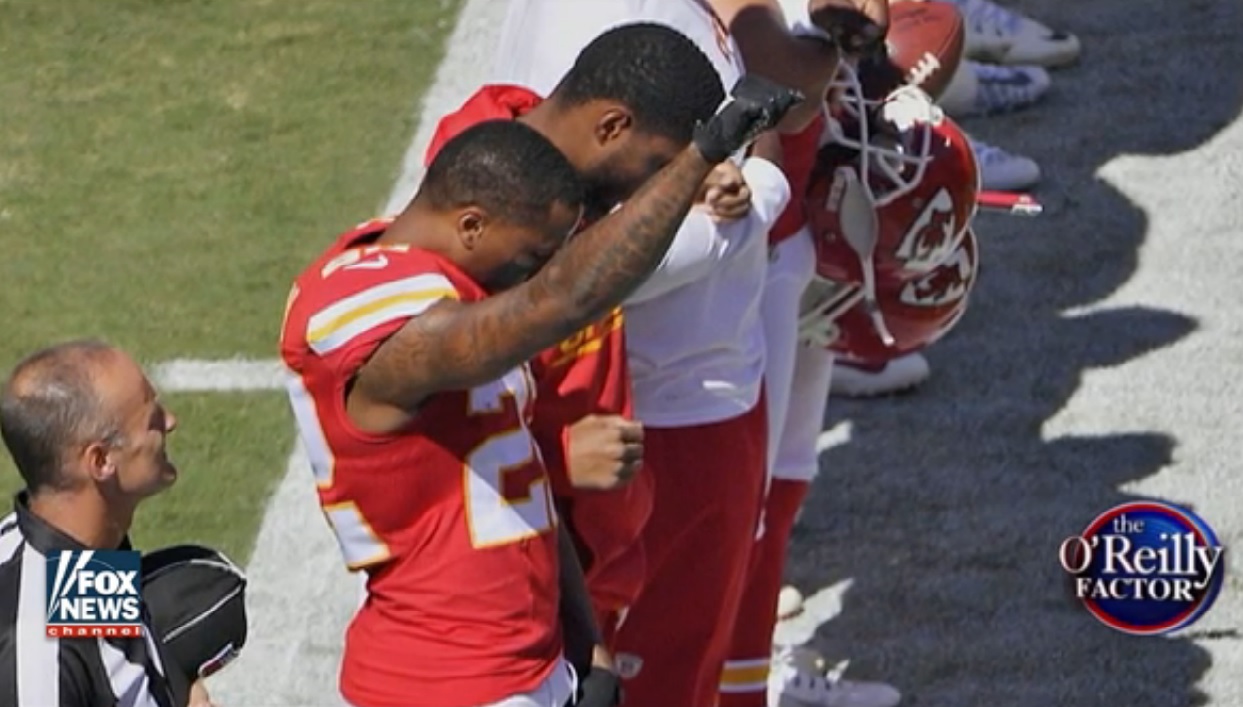
Marcus Peters raises fist in protest.
As I have watched the news reports and commentaries, I am reminded of the long history of protests against civil authorities and unjust practices in America.  Seeing Marcus Peters of the Kansas City Chiefs raise his fist during the National Anthem, on September 11, reminded me of how I felt upon seeing the raised fists of sprinters Tommie Smith and John Carlos in the 1968 Olympics as they stood on the blocks after receiving their medals.

American Olympians  vs. America, 1968
The headline-grabbing protests of recent years and my study of American history remind me that nonviolent protests have had a significant and positive role in drawing attention to injustices. The nonviolent protests led by the Rev. Martin Luther King, Jr. on behalf of minority rights transformed America in a positive way.  But
Dr. King's leadership as a Baptist minister of the Gospel was based on his commitment to the teachings of Jesus Christ, especially His fundamental command to love your neighbor as yourself (Matthew 19: 19) and when necessary, to turn the other cheek (Matthew 5: 39).  Dr. King’s focus on Christian love, character, and individual responsibility was an essential ingredient in the success of the civil rights movement.  

Although nonviolent protests have seldom been without at least some violence, several recent protests have boiled over into demonstrations of hate and mob rule.  For example, movements like Black Lives Matter claim that “Black lives matter” but fail to conduct themselves in a way that both respects all human life and property and presents a vision (e.g. Dr. King’s “dream”) for a better society.   Instead, there seems to be an unawareness or ignorance of the gains we have made in civil rights and racial reconciliation in America.  Protesters stir up social unrest by bringing up past injustices while interfering with the justice system by prejudging police actions. 

It is obvious that injustices exist in America.  But it is also true that many who make headlines through protest have been poorly educated in American history.  From elementary school upward, many of our children have been taught to view America through the lens of liberal progressivism.  The educational experience for many occurs within a constant stream of “news” provided by a liberal-dominated media that uses every opportunity to emphasize inequality.  Dissatisfaction among the poor and middle classes is fueled by the message that they have been mistreated by a system that favors the rich and dishonest.  While many press for “social justice” they ignore the fact that the disintegration of the American family hinders proper development of character which causes poor educational performance.   The result is a lack of competitiveness in the job market, resulting in unemployment, poverty, and proneness to join movements that foment protest.

Family breakdown and poor education impacts future generations.  Increasing numbers of poorly educated Americans become helpless pawns in a system that emphasizes groupthink instead of individual responsibility and accountability.  Instead of emphasizing human dignity, hope, and a pathway to achievement of joy and happiness as expressed in America’s founding documents, the liberal progressive message is, “See what you’re missing-- you’ve been cheated.  Look what you could have--just vote us into power.”

Janie Cheaney, in a WORLD article this month entitled, “Free and Equal,” writes,
Equality and inequality sound like complementary opposites, but they’re driven by non-complementary impulses.  Equality is about climbing up—a political principle written into our founding documents. It’s the theme when people feel empowered, or find empowerment within their grasp. Its primary emotion is hope.

Cheaney continues:
“I’m as good as you” backs up demands for equality: It may reveal a chip on the shoulder, but could also indicate a healthy desire to improve one’s condition. The complementary statement “You’re no better than me” hints at smoldering resentment. Inequality is about tearing down
.

Cheaney concludes that, Few if any political figures today are calling for more equality. Instead, they rail against inequality.  In the name of social justice they not only highlight contemporary inequality, but also condemn America because of the injustices she committed against minorities and the powerless throughout our history.   Social justice purveyors condemn the failures of the past based on current norms as if no moral gains have been made in respect to the rights of minorities.  Charles Krauthammer, conservative columnist, condemns this presentism, the practice of applying contemporary moral standards to actions committed in the past, and then posthumously condemning all who were involved.  For example, Colin Kaepernick’s protest has led some to condemn both Francis Scott Key and  our National Anthem, the lyrics of which he wrote, because Key was a slaveholder.


The events surrounding slavery and the Civil War represent a dark time in American history, and perhaps removal of all vestiges of the Confederate Flag is a respectful practice.  But as Shakespeare's Lady Macbeth learned, none of the attempts no matter how well meaning will purge away the “damn spot” represented in each sinful act of the past.   How then should America proceed in the midst of an era of media bias, misrepresentation of history, presentism, and collective guilt over past sins?

First, there is a great need for honest and accurate reporting by those responsible for conveying each day’s news and commentary.  And, we as watchers and listeners, and users of social media need to seek out all sides of the story.  We need to recognize the difference between news and commentary, and between objective journalists and political water boys or girls.


When we fail to get accurately reported news and perhaps are hampered by having only an elementary understanding of American history we end up like Colin Caepernick.  The 49ers quarterback and those who follow in his steps do not seem to have an accurate picture of either American history or of the current statistics on police actions toward young black men.  According to Charles Campisi, author of Blue on Blue: An Insider’s Story of Good Cops Catching Bad Cops, “In [New York City] a city of 8.4 million people…NYPD officers shot and killed 8 people in 2013—all males, all of whom were carrying guns or knives, 7 of whom had criminal histories….”  These statistics are not atypical of many of our cities.  Nor do they justify Kaepernick’s claim that police are oppressing black people and people of color…[while] …getting paid leave and getting away with murder.  People who wish to lead protests must have their facts straight—both from American history and from current events.


Second, we must recognize that no amount of group protest, collective condemnation of historical personalities and their unjust actions, or purging of our landscape and history books of names and symbols will atone for past sins.  There is only one way to account for past injustices.  That way requires that we recognize the Truth of the Christian Gospel (Good News) which does not deal primarily in group consensus or actions of either the past or present.  Our founding fathers understood that freedom and the pursuit of happiness can only flourish in a nation which recognizes that God is the Giver of opportunity.  Each individual is responsible for how he or she uses the opportunities God affords—i.e. exercises stewardship of the time, talents, and treasures entrusted to him or her.   The great commandments to love God with all of our being, and to love our neighbor as ourselves (Luke 10: 27) are the basis for a moral code.  The injustices throughout human history and up until our present day result when individuals fall short of these standards—i.e. what God calls sin.  How then should we respond?

The social justice approach is to point out injustices and then enlist followers into the business of correcting the injustice through protests, court actions, legislation, and coercion.  But social groups and governments do not sin.  Nor are these groups of well meaning individuals able to rid our nation of the “spots” left from past history or current injustice.  It is the individual who sins.  According to the Bible, no individual can make amends or atone for his or her own sins; or the sins of others.  In Psalm 49: 8-9 we read,

No man can by any means redeem his brother Or give to God a ransom for him--
For the redemption of his soul is costly, And he should cease trying forever--

Romans 3: 23 adds that all have sinned and fall short of the glory of God…  Romans 6: 23 explains how God, not mankind, has made provision for each sinner who recognizes his sin,  confesses, repents, and receives God’s Gift of atonement through faith in the death and resurrection of His Son, Jesus Christ:  The wages of sin is death, but the gift of God is eternal life through Jesus Christ our Lord.  Jesus Christ is the only Way to rid our souls of the “spots” of sin.  He said, …if the Son [Jesus] makes you free, you will be free indeed (John 8: 36).

Suppose we allow that Colin Kaepernick means well in protesting injustices of police toward black men.  Still, it doesn’t appear that he has either his present facts or past history correct.  Nor does he appear to realize that we are all plagued by sin, the tendency to rebel against God’s plan for true freedom and justice.  Furthermore, does Kaepernick know that each individual including himself needs a new heart through Christ’s atoning work on the cross.  God’s forgiveness and empowering through His Holy Spirit can help us put away the anger, resentment, envy, and a host of other sins that plague our souls.  The Apostle Paul admonishes Christians to live by this command:

Let all bitterness and wrath and anger and clamor and slander be put away from you, along with all malice. Be kind to one another, tender-hearted, forgiving each other, just as God in Christ also has forgiven you.

Only God can transform lives and set individuals free.  These individuals have opportunity and inspiration to love God and their neighbor and contribute toward building strong families, schools, communities, and civil government.   But if Americans continue to reject God’s justice and mercy, and refuse to own up to our individual responsibility for sin, we will continue to wander blindly about, biting and devouring one another.  On the other hand, if Americans realize that laws and their enforcers are for our good, and if punishment is justly given and received, then the guilty can be placed on a path to redemption, forgiveness, and freedom.

Although it is easy to point to the Kaepernick’s and other protesters of this world, I must first be sure that God’s justice and righteousness does its work in my own heart.  If you and I are  “born again” believers, this closing challenge is for us and for all who claim faith in Christ:

For it is time for judgment to begin with the household of God; and if it begins with us first, [then we may ask] what will be the outcome for those who do not obey the gospel of God? -- 1 Peter_4:17

Saturday, March 16, 2019

Black History 2 Reparations or Reconciliation?

My junior high and high school history classes in the early 1960’s were enriched by our celebration of the American Civil War (or War Between the States).  My imagination was captured by books, TV programs like The Rebel, and a series of centennial stamps.  Because of the notable character qualities of Robert E. Lee and Thomas J. “Stonewall” Jackson, the South drew my allegiance and I was saddened that they were defeated.

Then, I grew into manhood in the era of Alex Haley’s Roots which chronicled the life of the noble African native Kunta Kinte and his offspring through several generations of American history.   I began to realize that human glory and valor had distracted me from the untold suffering, humiliation, and death brought about by the institution of slavery, and the terrible cost of the Civil War that destroyed the lives and families of so many Americans.  I cannot imagine being a descendant of slaves wondering how my ancestors had suffered from being uprooted from  homeland and family in Africa, transported to a foreign land, and then be confined to labor on a plantation as the property of another human being.


My boyhood wish that the South had won soon gave way to the wish that this bloody chapter of American history had not occurred.  A chapter in which both the North and the South benefited from building their livelihood on the backs of an ethnic group of human beings deemed to be inferior—and a chapter which has continued to play out in the lives of African Americans who have not had the advantages of growing up a two-parent home, receiving a good education, and having a good network of peers.   So, I can at least partly understand the call for reparations (to “pay back,” or undo past offenses) to Black Americans for the losses they and their families have incurred over many generations. 

Ta-Nehisi Coates, correspondent for The Atlantic, has written a landmark article, “The Case for Reparations.”   Coates introduces his argument by quoting Deuteronomy 15: 12-15 in which God commands that slaves be offered freedom every seventh year, and that their masters not send [them] away empty-handed…[but give them] a generous farewell from the bounty of the land, all the while remembering that you were once slaves in the land of Egypt and the LORD your God redeemed you!

While some evangelical leaders today appeal to the Old Testament biblical command, many who do not profess faith in God are still moved by their God-given, inborn sense of right and wrong that enables them to feel in some indirect way the pain of injustice against Blacks.  The following Twitter exchange expresses this desire for reparation:

So let me get this straight; our [Black American] ancestors were robbed of their culture, lineage, dignity, and multiple trillions of dollars in wages over hundreds of years.  [But you still think] It’s an “entitlement” mindset for the modern descendants of those ancestors to demand to be paid?

In response to the questioner, Bob Woodson, Founder and President of The Woodson Center, tweets:

How is it (reparations) a remedy for the problems facing Black America?  What does it solve?  Reparations is a distraction, false solution, and an illusion of a cure.

I Invite Your Opinion
Rather than writing at great length about reparations when I’m just beginning to grasp the complexity of the subject, let me offer some points for discussion and invite you to respond in “Comments” below.  My points are as follows:  How will the cost of reparations be computed?  Will reparations really help?  Are reparations the right moral response?

Family separation at a slave auction.
Computing Reparations
First, consider the difficulty in computing the cost of reparations to Black Americans.  How could we establish the monetary value?  At what point in history would we choose as the starting year for the computation?  Realizing that most Black Americans today are not subject to the same harshness of their ancestors under slavery, how would this variable be factored into the cost to be paid for reparations?  For example, in his Atlantic article, Ta-Nehisi Coates writes that enslaved Africans in 1619, though torn from their homeland and transported to the colony of Virginia, “…did not initially endure the naked racism that would engulf their progeny. Some of them were freed.  Some of them intermarried. Still others escaped with the white indentured servants who had suffered as they had.”  So, are reparations also owed to enslaved whites?  Should Native American tribes who enslaved Blacks also be required reparations?

The fact that reparations are difficult if not impossible to compute does not itself provide reason for opposing the notion.  As Coates argues, “…for the past 25 years, Congressman John Conyers Jr., who represents the Detroit area, has marked every session of Congress by introducing a bill calling for a congressional study of slavery and its lingering effects as well as recommendations for ‘appropriate remedies.’”  Conyers’ bill does not require computation of reparations, but would “submit the question to study, and then assess the possible solutions.”  What do you think—should the Conyers bill be brought to the floor of the U.S. House of Representatives?

Will Reparations Really Help?
Some argue that reparations to Black Americans would simply be another slap in the face in which “advantaged White’s” are perceived as “paying charity” to “inferior people” who are not capable of “making it on their own.”  And, even if reparations were not perceived in this way, what will be their effect on the social and economic status of Black Americans?  Bob Woodson believes, “It is important to recognize that the destiny of Black people is not determined by what White people do or not do; it is in our own hands… It is our values that determine our condition in life not what some oppressor has done.”  
What do you think?  Instead of trying to pay reparations, would it be more beneficial to Black Americans in the long run to use contributions and tax dollars to develop educational, spiritual, and employment opportunities for all ages aimed at restoring hope, dignity, and purpose to individuals and families?

Are Reparations Morally Right?
Here, as with any moral issue coming under the category “social justice,” we must identify an objective standard for judging what is moral.  For example, in his landmark article cited above, Ta-Nehisi Coates references a biblical command given in Deuteronomy.  Whether he acknowledges it or not, the only truly objective foundation for moral judgments is the inspired Word of God (2 Timothy 3: 16; Proverbs 1: 1-7).  Unless we all agree that Blacks and all other ethnic groups are equal and valuable, that racism or any oppression of one ethnic group by another are moral and spiritual problems, and that reparations must be weighed against the need for moral and spiritual restoration of people living today, our efforts in my judgment will fall short.

The Statement on Social Justice and the Gospel presents a view of social justice and ethnicity (or “Race”) based on the Word of God:
God made all people from one man. Though people often can be distinguished by different ethnicities and nationalities, they are ontological equals before God in both creation and redemption. “Race” is not a biblical category, but rather a social construct that often has been used to classify groups of people in terms of inferiority and superiority. All that is good, honest, just, and beautiful in various ethnic backgrounds and experiences can be celebrated as the fruit of God’s grace. All sinful actions and their results (including evils perpetrated between and upon ethnic groups by others) are to be confessed as sinful, repented of, and repudiated.

DISCUSSION:  Inviting Your Comments:
Question #1 Individual Accountability: 
Do you agree that everyone of us is individually responsible to act according to an objective moral code or law?  For example, how would you respond to the following statement and the Scriptures cited:
Any human deviation from obedience to God’s commands in Scripture, including our neglect to love our neighbor, regardless of ethnicity, is sin.  The Bible teaches that every person is individually accountable to God for his or her own thoughts and actions (2 Corinthians 5: 10; Romans 1: 18-2: 16).  The Bible also teaches that every person has an inborn sense of right and wrong which can lead us to repentance, confession, and forgiveness (Romans 1: 18-21; 1 John 1: 9).  This point is illustrated in Acts 3: 17-21, a portion of the Apostle Peter’s sermon preached not long after the crucifixion of Christ.  As you read it, notice how Peter’s challenge comes down to a clear invitation to individuals and their spiritual accountability to the Gospel of Jesus Christ.

Question #2 Responsibility for the Past:  Do you feel responsible to make reparations for the sins of our ancestors? What motivates individuals to look beyond their individual moral standing and become committed to reparations for the failings of others throughout history?  Do you agree or disagree with the following:
Grievous as human sins of the past may have been and as much as we wish we could be a part of erasing the evil of the past, those sins are not “our sins.”  We are not meant to bear the weight of conscience from sins committed by others in history.  Yet, many in both the Church and in the secular world are obsessed with paying back what is owed by the injustices inflicted throughout history.  But God’s plan through the death and resurrection of Jesus Christ is for redemption of humans and His whole creation is not about reparations, but all about restoration.  God spiritually regenerates and restores individuals and adds them as “living stones” into His church, the body of Christ on Earth (1 Peter 2: 4-6).   As the psalmist writes (Psalm 49: 7-8), only God can redeem us (buy us back) from the slavery of sin because only He can pay the infinite cost:

No man can by any means redeem his brother
Or give to God a ransom for him—
For the redemption of his soul is costly,
And he should cease trying forever


Only God knows perfectly each sin of the past, and only God has the full remedy.  The Apostle Paul declares, For God was in Christ, reconciling the world to himself, no longer counting people's sins against them. And he gave us this wonderful message of reconciliation (2 Corinthians 5: 19). 

Can we agree, human effort alone cannot eradicate injustice?
Question #3 Is there a “right way?”:  Most would agree that history is filled with gross violations of what many call “social justice.”  Although we may not agree on how to address social injustices, would you agree that we must have a moral standard or reference by which to judge what is or is not “just?”  Would you also agree that this moral standard ought to address the nature of humankind and our tendency to fall short of that standard?  If we answer the above in agreement, then can we also agree that there is a common root cause for both the actions of perpetrators of injustice and the responses of those who are objects of injustices?  Finally, if we can agree on the root cause of injustices, can we also agree on at least the general nature of a restorative plan for both perpetrators and those unjustly treated?  Consider the following excerpt from the Statement on Social Justice and the Gospel which states, based on God’s Word, that …whatever evil influences to which we have been subjected via our culture can be—and must be—overcome through conversion and the training of both mind and heart through biblical truth.

For anyone who is grieved at the injustices perpetrated against Black Americans, and for those who have been victims of perceived injustices, healing and restoration begins by repentance and confession of sin.  Our restoration and healing are made possible because Christ paid for both our sins and our griefs on His Cross (Isaiah 53).  We must rely on the authority and trust in the sufficiency of His Word (2 Timothy 3: 16).

Will reparations of past injustices solve current ones?
Once we are transformed by the grace and forgiveness of Christ, the words of Bob Woodson can become a guide to moving forward in the freedom of Christ: “…the destiny of Black people is not determined by what White people do or not do; it is in our own hands… It is our values that determine our condition in life not what some oppressor has done.”  

All of humanity, deceased and living, are offenders and have been offended.   Grave injustices still occur all around the world as statistics on current human slavery reveal.  Christ-followers need to be attentive to how they might participate or support efforts to end human slavery and other injustices through biblical means.  

Concluding Points to Consider:
We began with a citation from Deuteronomy 15: 12-15 by Ta-Nehisi Coates in his Atlantic article that slave masters not send [slaves] away empty-handed…[but give them] a generous farewell from the bounty of the land, all the while remembering that you were once slaves in the land of Egypt and the LORD your God redeemed you!   Based on the spirit of this passage, what would be the nature of an approach to promote meaningful and lasting restoration of Black Americans and others suffering under real or perceived injustices?  Are you aware of organizations or programs that resemble such an approach?  Check out The Woodson Center which offers a hands up approach.

Related Articles: 
Black History: 1  Correct History Brings Light
Black History: 3  Bible and Biology Erase Racism

Saturday, March 31, 2012

Stewardship of “God’s Economy” – Reverent Discernment of His Word and World

The Greatest Teacher often pointed to His creation to illustrate important principles or to reveal God’s nature and purposes.  To his anxious followers, Jesus said, “look at the birds” and “consider the beautifully arrayed flowers” (Matthew 6: 26, 28).  He pointed to the vine (John 15: 5) and the fig tree to teach fruitfulness (Matthew 21: 19-20).

Today, there are plenty of reasons to be anxious and pout about our circumstances, or point fingers at Washington or our parents or spouses or pastors rather than take individual responsibility.  But we often face a second challenge – stewarding the Earth at a time when we seem to have limitless power and ability to alter creation from the ocean depths to the atmosphere above.  We use technology’s tools to mine the treasures of God’s creation in search of a satisfaction that material pursuits alone cannot deliver.  Instead, God is calling His stewards to “mine” His creation and His special revelation in the Scriptures with a disposition of reverent discernment that we might learn and exercise our individual responsibility toward Him, toward our neighbor, and toward His creation.

Won’t you join me in an exercise of “mining” creation-- thoughtfully considering it as Christ, the Creator, commanded?    Respectful contemplation of creation is warranted because creation belongs to God and is meant to reveal His wisdom and glory. 
 
Let’s get acquainted with three creatures and consider what lessons they might teach us about real stewardship, or oikonomia (hence, our word, “economy.”)  Stewardship in this context is management of a human economy within God’s created order, or Economy (Berry, 1987) with due respect for the laws that govern this Economy for the good of all and the glory of God.  Our panel of three creatures includes Spring Draba, Skunk Cabbage, and Black Bear.  Later, we will meet “Mr. Hourly Wage Earner” who resides in many different cultures.   

Spring Draba is an early-blooming spring wildflower which the 18th century botanist, Linnaeus, named Draba verna.  In March in SW Ohio, the alert observer can usually find Draba growing in the hard soil of paths or trails, or in the bear spots that interrupt an otherwise smooth, green lawn.  Best if we get on our knees to look carefully-- a good posture for reverent discernment of God’s Economy.  There, you may see Draba, barely the height of the toe of your shoe.  Even then, she reaches this height only when her delicate, white flowers are hoisted on slender, leafless stalks to attract pollinators.   Until flowering time, Draba is only a lowly rosette of tiny leaves covering the otherwise bare soil. 

Spring Draba, Draba verna, with fruits (Fr) developing from the flowers.
Usually by mid-April, tiny Draba has already completed her annual life cycle.  Seeds from the previous year have sprouted and the ground-hugging, leafy rosettes have captured sunlight necessary for growth, flowering, fruiting, and production of new seeds that will be shed to lie dormant until the next Spring.  How does such a tiny flowering plant survive, being relegated to the hard-packed soil and expected to bloom on cold, windswept, March days?

Pretending to understand more than we actually do, botanists claim that Draba is “adapted to its niche,” or “occupation,” through natural selection.  However, some of us would credit a Divine Designer for originating the genetic blueprint which then has passed down through succeeding generations with minor changes through natural selection to become what we call Draba verna

Although Draba’s origin is debated, there is no debating the “do or die” situation that Draba faces each year.  Survival depends upon germination of tiny seeds in bare soil each Spring.   The tiny leaves unfold at ground level, the warmest place on blustery March days, to soak up the sunshine necessary for photosynthesis of food to support growth, flowering,  and seed production for the following year.  While still on our knees, we can consider how Draba teaches us individual responsibility to live in harsh places.  But Draba is not the earliest-blooming plant in the Midwest.

In February, long before Draba blooms, I make my annual pilgrimage to a nearby fen (alkaline wetland), often while it is still blanketed with snow.  Careful examination will reveal the pointy, purplish mottled spathes of Skunk Cabbage, Symplocarpus foetidus, poking through the snow.   Each spathe is like a sheltering shroud that protects a fleshy, thumb-sized spike of tiny flowers within what amounts to a “warm room” in which pollination can occur. 

Skunk Cabbage:  Spikes of tiny flowers are surrounded by a hood-like "spathe"
What you won’t see on a cold, February day is the massive Skunk Cabbage taproot anchored deep within the wetland soil beneath each pointy spathe.  Here, soil temperatures average 55o F year-around.  Within the taproot are rich stores of “heating fuel” in the form of carbohydrates stored there during the year before.  When Skunk Cabbage flowers are ready to display mature pollen to insects for pollination, the flower hikes up its “thermostat” and burns stored “carbs” that flow up to the spike from the taproot.  Environmental physiology students and I have measured temperatures as much as 15o F warmer within the flower spikes than temperatures in the surrounding winter air!   Result?   Apparently, insect pollinators are attracted by the warmth and by the odor that is dispersed by the heat into the surrounding air.  By April, new cabbage-like leaves have emerged and their photosynthesis enables the production of many large seeds and the replenishment of taproot “fuel” for the following year.

Whereas, the Draba’s economy depends upon year-to-year production and germination of tiny seeds, the Skunk Cabbage economy is based on long-term savings and investment in underground energy reserves.   From these reserves it generates heat to accomplish pollination in the winter when there is little competition from other plant species for insect pollinators.   No matter to Skunk Cabbage if a bad year occurs; its taproot will have sufficient energy assets to “hold its ground” until a better year comes.

The Skunk Cabbage reminds me of another creaturely example, the Black Bear, Ursus americanus, common in western North America.  Like Skunk Cabbage, the economy of the Black Bear is based on large energy reserves formed during the summer by a diet that includes storage roots and tubers of plants, nuts, plant shoots and buds, large and small mammals, insects, honey, and salmon.  [Humm!  Would a Black Bear feed on a Skunk Cabbage taproot?] 

Like Skunk Cabbage which overwinters underground with its stored energy in a huge taproot, Black Bears also “go underground” in a den for the winter.   As days become shorter, bears prepare for winter’s food scarcity and cold by extensive foraging which leads to the addition of hundreds of pounds in body fat.  Pregnant female black bears have the additional challenge to their economy.   They must nurture two or more baby bears within their uteri which are then birthed in late winter.  To conserve energy, the Black Bear enters a suitable den to reduce body heat loss; and then, sharply reduces its metabolism to lower body temperature.   Denning and lowering metabolism conserve energy reserves for the bear just like a human family in a well insulated home that lowers its thermostat to save on their energy bill.

Black Bear, Ursus americanus
We have seen how one species, Draba, with relatively small energy reserves, and two larger species, Skunk Cabbage and Black Bear which depend upon huge energy reserves, each take responsibility to prepare for and survive harsh winters and rugged environments.  The energy economy of humans is not all that different from other creatures.  Each must have suitable nutrition, shelter, and social relationships necessary for procreation and nurture of offspring.  However, biblically speaking, humans have been created with vastly superior intellect and ability to enter into more complex social and political relationships that revolve around a monetary economy.

Let’s consider the laborer who earns an income based on an hourly wage or who is paid by contract when a particular task or job is completed.  The survival of many of the world’s workers and their families depends upon hourly or otherwise regular wage-for-work.  The plight of many laborers may be illustrated by the story once told by Ralph and Lucy, our family friends who once served as missionaries in Bangladesh.   Ralph had come upon a heated argument between several laborers, or coolies, along a riverbank.  It seems that at least one coolie was objecting to a request from his superior to unload bags of rice from a truck and onto a boat docked at the riverbank.  Why would a healthy, adult Bengali male refuse this opportunity for employment?

Upon inquiry, Ralph learned that the payment being offered to the coolie in rice grain for food in return for his labor was unacceptable to the man because it offered insufficient caloric value for his service rendered.  Amazingly, this man’s economy had taken into account the calories required to unload the rice from the truck, a task he was willing to do.  But, he refused to move the rice onto the boat in what would have been a smoother, more efficient operation.  Reason?   His payment in calories and nutrition would not have provided sufficient compensation for his bodily work plus extra calories and nutrition needed to feed his family.

This account illustrates the large cultural and economic gap that exists between Asian coolies and most people who read this blog.  The Bengali breadwinner’s economy required literally a day-by-day “balancing of the books” for him and his family to survive.  Few of us can even comprehend such an economy.  Like Draba with her “do-or-die economy” in the harsh soil and cold days of early Spring, many wage-earners must take day-to-day responsibility to support themselves and their loved ones.

We now return to our opening question:  If we agree that God calls us as His stewards to consider  His creation with a disposition of reverent discernment of our individual responsibility toward Him, toward our neighbor, and toward His creation; then, what can we learn from creatures so diverse as Draba, Skunk Cabbage, Black Bear, and a human laborer?   First, we learn the principle of God’s provision.  God provides for His creatures through the Economy of His creation.  All creatures must have a continual supply of energy and nutrition for sustenance.  Draba and Skunk Cabbage rely on sunlight to power their growth and reproduction from inorganic building blocks in the soil and atmosphere.  On the other hand, Black Bear and the human worker consume plants and sometimes meat as food.

Though they are diverse, the Creator has equipped each creature to obtain necessary sustenance according to their niche in the Economy of creation.  No creature can create and sustain life out of inorganic constituents.  Test tube experiments to produce even one living cell have failed, let alone efforts to create and sustain the economy of a whole ecosystem as attempted in the Biosphere 2 project in the Arizona desert in the 1980’s.

God’s special revelation in the book of Job underscores the necessity of His provision for His creation:
            But now ask the beasts, and let them teach you;
              And the birds of the heavens, and let them tell you.
              Or speak to the earth, and let it teach you;
              And let the fish of the sea declare to you.
             Who among all these does not know
             That the hand of the LORD has done this,
             In whose hand is the life of every living thing,
            
And the breath of all mankind?  -- Job 12: 7-10 (NASB)

The second principle we learn from the natural revelation through these four kinds of creatures is the principle of individual responsibility for survival and reproduction.   Within the larger Economy of creation, in order to survive, each creature must operate within physical and biological limits that govern its own economy.  Thus, we see Draba being and doing what Draba is designed to be and do; namely, facing the rigors of cold, March days on hard soil to grow and produce seeds for the next year.  

Likewise, the Bengali worker must complete his task for a payment of food that is sufficient for his bodily sustenance with enough extra to feed his family.  On the other hand, the economy of Skunk Cabbage, Black Bear, and many of us includes a means of storing energy or monetary assets that provide a “cushion” against immediate life or death.  However, the principle of individual responsibility still applies in that all creatures must acquire energy and nutrients during the season of opportunity and save extra for an unfavorable season lest they die.

A third principle revealed in Scripture and in creation is the principle of reverent discernment in conservation and restoration.   Successful conservation of the diverse forms of life on Earth must respect the unique requirements and context upon which each species depends for its existence.   Our panel of four creatures can each testify that even well meaning attempts to promote their welfare often represent a violation of natural laws that govern their well being.  For example, let’s help Draba by tilling the soil in those hard-packed, bare-soil spots and then add some nitrogen fertilizer.  Result?   Many of her tiny seeds will be buried too deeply to germinate; and, the increased soil fertility will enable other plant species including lawn grass to invade and occupy the bare spots and make it inhospitable for Draba.  The harsh environment that Draba is designed and adapted to face is the very key to her survival.

Like Draba, both Skunk Cabbage and Black Bear naturally benefit from simply being left alone by well meaning caretakers.  There is a reason that the two plant species have been called “wildflowers” and that Black Bear is considered a “wild animal.”   Attempts to “domesticate” or otherwise alter their natural context have violated the very nature of what they were created to be.

Well meaning attempts in the late 1800’s to conserve the Black Bear in Yellowstone National Park while providing closer access for tourists to observe and feed them led to a conversion of this grand , wild creature from bear to beggar.  As Angela Reese reported in her masters thesis (2007) 

Yellowstone condoned the regulated feeding of bears at these “lunch counters,” and tacitly gave patrons permission to feed bears themselves. Later she adds: Roadside feeding transformed passive spectators into active participants and allowed the park visitor an opportunity for interaction with park wildlife. These visitors became shapers of bears’ lives and behavior (Biel, 2006).

The same well meaning efforts, sometimes in the name of “social justice”, without reverent discernment can be as demeaning and degrading to humankind as it is with wild creatures. Before developing this notion further we must remember both the uniqueness of humankind and the great cultural diversity within Homo sapiens.

The average American has more economic security than many lower-income workers around the world.  Like the Skunk Cabbage and Black Bear, many of us have reserves in our household economies.  Nevertheless, all humans have an individual stewardship responsibility to utilize time, abilities, and opportunities to care for themselves, family, and neighbor.  Responsibility to work is grounded in the Judeo-Christian Scriptures which reveal a Creator Who works and rests.  It follows that God has given mankind a weekly cycle of work (six days) and rest (a Sabbath day) (e.g. Exodus 20: 9-11).   The Apostle Paul wrote in 2 Thessalonians, Chapter 3, that Christians should not lead “an undisciplined life” (verse 6).  Paul’s own economy as a tentmaker underscored his teaching (verses 7-9) as well as his command that “if anyone will not work, neither let him eat” (verses 10-12). 

There is no contradiction in God’s Word between “love your neighbor as yourself” (Matthew 19:19) and “if anyone will not work, neither let him eat.”  We are called to help the helpless; but with a correct definition of helping, one that respects human dignity.  Marvin Olasky (WORLD, 2009) quotes Josephine Lowell, a 19th century New York City charity leader, who wrote: 

the problem before those who would be charitable, is not how to deal with a given number of poor; it is how to help those who are poor, without adding to their numbers and constantly increasing the evils they seek to cure.  

Olasky further quotes an article in Charities Review, in 1900, in which Edward T. Devine called for charities whose goal was 

not "that poor families should suffer, but that charity should accomplish its purpose." Thoughtless generosity was akin to selfishness if it made charity misfire. Generosity plus discernment was key. 

Throughout history, there have always been people in need of help.  Good stewards are to use reverent discernment to rightly identify God-given abilities and opportunities both for meaningful work and to rightly discern the right ways to help our neighbor when he or she is in need (see Ephesians 4: 28).  Nowhere does the Bible teach that it is the responsibility of government to help of the poor and needy.  The 19th century charity leader, Amos G. Warner, understood this principle and saw governmental welfare as necessarily more impersonal and mechanical than private charity or individual action (Olasky, 2009).

Today’s news is filled with reports of well meaning efforts by Washington to help the needy while challenging the more fortunate to “pay their fair share.”  Yet Washington’s distance from the diversity of American families, businesses, and local economies, and its “one-size-fits-all approach is like fertilizing Draba or providing food “dumps” for Black Bears.  Result?  A violation of the natural order in which human dignity is often lost and an ever larger percentage of Americans become dependent upon government.

In summary, we can discern from God’s created order that all creatures are dependent upon His Economy.  Second, God has equipped each species to respond by using its genetic and behavioral equipment to “be fruitful and multiply.” Fruitfulness depends upon both individual responsibility and the state of the environment and biotic community within which a given species lives.

Third, any human effort to “help” another species or a neighbor must be guided by reverent discernment of God’s natural and special revelations.  Our father Adam’s first lesson in stewardship was to become acquainted with the other creatures with such detail that he came to understand that his niche was totally different from any other creature (Genesis 2: 15-25).  Likewise, humble discernment is necessary for effective conservation and restoration human communities and local economies.   Conservation of wildlife such as the Black Bear requires more than provision of feeding “dumps” that convert them to beggars.  Likewise, restoration of human dignity and purpose among the needy depends upon short-term assistance that includes assistance and incentives to find meaningful work.  

Conservation and restoration of both mankind and fellow creatures requires knowledge of and attentiveness to the uniqueness of each biotic community and neighborhood; gaining a “sense of place” as described in Oikonomia, Sept. 31, 2011 .   These are the tasks best taken up by responsible members of family and church spheres of authority in cooperation with appropriate local community groups.  

Your comments are always welcome.  My sources and some additional references are listed below.

References:
Berry, Wendell.  1987.  Home Economics.   North Point Press, San Francisco.
Biel, Alice Wondrak. 2006. Do (not) feed the bears: The fitful history of wildlife and tourists in Yellowstone. University Press of Kansas. 186 pgs.
Olasky, Marvin.  2009.   Giving That Worked.   WORLD Magazine, March 14, 2009).
Reese, Angela.   2007.   Addressing Food Conditioning of Cascade Red Foxes in Mount Rainier National Park, Washington.   Masters Thesis, Evergreen State College, Olympia, WA.