This room is real, Ben. And that
means the treasure is real. We're in the company of some of the most brilliant
minds in history because you found what they left behind for us to find, and
understood the meaning of it. You did it, Ben, for all of us - your
grandfather, and all of us. And I've never been so happy to be proven wrong.
-- Patrick Henry Gates, in National
Treasure
 |
| Scene from the movie, National Treasure (2004) |
Patrick Henry Gates, fictitious treasure-hunter, played by Jon Voight, congratulates
his son, Benjamin Franklin Gates (Nicolas Cage), in a climactic scene of the
2004 movie, National Treasure. The pursuit of the “national treasure”
requires decoding of a series of clues, including one written on the back of
the Declaration of Independence. Maybe
you saw this movie and remember the scene.
Patrick Gates’ exclamation to Ben was an invitation to movie viewers to imagine their excitement upon finding such a treasure. But, notice that the excitement was not focused entirely on the monetary value of the treasure. Instead, Patrick wants Ben (and the viewers) to “treasure” the experience of being there…in the company of some of the most brilliant minds in history because you found what they left behind for us to find, and understood the meaning of it. The exciting moment, framed by Patrick’s passionate words captures for me the excitement and interest you and l ought to have when we visit a historic place, or handle an artifact and try to understand the meaning of it.
In this blog article, my aim is to interest you in joining three co-leaders and me on another kind of “national treasure” hunt. If you decide to join us, bring your bicycle and plan to meet at the Prairie Grass Trailhead, 280 W. High St., London, Ohio, at 8:00 am, Saturday, July 29, 2017. This annual Prairie Appreciation Bike Ride is sponsored by the Friends of Madison Co. Parks and Trails, and the Madison Soil and Water Conservation District. You can ride at your preferred pace and distance, and we will stop along the way to observe what I will call “national botanical treasures”—prairie wildflowers and grasses that are descendants of historic plant populations that once covered large tracts of SW Ohio, the Midwest, and Great Plains.
Patrick Gates’ exclamation to Ben was an invitation to movie viewers to imagine their excitement upon finding such a treasure. But, notice that the excitement was not focused entirely on the monetary value of the treasure. Instead, Patrick wants Ben (and the viewers) to “treasure” the experience of being there…in the company of some of the most brilliant minds in history because you found what they left behind for us to find, and understood the meaning of it. The exciting moment, framed by Patrick’s passionate words captures for me the excitement and interest you and l ought to have when we visit a historic place, or handle an artifact and try to understand the meaning of it.
In this blog article, my aim is to interest you in joining three co-leaders and me on another kind of “national treasure” hunt. If you decide to join us, bring your bicycle and plan to meet at the Prairie Grass Trailhead, 280 W. High St., London, Ohio, at 8:00 am, Saturday, July 29, 2017. This annual Prairie Appreciation Bike Ride is sponsored by the Friends of Madison Co. Parks and Trails, and the Madison Soil and Water Conservation District. You can ride at your preferred pace and distance, and we will stop along the way to observe what I will call “national botanical treasures”—prairie wildflowers and grasses that are descendants of historic plant populations that once covered large tracts of SW Ohio, the Midwest, and Great Plains.
 |
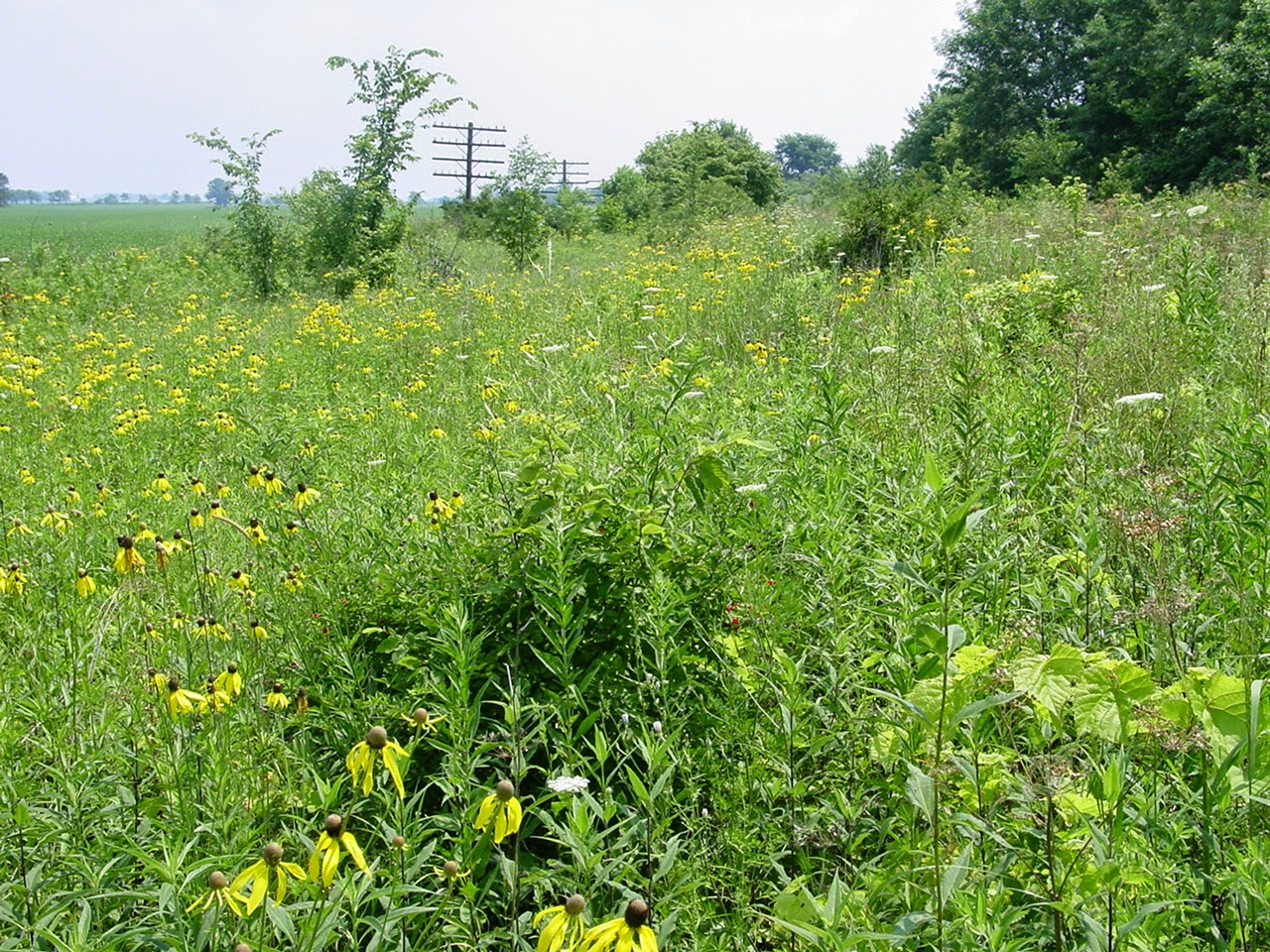
| Prairie Coneflower in a SW Ohio prairie remnant. |
Bring your imaginations and be ready to ride back into history. Get ready to imagine while you stand along
the Prairie Grass Trail Bikeway in the quiet freshness of a summer morning that
this was once part of an expansive Tallgrass Prairie. Then, after the railroad tracks were laid two
centuries ago, this remaining, narrow stretch of rails, ties, slag, and prairie
became a protected haven from the plow, agricultural weeds, and pesticides. But, they were not protected from regular
fires ignited by either lightning or sparks from the trains that whistled by. Fires were just what the prairie plants
needed since they were well adapted to survive fire, unlike many of the woody
shrubs and trees that have now invaded these “remnant prairies” now that the
railroad is gone.
 |
| Royal Catchfly, a rare prairie wildflower is restricted to only a few locations along the narrow Prairie Grass Trail |
So, bring your observation skills, your imagination, and your questions. Invite
friends and neighbors, and bring your children—junior age and older often ask
the best questions. You will observe some of our attempts to manage these “national
treasures” like Royal Catchfly and Prairie Coneflower. Learn how you can grow and incorporate these
or other nectar-rich plants like the Milkweeds into your own flower gardens. And, learn how local organizations and industry
partners are expanding their commitment to land stewardship around our country.
Hope to see you next Saturday, July 29. If you live too far from SW Ohio to attend, you may want to “visit” several of the websites below. Or better yet, maybe you can locate and join a conservation or land stewardship group in your area. Chances are you will find new friends who have become interested in “national botanical treasures” located in “natural areas” as refuges for native plant and animal species.
Hope to see you next Saturday, July 29. If you live too far from SW Ohio to attend, you may want to “visit” several of the websites below. Or better yet, maybe you can locate and join a conservation or land stewardship group in your area. Chances are you will find new friends who have become interested in “national botanical treasures” located in “natural areas” as refuges for native plant and animal species.
 |
| Wayne Roberts, Exec Dir., FMCPT with co-leaders Julie Cumming, Matt Silveira, and Karen Stombaugh |
And, for all of us, may our interest in the historical and biological heritage of
our neighborhoods and of our nation increase.
May we and our children be able to say, we have found what they left behind for us to find, and [we are willing to
learn] the meaning of it--and to value
it enough to be good stewards or “keepers” of it as we are commanded to do in
the Dominion-Stewardship
Mandate in the Book of Genesis:
Then the LORD God took the man
and put him into the garden of Eden
to cultivate (serve) it and keep (preserve) it.
– Genesis 2: 15
RELATED SOURCES:
Botany Along the Prairie Grass Trail
Fundamentals of Conservation, Part 2 "Serving with" Creation
Fundamentals of Conservation, Part 3 "Serving with Our Neighbor"
Then the LORD God took the man
and put him into the garden of Eden
to cultivate (serve) it and keep (preserve) it.
– Genesis 2: 15
RELATED SOURCES:
Botany Along the Prairie Grass Trail
Fundamentals of Conservation, Part 2 "Serving with" Creation
Fundamentals of Conservation, Part 3 "Serving with Our Neighbor"