Showing posts with label preservation. Show all posts

Friday, October 31, 2014

Fundamentals of Conservation, Part 2 Serving with Creation – Article #2: Knowing the Land

Regardless of the acreage, land conservation or stewardship assumes new meaning when a person is reconciled to God from the curse of the fall through faith in Christ.  Then, as a redeemed child of God, he or she finds true identity as a steward, serving at the behest of the Creator and Owner of creation (Part I, Article #1 April).  As growth in grace establishes an intimate walk with the Creator, the steward acquires a disposition of reverence toward God not unlike that of a child full of awe and wonder at creation.  He or she is motivated to learn more about the workings of creation, and is more receptive to the notion of conservation (from con-service = “serving with”) (See Part I, Article #2 May).  The quality of stewardship is further enhanced as one learns what is pleasing to his or her Creator (2 Corinthians 5: 9) and thus fulfills the role as God’s representatives (vice-regents) on Earth (See Part I, Article #3 June).   In summary, reconciliation and an intimate relationship with God leads to right values which in turn stirs a joyful passion that motivates a conservationist to “serve creation” by serving with God.  

In Part 2, entitled “Serving With Creation,” I emphasized that intimacy with God gives us a disposition that submits to both God’s natural revelation (in creation) and to His special revelation (in Scripture) so that we can learn from creation and conserve it for God’s glory.  I call this “serving with creation.”  

Part 2 begins (See Article #1 September) with an emphasis on knowing the history of the place we wish to conserve.  Just as acquaintance with a person must include a knowledge of his or her origin, family history, and future plans, so conservation of a particular place on planet Earth must consider the geologic and climatic history of the place in question, the present dynamics at work within it, and the most probable future trajectory for this particular place.  Allow me to apply this principle in a more practical way in the following paragraphs where I will share from my personal experience.  In Part II, Article #3, I plan to describe my recent land stewardship efforts.

With Jesse and my parents, Bert and Esther Silvius
Background: Dad's grafted apple trees & grandpa's bee hives
Having grown up on a farm, I learned how to care for livestock, operate farm implements, and grow crops.  My Grandpa, Jesse Silvius, and my father, Bert Silvius, were both men who recognized the importance of caring for the land.  Working alongside my grandpa as he ordered tree seedlings of Black Locust and Catalpa, and then planted them on strip mine spoil was a practical lesson in the importance of land restoration (or reclamation as we called it).   My grandpa along with my father and my two uncles were instrumental in implementing a contour farming approach to promote soil and water conservation on our hilly SE Ohio farm.   As I grew to appreciate the importance of these techniques, I also began to understand the importance of developing a sense of place and to use that concept to pursue the right management strategy to fit each place.

When I moved from the farm, married, began classroom teaching, and started raising a family, my farming interests shifted into gardening.  Maintaining a large garden became a useful a useful means to instill a work ethic into their lives.  It was a blessing for our family to share the satisfaction of fresh vegetables for our table in the summer, a store of food for the winter months, and the opportunity to share of our bounty with others.

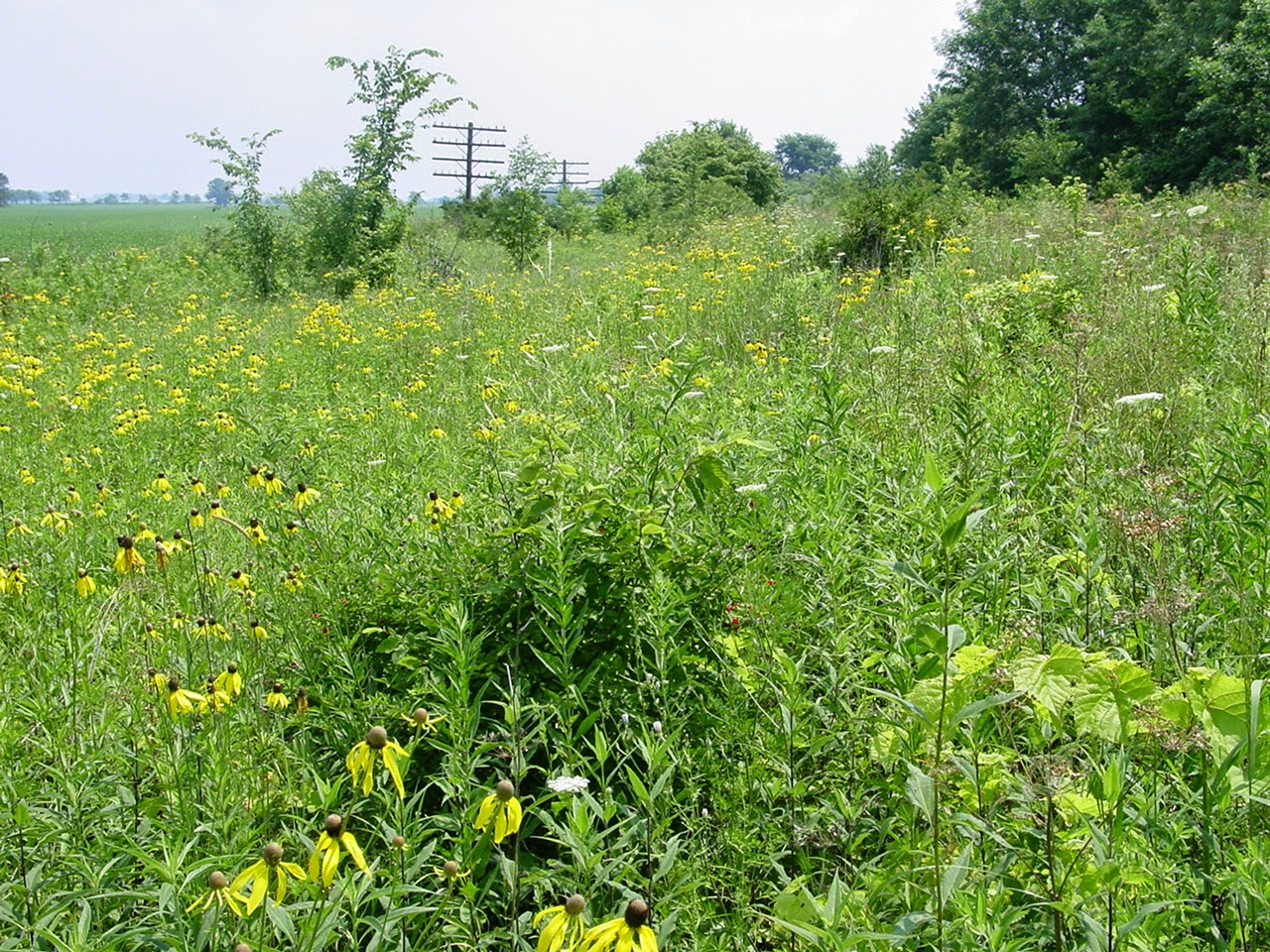
Since the 1990, my love of gardening has taken a turn to what some call the “wild side of gardening.”  Now that our children have their own homes, instead of mulching and cultivating garden plots, I’ve found joy and satisfaction in exploring and managing “wild places”—also called “natural areas.”  During my tenure as professor of biology at Cedarville University, I was privileged to introduce my botany and ecology students to remnant prairie communities that survived along the railway leading from Columbus through Cedarville to Cincinnati.  I had first become aware of these prairie remnants in the late 1960's when Dr. Charles C. King, my Malone College biology professor at the time, spoke of them.  [More about "Charlie King" in a future article.]

Remnant prairie communities are just that—“remnants” of an extensive mosaic of prairie grassland communities surrounded by a matrix of forest communities throughout what is now central and SW Ohio (See Part II, Article #1 September).  As Ohio forests were cleared for agriculture and urban development in the 18th and 19th centuries, wet and dry prairie communities were converted into cropland.  By the 20th century, the last refuges of prairie in Ohio were cemeteries and railways which had escaped the plow and bulldozer.

As we have noted, the settlement of the landscape of W-SW Ohio within the past two centuries has greatly altered it in all but isolated areas, mostly along railways, now bikeways.  Agricultural cropping would have eliminated its uniqueness as had been accomplished in the thousands of acres of surrounding farmland.  While the railroad right-of-way was still busy carrying trains, these prairie wildflowers were seldom even seen by humans unless they were visible from a railroad crossing or visible to those who hiked or farmed along the tracks.
"Sabbath Rest" between active railway era & Prairie Grass Trail
With the departure of the railroad era in the 1980’s, several decades of “Sabbath rest” began along the abandoned rails and the crushed limestone that supported the road bed.  During the railroad era, sparks and hot ash would frequently ignite dry, dead wildflower stems and oil-containing grasses causing a flaming furry that would often kill shrubs and trees by boiling their sap and killing cells.  Fire damage and the occasional clearing of woody plants by railroaders served to maintain an open treeless community where prairie wildflowers and grasses could thrive.  The shallow soil and stony railroad grade added to the environmental rigor that tended to exclude all but the hardiest plant species—those which had invaded what is now Ohio from the Great Plains during a hypothetical dry period after the Ice Age.

That such a narrow slice of landscape could have provided such a suitable refuge for prairie plant species that are used to populating the expanse of the Great Plains is a humbling fact to land stewards who now wonder how to manage these prairie remnants.  That’s right.  We now know that, in the absence of an active railway, conditions that had suppressed woody plants but had enhanced the prairie wildflowers were no longer operating.  Unless someone takes the responsibility to sustain these remnant communities they will gradually lose their unique species.  This notion brings us to our second lesson from the slender slice of the Ohio landscape.

If it is true that the beauty and botanical uniqueness of the Prairie Grass Path came about without the deliberate planning of land stewards, then sustaining its current existence will require that we humbly learn the “secrets” of a once active railroad right-of-way. “Secrets” of a railroad that was just “being a railroad” while it was being managed by railroaders “just being railroaders” and not promoters of prairie plants. Herein lies what I believe is a core principle for the management of remnant communities; namely, one must understand the environmental and biotic factors that shape a biotic community, and then go to the drawing board to decide how best to promote these conditions.  In Article #3 of Part II, “Serving with Creation,” I will more explain more specifically some of the progress we are making in remnant prairie management along the Prairie Grass Trail.

Monday, September 29, 2014

Fundamentals of Conservation, Part 2 "Serving with" Creation – Article #1: History is Important

As we walk the path of life, we each discern meaning, purpose, and priorities from an understanding of our origin, family history, and eternal destination.  Within this broader framework, those of us who want to practice conservation within our particular place on planet Earth should consider the geologic and climatic history of the place in question, the present dynamics at work within it, and the most probable trajectory for the place in the the future. 

In three previous Oikonomia articles on “Fundamentals of Conservation” in April, May, and June, respectively, under Part 1 “
Serving With
Our Creator,”  I emphasized the principle that intimacy with God gives a conservationist the basis for rightly valuing God’s creation.  Right values in turn stir a joyful passion that motivates a conservationist to “serve creation” by serving with God.   Now, in Part 2, entitled “Serving With Creation” I want to emphasize that intimacy with God gives us a disposition that submits to God’s natural revelation (as perceived in creation) and to His special revelation (as perceived in Scripture) so that we can learn from creation and conserve it for God’s glory.  I call this "serving with" creation.   It begins with an emphasis on learning the history of the place we wish to conserve.


The man in tattered clothes trudged tiredly over the crushed limestone that stretched out before him along the railway as far as he could see.  While making his way from Xenia eastward to Columbus that afternoon, he had napped in the shade of an old depot bearing the name “Cedarville.”  Now at dusk, the homeless man wearily followed the rails onward past the South Charleston station.  For miles, the railway had run alongside U.S. Highway 42.  Now, in the quiet darkness, he trudged with laboring steps as the railway bordered fields of corn, soybeans, and an occasional pasture.   As weariness began to overtake our wanderer, he aimed his steps from the sharp limestone to a nearby Bur Oak tree.  After pressing a worn, cloth bag containing his only possessions against the base of the oak to pillow his head, he reclined wearily and fell into a deep sleep.

The morning awakened the man with a gentle, periodic whirring sound.  He opened his eyes to see two Ruby-Throated Hummingbirds hovering near a cluster of beautiful red flowers. Unbeknown to our homeless friend, Royal Catchfly is only one of several unique wildflower species once common in large treeless areas of western and southwest Ohio.   As the sun rose higher in the sky, he made his way toward London, OH, at the time a bustling center of livestock auctions.  Along the way, he observed other colorful wildflowers with now-familiar names such as Ohio Spiderwort, Culver’s Root, Prairie Coneflower, and Prairie Dock; and grasses now known as Big Bluestem, Switchgrass, and Indian Grass.

The "Prairie Peninsula" resulting from the Post-Glacial
dry period which caused eastward migration of prairie.
That our homeless wanderer should happen to walk through these historic prairie communities was about as unplanned as the amazing events that produced them in the first place.  Instead of being the result of a deliberate, horticultural or landscaping plan, the historic prairie areas in the Midwest owe their existence to unplanned climatic and economic factors.  These factors are traced back to a post-glacial dry period during which the Great Plains prairie had extended eastward into the Midwest.  As the prairie marched eastward, it occupied landscapes too dry or too wet for forest communities.  Meanwhile, the deciduous forest retreated even further eastward into the Allegheny Plateau.

As centuries passed, the dry post-glacial climate gradually changed to one that provided adequate rainfall to support the westward return of forests to the Midwest.  However, the forest was unable to completely colonize some of the unsuitable sites.  Many of these sites retained the Great Plains plant community and were sometimes interspersed with woody species like Bur Oak, Hazelnut, and Sumac in drier sites; and, with sedges and rushes in wetter sites.  Early settlers of SW Ohio referred to these grassy, treeless areas with names like the Madison Plains, Darby Plains, and Selma Plains.

With the colonization and westward movement of American settlement, the second unplanned cause of the historic prairie remnants commenced.  The 19th century saw the construction of railroads across the Midwest, and the grassy areas were handily traversed without the extra labor of felling trees.  However, grassy areas of the “wet prairie” type often presented the construction crews with the challenge of providing extra “fill dirt” and proper drainage.    Farmers were able to cut the thick, prairie sod using the moldboard plow newly invented by John Deere.  As a result, they converted most of the remnant prairies of the Midwest into crop fields.  Sadly, the diverse prairie flora was eliminated from all but the unplowed areas, mainly railroad right-of-ways and cemeteries.
 
Aside from our homeless, railway wanderer, adventurous boys, and the railroad workers, few people over many years would have observed the unique, historic, prairie wildflowers and grasses along this lonely stretch of railway.  Yet surprisingly, it was the railroad workers who unintentionally participated in sustaining the historic prairie remnants along the railways of western and SW Ohio.  During hot summer days, passing railroad workers or passengers would commonly toss cigarettes and cigars into the dry rail-side vegetation.  Often the dry vegetation and organic litter would burst into flames resulting in extensive wildfires along the railroad.  Periodic fires over the years favored the prairie herbs and grasses at the expense of most woody plants, except for species like Bur Oak with its thick, fire-resistant bark.

Approximate locations of historic prairie (colored) each
surrounded almost entirely by forest.
Today, remnant prairie wildflowers add glorious color to the Prairie Grass Trail bikeway that now occupies the old Columbus-Cincinnati railway along which our homeless man once trudged.  The Rails to Trails Program provides hundreds of miles of bike trails, many of which bring bicyclists and hikers into contact with the rich flora of prairie remnants once viewed by only a few people.  However, we should note that the attractive prairie wildflowers along the trail will not survive without deliberate attempts to manage these plant communities.  How can these prairie wildflowers be preserved?  The answer rests on two important considerations.

The first consideration can be understood if you enjoy the thrill of visiting and revisiting a favorite “natural area?” Although we love them, we must realize that these areas are not “natural.”  And, we ought not to view them as a prehistoric Garden of Eden existing in a static condition for eons of time until humans arrived and caused the landscape around them to be “unnatural.”  To illustrate, remember that the historic prairie remnants of west-SW Ohio owe their existence to “climate change”—changes in climate across North America that occurred long before humans had arrived in significant numbers.  Therefore, we must use the term “natural” guardedly and with an understanding that every landscape and its resident biotic community is in the midst of a dynamic relationship in the midst of a changing climate, soil, and surrounding land use.

Aldo Leopold challenged us to reappraise “things unnatural, tame, and confined in terms of things natural, wild, and free?” But again we must realize that the terms “natural, wild, and free” imply a definable, static, pre-historic state, untainted until humans arrived.  To further illustrate, fire has likely been a “natural part” of prairie and savanna communities long before significant human intervention.  After all lightning, volcanic activity, and spontaneous combustion can start fires.  Consequently, the historic prairie remnants are an unintended consequence of “natural” forces in nature but they do not exist in a static, “natural” state. 

Prairie remnant community in Madison Co., Ohio with a
Royal Catchfly population. Note Bur Oak (rear center).
Prairie Grass Trail is visible on left.
Our first consideration leads us to the second point which is related to managing historic plant communities.  If “natural areas” are neither natural nor static, but rather moving targets then in fact, they are not something we can preserve.  Instead of preservation, our effort as land stewards must be aimed at conservation. That is, to con-serve, or “serve with” this particular place in God’s creation in light of an understanding of the dynamic relationships at work in creation.  Instead of land stewards devising plans to preserve plant communities based upon some preconceived notion of what is (or was) natural, we must “go there and learn” the dynamics that have operated and are now operating within these communities.  The understanding gained from this approach can help us predict the trajectory of change being driven by changes in climate, soil, and related landscape dynamics.

We must not fault our homeless friend who wandered along the railway observing prairie wildflowers and grasses with no idea of their history or current requirements for survival.  However, those of us who hope to manage the historic remnant prairie communities must avoid being found at fault ourselves for not realizing that they have been forged by a history of dynamic changes and are even now in the midst of dynamic change.  Remnant management that respects these factors will be the subject of my second article of Part 2, “Serving With Creation.”