Monday, May 27, 2013

Memorial Day Tribute to a Rich Uncle


It is Memorial Day weekend, and time to remember those who have given their lives for the cause of freedom and for their love of the United States of America.  A friend taught me many years ago to say, “Thank you for serving.” to each veteran or member of the armed services when I meet them.  This weekend, I met a Vietnam War veteran who was receiving physical therapy in the Carroll Health Center, Carrollton, OH.   As I thanked him for serving, I realized anew the ultimate in stewardship is demonstrated by those who have offered their lives, or who have given “the last full measure of devotion” in service of their country.

Memorial Day weekend also gives me the opportunity to remember my uncle, Glen Silvius, whose birthday is May 19, 2011 (died, Dec. 15, 1997), who served his country in World War II.  “Uncle Shorty” was among the courageous American GI”s who pressed forward from Normandy through western Europe to bring freedom from the scourge of Nazism to the war-torn landscapes and villages of France, Belgium, and Germany.


Even though, as a post-war, “baby boomer”, I never saw Uncle Shorty in a uniform, his reputation as a soldier became evident to me in my pre-teen years through books on his shelves, published by Hercules Engines Co. where he worked before and after the war.  Hercules produced engines for military vehicles, and the company proudly published books filled with photos from the war front to highlight their products in action.  Some of the photos left little to my imagination with respect to the power unleashed in war. 

Although Uncle Shorty seldom spoke of his service during WW II, I learned indirectly that his life had been miraculously spared several times.  As a young man in the 1920’s and 1930’s, he had dreamed of traveling the world.  However, when he was discharged from the U.S. Army in 1945, Uncle Shorty returned home and never traveled more than 100 miles from his farm home near Dundee, OH.

During my preadolescent years, the closeness of my relationship with Uncle Shorty was second only to that with my father, Uncle Shorty’s older brother.   My family’s farm home was an extension that my father had added to his family home; and so, my Grandpa and Grandpa Silvius and my Uncle Shorty lived in another part of the same house until my graduation from high school. 

Although Uncle Shorty’s chief employment was with Hercules in nearby Canton, OH, he routinely assisted my dad and another, younger brother Ralph, with their shared responsibilities of farming over 200 acres.  As you can imagine, two and sometimes three farmers who needed to decide how and when to do something made for some interesting and heated exchanges.   It was not hard for me to imagine that Uncle Shorty had been a military man on occasions when he felt that his was the right way to complete a job.

I thank God for what He taught me through Uncle Shorty.  He and my dad both valued education greatly and both were instrumental in encouraging me to attend college.  When I came home from college, Dad looked forward to hearing what I was learning in biology, chemistry, and math.   Uncle Shorty’s interest in my progress was no less than Dad’s , and when the three of us were together, I was challenged to think carefully and to justify exactly why I was in college and where I should go with my ‘higher education.’   Gradually, I sensed that these two men had great respect and love for me, and a confidence that I could “make something of myself.”

In 1969, I completed my BA degree in science at Malone College, married Alvadell Moser, and began a two-year period as a biology teacher at Dover High School.  During this time, our son, Bradley was born, and we maintained close relationships with both the Silvius and Moser families.  Although my dad’s profession of faith in Christ was evident through his public ministry as superintendent at our local Methodist church and through the example he set for me, my uncle’s profession of faith was a bit more subtle.  Thankfully, the conversations between nephew and uncle gradually reached a point where we could share in rather deep conversations about the Person of God and His plan and purpose for each of us.  I believe Uncle Shorty did know and personally accept the reality of salvation by faith in the Person of Christ.

Following this brief background, I would like to share a letter which Uncle Shorty sent to me 20 years after I had entered graduate school at WVU.  At this time, I was a professor of biology at Cedarville University.  I share his letter below followed by my letter of thanks to him.  May it be a post-humus thanks to a veteran who served his country, and to a man that I consider a “rich uncle” in the truest sense of the words.

Letter from Uncle Shorty (1991):
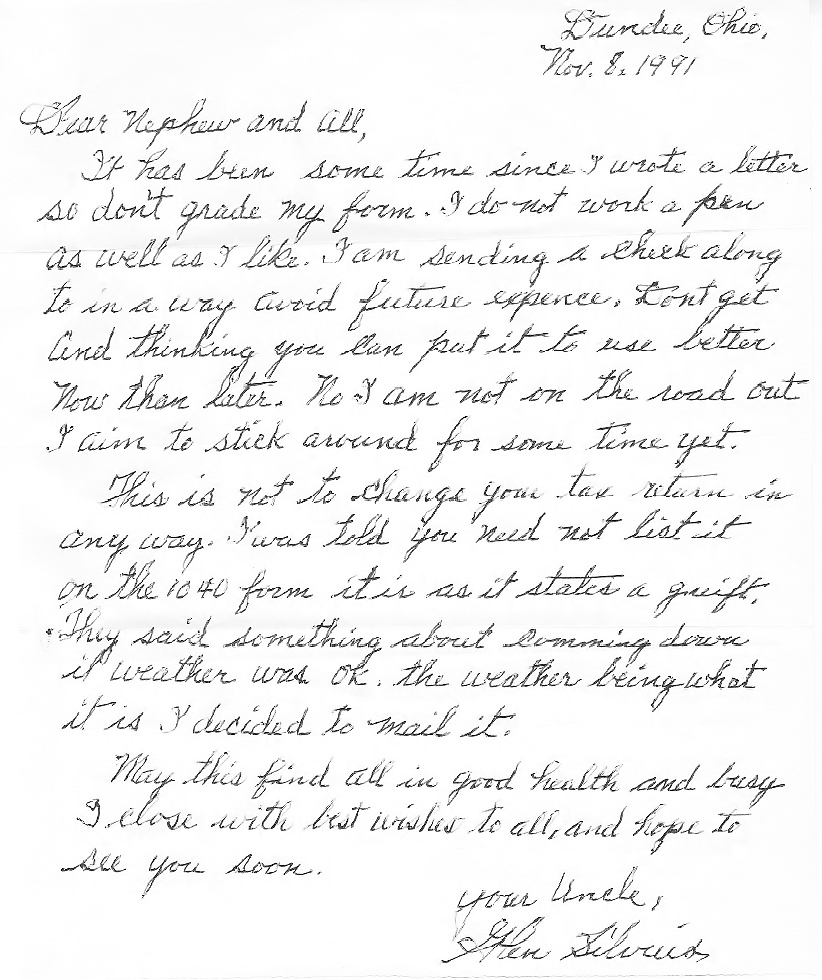


My letter of thanks to him:

Dear Uncle Shorty,                                                                                          November 12, 1991

I got home this evening after dark at about 6:00pm.  I had just finished teaching a 3 hour lab in botany in which we were sectioning and staining Begonia stems and basswood (linden) twigs to study the stem tissues.  So it was a real encouragement to pull your letter out of the mail box.  It was quite a surprise to see the enclosed check.   This was a very generous gift to us and we want to thank you in the words of this letter, and perhaps more significantly, by our wise use of what you have given.

Brad worked two jobs this summer and is working nights now to pay on his college expenses in addition to that which we provide.  Some of this will be used to help him and to save for Mindy's college expense.  We have had a series of replacements of appliances that have worn out in recent months and are anticipating major repairs or replacement of our heat pump which is about 16 years old.  We have been praying that God would help us to know how to meet these expenses.  We have never really lacked for anything good, and I believe God has provided these essentials.  I hope you have experienced a sense of satisfaction and will be blessed by God for your kind assistance.

This is not the first time your gifts have been an encouragement to this particular nephew.  I remember my first wrist watch which was a gift from you. As I recall, you had to show me which wrist to wear it on.  Much later, I learned that it was partly by your encouragement that Dad purchased a used black Volkswagen, my first car.  Then, when I finished my graduate work at West Virginia University, you helped me to purchase some nice shirts, ties, and sweaters.  Interestingly, I still wear the two sweaters around the house that I bought at that time to teach in at University of Illinois. 

I am sure that others of your nieces and nephews could think of many ways you have helped them, too.  For my part, I just want to say that, while it was not for you to have sons or daughters of you own, you have had a large part in helping this nephew in a fatherly way.  I hope your gift will help me to do what is right in being a good husband, and good father as our two children are going through transition to adulthood.

We hope to visit you on Thanksgiving or, more likely during Christmas time.  It is a busy quarter for me with the changes in our existing science building (this summer we had to move out for installation of air conditioning), and the construction of a new addition on the north side of the building.  You would enjoy seeing this; wish you could come down and spend a few days.  It is a 3 story steel framework with brick and glass, enclosing 60,000 sq. feet for our nursing and engineering programs (mechanical and electrical). 

I think your writing is still very good ; much better than mine most of the time.   I have become spoiled by the computer, and I hope you do not think this letter any less personal because it is typed rather than handwritten.  I hope you too are well and that you are at peace with God and yourself.  Thanks for the part you have had in my life, and may God bless you.

Friday, May 17, 2013

Jackie Robinson -- “YOU Don’t Belong Here!”


“YOU don’t be-lo-o-n-g here!” How many times did Jackie Robinson, America’s first black, major league, baseball player, hear this derogatory statement and dozens of more barbs hurled at him from different corners of major league stadiums in the late 1940’s?   Branch Rickey, manager of the Brooklyn Dodgers, also bore much criticism for choosing Robinson and supporting him emotionally and spiritually as together they broke the color barrier to major league baseball.

This Spring, the movie 42, named for the historic number worn by Jackie Robinson, recounts how Robinson and Rickey, broke the color barrier to major league baseball, in 1947.  To accomplish this feat, Rickey wanted a talented black baseball player who could “stand and deliver” at the plate when the pitches came.  But Rickey also wanted a player who could stand and take the verbal and physical abuse hurled at him both on and off the field. The following dialog between Robinson (played by Chadwick Boseman) and Rickey (Harrison Ford) attempts to capture what was at stake for both men:

Rickey:   “Your enemy will be out in force but you cannot meet him on his own low ground.”
Robinson:   “You want a player that doesn’t have the guts to fight back?”   
Rickey:  “No, I want a player who’s got the guts NOT to fight back.”
Robinson:  “You give me a uniform and give me a number on my back, and I’ll give you the guts.”

In spite of the ensuing abuse hurled at him on and off the field, Jackie Robinson proved himself in the minor leagues and then with the Brooklyn Dodgers.  Few of us can even imagine the challenge of having to perform on an athletic field while listening to degrading taunts like “You don’t belong here!”

The torments and temptations that Jackie Robinson faced in breaking the color barrier to major league baseball were rooted in the most fundamental temptation used by the Satan from the beginning of human history.  Satan’s tempting ploy, expressed through the serpent in the Garden of Eden, was a variation upon the same ugly statement, “YOU don’t belong here!”  

God had appointed Adam as a “servant king” over creation to serve and preserve it as an expression of His own love for creation.  Then, God created woman out of Adam’s flesh to provide him with a complementary partner; and God performed the first marriage between man and woman.  However, Satan’s approach was to divide and deceive both partners.  His question to Eve, Indeed, has God said, 'You shall not eat from any tree of the garden'?  caused her to wrongly believe, “I don’t belong here!  After all, God must be withholding something greater from me.  Instead, look at me here, living under the restrictions of both God and my husband.”  Eve succumbed to temptation, and Adam along with her.  As a result of the fall of man, every one of Adam’s descendents is infected with the curse of sin.

How many lives of people from all walks of life have been deceived and destroyed by succumbing to the Tempter’s whisper, “You don’t belong here?”  Instead of celebrating the amazing ethnic diversity that exists within the human gene pool, we have used the differences like skin color, language, and cultural traditions as an excuse to divide, wall off, and exclude each other--complete with posted signs like “Whites Only” and exclamations like “You don’t belong here!”

But there was One Man Who withstood the Tempter’s snare--the God-Man, Jesus Christ.  The Gospels record Satan’s attack on Jesus with the same ploy he used on Adam and Eve—“You don’t belong here!  Look at you, Son of God, here in this wilderness without bread (Matthew 4: 1-4).”  Later, Satan offered Jesus a supposed better place to belong: “You belong on the pinnacle of the temple where all can see Your power as You cast Yourself to the ground and are protected by angels (v. 5-6).  But our Savior resisted the temptation (v. 7) and eventually went to the cross as a sinless sacrifice.  Isaiah 53: 11 reveals Jesus, the Suffering Servant, prophetically:

 …as a result of the anguish of His soul, He [God the Father] will see it and be satisfied; By His knowledge the Righteous One, My Servant, will justify the many, As He will bear their iniquities (Isaiah 53:11).

As a result of Christ’s victory over death, He became the first of many who by faith in God are marching in the victor’s triumph over sin and temptation (2 Cor. 2: 14).  The movie 42 makes clear that the “guts” of both Rickey and Robinson were undergirded by their Christian faith.  Rickey challenges Robinson, “Like our Savior, you have to have the guts to turn the other cheek.”   

Branch Rickey encourages Jackie Robinson in scene from 42
In one of my favorite scenes, Robinson retreats to the tunnel after being verbally abused on the field.  There in the apparent privacy of the tunnel, Jackie emotionally explodes and splinters his bat in frustration.  Seemingly out of nowhere, Branch Rickey appears at Jackie’s side.  Sensing Jackie’s frustration, Rickey embraces him but is greeted with Robinson’s accusation, You don’t understand!  Rickey replies (as I recall), No.  I don’t understand [what you are going through]. But the Savior does.  It’s the wilderness [referring to Christ’s physical, emotional, and spiritual battle with temptation].

Jackie Robinson’s accomplishment on behalf of Black Americans places him in a long line of distinguished Americans of color whose faith, courage, and determination enabled them to be the first to enter other avenues of life in America.  Thus, in 1869, Hiram Rhodes Revels (R-Mississippi)(1827-1901) became the first Black American elected to the U.S. Senate, while Joseph H. Rainey (R-South Carolina)(1832-1887) became the first Black in the U.S. House of Representatives.  Likewise, Black Americans have made major contributions in education (Booker T. Washington, 1856-1915), the fine arts (Edward Clark, 1926- ), and statesmanship (Frederick Douglass (1818-1895). 

Among Black American women who rose to leadership and helped others achieve their destinies is
Harriet Tubman, credited with leading over 300 slaves to freedom through the “underground railroad.”  In recent years, Condoleeza Rice became the first Black American to serve as a U.S. national security adviser; and later, the first Black woman to serve as U.S. Secretary of State (2005-09).

Although the sampling of Black American’s I have included here is relatively small,  I believe those I have chosen represent the great number of Blacks who have not bowed to the taunts represented in the abusive claim, “You don’t belong here!”  Indeed, I would contend that those of any minority, whether Black, Hispanic, Irish Catholic, Jew, or Asian have succeeded, particularly in more recent times, because they overcame an even more subtle obstacle; namely, the tendency of some in positions of power to treat them as a “constituency.”  Members of constituencies are often discouraged and dispassionate in the face of constant reminders that they have been treated unjustly and therefore, are deserving of special advantages to compensate for these injustices.  Instead of being told, “You don’t belong here!” they hear a different, condescending message; namely, “You belong HERE.  You belong on a “plantation of Washington’s creation”--among those who have become perpetually dependent upon government handouts through food stamps, welfare, etc.”   In return for your gratefulness for these handouts, come election time, you should be kind enough to give your vote to those who are always there to help you along.

Creation of a political constituency by fostering dependence upon government is immoral and diabolical because it degrades the very spirit within man that can only be fulfilled by striving to achieve the purposes for which he or she was created.   Consider what really is necessary for achievement for anyone including Black Americans, as expressed in Harriet Tubman’s challenge:

Every great dream begins with a dreamer. Always remember, you have within you the strength, the patience, and the passion to reach for the stars to change the world.

Frederick Douglass understood the importance of individual responsibility in striving for success and listed “honor, integrity and affection" as the essential prerequisite for enduring success.  In his lecture, “
Self-Made Men,” Douglass, the great Black orator, educator, and statesman of the Civil War era, describes a natural hierarchy of men which includes the “ambitious man” and the “unmotivated man.”  He applies the moral principle as follows:

the man who will get up will be helped up; and the man who will not get up will be allowed to stay down….   Give the negro fair play and let him alone. If he lives, well. If he dies, equally well. If he cannot stand up, let him fall down... (p 557)

Douglass further comments on the conditions that encourage or discourage achievement:

As a general rule, where circumstances do most for men there man will do least for himself; and where man does least, he himself is least. His doing makes or unmakes him (p 558).

The voice of Jackie Robinson echoes loud and clear with the voices of Harriet Tubman and Frederick Douglass of the Civil War era, all in sharp contrast to the politics of Washington that would keep minorities in a perpetual state of dependence.  Robinson stated: 

 Life is not a spectator sport. If you're going to spend your whole life in the grandstand just watching what goes on, in my opinion you're wasting your life.

Dr. Ben Carson
In recent months, Dr. Ben Carson, director of pediatric neurosurgery at Johns-Hopkins University, has become a vocal advocate of individual responsibility, courage, and integrity.   Dr. Carson’s life story is a testimony that one can rise from a culture of low expectations to achieve great things.   He is quoted as follows:

You have the ability to choose which way you want to go. You have to believe great things are going to happen in your life. Do everything you can - prepare, pray and achieve - to make it happen.

Dr. Carson has frequently heard in so many words, “You don’t belong here.” when he spoken out against government dependency, or has shared positive solutions to our current health care debate.  Commentator Cal Thomas, in a recent WORLD Magazine article, has used the life of Dr. Carson to point out that strong Black American families can have a much greater success in building individuals with character than liberal programs that only foster government dependency:

The nightmare for liberals would be if Ben Carson became a role model for the poor instead of a target.  If more of the poor had mothers like his (and maybe active fathers, which he didn’t have), who focused on reading and discipline, more might grow up to be like him. They might reject the lie that they are incapable of succeeding because of their circumstances.

Jackie Robinson on "What's My Line?"
May the tribe of Jackie Robinson, Ben Carson, and so many other courageous minority leaders increase; and, may those in positions of authority recognize that proper stewardship of power should reflect the example of Branch Rickey who, as a godly, empathetic mentor, seized the opportunity to lift up a brother and support him in using his God-given talents to make a positive difference in sports.  It is noteworthy that Jackie Robinson never forgot to mention Branch Rickey as the essential element in his success.


For sake of discussion beyond comments you might wish to make regarding how you liked the movie, 42, I will close with a quote from Rachel Schroeder, at www.filmfracture.com who writes:

As a movie about Jackie Robinson, 42 is not going to provide any real insight into the man. What it will do, as movies of this sort always do, is signify something greater and remind all of us of what kind of place we came from, how far we have come, and how much farther we have to go--and that it is possible.   

After seeing the movie, or perhaps reading this blog entry, would you agree with Ms. Schroeder?  Is it expected and right that we today should carry guilt for what our ancestors have done?   If so, can that sense of guilt suffice as a motivation to take action?  What kind of action?  Or, should I learn from the past but not focus on the injustices of the past—while instead taking responsibility as an individual before God to love my neighbor in word and deed?

Saturday, April 20, 2013

"Little Today. Leaders Tomorrow."

If opinion polls are any indication, many Americans are pessimistic about their future.  In a recent USA Today/Gallup poll, 1,025 adults aged 18 and older were asked to respond to the statement, When you think about the future of the United States – which do you agree with more:   the country’s best years are ahead of us (or) the country’s best years are behind us?   The poll results indicate that our nation is divided almost evenly in their outlook—47% said the best years are ahead, while 50% said the best years were behind us.

When clouds of pessimism arise about our future, we are often encouraged by good news and real-life stories that portray a positive outlook.   One such story began in 2004 when our son, Brad, founded The Little Leaders Company for the purpose of producing a Bible-based series of developmental videos for young children, infants to age three.

Within two years of its founding, the multimedia company had produced four 30-minute DVD's, each designed to introduce important Biblical concepts through the examples of Biblical characters—Noah, Moses, Joseph, and Ruth.  Each DVD is an explosion of vivid colors with quality animations designed to capture the attention of youngsters (and their parents) and to assist them in learning important biblical character qualities and other practical skills—learning their colors, learning to count, and exposure to other languages.
Brad with his niece (Kiara) and nephew (Caleb)

The DVD, Little Joseph, teaches that God has a plan for each of our lives; and, his “coat of many colors” gives opportunity for children to learn their colors and find joy in the richness and beauty of God’s creation.  Little Ruth, which features the life of the Old Testament character, Ruth, teaches children the importance of respecting their parents and other members of their family.  Little Noah and Little Moses introduce children to these Old Testament men of faith; and, demonstrate God’s faithfulness in saving Noah from the flood, and by leading Moses and the Israelites out of bondage.


From the beginning, The Little Leaders Company was rooted in family relationships.  As Brad recounts, his inspiration for this project was from existing DVD’s such as “Baby Einstein” which were favorites of his niece and her parents, Mindy and Steve Salyers.


Team of the Little Leaders Company
As Brad began the writing and production stages, he enlisted family members and friends to help with voice recordings, foreign languages, stand-ins, and choreographic roles.  Brad’s wife, Raquel, assisted in production while his sister, Mindy, and cousins, Sharon and Keith Kohler assisted in marketing of the DVD’s.

The slogan of The Little Leaders Company for nearly a decade has been “Little Today.  Leaders Tomorrow.” Now, children who have been exposed to important biblical truths and skills through Little Leaders are reaching the age when leadership skills are beginning to emerge.  So, we thought it would be interesting to feature several children who were “Little” nearly a decade ago and are becoming “Leaders Tomorrow” as they enter their adolescent years.

Caleb and his dad (2003); and assisting with media at his church in 2013.

For example, Brad’s nephew Caleb has entered high school this year at Stateline Christian School, in Temperance, MI.  While in junior high, Caleb was elected to a class office.  He currently assists in the ministry of Northpoint Church of the Nazarene, in nearby Toledo, OH where his father, Steve Salyers is pastor.  Caleb is developing his own interest in multimedia production with the encouragement of

his uncle Brad.  Meanwhile, Caleb’s sister, Kiara, finds joy in singing both at home and at her church, sometimes in duet with her sister, Della; or with other former “Little Leaders,” Cassandra and Brenda Petrey.

Other children of the past decade who were featured in Little Leaders DVD’s include Caleb and Kiara’s cousins. 

Kiara, Cassandra, and Brenda across top, in 2004;
and with Cassandra's sister, Serena, in 2013.
Space allows the featuring of only a few family members and acquaintances who have participated in The Little Leaders Company.  In fact, we trust that those who participated in the DVD’s are only a few of the “Little Leaders” who are becoming “Leaders Tomorrow” as their lives have been enriched by biblical principles through their parents, church, and community. 

Finally, if you know of one or more children or adults who have been encouraged by the biblical message through Little Leaders, please share it here through a “Comment” or other means provided on this page.  At a time when we are confronted with many unsettling challenges both at home and abroad, we applaud ministries like The Little Leaders Company as well as dedicated moms and dads, churches, and communities that are nurturing godly leaders for tomorrow.

Saturday, March 30, 2013

No Gun Control Without Self-Control

What do firearms, knives, and words have in common?  All three can protect or save lives; and, all three can destroy by sharp and deadly replies. 

Thanks to the First and Second Amendments to the U.S. Constitution, we Americans have freedom of speech and freedom to bear of arms, respectively. These freedoms also mean relatively few restrictions against fiery tongues and fiery guns.  Nevertheless, our protection from both tongue and gun is rooted not in civil law but in the moral code.  The moral law is grounded in Jesus’ teaching that it is out of the heart [that] come evil thoughts, murders, adulteries, fornications, thefts, false witness, slanders (Matthew 15:19).  Therefore, the answer to a safe and civil society is not found alone in “tighter controls” on guns and speech.  Instead, there must be a revival within institutions that nurture a godly disposition of the heart; namely, the family and the local church, both within the context of caring communities.

All Violence Comes Ultimately from the Heart
I believe government is ordained by God to establish rule of law, execute justice for lawbreakers, and protect the nation from foreign invasion.    But, for such a system to work requires both leadership committed to just enforcement of the laws of the land; and, a citizenry that recognizes its individual moral and ethical responsibility to higher authority--and ultimately to God.  This relationship requires no less than a partnership between government and religious institutions, both functioning in their respective roles to maintain order.  While civil authorities encourage social behavior by external laws and deterrents to anti-social behavior; family and church nurture character qualities that promote self-restraint, personal responsibility, and benevolence.  Alexander Solzhenitsyn, in his essay "Repentance and Self-Limitation in the Life of Nations," underscores the necessity of strong character in individuals if a society is to prosper:

Whatever feelings predominate in the members of a given society at a given moment in time, they will serve to color the whole of that society and determine its moral character.  And if there is nothing good there to pervade that society, it will destroy itself or be brutalized by the triumph of evil instincts no matter where the pointer of the great economic laws may turn.[i]

Although many believe that government shouldn’t “legislate morality” or “engineer” society, still federal, state, and local governments continue to move in this direction.  Perhaps the moral laxity and the decay of the nuclear family have created the vacuum that government now seeks to fill.  Leadership in Washington, through “ObamaCare” has taken on the management of human health care and even the ‘health’ of planet Earth.  At the local level, the city of New York is attempting to ban big sugary drinks as If to occupy the vacuum left by an adult population that seems less responsible for both their own nutrition and that of their children. But government efforts to legislate individual and planetary health are both doomed to fail without a revival of godly human character and personal responsibility.

The Bible emphasizes individual or personal responsibility under the concept of stewardship.  Stewardship is managing that which is not ours but has been entrusted to us by our Creator—our abilities, our time, and our opportunities to become responsible, members of society.  Stewardship is taught in many parts of the Bible as I have previously highlighted in Oikonomia.  Of particular relevance here is Colossians 3: 23-24 where Paul states:

Whatever you do, do your work heartily, as for the Lord rather than for men,
knowing that from the Lord you will receive the reward of the inheritance.
It is the Lord Christ whom you serve.


In order to fulfill our responsibility as stewards of creation, we have been entrusted with great potential as image bearers of the Creator Himself.  We are to be God’s caretakers who represent His interests as we rule over His creation.  But instead of representing God’s interests, our father Adam acted on his individual interests and consequently brought God’s judgment upon him and all his descendents.

In spite of the fall of man and the curse upon the creation, mankind was allowed to remain as stewards of  creation.  What followed was a steady march of “human progress” in the development of more sophisticated technology.  Each development increased the reach and power of humans to utilize the richness of creation’s treasures of soil, water, minerals, metals, fossil fuel, and biodiversity.  And, with each new technological advance from club and arrow to gun and bullet, and then, to rocket and drone came the challenge to use the potential of that technology either for human benefit and God’s glory, or for human destruction and God’s dismay.

The table below lists several common technologies that are influential in today’s culture.  (Click on table to view.)  The middle and right columns demonstrate that most technology can lead to either morally “good” or “bad” outcomes.

There are differing viewpoints about the moral component of technology[ii].  However, I believe the quality of moral character, judgment, and personal responsibility of the individual user is the chief determiner of whether a morally “good” or “bad” outcome will result from the use of technology.  For example, the same firearm used by an elementary school policeman to protect the students and teachers from the murderous intent of intruders can also be used by the same policeman in a fit of rage to commit the horrible act he or she is hired to prevent.  It follows that our society will not prosper amid a myriad of guns, gadgets, and goodies unless greater attention is given to the importance of each individual taking personal responsibility for his or her actions.

Mass shootings like the ones at Aurora, Colorado [See Oikononia, July 25, 2012] and Sandy Hook, Connecticut have prompted requests for new laws to prevent such tragedies.  Sadly, the moral and spiritual principles voiced by our clergy at memorial services for the dead are not allowed into our public schools, universities, and halls of government where attempts are being made to make sense of such behaviors and to prescribe ways to stop needless killing

Dr. Alveda King told Newsmax (March, 2013) that both her grandmother and her uncle, Dr. Martin Luther King, were killed by guns; but her father was mysteriously killed with no gun involved.  She concludes that,

…rather than giving all of our effort to gun control, we need to start looking at the hearts of the people and even consider when you do things like taking prayer out of schools…or just cut off all efforts to give people value systems, and morals…

Solzhenitsyn claimed that the only “way out” is through repentance:

What way out remains to us?  Not the embittered strife of parties or nations, not the struggle to win some elusive victory -- for all the ferocious causes already in being -- but simply repentance and the search for our own errors and sins.  We must stop blaming everyone else -- our neighbors and more distant peoples, our geographical, economic, or ideological rivals, always claiming that we alone are in the right.  Repentance is the first bit of firm ground underfoot, the only one from which we can go forward not to fresh hatreds but to concord.  Repentance is the only starting point for spiritual growth. ‘For each and every individual.  For every trend of social thought.’

Shouldn’t we who are so rich and surrounded by gadgets—we who are even shaped by them, and who are killing and being killed by them (whether gun, knife, or pen)—shouldn’t we TAKE the only “way out?”  Solzhenitsyn’s “way out” of this rings consistent with God’s heavenly call recorded in the Old Testament:  If…my people who are called by My name humble themselves and pray and seek My face and turn from their wicked ways, then I will hear from heaven, will forgive their sin and will heal their land (II Chronicles 7:13 (part)-14). 

Taking the only way out?   Perhaps during this Holy Week, we can begin by setting aside a quiet time (away from distracting gadgets if possible), obtain a copy of the Bible, and read God’s Word.  Christ’s “Sermon on the Mount” recorded in Matthew Chapters 5-7 may be a good place to start.  Then, pray in communion with our Creator God, allowing His Spirit to illuminate our reading and our medication upon His truth claims.  After all, isn’t …the Word of God is living and active and sharper than any two-edged sword, and piercing as far as the division of soul and spirit, of both joints and marrow, and able to judge the thoughts and intentions of the heart (Hebrews 4:12)?

Prayer:   Thank you Father for being a loving God and even “Father” to those who have simply surrendered their pride and rebellious hearts to receive forgiveness for sin based on Christ’s sinless sacrifice on the cross.  Help us to recognize that our hearts are deceitfully wicked without your transforming work through your Holy Spirit.  Without your transformation of our dispositions from pride and hate to humility and love, no amount of man-made legislation will bring resolution to the problems we face in our homes, churches, schools, governments, and environment. Conversely, as we surrender to You, be pleased to mold and shape our hearts so that we are transformed by the renewing of our minds [so that we may] prove what the will of God is, that which is good and acceptable and perfect (Romans 12:2).


[i] I am indebted to Dean Ohlman for recent discussions in which he pointed me to Alexander Solzhenitsyn’s essay cited herein.   He has developed these thoughts very well at http://wonderofcreation.org/2012/07/03/confessing-for-the-church-part-2/
[ii]  Admittedly, there is disagreement as to where the moral component resides, whether in the technology itself, in the human creator, or in the interaction between creator and technology.  For example, see the following source:  Latour, Bruno.  2002.  Morality and Technology: The End of the Means.  Theory, Culture & Society  (SAGE, London, Thousand Oaks and New Delhi), Vol. 19(5/6): 247–260

Thursday, February 7, 2013

Lessons from Bilbo Baggens on the Big Screen

During the Christmas season, I enjoyed the movie, The Hobbit: An Unexpected Journey with our son-in-law and grandson.  At a time when movies introduce us to incredible fictional characters like Batman, Captain America, and Iron Man; and, historical giants like Lincoln, it is easy for me to dismiss the significance of “an ordinary life.”   However, in this first of three movies based on J.R.R. Tolkien’s The Hobbit, I was challenged by the significance of just such an ordinary life through the character Bilbo Baggins.

Bilbo Baggins is a Hobbit.  Tolkien describes these little fictional characters as “just rustic English people, made small in size because it reflects the generally small reach of their imagination.”  I wonder if Tolkien was thinking of Moses’ account in the Old Testament Book of Numbers when twelve exceptional leaders, one from each of the twelve tribes of Israel, were assigned to spy out the land of Canaan.  If you are familiar with the account, all of the spies except two, Joshua and Caleb, concurred with the report which stated “we became like grasshoppers in our own sight, and so we were in their sight (Numbers 13:33)."

If the Hobbits were “made small” because of limited imagination, perhaps in a similar way, the Israelites were “made small” because the image of God was too small in their imagination.  Not long after a miraculous deliverance from the Egyptians by the parting of the Red Sea, God had given the Israelites the go-ahead to enter the land of Canaan backed up with the promise based on His character and His Word which stated: "Every place on which the sole of your foot treads shall be yours (Deuteronomy 11:24).”   The Israelites present a clear example of how our exploits for God may be stunted or prevented by a small imagination and a unbelief in His Word.
 
How many times has my accomplishment for God been stunted or denied by my inability or unwillingness to see and imagine God’s power and wisdom through eyes of faith?   Therefore, I immediately related to the Hobbit, Bilbo Baggins, a very ordinary life compared to the wizards and dwarves in the story.  Gandalf the wizard asks Bilbo to travel with dwarf leader, Thorin, and a band of dwarves to Lonely Mountain to reclaim the treasure belonging to the dwarves and now under the control of Smaug the great dragon.   Bilbo’s role is to serve as the company’s burglar.

As Bilbo and company encounter numerous dangers, Bilbo remains physically a small Hobbit, but he gradually grows in courage and resourcefulness, eventually earning the respect and confidence of Thorin.  Through Bilbo, I learned that great accomplishments are possible when my faith is exercised.


Near the end of the movie, Bilbo Baggins challenged me in another way.  When Bilbo was asked why he had exercised a courage that had helped to save his comrades, he says something like this:   "Well, I like my home; I like my comfortable chair, and I was content.   But now I realize that you, my friends, have no home.  Your homes have been taken from you!  Therefore, it is only right that I help you to reclaim your homes."

Like Bilbo, the ordinary Hobbit, I have often been satisfied to be an ordinary person enjoying a comfortable, unambitious life.  But then, I remember that I belong to a band of humans who are also wandering orphans, deprived of a rightful home as intended by our King, the Creator of the universe.  But we have now been purchased by His blood.  For He came to Earth as Emmanuel, God with us; and, His obedience and ultimate death on a cross for our sin brought victory over the enemy who stole into the King's creation and brought corruption and waste.  Now, we have a home assured for us in Heaven, but having been enlisted in the King’s army, our mission is based on submission to His authority so that we can see clearly those all around us who have no home, whose homes have been taken from them so that they are wanderers on the Earth.

All these died in faith, without receiving the promises, but having seen them and having welcomed them from a distance, and having confessed that they were strangers and exiles on the earth.  But as it is, they desire a better country, that is, a heavenly one. Therefore God is not ashamed to be called their God; for He has prepared a city for them. 
                                                – Hebrews 11: 13, 16

For consider your calling, brethren,
that there were not many wise according to the flesh,
not many mighty, not many noble;
but God has chosen the foolish things of the world
to shame the wise,
and God has chosen the weak things of the world
to shame the things which are strong,
and the base things of the world
and the despised God has chosen,
the things that are not, so that He may nullify
the things that are,
so that no man may boast before God. 
                        -- 
I Corinthians 1: 26-29 NASB

May God help us to recognize ourselves as aliens in a kingdom of “homeless people.”  Then, may we submit to the King’s authority and power, and then, enlist in His mission to seek and to save the lost, so that the homeless may gain an eternal home while there is time.

Web Links:
The Hobbit – Concept and Vocabulary Analysis (source of artwork used above, by David Wenzel)