Saturday, August 12, 2023

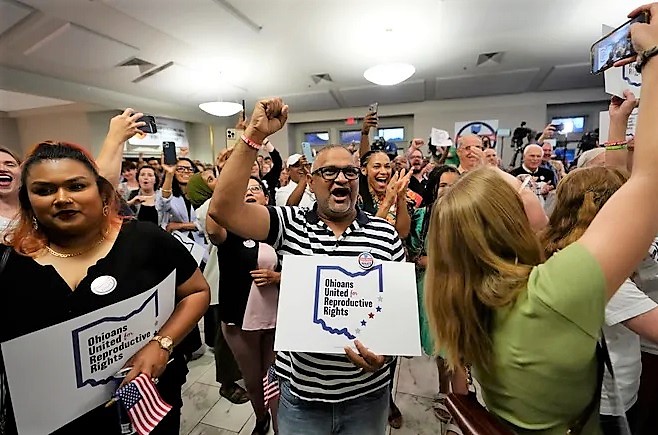
Ohio Issue 1 Defeated-- What Does It Mean?

The August 8 special election in Ohio produced a convincing victory for the opponents of Issue 1. If it had passed, Issue 1 would have increased the size of the majority necessary to amend the Ohio Constitution from the current 50% + 1 vote majority to a 60% majority.  In view of the steeper requirements of most other states, and the two-thirds majority necessary to amend our U.S. Constitution, the call for a 60% majority was certainly reasonable.

In addition to increasing the majority to 60%, Issue 1 would have required that any initiated petition to amend the Ohio Constitution after January 1, 2024 must contain the signatures of at least 5% of the population in each Ohio county.
 In this way, Issue 1 had aimed to ensure that all counties in Ohio, not just urban counties, can have a voice in the democratic process.  [Read more, click HERE.]

Were Ohio Voters Confused?
Admittedly, many of us were disappointed that Issue 1 failed by a wide margin, 57% to 43%.  Our first reaction was to believe that the vote did not reflect the values that a majority of Ohioans place on the sanctity of the life of unborn children, and of their mothers and fathers.  After all, both opponents and supporters focused their appeals on protecting the Ohio Constitution and suggested that, if we don’t vote their way, the will of Ohioans will cease to be represented. Because abortion was highlighted less by both sides, we thought the outcome might represent a confused electorate rather than their views on abortion.

However, when we looked at the polling data prior to the election, we discovered that the “confused voter theory” would not hold water.  Opinion polls taken prior to August 8 revealed that a majority of Ohioans had already declared their opposition to the Heartbeat Law.  In fact, a USA TODAY Network/Suffolk University poll (Click HERE.), conducted July 9-12, 2023 with a margin of error of + 4.4%, indicated that 58% of Ohio voters supported the abortion rights proposal that may be on the November, 2023 ballot, 32% opposed it, and 10% were undecided.   As noted earlier, an almost identical 57% of Ohioans voted against Issue 1.  Also, and Emerson College Poll (Click HERE.) conducted in October, 2022 registered a similar result with 54% opposed, 46% in support of the Heartbeat Law.

We might conclude that the defeat of Issue 1 was in fact reflective of Ohioan’s position on abortion law and not due to confusion from the campaign arguments.  But wait!  We ought to address three more questions that arise--one from the polling data, another from the distribution of the voting across the State of Ohio, and the third, “How Should We Respond?”

Are Polling Data Accurate?
The accuracy of any polling data depends upon how the sampling of public opinion was collected.  For example, how were the questions worded, how large was the sample size, and was the sampling representative, in this case, of the voting population of Ohio?  In our opinion, the USA TODAY Network/Suffolk University poll does not meet these standards.  The polling sample size was only 500 Ohio voters.  This number amounts to only one-half dozen voters per county, and it is unlikely that every Ohio county was represented.  Of the 500 voters questioned, only 46 people were registered voters!  So, the conclusions made from this poll was based largely on 454 individuals, many of whom may not have cared enough to invest the time to become informed and then actually vote.

Nevertheless, we might be tempted to accept the polling results based on the fact that, as we noted above, its results predicted very closely how the vote on Issue 1 would fall.  On the surface, this logic appears sound.  However, we must remember that while pre-election polls can predict the outcome, there is also the possibility that polls can influence an outcome.  For example, voters who have a weak moral foundation and/or who are easily swayed by the direction of the crowd or culture could be influenced by polling data favorable toward abortion.

We now turn to our third question:  Was the outcome of the special election representative of the opinion of Ohioans as a whole?   Just as polling data can fail to represent the opinion of a population at-large; so, a political issue can be decided without a large sector of the population being represented.  Let’s look at the distribution of the August 8 voter returns.

Did the Vote Represent All of Ohio?

Results of the election in each county suggest that the wishes of the rural population of Ohioans, spread over much of the area of the state and representing 67 counties, were not represented in the outcome.  Instead, the outcome was determined largely by urban voters in only 21 counties out of 88 Ohio counties.  Granted, Issue 1 failed on the basis of vote count.  But it is unfortunate that high population densities in relatively few Ohio cities can overpower the wishes of voters in hundreds of small cities, towns, and rural areas.

Perhaps there are at least two challenges given by the defeat of Issue 1.  First, the defeat is an example of the will of “urban Ohio culture” being exercised over the will of “rural Ohio culture.” This outcome emphasizes all the more the importance of the requirement stated within Issue 1.  Namely, if both cultures in Ohio are to be represented in major lawmaking decisions, then any constitutional amendment should require supporting signatures from all Ohio counties.  Second
Ohio will become further divided politically, culturally, and spiritually, unless we work to improve communication and understanding between urban and rural cultures.  If we do not, Ohio will join other states like Illinois, Michigan, and California where cultural values of the more conservative rural landscape are held hostage by deteriorating urban areas.

How can we accomplish bridging the “two Ohio’s?”  From a Christian viewpoint, we have many examples of how the church has been effective in bringing people out of hopelessness to salvation and restoration.  Throughout history and around the world, God’s people have given their love, treasures, and message of hope to urban dwellers.  Many urbanites have never traveled to a rural landscape or been exposed to rural culture and values.  Perhaps readers will join us in praying, seeking God’s leading on how to respond to this need which is increasing with the increase in urban lawlessness and the influx of migrants.  For example, we just published an article, “Community Caring for People and Land” (CLICK HERE.)  What if the example of community caring for people and land exercised in small town Ohio through parks and recreation organizations, churches, etc. could be expanded to build bridges into larger urban communities?  Please let us hear from you.  Use “Comments” below or contact us at silviusj@gmail.com.

How Should We Respond?
No one likes to lose, especially in an important election.  But we must press on realizing that the Heartbeat Law may be on the ballot in November.  We can be informed, advocate, and pray on behalf of lives of the unborn.  We can continue to use the 6-Week Prayer Guide for Ohio, the Unborn, and Women entitled More Than Conquerers, which is freely available for individuals, churches, or groups from the Center for Christian Virtue, an Ohio advocacy group (CLICK HERE for more information.).

Prayer reminds us that we serve on behalf of God’s purposes and His coming kingdom.  Prayer helps us develop a distinct hate and aversion to sin while loving the sinner as Christ loves all of us sinners, both the redeemed and those who still need to repent and receive Christ as their Savior.

Again, our readers should understand that we do not condemn mothers who elect to have an abortion, or the fathers who support or press for that decision.  Rather, we condemn the act of abortion and regret the sin and the judgment that follows this violation of God’s command not to murder (Genesis 9: 6:  Exodus 20: 13).  Isn’t it tragic when mothers who are alive because their mothers chose life decide that their babies have no right to live?  Even apart from the penalty of violating God’s law are the natural consequences of violating the “sowing and reaping principle (Galatians 6: 7-8)”:

Do not be deceived: God is not to be mocked.
Whatever a man sows, he will reap in return. 
The one who sows to please his flesh,
from the flesh will reap destruction;
but the one who sows to please the Spirit,
from the Spirit will reap eternal life.


We conclude with a challenging call from the six-week prayer booklet,
More Than Conquerers, cited above.  The call is to worship and lift our prayers to God on behalf of the unborn, mothers, and fathers:
 
“American culture is captivated by instant gratification. As our attention spans have waned, so has our ability to wait; to endure moments of discomfort and distress; even to understand why sometimes we shouldn't get everything we want the moment we want it.

In such a culture, patient and persistent prayer to the God of the universe is a radical idea. Prayer is stillness. Prayer takes time. Prayer requires honesty and, even sometimes, discomfort. Prayer acknowledges that we are not in control.

Through prayer, Christians are invited to "humble yourselves under the mighty hand of God so that at the proper time He may exalt you, casting all your anxieties on Him, because He cares for you" (1Peter 5: 7).

Not only is prayer counter-cultural to those outside the church; often it's misunderstood inside.  Prayer is not a moment that we decide to spend in God's presence, as if He lives in our world.  Rather, prayer is a moment in which we discipline our hearts to focus on God's constant presence.

Through prayer, we worship God.  Through that worship, we tune our hearts to His goodness.  We remind ourselves of who He is, and of the gift of knowing and trusting Him.  And yes, we bring Him our supplications-- because that is what Jesus told us to do when He said to pray for His Kingdom to come and His will to be done (Matthew 6: 10).

Praying for the protection of preborn babies in a culture captivated by instant gratification, the worship of "individualism," and a growing disdain for the value of human life can feel like a futile endeavor.  But let us remember, again, how God delivered His people from slavery in Egypt.  Exodus 3 contains five of the most radical words in all of Scripture: "I have heard their cries."  And because God heard those cries, with a "mighty hand and an outstretched arm (Deuteronomy 26: 8), He brought justice. 

Pray this week, with confidence in God's goodness and His deliverance, that He would hear the cries of His people for the protection of new life.   Pray that He would turn the hearts of mothers toward their children and away from fear, and that He would thwart all plans of the Enemy to persist in building a culture of death.  Pray that his justice would "roll down like waters" (Amos 5: 24).   
Pray that his Kingdom would come, where every human life no matter how new or small or "planned," is valued and protected. Pray that his will would be done.  (From:  More Than Conquerers, Center for Christian Virtue, pages 13-14.)

Comments:
As always, we welcome “Comment” from readers.   We are particularly interested in your thoughts about the “two Ohio’s,” one urban and the other rural as the Ohio map of Issue 1 voting clearly shows.  If you reside in another state, or in a smaller town or city, you may still experience this two-culture phenomenon.  How can we make a difference?  Please use the “Comment” link below for ideas or questions; or, contact us personally at silviusj@gmail.com

Tuesday, August 8, 2023

Community Caring for People and Land

The Engish word, "community" is derived from the Latin word, communis, meaning "in common," or  "public, shared by all or many."  Similarly, our word "conservation" has the meaning of "serving together with."

Conservation of land and resources makes us aware that we are members not only of the local civic community but also of a complex “biotic community.” Within this community, we share a vital interdependence upon “the land”-- the soil, water, landscape, and creatures.  Participation in conservation draws people into a community of caring individuals as they develop awareness, and then, an ethical commitment to be stewards or caretakers of the land.  Their commitment to serve together toward a common goal strengthens the human community and benefits the biotic community.

Reasons for Caring
Caring for the land brings many rewards or benefits.  Some of these are monetary as urban residents recognize under the heading of “maintaining property values;” or, as our dedicated farmers realize, and therefore are committed to conserve their soil, water, and wildlife.  Local and regional businesses and corporations can also profit by presenting an environmentally conscious image.

The motivations for caring about the land we have so far discussed, while certainly valid and worthy of merit, rest heavily upon the hope of direct or indirect personal gain—i.e. they are ultimately human-centered, or anthropocentric, and utilitarian.  However, for some of us, the human-centered motivations can lead to a deeper level of commitment to the land which becomes interwoven with the people and things we hold dear.  The great land conservationist, Aldo Leopold, inspired his followers to develop a love and affection for the land out of a conviction that it has value in its own right apart from human valuing.  The ethicist J. B. Callicott has stated that the biblical environmental stewardship ethic confers “objective intrinsic value on nature in the clearest and most unambiguous of ways:  by divine decree.”  [For those wishing to read more on the subject, we have discussed land conservation ethics elsewhere (Click HERE.)]

Conservation in Madison County, OH
Regardless of our motivation for caring about the land within which we live, participation in land and community stewardship efforts tends to deepen our awareness, appreciation, and commitment to the land.  Although we are no longer residents of southwest Ohio, and in particular Greene, Clark, and Madison counties, our commitment to land and community stewardship was deepened through our association with those local landscapes and the land stewards who were committed to their care.

This article is a tribute to both the land and people who have invested so much because of their love and respect for the land and the community within Madison County.  We will especially highlight their efforts to conserve pre-settlement prairie community remnants for their ecological, historic, and aesthetic value.

Historic Treasures of ‘Madison Plains’
Residents of Madison County are familiar with the “Madison Plains,” a name that was derived from the historic existence of extensive treeless areas dominated by prairie grasslands.  [We have discussed the geologic and historic origins of these prairie areas and their current remains (remnants) elsewhere (Click HERE.).] 

The focus of this article is upon several personalities who recognized the significance and value of these prairie remnants and were instrumental in educating local residents and visitors as to their worth.  Each of these would humbly defer to others as having a more significant role—evidence of a cooperative effort for the sake of the community and the land. 

Speaking of cooperative effort, the Friends of Madison County Parks and Trails (FMCPT) and the Madison Soil and Water Conservation District represent great cooperation between organizations and within the membership.  I have relied heavily on the excellent website of the FMCPT (Click HERE.) maintained by their webmaster, Gregg Alexander; and communications with FMCPT Executive Director, Wayne Roberts, for information shared below.

Jack McDowell

Our tribute to conservation of remnant prairie areas in Madison County in recent years must acknowledge Jack McDowell, “friend, nature advocate, and community leader,” who died in 2012.  According to the Jack McDowell Memorial webpage of the FMCPT, Jack was an early member of the organization and was “involved with the work of parks and trails for decades.  He was researching and identifying wildflowers and prairie grasses along the Prairie Grass Trail long before the idea of the Ohio to Erie Trail was born.  Jack was a key proponent of the trailheads and nature preserves in Madison County.”

It was my privilege as a student at Malone College to learn of Jack’s interest in Madison Co. prairie communities through my biology professor, Dr. Charles C. King.  “Charlie” had met Jack while each of the two Ohio conservation enthusiasts were exploring remnant prairies back in the 1960’s.  Nearly a half-century later, in 2008, it was my honor to walk the Prairie Grass Trail with Jack to experience his passion for native flora and to observe some of the fruit of his vision and field work.  An informational sign honoring the contribution of Jack McDowell has been located at the London, Ohio trailhead.

“Roberts Pass”

Bicyclers who travel the segment of the Ohio-Erie Trail from Maple Street to Wilson Road, London, Ohio traverse what is affectionately known as “Roberts Pass.”  But instead of seeing steep topography or tall canyon walls as the name suggests, bikers may learn that “Roberts Pass” is named in memory of two humble men who will always stand tall in the records of Madison County conservation and community enrichment.  One of these men is Wayne Roberts, Executive Director of FMCPT who has not only capably led the organization but has been instrumental in establishing cooperation of FMCPT with many other community, state, and national organizations related to conservation and recreation as recorded in the FMCPT website.  Among the appropriate recognitions of Wayne’s valuable contributions was the induction into the Central Ohio Senior Citizens Hall of Fame, in 2013.  It has been difficult to write in tribute to Wayne because he insists on deflecting credit and referring to the contributions of so many of his committed Friends of Madison County.

One such loyal friend of Wayne and of FMCPT, recently deceased, was Gene Pass whose name fittingly completes the name for “Roberts Pass.”  In recognition of his decades of hard work, cooperative spirit, and leadership related to advancement of Madison Co. parks and trails, Gene was inducted into the Central Ohio Senior Citizens Hall of Fame, in 2006.  The following excerpt from a letter supporting Gene’s nomination describes a portion of his admirable participation prior to 2006:

During his tenure on the board, Gene played a key role in extending the Ohio to Erie Trail across Madison County.  He helped document key engineering points such as bridges and culverts.  He donated the use of his truck, trailer, mower, chainsaw, and many other personal tools to help prepare for the construction of this multi-purpose trail.  He personally picked up and carried away literally tons of trash along the trail right-of-way.  Along with cleaning up the trash, he spent nearly three years clearing trees and brush to develop a construction road 6 ½ miles long to help reduce the cost to the community for the actual construction of the trail.  During the cold of winter and heat of summer this tireless senior was the shining example of persistent volunteerism.  Later, he was on the site on a daily bases to assist the contracted construction company during the building of the trail.  As a result of his dedication to this project, the Madison County Park District, the City of London, and the Ohio to Erie Trail Fund, without prior knowledge to Gene, placed a stone marker at the start of this 6 ½ mile section of the trail calling it “Roberts Pass” in recognition of Gene Pass and Wayne Roberts.

Gene’s magnetic personally has attracted volunteers to the various non-profits he has served in the community.  Part of this is because he quietly leads by example, preferring to leave the recognition to others.  However, when put into a leadership position he has carried out his duties professionally.

Abby’s and my acquaintance with Gene began later in his life when he was dealing with age-related ailments but still maintaining an active role in FMCPT and bikeway-related events.  Like Wayne Roberts, Gene’s life is a testimony of dedication to a enhancing his community and its residents by participation and leadership in efforts aimed at conservation and recreation.

Jerry Miller
Jerry Miller is another tireless worker who we have been blessed to know.  A recognition of Jerry on behalf of the FMCPT for his character and contributions is worthy of reprinting here in part:

It’s not unusual for people to give back to their communities.  But when someone over 70 with physical pain, gives cheerfully and energetically back to others, it’s an inspiring example and deserving of recognition.  However, when that person had a tough start in life, when his parents separated while he was three and placed him in foster care, it’s even more inspiring.  After living with several foster families, and changing schools thirteen times before graduating from high school, Jerry decided to make some changes.  He moved to Columbus, found a job, and joined the National Guard.  During the next six years he married his high school sweetheart, received an Honorable Discharge, and was asked to run the construction company where he worked.  In a few years, he decided to open his own company, hired workers, and never looked back.

After retiring due to a deliberating ankle injury, Jerry started looking for volunteer work.  He heard that FMCPT was trying to acquire space in a building that needed repairs.  Jerry explained about his building experience and soon gave the building a thorough review and a checklist of repairs for FMCPT to consider.  The FMCPT Board soon came to understand that Jerry was a leader and a doer so they decided to nominate him to the Board of Directors, in 2010.

Jerry has donated his carpentry skills toward making display cabinets and kiosks for the London Trailhead and along the trail; and, donated his own equipment to assist in brush removal and excavating to create level platforms for a camping area near the trailhead.

Besides Jerry Miller’s extensive physical contributions to the community, the tribute to him also includes reference to Jerry’s character, noting that …what’s even more important is what he teaches us.  That at any age, even with medical issues, one can express kindness and generosity in a manner that motivates others to do more, to try harder, to resist the temptation to give up when the going gets tough.  Jerry shows us that being strong has very little to do with one’s physical size or strength.  That a person’s high moral character while doing one’s best persistently and consistently, are what people see as a truly strong person.  Jerry inspires others to do their best by the life he lives.

Public Recognition, Private Satisfaction
By now, I suspect that readers of this tribute will be thinking of the names of others that deserve recognition but have not been included.  I recognize that anyone’s good intention to honor individuals who are worthy will invariably come with the risk that omissions will offend.  However, I hope readers will forgive me.  Indeed, my omissions speak more of my own limited acquaintance with the many other noteworthy individuals and projects of the FMCPT over the years.

I trust that those who expect to see more names, including perhaps their own name, will rest in the fact that contributions of whatever sort that are made in good faith from the heart will be honored much beyond our poor ability to do so here.  I am comforted in the fact that I know from my acquaintances and friendships over the past 15 years that Friends of Madison Co. Parks and Trails work for a cause much above personal recognition—rather it is for community, recreation, conservation, and the betterment of biological, soil, and water resources.

Not only do we find comfort in worthy work well done regardless of public recognition, but there is much encouragement when a family and an organization honor their members and their dedication long after their death.  To illustrate, we offer personal tributes to two Friends of Madison County Parks and Trails whom some of us remember fondly from personal experience:  Bill Young and Richard McKenzie.  Although they are no longer with us, their names engraved on memorials or functional structures along the trails remind us of their dedication and respective contributions. 

B
ill Young
Bill Young was a  much beloved and dedicated member of the FMCPT.   A tribute to Bill on the FMCPT website (Click HERE.) includes the following:

John W. “Bill” Young, founding member and Board Director of FMCPT died on Saturday, November 1, 2008 while doing what he loved – cycling. He suffered a fatal heart attack along the Prairie Grass Trail just outside of London. Bill was actively involved in the community for many years. He helped clear brush, trees, and trash in preparations for the Ohio-To-Erie trail being built through Madison County. He was a trained and certified Trail Sentinel. Bill actively served as a fundraiser and past Treasurer for FMCPT.

I was privileged to work with Bill in one of my first encounters with FMCPT while we were clearing brush along the Prairie Grass Trail.  The memory of Bill’s life and dedication to community and conservation lives on in our hearts and is reinforced by a wonderful memorial located near the London trailhead.

Richard McKenzie 
Visitors to the London Trail Head who use the walking bridge connecting the Prairie Grass Trail to the nearby Madison County Senior Center will learn that the bridge has been named the “McKenzie Bridge” in honor of Richard McKenzie.  According to Wayne Roberts, Richard literally “was the bridge” that connected the ministry of the Senior Center to the Friends of Madison County Parks and Trails. 

The “bridge construction” between the Center and FMCPT began when Richard retired from the State of Ohio Corrections and Adult Parole Authority after 31 years and began to volunteer at the Senior Center.  He was elected to the Board of Directors in 1996 and devoted many volunteer hours to brightening the lives of seniors and other needy folks through teaching a carving class, distribution of food, and offering kind assistance and a listening ear to the elderly and lonely.  In 1999, Richard was honored with a service award by the Summerfield United Methodist Church for his “dedicated food deliveries to the church.”

In 2000, Richard became interested in the Ohio-to-Erie bike trail and was elected to the Board of FMCPT as one of the original members.  He soon became the main fundraiser for FMCPT for a number of years by organizing the live auction which was held at the Senior Center.  His commitment to both the Senior Center and FMCPT enabled Richard to serve as a major force behind the funding and construction of the bridge that bears his name.  Richard along with Bill Young, and also Gene Pass whom he brought into FMCPT, helped clear the path for the Prairie Grass Trail.  Appropriately, Richard has a memorial bench at the Prairie Grass Trailhead and he was inducted into the
Central Ohio Senior Citizens Hall of Fame,
in 2002.

Enduring friendships made in community organizations like the Friends of Madison Co. Parks and Trails enrich our lives.  They also enrich our experience of bicycling on the trails that now bear the fruit of those whose sweat, skill, creativity, and passion have maintained the trails and native plant populations that adorn the landscape.  And, speaking of memorials and history, the latest project of FMCPT and cooperating organizations makes a great addition for cyclers to enjoy.

Community Mural Project

The Community Mural Project was accomplished by FMCPT under the leadership of Gregg Alexander and coordinated with Wayne Roberts, Van Viney, and Ray Thornton.  They enlisted young volunteers from Michigan to restore the trim of a deteriorating brick building located along Roberts Pass Trail in London, OH. The volunteers who serve within the nationwide Student Life Camp network scraped, primed, and painted the trim.  The students were provided housing on campus at nearby Cedarville University.


The renewed trim now surrounds beautiful murals painted by local artist, Clay Hurley, featuring various stages in the history of the landscape of what is now Madison County.  Landscaping between the murals and the bikeway includes 1,400 plantings of native plant species and is still a work in progress.  The Madison County Master Gardeners are planning to add 900 more plugs of native grasses and wildflowers in September.

Conclusion
In conclusion, we began by emphasizing that participation in land conservation makes us aware that we are residents not only of the human community around us, but also the biotic community with its landscape of creatures, soil, and water.  Hopefully, our tribute to several noteworthy participants in Madison Co. community and conservation efforts will motivate us all toward an appreciation of and commitment to our own community as participants who fulfill our responsibilities as stewards of that which is entrusted to us for our care, enjoyment, and commitment to purposes and values that extend beyond ourselves and our time on Earth. 

Comments: 
As always, we welcome “Comment” from readers.   You may use the “Comment” link below or contact us personally at silviusj@gmail.com

Reference:
 1 Quoted from Fred Van Dyke, 2006.  Perspectives on Science and Christian Faith 58(1):48.

Reasons to Vote For or Against Ohio Issue 1

The Akron Beacon Journal Editorial Board, on July 19, 2023, published “8 Reasons for Why Issue 1 Is Wrong for All Ohioans, Even Conservatives.”  
We would like to respectfully respond to each of the 8 points.

1. The arguments are contradictory:  Reason #1 argues that August elections are wrong, if not illegal.  This reason is based on the claim that Ohio lawmakers “largely banned” August elections (but stopped short of doing so) on the basis of low voter turnout that can allow important decisions to be made by “a very small minority of Ohioans.”  But in what seems contradictory, their Reason #2 argues that “Ohio voters are smarter than politicians give us credit” and “can be trusted to do the right thing.”  If Ohio voters are “smart” and “can be trusted,” then why not encourage Ohio voters to turn out next week, vote according to their conscience, and respect the outcome to represent the will of smart Ohioans who cared enough to want what they think is best for Ohio?  After all, when we Ohioans are challenged, we rise to the occasion, don’t we?

2.  The arguments are biased:  Reason #3 rightly claims that “majority rules in a democracy.” And, Reason #4, claims that “citizens should preserve their power.”  The question is, “which side’s majority” will rule, and “which side’s power” will bring the best for Ohioans.  Voting YES on Issue #1 does not mean “one county could stop a petition campaign before it even begins.”  On the contrary, Issue 1 aims to ensure that all counties in Ohio, not just urban counties, can have a part in enlisting us smart, trustworthy Ohioans to “preserve their power” (Reason #4) by participating in the democratic process.  Issue 1 also would assure that the wishes of the rural counties of Ohio which can easily be ignored are given a voice in our constitutional process.

3.  Reason #5 to vote “NO” on Issue 1 is actually a reason to vote “YES:” Opponents of Issue 1 which largely represent a liberal-progressive vision for Ohio say, “Vote NO” because one day, their conservative opponents may be in the minority and have to face the 60% majority requirement if Issue 1 passes.  However, this logic actually favors voting “YES” on Issue 1.  Regardless of which political view occupies the majority, to change our Ohio constitution is a serious matter and should be decided by more than 1 vote more than the current 50% majority. I believe the conservative philosophy of government welcomes the caution exerted by steep majority requirements that can serve as a brake to slow unwise, ill considered changes.

4.  Reason #6—the claim that “supporters of Issue 1 are lying:”  Let’s be honest on both sides of Issue 1.  There is an “elephant in the room” (no pun intended) on both sides.  Opponents of Issue 1 wish to reinstate the right to abort up to a point far beyond when the heartbeat is first detected.  Some favor extending abortion to the point of birth.  On the other hand, supporters of Issue 1 want to raise the bar to change current Ohio law that currently protects the lives of unborn children.  Let’s be forthright on both sides of Issue 1.  Thousands of unborn lives are at stake, as well as the impact on mothers and fathers of these children.  If we honestly define what is at stake, perhaps voter turnout will improve.

5.  Reason #7 rightly claims “Ohioans deserve a fair ‘majority rules’ vote on abortion.”  Unfortunately, opponents of Issue 1 define “fair ‘majority rules vote” as the current “50% plus 1 vote” rather than the proposed, broader-based 60% majority vote which is not too much to ask for major Ohio constitutional changes.  Who of us would want to be the “1 vote” to decide on Ohio law, especially on issues in which thousands of lives are at stake?

6.  Finally, Reason #8 rightly claims that “one-party rule harms Ohio.”  Again, if we honestly admit that the August 8 special election vote on Issue 1 is about whether or not abortion rights are expanded, then it should not be a partisan issue.  When human lives of children and parents are at stake, we ought to vote on moral principle and moral conscience, not according to party affiliation!

Thank you for reading.  Let’s reason carefully, ask what kind of people we are and what kind of people we want to be as Ohioans.  Then, vote with conviction, compassion, and a moral conscience you will be proud to share with your children and grandchildren.

John Silvius
Wooster, Ohio

August 4, 2023

NOTE:  As of this morning, August 8, our “Letter to the Editor” to both the Akron Beacon Journal and the Wooster Daily Record, sister newspapers, has not been published.

COMMENTS are welcomed if you choose to clarify or rebut any point shared in this article.  Please vote today, August 8, if  you are an Ohio resident.

Tuesday, July 18, 2023

Reasoning for Life -- 2. The Creator of “Fitness” Didn’t Fit

All things were made by Him [Jesus Christ];
and without Him was not any thing made
that was made.  – John 1: 3

This article raises the question, “What are the ‘All things' the Apostle John is referencing?"  Literally, “All things” encompasses everything we see around us and everything within us.  It includes our eyes to see these things and our minds to contemplate their wonder and complexity.  We begin by considering ants and flowers.

“All Things” - Including Ants and Flowers
Our peonies have bloomed beautifully this year.  Recently, we saw a comment on Facebook from someone who was unable to make an indoor bouquet of their peonies because the flowers were attracting so many ants.  Although ants can be pests in homes and at picnics, the ant-peony relationship deserves a closer look.

Have you heard the claim that ants are necessary for peony flower buds to open and bloom?  We had heard this claim, too, but had never questioned the validity of it.  Turns out it is false.  But wait!  There is actually a more fascinating relationship between ant and peony, one in which each species benefits by its relationship with the other.  A relationship in which each species benefits is called biological mutualism. 

The ants observed on peony flower buds are attracted to the sugary droplets of nectar that are secreted from the sepals that enclose the flower within the bud.  According to the
Farmer’s Almanac online, the nectar is “a great food source for ants, containing not only sugars, but also amino acids, lipids, and other organic compounds. When a scout ant finds the nectar on the peony, she emits a pheromone or odor trail on the way back to her nest.  Upon arriving at the nest, the ant scout alerts other ants about the food source.  The recruited ants then follow the odor trail back to the nectar on the peony flowers.”

Meanwhile, as the peony flower buds provide a food supply, the ants provide a valuable service to the peonies.  According to the
Almanac, while ants are obtaining food from the peony flower buds, they “…protect their food source by attacking bud-eating pests by stinging, biting, or spraying them with acid and tossing them off the plant.” 

The fascinating relationship between ants and the peony plant is just one of a multitude of biological mutualisms on planet Earth.  Mutualisms exist with a variety of benefits that favor survival and reproduction including nutrition, protection from predators, pollination, seed dispersal, shelter, and numerous other functions.  Some plants like violets attach tiny food-containing eliasomes to their seeds to incentivize ants to carry and plant their seeds.

Amazing Complexity of Communities

Even more amazingly, planet Earth is populated on land and in the sea by unique biotic communities, each consisting of hundreds of animals, plants, and microbial species.   Each species lives in interdependent relationships with other species.  Biotic communities function with amazing persistence, seemingly with only the “invisible Hand” of their Creator who spoke each kind of creature into being and assembled them into biotic communities along with other kinds.  According to God’s Word, He is the Sustainer who makes provision for every living thing:

  The eyes of all look to You,
      And You give them their food in due time.
  You open Your hand
      And satisfy the desire of every living thing
.  – Psalm 145: 15-16

But how does God “satisfy the desire of every living thing?”  The science of ecology reveals that each species that flourishes in a biotic community does so because of the interdependent relationships like we have described above.  To underscore the complexity of biotic communities, just pause for a moment and recall the last time you experienced the sights, sounds, and fragrances of a forest, wetland, alpine, or grassland community.  What is so stunning to us as observers is the amazing complexity and wonder of the myriad of plants, animals, and microbes living in interdependent relationships together.  To illustrate, check out the YouTube video made in a forest community—click
HERE.

Those of us who enjoy gardening may appreciate how challenging it is to “create” a small perennial garden with a half-dozen or more horticultural flowering plants.  Even though our flower gardens are far less complex than native biotic communities, still it requires continual weeding and other efforts to maintain its original diversity. 

Another way to learn to appreciate the complexity of biotic communities is to try to “create” a biotic community “from the ground up?”  [Some may recall our efforts in cooperation with Cedarville University students to establish a prairie on a former agricultural crop field.  See
HERE to begin a multi-webpage account.]

Then, there are “restoration ecologists” who claim not to be “gardeners,” partly because they are not starting “from the ground up.”  Instead, they devote their expertise to restoring existing native biotic communities that have become degraded—i.e. communities that have lost species by local extinction (extirpation) or which have become overrun by unwanted species, the so-called invasive species.  Invasive species were adapted to other biotic communities where natural interactions such as grazing and predation have kept their populations in check.  But when these species escape or are transported to a different biotic community, they can easily become overpopulated and harm populations native to the community. 

A prime example of an invasive plant species is
Kudzu vine (Pueraria montana) a member of the Legume Family which was imported from Southeast Asia in the 1930’s.  Although Kudzu was appealing for its fragrant blooms, sturdy vines, and ability to colonize steep, eroded land, it soon became evident that it would not “fit” into biotic communities of temperate, Eastern North America.  The same sad outcomes are occurring all over the planet when people unwisely tamper with biotic communities and misjudge the “fitness” of an introduced plant or animal species.  These unfortunate outcomes are often partly due to an ignorance or misunderstanding of the ecological and genetic concept of “fitness.”

“Fitness” versus “Fit-ness”
In order to understand the term “fitness,” we must distinguish “fitness” from “fit-ness.”  “Fitness” is popularly associated with Darwinian evolution (Recall “survival of the fittest?”).  Here, “fitness” is judged by its success in survival and reproduction.  Darwinian “fitness” is defined by outcomes in an actual biotic community.  However, it is difficult to predict outcomes, especially when a species like Kudzu is introduced into a new community.  What may look like a good “fit” to conservation biologists and horticulturalists can turn into a “monster.”  The list of destructive invasive plants and animals is long.  For more examples, just perform an internet search using the key words “Australia” [or your own state or province] and “invasive species.”  You’ll be amazed!

How then can we avoid such catastrophes?   First, we must understand that while invasive species like Kudzu have superior “Darwinian fitness” to survive and reproduce compared to other species, they are very poor at “fit-ness” as judged by their ability to “fit into” a community along with hundreds of other resident species of that community.  This reality brings us back to what ought to be a great appreciation for the Creator of biotic communities.  It is the “fit-ness” or capacity to “fit in” that is essential to building a complex biotic community.  “Fitness” in the Darwinian evolution context is of lesser value because, as we said, it is limited in predictive capacity.  In fact, much of what we claim to know about the functions of the biological world is more “descriptive” than “predictive” or “explanatory.”  When we come to grips with this fact, we ought to be humbled.

Complexity Inside Cells
We have emphasized the complexity of biotic communities with their numerous species that display amazing “fit-ness,” each being intertwined with other species in relationships that provide mutual benefit.  But there is even more complexity and evidences of purposeful “fit-ness” beneath the surface—or should we say, beneath the skin or epidermis of animals and plants.  Each multicellular animal and plant species grows and develops through cellular reproduction of the zygote, the first cell of a new generation.  This reproduction leads to more cells but more amazingly, the cells begin to differentiate into different-looking cells whose form exactly complements their respective functions within tissues and organs.

For example, as a plant grows from an embryo of a seed, it develops leaves containing the green pigment chlorophyll precisely arranged within tiny organelles ("little organs") called chloroplasts.  Click HERE to visually go on a kaleidoscopic tour deep inside a plant leaf to observe how chlorophyll absorbs sunlight and converts it to chemical energy by converting carbon dioxide and water to carbohydrates, lipids, and proteins used in plant growth. 


The human body is composed of billions of cells that are diverse in form and function.  For example, consider our nerve cells, blood cells of different types, skin cells, muscle cells, and bone cells.  In most organisms that have sexual reproduction, sexual maturity occurs when sex cells, sperm and egg, reach maturity.  Sexual union demonstrates “fit-ness” literally as evidenced when two mates “fit together” in what humans refer to as sexual intercourse between male and female. 

Sexual union in humans is designed and intended by God for intimacy and procreation within marriage. But “beneath the surface” of this coordination at the organismal and organ level is a crucial and precise “molecular fit-ness.”  [Note that this molecule-level coordination also bears the design and purpose of God that calls for a "fit-ness" of our male and female sexuality within the bounds of marriage.]  Here, an array of molecules called hormones coordinate the functioning of the individual male and female reproductive systems through precise “lock-and-key fitting” of specific hormones with specific membrane receptors.  The precise “lock-and-key” encounter of hormone with receptor causes cellular processes to be set in motion.  The resultant cascade of molecular events controls the precise timing of sexual processes that God intends to promote sexual intimacy that can at times lead to sexual union (copulation), fertilization, and eventual development of offspring.  Although our explanation is very elementary, hopefully we can see that human sexuality affords one of the most amazing examples of God's design and "fit-ness" in creation.

Nanomachines within Living Cells
Proverbs 25: 2 states,
It is the glory of God to conceal a matter,
But the honor of kings is to search out a matter
.

The writer of Proverbs invites us to exalt our Creator for the treasures of complexity He has hidden within His creation.  He adds that it is the honor of a king that the scientist is equipped with a mind to inquire and learn of creations complexity and wonder.  So far, we have traversed creation’s complexity from community to organism, and to cells and molecules.  Permit us to take one more dive into the complexity of how cells are composed and conduct the metabolism that supports our lives.

Earlier, we noted that our bodies are composed of many different kinds of cells.  Each cell is composed of membranes which consist of two layers of lipids (a lipid bilayer).  The lipid bilayer has numerous proteins and protein complexes imbedded within or traversing the bilayer.  Membranes form the boundary of cells, they form organelles (“little organs”), and also complex matrices such as endoplasmic reticulum within each cell.

Membranes are important in creating order within cells.  For example, the smooth muscles of our heart are designed to produce contractions necessary to pump blood.  Smooth muscle cells, or myocytes, contain two types of protein molecules, myosin and actin which together can produce muscle contractions which we detect as “heartbeat.”  Our purpose is not to teach heart physiology but to demonstrate the incredible complexity and design that makes regular heartbeat possible. Click
HERE to WATCH A VIDEO that explains how heart muscle contraction is controlled by so-called action potentials produced by the pumping of ions across cell membranes.  Notice how the precise configuration of cells and membranes and the millisecond changes in action potentials all work in precise “fit-ness” to enable each heartbeat.

Some of you may use prescriptions of drugs known as beta blockers.  These drugs can control the duration of action potentials to improve heart function.  Again, we can see “fit-ness” at work.  What makes a prescription drug successful is its precise molecular configuration that enables it to bind to specific locations on ion channel proteins.

Finally, you may have noted that generation of action potentials requires energy in the form of the molecule ATP (adenosine triphosphate).  Because ATP is expended not only for heart muscle contraction but for skeletal muscle contraction and just about everything that cells do, it must be replenished.  In most living cells that possess organelles, the ATP is generated in organelles called mitochondria.  Mitochondria are known as the “powerhouses” of cells.  As we might guess, muscle cells are loaded with mitochondria!

Each mitochondrion has a double-layering of membranes, an inner and an outer membrane.  Within the inner membrane are protein complexes known as ATP synthase.  Click
HERE and WATCH A VIDEO of the fascinating process of ATP synthesis by these motor-like ATP synthases.  Again, notice “fit-ness” on display as the “molecular motors” like nanomachines with many parts fitting and working together to rotate and crank out ATP molecules.

Finally, some readers may remember observing cells of one-celled life, protozoa and bacteria, under a microscope.  Based on high-powered microscopy and study of protein molecule configurations, we now can observe how one-celled organisms can propel themselves.  Click HERE to WATCH A VIDEO of how ATP energy is used to drive bacterial flagella via “flagellar motors.”  We ought to marvel at the design and purpose evident in the “fit-ness” of these motors and their protein components within membranes.

The Creator of “All Things” Doesn’t Fit
As we conclude, we hope you have been drawn into a clearer awareness that “fit-ness” as seen by how things at every level from whole communities of life to molecules --“ALL THINGS” seem to have a “fit-ness”—i.e. an appearance of design and purpose that has come from something or Someone beyond shear matter itself.  The Apostle John who lacked the scientific knowledge we now possess penned these words under the inspiration of the Holy Spirit of God (emphasis added):

In the beginning was the Word, and the Word was with God, and the Word was God. He was in the beginning with God.  All things came into being through Him, and apart from Him, nothing came into being that has come into being (John 1: 1-3).

The above words are the opening of John’s inspired Gospel-- a profound and powerful statement which takes us back to Eternity past.  As we said in Part 1 of “Reasoning for Life, Part 1: Before There Was Any Thing” (Click
HERE to read.), John takes us even further back than the opening to the Book of Genesis.

Think about it!  Without the Word, the Logos, there was NOTHING!  Because ALL THINGS came into being through Him, Jesus Christ! 

In this article, we have touched on only a few of the ALL THINGS created by Him.  Why not pause again, and take a few minutes to look around you and listen to the sounds of birds, the wind, the sound of voices, and the awareness of your beating heart.  Although John had similar experiences by his five senses, he had no idea of what God would allow us to see through science since his first century writing.  John knew nothing of cells, membranes, molecules, and cellular motors that generate ATP.  His “All things” statement was meant to inspire hearers and readers in his era; but his words ought to inspire us even more.

But the Apostle John follows his “All Things” statement with another profound statement.  This one is tragically sad:

He (the Word, the Creator, Jesus Christ) was in the world, and the world was made through Him, and the world did not know Him. He came to His own, and those who were His own did not receive Him. – John 1: 10-11


Jesus Christ, the Creator of “All Things,” came into His creation in human flesh through the Virgin Birth, but “the world did not recognize Him…did not receive Him.”  The Creator of amazing “fit-ness” from creatures living in interdependence within biotic communities all the way to the muscle cells and ATPase as membrane motors did not “fit!”  Membrane motors that enable the muscular predators to capture their prey, or the prey to escape their predators.  Christ came among us and walked among the His people, the Jews, and among the birds and flowers of the fields.  Walking within all that evidence of “fit-ness” that He created--yet He didn’t “fit!”

How can this be?  What kind of reasoning, or lack of reason, can explain humanity's rejection of Jesus Christ; and, the conclusion that He was “fit” only for horrible suffering on a Roman cross where He died as the sacrificial Lamb?  In “Reasoning for Life Part 3: Death of Reason” (CLICK HERE.), we try to answer this question.

Your Thoughts?
Maybe you have a question or wish to correct a perceived error in what you have just read—please feel free to use the “Comment” link below.  We hope you have been challenged to consider the amazing intricacy of the world around us and to reexamine your belief about how it came about.  The Creator of the universe has spoken to us through His Word.  John follows his tragic statement about the world’s rejection of Christ with these words, But, as many as received Him, to them He gave the right to become children of God, even to those who believe in His name, who were born, not of blood nor of the will of the flesh nor of the will of man, but of God (John 1: 12-13). If you have additional questions or comments, we’d love to hear from you.  Just post a “Comment” below or e-mail me at silviusj@gmail.edu