Saturday, November 5, 2022

Consistent Conservation -- Part 2: Following the Right Vision

 Few of us deny the importance of promoting the conservation of energy and other resources.  But, conservation without “consistency” is like a baker wanting “consistency” in bread or cookie dough without first gathering all the ingredients and then following the recipe.  Conservation of resources without “consistency” leads to a misguided and confused environmentalism.  It confuses the role and value of humans with that of the other creatures with whom we share planet Earth.  Without “consistent conservation” based on the Christian environmental stewardship ethic, policymaking and execution of policy will be “half-baked” and even toxic.  [For a more detailed discussion of these points, click HERE to read Part 1 of this series.]

In Part 2 of this series, we will consider the history of the environmental movement.  In particular, we will discuss the contributions and legacies of two men who each represent a very different view of the value of human life and how we can conserve natural resources.  But first, we will recount some of our own life experiences with the environmental movement of the 1960’s.


Growing Environmental Awareness
Our childhood experiences paralleled much of the history of our culture’s growing environmental awareness and conservation movement.  Both Abby and I grew up on small farms where we had opportunity to work in garden and field.  We learned to enjoy the smell of freshly tilled soil, but also experienced the toil and sweat required to combat bugs and weeds in order to produce a harvest.  

I learned from both my father and grandfather the importance of caring for the soil and water. My grandfather was one of the first in our region to implement contour (strip) farming along hillsides to reduce soil erosion.  We also planted tree seedlings on nearby strip mine land to restore the disturbed landscape.  I learned to conserve water because, not having “running water” in our home, one of my chores was to carry our drinking water from a spring-fed reservoir.  Our home heating and cooking depended on coal and wood which we carried from nearby stockpiles prepared before each winter.

Abby and I were blessed not only to grow up close to the processes of the soil and water, but also to learn lessons of hard work and responsibility toward employers.  She worked at a local grocery store, and I was a manual laborer in the Belden Brick Company.  Like most young people growing up in the 1960’s and earlier, we were not ignorant or confused about the origin and conveyance of our basic needs for energy, clean water, food, and shelter.

Ehrlich’s Environmentalism
When we entered secondary school and then college in the 1960’s, we became acquainted with powerful influencers of thought in resource conservation.  Some voices like that of Dr. Paul Ehrlich, professor of biology at Stanford University, prophesied a future of doom and gloom.  Ehrlich had visited India where he saw millions of people living under the grip of hopeless poverty, starvation, and despair.  The opening sentence of Ehrlich’s widely read book,
The Population Bomb (1968), presented a shocking prediction to our generation of young college students at the time:

The battle to feed all of humanity is over. In the 1970s hundreds of millions of people will starve to death in spite of any crash programs embarked upon now. At this late date nothing can prevent a substantial increase in the world death rate
...

Ehrlich’s solution was population control.  He predicted it would come about either from deliberate human effort or by a combination of human effort and the inevitable death toll from disease and starvation.  While his predictions turned out to be badly wrong, the resulting fear and concern from his dire warnings challenged the thinking of many in positions of influence.  Ehrlich’s interpretations and predictions were based on a narrow viewpoint and therefore, his “recipe” for addressing the human predicament lacked important ingredients.  The result—Ehrlich’s conservation was an “inconsistent conservation.”

Dr. Ehrlich’s failed prediction can be attributed in part to his misunderstanding of the dynamics of human population growth.  World Birth Rate was already on the decline when Dr. Ehrlich made his dire prediction.  According to the United Nations
World Population Prospects, the World Birth Rate had been decreasing since the 1950’s.  It declined from 37.8 births per 1,000 people in 1950 to 17.8 per 1,000, in 2021.  This trend resulted from several factors including more women working outside the home.  Then, in the 1960’s, concurrent with Ehrlich’s prediction, came the loosening of moral standards and the growing women’s liberation movement.  Together, these developments led to a progression from increased voluntary birth control to a greater acceptance of abortion; and then, to legalized abortion and eventually the one-child policy in China.  Increasingly, human life was devalued.  The human population began to be viewed as a blight on planet Earth that needed to be controlled.

Borlaug’s Better World
Whereas, professor Ehrlich’s environmentalism focused on population control, others like American agronomist, Norman Borlaug, viewed the human population differently.  Thanks to his leadership in the advancement of agriculture and crop genetics in the 1950’s and 60’s, farmers in nations like Mexico and India realized a doubling and even tripling of wheat yields.  While Ehrlich predicted mass starvation, Borlaug set about conducting genetic screenings for fungal rust-resistant varieties to prevent wheat crop losses due to the rust disease. This required the painstaking work of removing the male stamen from each bisexual wheat flower to allow only cross-pollination necessary to produce new, rust-resistant varieties.  In less than one decade, Borlaug’s team accomplished 6,000 crossings of wheat, and by 1956, Mexico’s wheat production had doubled.

According to
Gopi Rajagopal, “Borlaug’s next step was to speed up the progress by breeding wheat twice in a year. In the summer, he would breed wheat in the central highlands, then immediately take the seed north to the Yaqui Valley research station. Because of different altitudes and temperatures, crops could be planted back-to-back in the two areas. This solved the problem of photoperiodism.  He planted wheat at low elevations in the north of India while the days were getting warmer and shorter.  Then, Borlaug’s team took the harvested seed from the best plants in the north to the high elevations of the south when daylength became longer and temperatures and rainfall were higher.  According to Borlaug: “Soon we had varieties that fit the whole range of conditions. That wasn’t supposed to happen by the books.”  The results were “spectacular:” Whereas, India harvested only 12 million tons of wheat in 1965, by 1974 it had become self-sufficient in cereal grains!

At the same time community development efforts in sanitation, nutrition, and education resulted from organizations like the Peace Corps started by President John F. Kennedy.  Like many committed college graduates, my boyhood friend and neighbor, Bob Baker, left his family and farm for The Ohio State University and then volunteered for several years to serve through the Peace Corps in India.  Other friends chose paths which allowed them to apply their faith to serve in Christian missionary efforts overseas or stateside.

Looking back on the contribution of Paul Ehrlich, we can easily criticize him and his followers for viewing people and resources as a zero-sum game.  After all, if we view “resources” as simply a finite pile of materials which can be depleted, then more human consumers mean a more imminent exhaustion of the supply and eventually, human misery.  If we accept this claim which is inconsistent with reality, then it makes sense that a priesthood of wiser humans among us must be allowed to take charge of the Earth, curb human population, and cut back on consumption.

In contrast, Borlaug and company viewed each human being as a “human resource.”  Each person who is allowed to be born and nurtured to adulthood is precious and worthy of an opportunity to live a meaningful life.  Borlaug believed that when human ingenuity is put to work toward advancing plant genetics and agronomic techniques, limitations on crop growth and yields could be removed.  

Like any visionary leader, Borlaug had his critics.  They pointed to the environmental consequences of the heavy use of agrochemicals (fertilizers and pesticides).  There was also the trend of large agricultural corporations driving out small farmers.  But even these negative aspects can be addressed through policies and practices based on consistent conservation. 

There were also some unexpected benefits to Borlaug’s “Green Revolution.”  According to
James Wanliss, resultant higher crop yields per acre curbed the desperate need to increase cropland acreage by deforestation.  At the same time, “population growth dropped in every developing nation which applied [Borlaug’s] techniques, and education gained importance relative to muscle capacity.”   More people were fed and could live and contribute meaningfully to the betterment of both Earth and mankind.  Indeed, if Borlaug’s Green Revolution had not prevented severe food shortages in India in the 1960’s, some of Ehrlich’s predictions might have come true. 

Consistency in Conservation
What can we learn from the contrasting worldviews of Paul Ehrlich and Norman Borlaug?  Ehrlich’s environmentalism was based on the notion that mankind can and must take charge of planet Earth’s finite resources and decide how many and who can be allowed to live and reproduce.  The outlook of Paul Ehrlich and those who have followed him has fueled the notion that an elite group can “be as gods” who decide for the rest of the world who can have children, which children and elderly should live, what we ought to eat, what our health practices should be, and how we can control the climate of the Earth.  Clearly such misguided and even unethical goals are evidence of the need for “consistent conservation.”  Otherwise, powerful people with flawed character will make unethical decisions that only a just God is capable of making.

In contrast, Borlaug saw both the planet and mankind as expandable resources that if managed wisely would allow both mankind and the Earth to flourish.  To Borlaug, this meant learning to “serve-with” the created order.  Consistent conservation recognizes the human responsibility and privilege of harnessing the great genetic potential within plants, animals, and microbes for the use and flourishing of mankind.  However, to be consistent in conservation, we must also recognize our ethical responsibility to do our part in sustaining the life-supporting potential of the created order.  When we do not recognize our place as stewards under God, we begin to confuse our role with “being as gods” and foolishly overstep our role and ability (Romans 1: 18-23).

As we emphasized in Part 1 of this series, “Consistent Conservation -- Part 1: Following the Right Recipe,” true consistency is only possible when we submit as stewards in willing servanthood to Christ who is before all things, and by Him all things consist, or “hold together” (Colossians 1: 17).  Leaders can cast vision and nations can adopt conservation policies, but ultimately it falls to each of us to make “consistent conservation” a part of our value system and lifestyle.  In Part 3 of this series, we will consider how “consistent conservation” looks, or ought to look, in our individual lives.

What Do You Think?
As always, we welcome your responses.  You may use the “Comments” link below or e-mail to silviusj@gmail.com.  Here are some questions for further application:
1.  Can you name influential leaders or predictors of our day who represent the same perspective as Paul Ehrlich from the 1960’s?
2.  Who among leaders of our day might oppose Norman Borlaug and his “Green Revolution” approach?
3.  What examples of “consistent conservation” and “inconsistent conservation” can you identify among influential leaders, policies and practices of our day?

Thursday, October 27, 2022

Consistent Conservation -- Part 1: Following the Right Recipe

Those who can bake delicious cakes, cookies, and breads realize that their batter or dough must have “consistency.” That is, it must have the proper thickness, firmness, or stickiness.  Consistency depends on the right ingredients, the amounts of each, the order in which they are each added, the manner and duration of stirring, and other factors.  Proper consistency means there is an agreement or harmony of parts or features to one another resulting in an integrated whole.    

Imagine the frustration we would incur if we hastily began to bake a cake before getting the right recipe and gathering all of the proper utensils and ingredients.  Good baking depends on planning, timing, and careful attention to the recipe.  The same goes for the planning and administration of economic or social policy.  Policy aimed at shifting from a fossil fuel-driven economy to a green- or renewable energy-driven economy is producing disruption and frustration on a much larger scale than a poorly executed baking effort. 

The rush to renewable energy (e.g. solar, wind, geothermal) is driven largely by an attempt to reduce or eliminate our reliance on fossil fuels (e.g. coal, oil, natural gas) that are thought to cause climate change.  The widespread economic and political impacts of this initiative in America and worldwide are causing considerable debate. 

This article is Part 1 in a series on what we shall call “Consistent Conservation.”  Here, we examine the validity of arguments and motivations for using renewable energy.  Many well-meaning efforts are based on subjective notions instead of objective truth about our role as humans on planet Earth.  We will emphasize that truly “consistent conservation,” like a well- executed cake-baking effort is only possible when the “ingredients” are in place and the “recipe” of policy and practice are grounded in the Christian environmental stewardship ethic.

Renewable Energy Considerations
Although many of us are switching to a more conserving lifestyle, it is important that we have the right motivations for conserving.  Two disclaimers are in order. 

First, no one should disparage those who favor “green energy” based on a deeply held conservation or stewardship ethic (Read more
HERE.)  Readers who have purchased an electric car, solar collectors, or geothermal heating-cooling systems; or, who have joined more traditional cultures in erecting a windmill near their home are lowering their energy demand and cost.  In addition, partial dependence on renewable energy invites us to be more energy-conscious and to pursue additional energy-conserving strategies.

Second, we do not oppose policies for expanding the use of green, renewable energy in our economy.  However, we do oppose drastic efforts to curb the use of fossil fuels based on false claims that climate change is the most dangerous existential threat we face. [See “Climate Change in Context – 2. Rightly Weighing Our Risks.” Click
HERE to read.]  Indeed, a more imminent threat to human life and well-being than climate change may come from

reckless anti-fossil fuel policies.  For example, agricultural production of food depends on fossil fuels to produce synthetic fertilizer.  It follows that restriction of synthetic fertilizer use by farmers will disrupt agricultural production leading to food shortages and political unrest.  Tragically, this scenario is already playing out in Sri Lanka  [Click HERE.]and the Netherlands [Click HERE.]

“ESG” Incentives

What kind of logic is so influential as to cause a whole nation to voluntarily choke off agricultural chemicals to its farmers?  Increasingly, the answer is ESG which stands for Environmental, Social, Governance.  Companies like
ESG Enterprise offer financial advice to investors in capital markets who may wish to promote their own ethical values with respect to “sustaining the environment” or promoting “social justice.”  The ESG approach incentivizes corporations and whole nations to adopt policies that generate a good “ESG score.”  Individuals, corporations, or whole nations can earn a high "ESG score" by aligning policies and investments with the liberal, progressive philosophy of what is deemed good for the Earth, and economically and socially equitable.  In turn, they are rewarded in ways that improve their marketing competitiveness and enhance their appeal to ESG-conscious investors.

The ESG approach is largely responsible for what is happening to agriculture in
Sri Lanka and the Netherlands.  Both nations have attempted to earn high ESG scores, partly by restricting supplies of fertilizers to their farmers which have led to the food shortages and political unrest noted above.  Yet, in spite of scientific evidence that climate change is only partly due to human practices, policies driven by efforts to curb gradual climate change are posing immediate threats of national food shortage and civil unrest.  Another mismatch of policy with reality is evident in the current push for electric cars without adequate charging capacity (Click on graphic below to enlarge).

The ESG and “Green New Deal” approach may be well intended.  However, unless our good intentions are based on “good science” and sound governmental and economic policies they can cause immediate and acute threats.  Unfortunately, instead of realizing and learning from bad outcomes when fertilizers are withheld, many want to charge ahead.  Two personal considerations are worthy of our attention.

First, some of us who have retirement funds invested in capital markets that support ESG may want to consider whether we are wise to support an unethical environmental agenda.  Second, we ought to check our motives in making purchases in response to “green initiatives.”  For example, before purchasing an electric car we should be aware of the current shortages of charging capacity and the environmental impact of extracting lithium and others raw materials needed to make the batteries.  Rushing full steam down a bad path is often encouraged by our biased media which hides news contrary to liberal progressive ideology. 

Shallow-Rooted Motives

Bias in journalism and science reporting have persuaded many to become “me-too conservationists.”  This group, generally speaking, includes those who deliberately or unknowingly give lip service to a shallow environmentalism.  Me-too conservationists are easily allured by a desire to show others that they have “bought green” or have acquired a high ESG score.  Their motivation may be for social acceptance or for political or economic gain.  Everyone wants to be socially accepted; but even the best intentions are no excuse for an ignorance that underestimates the complexities of energy conservation. 

Wise natural resource conservation requires an environmental ethic rooted in something deeper than a “me-too motivation” that follows the latest fad or charismatic leader; or, that responds in fear of the latest apocalyptic prediction.  Instead, we must realize that each person thinks and makes choices according to a
system of morality and ethics that is rooted in their worldview.  Therefore, if we are to behave properly toward the environment and influence others to follow, we must understand the nature and influence of our worldview.  [NOTE:  A worldview is a framework or lens through which we can understand and relate to the world around us.  For more on “Worldview,” see “Reflections at Age Seventy-five;” click HERE].

A person’s morality may be either subjective, based on his or her view of how one ought to live; or, objective and based on an external set of absolutes.   
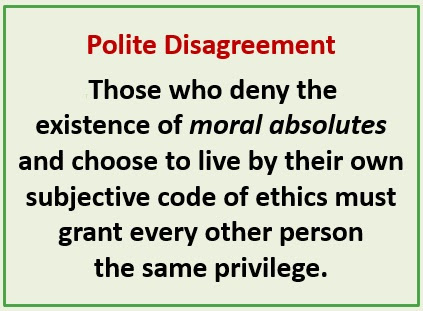
According to a survey of 2,000 adult Americans by the American Worldview Inventory 2021, over half (54%) embrace the postmodern idea that all truth is subjective and there are no moral absolutes.  However, those who deny the existence of moral absolutes and choose to live by their own subjective code of morality and ethics must grant every other person the same privilege.  A culture based on “I’m okay, you’re okay” sounds good in theory.  However, in reality this subjectivity leads us down a path of selfishness, misunderstanding, inconsistency, confusion, division, frustration, and even despair and suicide.

Consistency in Conservation
Into this world of selfishness, confusion, and conflict, God has revealed through His Word in the Scriptures exactly who we are and what our purpose is.  He created us to be His stewards who can only find fulfillment and joy when we serve under His authority rather than being masters of our own lives.  This means surrendering our subjective notions of how to govern our lives; and instead, yielding to the objective revelation of God’s Word.  Instead of falling for the satanic deception as Adam and Eve did in the Garden of Eden (Genesis 3), God offers us, through the free gift of salvation in Christ, the wisdom and opportunity to make choices that are right and pleasing to Him. 

The choice is ours of either “consistent conservation” or a path into “woke environmentalism.” 
Me-too environmentalists who go so far as to live in deliberate rebellion against God’s authority can become susceptible to the popular woke ideology based on critical theory.  Woke philosophy and critical theory are based on a false historical narrative and a false view of humankind.   Wokeism thrives on a distorted view of both God’s natural revelation (His creation) and God’s special revelation (inspired Scriptures).  The result is a spiritually darkened view of humankind that divides us from our neighbor and dislocates us from our position as submissive stewards under God who calls us to exercise dominion over creation.  In so doing, wokeism destroys the only objective justification for our responsibility as servant caretakers of the Earth.  [Read more in “Stewards without a Master” by clicking HERE.]                                                                                        

On the other hand, consistent conservation is the only objective path to conserving resources while at the same time respecting the needs of our neighbors both near and around the world.  As we have explained in detail earlier, the word conservation is derived from the Latin, con- (with) + servitium (service).  Both conservation and stewardship carry the notion of serving with or for the benefit of another as opposed to serving oneself.  [For more detail, click HERE.]

We Are Consistent… in Christ
God never asks us to follow His principles without showing us how to follow.  He did that by sending His Son, Jesus Christ, who “served with” His Father as a perfect steward… Who, being found in appearance as a man, He humbled Himself by becoming obedient to the point of death, even death on a cross.  For this reason also, God highly exalted Him, and bestowed on Him the name which is above every name, so that at the name of Jesus EVERY KNEE WILL BOW, of those who are in heaven and on earth and under the earth, and that every tongue will confess that Jesus Christ is Lord, to the glory of God the Father (Philippians 2: 8-11).

Whereas “conservation” is perfected when we follow Christ’s example of “serving with” our Father, we must also consider conservation that is “consistent.”  Consistent conservation is the practice of the Christian stewardship ethic which is grounded in the wisdom of Christ.  In Colossians 1: 15-17, Apostle Paul exalts Jesus Christ as being …the image of the invisible God, the firstborn of every creature: For by Him were all things created… by Him, and for Him:  And He is before all things, and by Him all things consist (or, "hold together").

The child’s Bible song, “He’s Got the Whole World in His Hands” is the elementary expression of the truth that Christ “existed before anything else, and He holds all creation together (Colossians 1: 17 NLT).   Who can read this proclamation without exalting Christ as Creator, Savior and Lord?  It is not by our own intelligence or any other trait which we can boast, but by the mercy of God who calls us to yield our lives to His rightful authority.  Only by following the example of Christ can we expect to live a life of consistency and practice consistent conservation of the resources God grants to our care as stewards.  

But, instead of submitting to the authority of Christ and seeing how all things "hold together" in Him, many are refusing Christ’s rule and are "coming apart." See our expanded definition of consistent conservation in text box on the right.

Everywhere we look we see the results of energy and economic policies that lack “consistency."  Like hasty bakers who have not followed the recipe, our leaders follow policies that produce worthless “batter” because it lacks consistency.  Well-intended policies that proport to “save the planet” from climate change are driven by a supposed existential threat which is not supported by significant global temperature change.  Nevertheless, energy policies are being implemented by “Green Energy” proponents at the expense of inflation and recession which are bring great hardship on the most vulnerable among us.  [See “Climate Change in Context – 2. Rightly Weighing Our Risks.”  Click HERE.]

In Part 2 of “Consistent Conservation,” we highlight two important thought leaders who represent two very different views of the role and future prospects for humankind on planet Earth:  Paul Ehrlich and Norman Borlaug.  We contemplate which of these two influencers of our current environmental policy direction exercised “consistent conservation.”  Click HERE to read Part 2.

Comments and Questions:
How have current energy and economic policies affected your decisions and lifestyle?  Are there ways you exercise “consistent conservation” or plan to do so?  As always, we welcome your responses using the “Comments” link below to express your thoughts, questions, and suggestions.  You may also write privately to silviusj@gmail.com

Thursday, September 29, 2022

Worshipping God, Honoring Pastors

The LORD is my Shepherd,
I have all that I need.  –
David (Psalm 23: 1 NLT)

This article is about shepherds.  In particular, it is about modern-day shepherds of churches.   We call them “pastors” (Latin, pastor = “shepherd”).  In particular, this article invites you to read and then listen and watch a worship service online in which God is honored through Scripture reading, prayer, and singing.  All of these are followed by a message of encouragement from a much beloved pastor who has served for many years in our church and community.  

As you read, you may notice this article is more brief than usual.  Our brevity is partly a response to family and friends who have commented, “Your blog articles are really long.”  But we also want you to read less and listen more.  You may even be drawn to worship God and His Son, Jesus who declared, “I am the Good Shepherd” (John 10: 11).

God’s Ministering Shepherds

The Old Testament reveals that David was a shepherd (1 Samuel 17: 34-37).  He had spent many lonely days and nights with his father’s flock.  But David also recognized that the LORD, Jehovah, “the eternally existent One,” was his own Shepherd.  We learn just how much David needed and loved His Eternal Shepherd when we read the beautiful lyrics of Psalm 23.  David composed and sung these words along the hillside pastures and still waters near Bethlehem.  Over 1,000 years later, God’s Son Jesus, the “Good Shepherd,” would be born there in Bethlehem with shepherds watching their flocks nearby.

We all depend on shepherds, and we owe our lives to them. But most shepherds are not dressed in shepherd’s garb or carry a rod and staff.  Personally, we are thankful for the many shepherds God has sent along to encourage, protect, and discipline us.  As a boy, I saw God’s shepherding care and discipline through my parents, grandparents, and public school and Sunday school teachers.  Shepherding care also came and still comes through doctors.  Police and highway patrol provide protection and stern reminders to respect the law.  Brothers and sisters of faith in Christ are vital encouragers and include accountability partners.  All of these are essential.  But there’s one more shepherding that was central to my spiritual life; the effectual ministry of caring shepherd-pastors.

No one who claims faith in Christ and then grows in grace and in the fruit of the Spirit (Galatians 5: 22-23) can claim to have done it on their own.  Just as Oikonomia is not “my blog” because it is the result of the inspiration of God and the inspiration and ideas of others, so coming to faith in God is the work of God’s Spirit (Titus 3: 3-6) working through the witness and nurturing of pastor shepherds and laypersons inspired by the pastoral leadership of the local church.

Honoring a Shepherding Pastor

The month of October is Pastor Appreciation Month which reminds us to show our love and appreciation to our pastors and staff.  We are personally thankful for our pastors and staff at West Hill Baptist Church here in Wooster, Ohio. This article aims in particular to honor Pastor Eric Fairhurst and his wife Becky who have faithfully served in our church during a span of 42 years. 

This past Sunday, our service and the fellowship meal afterwards honored Pastor Eric for his many years of shepherding ministry.  The worship service is available to you online from the links below, beginning with the reading of Scripture and opening prayer by Ms. Tracey Price.  If you “stay tuned” thereafter, you can participate in the worship in song led by Pastor Andrew Rogers prior to leading to Pastor Eric’s message.  You can also go straight to his message using another link provided below.

Pastor Eric’s message, “Written on Our Hearts,” is based on the words of another shepherding pastor, Paul the Apostle.  Using Pastor Paul’s letter to the church at Corinth, Pastor Eric explained how, in 2 Corinthians 2: 14 to 3: 6, Paul the Apostle opened his heart to the Corinthian church.  Many of the Corinthian Christians had not shown respect either for him or the Lord Jesus who had given His life for them.  Paul’s strongest and most loving pastoral appeal to the Corinthians, found in 2 Corinthians 3: 2, is the basis for the title of Pastor Eric’s message:  You yourselves are our letter of recommendation, written on our hearts, to be known and read by all.

Pastor Eric conveyed beautifully and reverently the message of God’s great love for us.  Eric also expressed his love for us as our pastor.  I personally thank you, Pastor Eric, for your ministry of nearly ten years to Abby and I.  God has used you, His shepherd, to write the message of God’s love and grace on our hearts through your selfless testimony, your friendship, teaching and preaching of God’s Word.  Thank you!

West Hill Service Online

Scripture Reading and Prayer – Click HERE

Message: “Written on Our Hearts” Click HERE

Excerpts from “Written on Our Hearts” – Personal Testimony and Parting Words
:
The ministry is this beautiful thing.  It is like a rose but there are some thorns along with that process; and sometimes I am the thorn.  I had to learn some lessons, and God needed to knock some rough edges off of me.  This morning in my prayer time, I was giving thanks to God…for all of these people, many of whom are sitting here this morning whom God has used to encourage [Becky and I], to support us, to admonish us at times, to help hold us accountable, to pray for us; we have been supported beautifully in so many ways, and we are grateful, we are truly, truly grateful.  So grateful to be here with you, so I want to express my heartfelt love…to all of you, my general family at West Hill...for the last forty-two years.

So I say again, you are written on our hearts, on Becky’s heart, on my heart.  As one of your pastors, soon to be former, I long to be that triumphal procession of Christ with you…   Can you imagine that day?  It’s going to be better than incense and flower petals.   What a triumphant procession that will be as we come before the throne of God and give Him all the praise and all the glory.  May our fragrance be such that many are drawn into this procession with us.

I pray that in Christ you will remember us well for trying to sincerely be a minister of the Gospel to you.  And finally I want you to know, family here at West Hill Baptist Church, you are written again on our hearts… you have in many ways legitimized my calling as a minister in Jesus Christ.  This has been the trellis that God has used upon which I have been given the freedom to grow and to be nurtured.  Thank you for your investment in Becky’s and my life…in our children’s lives...  You’ve shaped us into better ministers of the New Covenant in the Lord Jesus Christ.  We love you.

Thank You for Reading
The benefit of Oikonomia lies not so much in what we write but in the links we provide to what others have written, or articles we provide in our Mailchimp e-mails to our subscribers.  Also, when readers take time to “Comment” (see link below), your insights and questions add value to our articles.

SUBSCRIBE:  To receive monthly Oikonomia articles, other selected articles, and fun activities, just look to the right sidebar (web version) for “Subscribe to Mailing List
” where you can enter your e-mail and name to receive your free subscription.

Thankful for Three Hundred
This installment of Oikonomia: Science, Faith, and Culture is number 300 in the series which began in 2008.  We have learned much during this period of time from you the readers who add to Oikonomia through your online comments, e-mail messages, and comments in person when we cross paths.  Thank you! 

Our thanks also to my wife, Alvadell (“Abby”), for many meaningful conversations and for her patience in allowing me the time to write.  Most of all, we thank our loving God and Creator, Jesus Christ.   There is no doubt that whatever good has come from the writing is due to His leading and inspiration in so many ways, particularly through His Word, the Bible, and through what others have written and spoken to us.  That is why I’ve begun to use the pronoun “we” instead of “I.” Oikonomia is a “stewardship” of many voices, past and present. To God be the glory! 

Friday, August 5, 2022

Climate Change in Context – 2. Rightly Weighing Our Risks

Most of us would think nothing of standing beneath a huge cliff overhang.
  Some of us have even camped overnight in the “shelter” of an overhang.  However, we might be wary of standing or camping there if a huge fallen tree had precariously angled itself against the cliff edge.  Would you take that risk?

Our assessment of the level of danger might change when we factor in both the cliff and the fallen tree.  It’s a matter of perceived risk.  We judge that the biological processes decaying the tree will soften and dislodge the tree more rapidly than the geological processes of weathering will loosen the rocks.  Therefore, we conclude that we are at greater risk of being crushed beneath the decaying tree than being crushed by fallen rocks.

We make many of our choices based on the apparent level of risk, imminence of danger, and our personal threshold of fear.  I remember dressing in a protective honeybee hat and long sleeves with “bee smoker” ready to help my grandpa capture a bee swarm high up in a tree.  As I climbed the ladder, I immediately performed a risk assessment as to which would be the greater threat to my life—getting stung, or falling from the ladder while trying to avoid bee stings.  I decided to hold onto the ladder no matter what.

Divided Over Our Risk
Today, we are confronted by multiple threats to our lives.  Some seem remote; others may appear imminent.  For example, studies reveal that passengers of large-size cars are more likely to survive a crash than those riding in small cars.  However, those concerned about carbon footprint and the threat of climate change encourage us to drive smaller cars, even hybrid or electric cars.  Once again however, we must prioritize among the three risks to decide which is most urgent:  risk of dying in a car crash, risk of going broke from buying the more expensive car, or risk of a global climate crisis.

Speaking of the “global climate crisis,” Americans have been divided for several decades among “climate deniers,” “non-deniers,” and “disavowers” (i.e. those who accept the climate data but don’t take action).  Such a deeply divided culture needs an atmosphere of civility in which open dialog and sound reasoning can occur among climate scientists, ecologists, politicians, social scientists, and the general public.  We emphasized this point in a 2020 Oikonomia article, “
Climate Change in Context – 1. Getting the ‘Atmosphere’ Right.”  

Now, in Part 2 of our series on climate change, we focus on “Rightly Weighing Our Risks.”  Our purpose is to assess the relative influence of three spheres of influence on popular opinion and behavior related to the “climate crisis;” namely, (a) science, (b) politics, and (c) religion.  We understand that any of these three can influence the others, but we will try to address them separately.

Can Science Persuade?
In 2017, our Oikonomia article entitled “
Paris Accord: Wrong Climate for Creation Care” reviewed climate science data and various interpretations in considerable detail.  We raised important considerations related to the following:
(a) reliability of climate data,
(b) validity of scientific interpretations,
(c) predicted benefits of climate policies toward planetary and human health; and,
(c) influence on behavior of world leaders and their followers. 
Please click HERE to revisit our earlier analysis.


According to recent polling, voters are not convinced that climate change is the most urgent threat.  For example, polling by a progressive think tank, Data for Progress [Click HERE.], revealed that nearly half of Americans (48%) rank the faltering economy as their greatest concern compared to only 6% for climate change.  That the majority of Americans rank the economy and other issues at higher risk than climate change suggests that, in spite of dire predictions, they have adopted a utilitarian ethic.  Utilitarians pursue what they believe is the greatest good for themselves, and secondarily, the greatest good for the greatest number of other people.

Michael S. Northcott, Professor Emeritus of Ethics at the University of Edinburgh, concluded, “Scientific prophecies of environmental crisis do not have the motive power to change the direction of a form of civilization which has become accustomed to courting risk and hazard as a way of life (The Environment & Christian Ethics. Cambridge U. Press, 1996).”  As we noted earlier, we all assess risk of danger in our decision-making.  But sometimes we are tempted to ignore warnings and plunge ahead in spite of danger.  At other times we are distracted by “shiny objects” that distract us or distort our judgment from realizing a great and looming danger. 

The chart below highlights a few of the potentially disturbing changes in American culture.  Some have much larger and immediate implications than climate warming.  We recognize that these data are but a small subset of much more data on each subject.  However, based on these data which would you rank in the top five needing most immediate attention? [Click on chart to enlarge.]


Maybe we should be asking ourselves whether we’ve been too distracted by the “shiny objects” of climate change and the Green Revolution at the expense of other more imminent and dangerous trends.  On the other hand, maybe the distraction has kept us from marveling at the amazing near-constancy of many of the life-sustaining conditions of planet Earth (See blue portion of chart.).  Certainly, politics and the media have a persuasive influence on how we judge risks among the various threats we face.  We go there next.

Political Persuaders
Many politicians and policy makers emphasize the “imminent threat” of climate change.  To them, the climate threat justifies drastic reductions in fossil fuel usage. The resulting limits have hiked energy costs and triggered economic inflation.  Together, these changes cause additional emotional and spiritual challenges to the health of our culture.  Nevertheless, in efforts to convince climate-deniers and disavowers of the imminence of the “climate crisis,” some call for more aggressive re-education.

In the Journal of Environmental Thought and Education (Japan) [See
HERE.], John P. Clark writes (emphasis added) “we need to work harder on creating good environmental education so that the public can engage in more effective environmental thinking.”  But Clark’s view of “good environmental education” calls for aggressive indoctrination.  He recommends “reorganizing our social world into networks of awakened and caring transformational communities that are dedicated to undertaking whatever actions are necessary to put an end to the Necrocene (“era of death”) and initiate a new era characterized by the flourishing of life on Earth.”

Clark’s approach to environmental education, and that of many others who support “Green Energy” policies, involves integrating ecological principles with the social and political sciences.  Education ought to include integration across disciplines.  But education can quickly become forced indoctrination when it includes, in Clark’s words, “undertaking whatever actions are necessary” to bring about their envisioned transformation.  Not to be alarmist, but history has shown that individuals and followers who vow to “undertake whatever actions are necessary” have given rise to much suffering, destruction, and death.  Already, we can see signs of trouble on the horizon.

For example,
the agenda for 2030 of the World Economic Forum (WEF) [Click HERE] calls for a one-world government.  As we wrote in Oikonomia during the pandemic in 2020, “power-seeking individuals of the WEF believed the COVID lockdown provided the model for the next global lockdown—one justified by the threat of climate change!  [See “Climate Lockdowns Coming Soon,” click HERE.]  A 2020 statement by WEF proposes that the responses by “political institutions” to the COVID pandemic could serve as a “crucial dress-rehearsal for a transition to a different economic model…”  Already, Senator Jeff Merkley (D-OR) has urged the initiation of a climate lockdown as follows:

The climate crisis is one of the biggest emergencies that our country has ever faced, and our time is running out. Americans are counting on Biden to lead accordingly. Let’s act boldly, and treat this crisis like the emergency it is.  [Click 
HERE to read more.]

Senator Merkley’s proposal to avert the predicted “climate crisis” is typical of many
bold revolutionary proposals offered by scientists and politicians today.  Again, we must call for objective and civil discussion to assess the certainty and imminence of the climate threat and the likelihood that a given policy will bring about the intended result.  Building civility and community consensus at the national and global level is a tall order.

Lack of “Community” among Authorities
Authorities in both the scientific and political “community” would certainly be more convincing if they could reach a consensus that we are indeed facing a “climate crisis.”  However, in spite of the “Paris Accord,” there remains much “discord” among world leaders [See HERE.].  Many do not all take the climate data equally seriously.  Nor are they all equally committed to making good on commitments to reduce fossil fuel usage and resultant carbon emissions in the spirit of the Paris Accord.

The website “Our World in Data” [Click
HERE.] has an interactive collection of data charts on CO2 emissions by region and by nation.  The data reveal that Communist China lacks a genuine commitment to lowering atmospheric carbon emissions.  Note that China’s annual carbon emissions are over twice that of the United States.  Furthermore, China’s carbon emissions continue to trend upward while the US and other western nations have achieved drastic reductions in emissions. 

In spite of this great disparity, the
WEF and other authorities are pushing the notion of a global climate crisis.  Simultaneously, they are pressuring the US and western nations for drastic reductions in fossil fuel usage in favor of renewable energy, particularly wind and solar energy.  Efforts to restrict fossil fuel extraction in the US in order to force the switch from gasoline- and diesel-powered to electric-powered cars and trucks is well intended but experts believe, too fast for technology and the markets to adjust.  Already, restriction of synthetic fertilizer use by farmers disrupts agricultural production, resulting in food shortages and political unrest in nations like Sri Lanka and the Netherlands [Click HERE.]


Clearly, the so-called “global community” of nations is not behaving as a true community in addressing current ecological and economic concerns.  From a utilitarian ethical perspective, we can see that China’s “greater good” appears to be aimed at economic and political domination.  The governing Communist Party uses every weapon in its arsenal to achieve this goal with little apparent concern about the “climate crisis.”  Considering China’s effort to promote its prominence in the world through the Green Revolution, and before approving Sen. Merkley’s proposed “climate emergency” measures, we should remember the devastating effect of lockdowns during the COVID-19 (Wuhan Virus) pandemic on education, economy, education, exercise of faith, and overall well-being.

In view of China’s lack of cooperation in a “global community” approach to reduce carbon emissions, the recommendation of John P. Clark  to establish “awakened and caring transformational communities“ worldwide seems shallow and unrealistic.  Already, efforts like the Paris Accord and WEF are playing into the hands of Communist China, giving it the upper hand in its effort toward world domination, leaving the US in an increasingly weakened position.

Religious Faith Persuasion
Admittedly, the notion of a “global community” is not inherently wrong.  Each of our three spheres of influence-- science, politics, and religion attract people into community based on common goals, interests, or beliefs.  Like science and politics, our third system of influence, world religions, are systems of beliefs and practices believed to justify adherents in the eyes of some higher being or standard.

In recent years, many environmentally conscious people have integrated their love for nature into their preferred sacred, religious belief(s).  Many environmentally conscious people who have chosen to follow secular liberalism have rejected traditional the Judeo-Christian teachings of faith in God and the importance of marriage, family, and community.  Yet, as Sumantra Maitra writes,1 their human instincts for faith — to believe, worship, submit, and fear — didn’t just go away but manifested in various other pre-civilized tribal ways.  For example, a liberal seminary encouraged its students to skip classes to pray and confess sins in front of potted plants.  In Switzerland, 250 people in full funereal garb mourned the apparent approaching death of a glacier.

Major religions include the monotheistic (Judaism, Christianity, and Islam), polytheistic (e.g. Hinduism, Confucianism, Taoism), and atheistic and pantheistic (e.g. Buddhism).  Historically, the creation or natural world has served as an inspiration within many religions, each claiming they represent “the Way” to follow.  What follows is a sketch of how some have drawn upon Buddhism as a basis for right living and caring for the Earth.

Buddhism and Christianity
John P. Clark’s call for an “era of a liberated humanity and a liberated nature,” described earlier, is rooted in Buddhism [See
HERE.].  As Clark elaborates, “In this endeavor, we can find inspiration in the ancient Buddhist concept of Appamāda. “Appamāda” is a Pali word (“Apramada” in Sanskrit) that conveys the ideas of both ‘mindfulness’ and ‘care.’ The practice of Appamāda implies that we must be awakened to the world and all the beings around us, and that in such an awakened state we become capable of responding to and caring for them effectively.”

Buddhism denies the existence of God and His salvation by grace through Jesus Christ.  Instead, “salvation” rests in human effort.  The Buddhist practice of Appamāda, in conjunction with extensive periods of meditation, can lead us to find within ourselves our own moral justification through enlightenment resulting in a greater mindfulness and a caring attitude.  Clark blames the “capitalist society of mass consumption” for generating “a certain form of selfhood that is inclined to obsessive desires, powerful addictions, and sick attachments.”  Clark goes on to suggest that capitalism generates “…an entire culture of consumption that socializes us into believing that a world of obsessive craving is the only one possible.”  On the other hand, as we are enlightened, we overcome the inclination to satisfy our compulsions and destructive behavior toward ourselves and the Earth.

In contrast to the subjectivity of Buddhism, Christianity is based on the objective revelation and authenticity of God’s Word (2 Peter 1: 20-21).  The inspired Scriptures reveal everything we need to know about our moral state, our responsibility before God, our justification, and our future.  God’s objective revelation culminates in the revelation of His Son, Jesus Christ, the Living Word, and His incarnate birth, sinless life, death, and resurrection.

Whereas, the Buddhist targets the material world and capitalist society as sources of our cravings, addictions, and unhealthy attachments, Christianity locates the source of our destructive thoughts and behavior within the sin-corrupted mind and heart of each person.  We are rebels in the image of Adam and Eve who yielded to Satan’s lies.  Romans 1: 21-24 reveals the pathetic path our ancestors chose (emphasis added to highlight progression): 

For although
(a) they knew God,
(b) they neither glorified Him as God nor gave thanks to Him,
(c) but they became futile in their thinking and darkened in their foolish hearts.  Although they claimed to be wise, they became fools, and exchanged the glory of the immortal God for images of mortal man and birds and animals and reptiles. 
(d) Therefore, God gave them over in the desires of their hearts to impurity for the dishonoring of their bodies with one another.

Unlike Buddhism which offers unending cycles of reincarnation, Christianity offers the free gift of eternal life beginning at the moment of salvation by faith.  Jesus said, “Truly, truly, I say to you, whoever believes has eternal life (John 6: 47).”  Christian theology teaches that each individual is bound for eternal suffering in Hell unless justified by faith in the suffering, death, and resurrection of God the Son who paid the price for our justification (Romans 6: 23).  The Apostle Peter wrote, Christ suffered for our sins once for all time. He never sinned, but he died for sinners to bring you safely home to God.  He suffered physical death, but he was raised to life in the Spirit (1 Peter 3: 18).

The Christian is born again to new life and now has the power of the Spirit of Christ to enable him or her to produce “the fruit of the Spirit which is love, joy, peace, patience… self-control; against such things there is no law” (Galatians 5: 22-23).  This fruit is contrasted with works of our flesh which are “…sexual immorality, impurity, sensuality, idolatry,” and other compulsions (v. 19-21) which John P. Clark named as the cause of environmental degradation. 

New Profession: “Steward’
The Christ-follower does not have to seek personal identity in materialism and excessive consumption.  Instead, he or she finds love, joy, peace, and self-control in his or her intimate walk with God.  Spirit-led Christ-followers reject the path of the first man, Adam, who was given dominion and stewardship of the Earth but rebelled, leading to the Fall of mankind (Genesis 1: 28; 2: 15).   

The Christ-follower is reborn and renewed in the Spirit of the “second Adam (Christ)” to serve as steward of God’s grace and God’s creation.  This stewardship is central to his or her keeping of the two great commandments—loving God whole-heartedly and loving neighbor as much as love for self (Matthew 22: 36-40).  The steward who focuses on loving God and neighbor is wonderfully positioned to balance his or her vibrant hope of eternal Heaven with a commitment to stewardship of the Earth which he or she serves for the glory of God and the good of neighbor.  In contrast to the ambiguity and subjectivism of Buddhism and all other man-derived religions, the Christian faith provides a clear, complete, and objective revelation through the Scriptures.  Environmental ethicist, J.B. Callicott, has written, The Judeo-Christian Stewardship Environmental Ethic is especially elegant and powerful.  It also exquisitely matches the requirements of conservation biology [by conferring] objective intrinsic value on nature in the clearest and most unambiguous of ways:  by divine decree2.  

What Are Your Greatest Risks?
Would you ever choose to stand beneath or locate your camp under a cliff overhang with a decaying log teetering above you?  We hope not; at least before you assess the risk of danger.  We also hope this article has helped you consider how you are prioritizing among the various social and global risks that pose a threat to you and your loved ones, community, and nation.  Shouldn't we all try to become more knowledgeable of how science, politics, and religious faith are influencing our leaders?   Then, we can be better prepared to exercise our voices and our votes in support of leaders who will make wise decisions.   

From our Christian faith, we conclude by saying, God offers Christ-followers the promise of life forever in the New Heaven and the New Earth in which righteousness dwells (Revelation 21-22).  Some of us may die from underestimating risk.  Others of us may be called by Christ our Savior to risk our lives for a person or for the cause of His Gospel.  Regardless, both the Scriptures and experience tell us our death rate is 100%.   After this comes judgment that determines where we will spend eternity (Hebrews 9: 27).  Risk of calamity from climate warming is worthy of consideration, but the risk of eternal damnation and separation from God is 100% if we reject God’s provision through the Cross of Christ.  About what risks are you most concerned?

Comments and Questions:
As always, we welcome your responses using the “Comments” link below to express your thoughts and questions about this article, or what you believe and why.  You may also write privately to silviusj@gmail.com
-------
Footnote:
1 Maitra, Sumantra. "Climate Worship Is Nothing More than Rebranded Paganism.  The Federalist, September 26, 2019.
2 Van Dyke, Fred. 2006. Cultural Transformation and Conservation: Growth, Influence, and Challenges for the Judeo-Christian Stewardship Environmental Ethic Perspective on Science and Christian Faith 58(1):48

Related Readings:
“Creation Care and Christian Character” Creation Care, Summer, 2007
“Calling for Stewardship Without a Master” July 2, 2013
“Fundamentals of Conservation, Part 3 "Serving with Our Neighbor” November 23, 2014

“Paris Accord: Wrong Climate for Creation Care”   Oikonomia, June 9, 2017
“
Climate Change in Context – 1. Getting the ‘Atmosphere’ Right.”  September 21, 2019
“Earthkeeping and Character: Book Review” December 5, 2020