Showing posts with label dominion. Show all posts

Thursday, October 27, 2022

Consistent Conservation -- Part 1: Following the Right Recipe

Those who can bake delicious cakes, cookies, and breads realize that their batter or dough must have “consistency.” That is, it must have the proper thickness, firmness, or stickiness.  Consistency depends on the right ingredients, the amounts of each, the order in which they are each added, the manner and duration of stirring, and other factors.  Proper consistency means there is an agreement or harmony of parts or features to one another resulting in an integrated whole.    

Imagine the frustration we would incur if we hastily began to bake a cake before getting the right recipe and gathering all of the proper utensils and ingredients.  Good baking depends on planning, timing, and careful attention to the recipe.  The same goes for the planning and administration of economic or social policy.  Policy aimed at shifting from a fossil fuel-driven economy to a green- or renewable energy-driven economy is producing disruption and frustration on a much larger scale than a poorly executed baking effort. 

The rush to renewable energy (e.g. solar, wind, geothermal) is driven largely by an attempt to reduce or eliminate our reliance on fossil fuels (e.g. coal, oil, natural gas) that are thought to cause climate change.  The widespread economic and political impacts of this initiative in America and worldwide are causing considerable debate. 

This article is Part 1 in a series on what we shall call “Consistent Conservation.”  Here, we examine the validity of arguments and motivations for using renewable energy.  Many well-meaning efforts are based on subjective notions instead of objective truth about our role as humans on planet Earth.  We will emphasize that truly “consistent conservation,” like a well- executed cake-baking effort is only possible when the “ingredients” are in place and the “recipe” of policy and practice are grounded in the Christian environmental stewardship ethic.

Renewable Energy Considerations
Although many of us are switching to a more conserving lifestyle, it is important that we have the right motivations for conserving.  Two disclaimers are in order. 

First, no one should disparage those who favor “green energy” based on a deeply held conservation or stewardship ethic (Read more
HERE.)  Readers who have purchased an electric car, solar collectors, or geothermal heating-cooling systems; or, who have joined more traditional cultures in erecting a windmill near their home are lowering their energy demand and cost.  In addition, partial dependence on renewable energy invites us to be more energy-conscious and to pursue additional energy-conserving strategies.

Second, we do not oppose policies for expanding the use of green, renewable energy in our economy.  However, we do oppose drastic efforts to curb the use of fossil fuels based on false claims that climate change is the most dangerous existential threat we face. [See “Climate Change in Context – 2. Rightly Weighing Our Risks.” Click
HERE to read.]  Indeed, a more imminent threat to human life and well-being than climate change may come from

reckless anti-fossil fuel policies.  For example, agricultural production of food depends on fossil fuels to produce synthetic fertilizer.  It follows that restriction of synthetic fertilizer use by farmers will disrupt agricultural production leading to food shortages and political unrest.  Tragically, this scenario is already playing out in Sri Lanka  [Click HERE.]and the Netherlands [Click HERE.]

“ESG” Incentives

What kind of logic is so influential as to cause a whole nation to voluntarily choke off agricultural chemicals to its farmers?  Increasingly, the answer is ESG which stands for Environmental, Social, Governance.  Companies like
ESG Enterprise offer financial advice to investors in capital markets who may wish to promote their own ethical values with respect to “sustaining the environment” or promoting “social justice.”  The ESG approach incentivizes corporations and whole nations to adopt policies that generate a good “ESG score.”  Individuals, corporations, or whole nations can earn a high "ESG score" by aligning policies and investments with the liberal, progressive philosophy of what is deemed good for the Earth, and economically and socially equitable.  In turn, they are rewarded in ways that improve their marketing competitiveness and enhance their appeal to ESG-conscious investors.

The ESG approach is largely responsible for what is happening to agriculture in
Sri Lanka and the Netherlands.  Both nations have attempted to earn high ESG scores, partly by restricting supplies of fertilizers to their farmers which have led to the food shortages and political unrest noted above.  Yet, in spite of scientific evidence that climate change is only partly due to human practices, policies driven by efforts to curb gradual climate change are posing immediate threats of national food shortage and civil unrest.  Another mismatch of policy with reality is evident in the current push for electric cars without adequate charging capacity (Click on graphic below to enlarge).

The ESG and “Green New Deal” approach may be well intended.  However, unless our good intentions are based on “good science” and sound governmental and economic policies they can cause immediate and acute threats.  Unfortunately, instead of realizing and learning from bad outcomes when fertilizers are withheld, many want to charge ahead.  Two personal considerations are worthy of our attention.

First, some of us who have retirement funds invested in capital markets that support ESG may want to consider whether we are wise to support an unethical environmental agenda.  Second, we ought to check our motives in making purchases in response to “green initiatives.”  For example, before purchasing an electric car we should be aware of the current shortages of charging capacity and the environmental impact of extracting lithium and others raw materials needed to make the batteries.  Rushing full steam down a bad path is often encouraged by our biased media which hides news contrary to liberal progressive ideology. 

Shallow-Rooted Motives

Bias in journalism and science reporting have persuaded many to become “me-too conservationists.”  This group, generally speaking, includes those who deliberately or unknowingly give lip service to a shallow environmentalism.  Me-too conservationists are easily allured by a desire to show others that they have “bought green” or have acquired a high ESG score.  Their motivation may be for social acceptance or for political or economic gain.  Everyone wants to be socially accepted; but even the best intentions are no excuse for an ignorance that underestimates the complexities of energy conservation. 

Wise natural resource conservation requires an environmental ethic rooted in something deeper than a “me-too motivation” that follows the latest fad or charismatic leader; or, that responds in fear of the latest apocalyptic prediction.  Instead, we must realize that each person thinks and makes choices according to a
system of morality and ethics that is rooted in their worldview.  Therefore, if we are to behave properly toward the environment and influence others to follow, we must understand the nature and influence of our worldview.  [NOTE:  A worldview is a framework or lens through which we can understand and relate to the world around us.  For more on “Worldview,” see “Reflections at Age Seventy-five;” click HERE].

A person’s morality may be either subjective, based on his or her view of how one ought to live; or, objective and based on an external set of absolutes.   
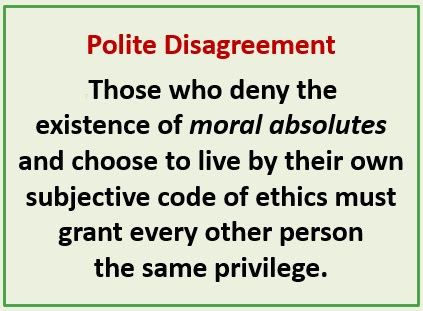
According to a survey of 2,000 adult Americans by the American Worldview Inventory 2021over half (54%) embrace the postmodern idea that all truth is subjective and there are no moral absolutes.  However, those who deny the existence of moral absolutes and choose to live by their own subjective code of morality and ethics must grant every other person the same privilege.  A culture based on “I’m okay, you’re okay” sounds good in theory.  However, in reality this subjectivity leads us down a path of selfishness, misunderstanding, inconsistency, confusion, division, frustration, and even despair and suicide.

Consistency in Conservation
Into this world of selfishness, confusion, and conflict, God has revealed through His Word in the Scriptures exactly who we are and what our purpose is.  He created us to be His stewards who can only find fulfillment and joy when we serve under His authority rather than being masters of our own lives.  This means surrendering our subjective notions of how to govern our lives; and instead, yielding to the objective revelation of God’s Word.  Instead of falling for the satanic deception as Adam and Eve did in the Garden of Eden (Genesis 3), God offers us, through the free gift of salvation in Christ, the wisdom and opportunity to make choices that are right and pleasing to Him. 

The choice is ours of either “consistent conservation” or a path into “woke environmentalism.” 
Me-too environmentalists who go so far as to live in deliberate rebellion against God’s authority can become susceptible to the popular woke ideology based on critical theory.  Woke philosophy and critical theory are based on a false historical narrative and a false view of humankind.   Wokeism thrives on a distorted view of both God’s natural revelation (His creation) and God’s special revelation (inspired Scriptures).  The result is a spiritually darkened view of humankind that divides us from our neighbor and dislocates us from our position as submissive stewards under God who calls us to exercise dominion over creation.  In so doing, wokeism destroys the only objective justification for our responsibility as servant caretakers of the Earth.  [Read more in “Stewards without a Master” by clicking HERE.]                                                                                        

On the other hand, consistent conservation is the only objective path to conserving resources while at the same time respecting the needs of our neighbors both near and around the world.  As we have explained in detail earlier, the word conservation is derived from the Latin, con- (with) + servitium (service).  Both conservation and stewardship carry the notion of serving with or for the benefit of another as opposed to serving oneself.  [For more detail, click HERE.]

We Are Consistent… in Christ
God never asks us to follow His principles without showing us how to follow.  He did that by sending His Son, Jesus Christ, who “served with” His Father as a perfect steward… Who, being found in appearance as a man, He humbled Himself by becoming obedient to the point of death, even death on a cross.  For this reason also, God highly exalted Him, and bestowed on Him the name which is above every name, so that at the name of Jesus EVERY KNEE WILL BOW, of those who are in heaven and on earth and under the earth, and that every tongue will confess that Jesus Christ is Lord, to the glory of God the Father (Philippians 2: 8-11).

Whereas “conservation” is perfected when we follow Christ’s example of “serving with” our Father, we must also consider conservation that is “consistent.”  Consistent conservation is the practice of the Christian stewardship ethic which is grounded in the wisdom of Christ.  In Colossians 1: 15-17, Apostle Paul exalts Jesus Christ as being …the image of the invisible God, the firstborn of every creature: For by Him were all things created… by Him, and for Him:  And He is before all things, and by Him all things consist (or, "hold together").

The child’s Bible song, “He’s Got the Whole World in His Hands” is the elementary expression of the truth that Christ “existed before anything else, and He holds all creation together (Colossians 1: 17 NLT).   Who can read this proclamation without exalting Christ as Creator, Savior and Lord?  It is not by our own intelligence or any other trait which we can boast, but by the mercy of God who calls us to yield our lives to His rightful authority.  Only by following the example of Christ can we expect to live a life of consistency and practice consistent conservation of the resources God grants to our care as stewards.  

But, instead of submitting to the authority of Christ and seeing how all things "hold together" in Him, many are refusing Christ’s rule and are "coming apart." See our expanded definition of consistent conservation in text box on the right.

Everywhere we look we see the results of energy and economic policies that lack “consistency."  Like hasty bakers who have not followed the recipe, our leaders follow policies that produce worthless “batter” because it lacks consistency.  Well-intended policies that proport to “save the planet” from climate change are driven by a supposed existential threat which is not supported by significant global temperature change.  Nevertheless, energy policies are being implemented by “Green Energy” proponents at the expense of inflation and recession which are bring great hardship on the most vulnerable among us.  [See “Climate Change in Context – 2. Rightly Weighing Our Risks.”  Click HERE.]

In Part 2 of “Consistent Conservation,” we highlight two important thought leaders who represent two very different views of the role and future prospects for humankind on planet Earth:  Paul Ehrlich and Norman Borlaug.  We contemplate which of these two influencers of our current environmental policy direction exercised “consistent conservation.”  Click HERE to read Part 2.

Comments and Questions:
How have current energy and economic policies affected your decisions and lifestyle?  Are there ways you exercise “consistent conservation” or plan to do so?  As always, we welcome your responses using the “Comments” link below to express your thoughts, questions, and suggestions.  You may also write privately to silviusj@gmail.com

Wednesday, July 25, 2018

Making “Creation Care Connections”

It is a beautiful thing to observe relationships functioning in harmony as God our Creator desires.  We feel joy and satisfaction when we experience or observe the mutual enjoyment of a married couple in love; or the performance of a sports team functioning like a well oiled machine in an exciting contest.  Some of us find a similar satisfying beauty when we experience the interactions of creatures in a forest community or in a prairie landscape or in a colorful, undersea, coral community.

In this article, I will share a few inspiring examples of how a simple willingness to become involved in expressing the love of our Creator to our "human neighbors" and to our "creation neighbors" can help us to form “creation care connections”—i.e. connections that bring our Creator, His creation, and our neighbor together--"for good."

As humans, we experience joy and satisfaction from harmonious relationships because God is relational (i.e. perfect harmony among Father, Son, and Holy Spirit) and He created and equipped us to love Him and to love our neighbor (
Mark 12: 30-31) and to love and care for His creation (Genesis 1: 27-28; 2: 15).  Readers who have put their faith in God’s love gift of His Son as a sacrifice for our sins will understand the Apostle Paul’s words, Above all, be loving. This ties everything together perfectly (Colossians 3:14).  Pure faith in a perfect God provides the oil for well functioning relationships.
New kiosk constructed by Gospel Road 2018 and FMCPT

Now, allow me to share a few inspiring examples of how the exercise of “creation care” can allow us to form “creation care connections”—i.e. connections among our Creator, His creation, and our neighbor. My first example involves our wonderful national and state parks, preserves, and trails.  For many people, especially the majority who live in urban communities, these places may offer the only exposure to the soul-satisfying beauty of the creation.  But parks and trails require continual administration and maintenance in order to provide safe and accommodating services to hikers, equestrians, boaters, and cyclists.  As individuals and families, when we visit parks and natural areas, we can form a “creation care connection” by simply following park rules or by stopping to pick up litter.

Just this past week, approximately 150 high school students, grades 9-12, from all over central Ohio participated in a five-day, mission-focused, work camp called the Gospel Road 2018.  The students along with their adult chaperones and volunteers represent Catholic churches and schools throughout the Diocese of Columbus.   According to Wayne Roberts, Executive Director of the Friends of Madison Co. Parks and Trails (FMCPT), the workers devoted their time and energy to approximately 46 projects.

Gospel Road 2018 workers at refurbished kiosk (London, OH)
Of particular interest to me are two of the projects completed by the Gospel Road 2018 teens involving the FMCPT.  First, they constructed a kiosk for the Little Darby State Scenic River Preserve north of London, OH, in Monroe Twp. of Madison Co.  The teens also contributed their “elbow grease” and skills to sanding and staining the kiosks near and around the Prairie Grass Trailhead at London, Ohio. 

According to Roberts, “both the student volunteers and the instructors-adult leaders were generous, good-hearted people.”  Needless to say, these teens and their leaders formed a “creation care connection” with their neighbors from the FMCPT, with bicyclists and other users of Madison Co. parks, and with the living creatures that reside in the parks and trials and give them structure and beauty.  Through their hard work, the Gospel Road 2018 group left an aroma of the “good news” for the benefit of both God’s creation and future park visitors through the caring connections they formed.

My second example to illustrate the formation of a “creation care connection” has a more expansive scale; one that spans two continents.  Beginning June 20, a small team used their skill of stand up paddle boarding (SUP-ing) to travel from Cooperstown, NY on a 444-mile trip down the Susquehanna River.  The paddle boarders were led by Peter Savard, assistant professor of nursing at Cedarville University.  The team included Savard’s daughter, Ainsley, a high school student; Jared Mitchell, a 3-D modeling and design teacher at Troy Christian School, and students from Cedarville and Wright State Universities. 

#SUP4WATER paddlers and portable clean water equipment
Prof. Savard is founder and chairman of Global Water Consortium which supports sustainable clean water projects in remote areas of the world.  As quoted in the Wyoming Co. Press Examiner in Tunkhannock, PA., Savard stated, “Throughout the trip, we will carry the same water equipment used to establish clean water projects in developing countries to showcase its mobility in remote locations.” 

The #SUP4WATER paddle board trip was completed last week.  During the time devoted to this 30-day trip, Water Consortium statistics estimate that 126,540 children in Kenya and India will die due to unsafe water.  According to Savard, “The goal is to raise $1 for each of these children and to bring increased awareness for sustainable water projects around the world.  Those who wish to donate to #SUP4WATER may do so at the Global Water Consortium website.  Additional details of the Susquehanna trip are provided through social media:  Facebook.com/GlobalWaterConsortium, Instagram.com/global_water_consortium, and Twitter.com/@peteGWC Global Water Consortium.

#SUP4WATER member, former student, and friend, Jared Mitchell
Both of my examples of “creation care connections” have featured a common invitation rooted in the biblical commands to be stewards of the Earth.  Stewardship of the creation is the fundamental context within which we express through our actions a supreme love for our Creator and love for our neighbor.  While we find satisfaction and “re-creation” in beautiful parks and along scenic trails, we should also look for ways that we can contribute to the stewardship of these places. 

Local park districts and allied citizen’s groups often invite volunteers to join in work day efforts while many states have the Adopt-a-Highway program.  As in the case of stand up paddle boarding to improve water quality in needy areas of the world, the steward first sees the need; then, is convinced of the importance of that need; and finally, becomes involved in making a “creation care connection.” Here, the connection was prompted by love for our “human neighbors” on another continent and the expression of that love through caring for the “creation neighbor,” in this case, the water quality upon which our human neighbor depends for life.  When environmental stewardship done for the glory of God, the connection is complete because God, humanity, and creation are all served—a beautiful and satisfying result.
Co-Leaders of the Prairie Grass Trail Ride at a remnant prairie

Immediate Application:
If you live in Eastern U.S.,  I would welcome you to make your own “creation care connection” by joining us on Saturday, July 28 at the trailhead of the Prairie Grass Trail in London, OH at 8:00 am for a leisurely bike ride through some scenic remnants of the original prairie in SW Ohio, preserved along a former railroad right-of-way.  Here, you can connect with members of the Friends of Madison County Parks and Trails, and representatives of other local public and private organizations who are interested in management of these prairie wildflower and grass communities.  Of special emphasis this year will be how to connect with creation by learning to collect seed and grow native wildflowers and grasses in your garden or on other land over which you exercise stewardship.  See Prairie Grass Trail Ride online poster and I hope to see you there.

But Isn't Loving My "Creation Neighbor" a Distraction?
I'm glad you may be asking this question.  I have written more on this topic in a previous Oikonomia under the title, Fundamentals of Conservation, Part 3 "Serving with Our Neighbor"  That article includes reference to my friend Lynn Holtzman's master's thesis entitled “Nature as Neighbor: Aldo Leopold’s Extension of Ethics to the Land.”  I would urge you read more on this important subject, beginning with my previous article.  For now, allow me to summarize my point about our responsibility to both "creation neighbor" and "human neighbor."

God revealed His design for relationships in the Genesis 1 account of the origin of creation where we read of His mandate to Adam and his offspring to exercise dominion over creation (Genesis 1: 27-28).  Genesis 2 elaborates on the nature of the Dominion Mandate.  We are to live as “servant rulers,” or stewards, of creation (Genesis 2: 15).  Indeed, servanthood was to be the primary occupation through which humans would demonstrate their obedience to 2 other fundamental commands –to love the Lord God with all our heart, soul, mind, and strength; and to love our neighbor as ourselves (Mark 12: 30-31).  These three commands form a tri-unity because God asks us to (1) choose carefully our activities as stewards of His material creation in light of whether or not they (2) express our love to Him and (3) love to our neighbor.  Conversely, we demonstrate our love for God and for our neighbor by the way in which we exercise “creation care” through proper handling of the material gifts God has entrusted to us to manage and use for the greatest good.  Indeed, we cannot love “our human neighbors” without proper love and respect for “our creation neighbors,” the soil, water, air and creatures, upon which “our human neighbor” depends for life.  Hopefully, the two examples cited in the main article above illustrate how volunteering our time, energy, and resources can express our love to God through acts that help both our neighbor and the creation context upon which his life depends.

Wednesday, April 30, 2014

Fundamentals of Conservation, Part 1 "Serving With" Our Creator -- Article #1 Biblical Foundation

Spring is here and with it, green grass, colorful flowers, and joyful people breaking forth from the confinement and discomfort of a long winter.  Our thoughts turn to breaking out the rakes, mowers, and other implements to spruce up the grounds.  Some of us have only a tiny lawn and perhaps a flower bed along a foundation or sidewalk.  Others have an extensive lawn and maybe a “back forty” that requires hours to manage each week.   Regardless of the acreage, our work takes on a rich meaning when we recognize the biblical responsibility of being stewards of the land entrusted to our care.

This blog entry is the first of three parts on the subject of conservation, or as some call it, land (or Earth) stewardship.  Both conservation and stewardship carry the notion of serving with or for the benefit of another as opposed to serving oneself.  The word conservation is derived from the Latin, con- (with) + servitium (service).  Therefore, as explained by Dr. Calvin DeWitt a highly respected leader in Christian environmental stewardship, a conservationist is one who serves with the household of life.  That is, as humankind acts responsibly in service toward creation, the creation will continue in its service toward humans and all life—hence, a con-service.  DeWitt more completely explains this derivation of conservation in his book, Earthwise (2011, Faith Alive Christian Resources, 3rd ed.).

As humans obey God and "keep" creation, God and His
creation will "keep" mankind--the essence of "con-service"
The Bible teaches in Genesis 2:15 and elsewhere that God appointed Adam and his descendants as stewards of creation. A steward is one who is appointed by his or her superior to manage a household or property to which the superior holds title.  DeWitt asserts that conservation and stewardship are both empowered by a commitment to serve with creation.  Furthermore, the steward of God’s creation recognizes that he or she is not only called to serve with creation but to do so out of a commitment to serve with the Creator God Himself.

Our three-part series in Oikonomia will consider conservation and creation stewardship from the perspective of Judeo-Christian teaching in Scripture.  Specifically, we will consider what it means (a) to serve with God, the Creator and Sustainer of Earth, (b) to serve with creation out of a knowledge of the ecological relationships we understand from science, and (c) to serve with our neighbor, given that our stewardship of God’s creation will always impact not only creation but also our neighbor.   

My thesis for Part 1 is that while many today have a deep sense of caring for the Earth in the face of possible human destruction, God’s plan is moving toward a second judgment, one that will lead eventually to a New Earth as part of His plan to bring reconciliation and resurrection to all who have accepted Christ’s sacrifice for sin.  As Randy Alcorn teaches, Jesus Christ died to secure for us a resurrected life on a resurrected Earth (Heaven, p 131; Tyndall House, 2004).   Those who accept this claim about the future of Earth and mankind should view conservation in a different light.  That is, we should recognize that every act that is intended to do good toward the Earth should be done with the reality that unless the contributor has individually reconciled with God and accepted His atonement for sin, he or she is on a path to eternal Hell.  Meanwhile, the Earth has a much brighter future in spite of its current groaning under the weight of sin (Rom. 8: 19-22).  But how do we balance or reconcile these two legitimate priorities—concern for individuals needing reconciliation with God; and, exercise of our responsibility to be stewards of Earth as part of our dominion mandate from God?

The Bible teaches us that God created the universe (Gen. 1:1) and granted to humans alone the privilege of exercising dominion over creation to serve Him in part through serving and keeping creation (Genesis 1: 28; 2: 15).  The great theme of Scripture is the unfailing love of God for His creation and for all of mankind.  God’s desire for fellowship with mankind is expressed in the creation of Adam and Eve whom He invited into perfect communion with Him in the Garden of Eden.  We understand that Adam and Eve did walk with and serve with God for a period of time (Gen. 2: 28: 3: 8-9).

The metaphor of walking with God is presented throughout Scripture to describe the intimate communion God desires with anyone who will return His love in obedient submission.  Enoch (Gen. 5: 22, 24), Noah (Gen. 6:9), and Abraham as well as other patriarchs (Gen. 48:15) walked with God.  Their faith and obedience faltered at times but was hinged upon God’s revelation of His covenant plan to them—a plan that would ultimately result in descendents as many as “the sand of the sea” (Gen. 32: 12).

When I think of the Enoch, Noah, and the patriarchs, I think of the list of giants of the faith in Hebrews 11.  My reaction:  Who am I to compare with these giants?  Yet, the Apostle James challenges us to walk with God as the giants like Elijah did, saying, Elijah was a man with a nature [just] like ours… (James 5: 17).  Each of the “heroes of faith” is just like us.  And, just like them, when God calls us to a life of obedience, He expects us to respond by understanding and following His leading.  Thus, Noah was warned of coming judgment and he constructed the ark (Heb. 11: 7).  And Abraham was called to go out to a land God would provide for him and his descendants (Heb. 11: 8).  

God has done more than call us to walk with Him.  He even puts within our hearts the capacity to know and believe in Him-- because that which is known about God is evident within them; for God made it evident to them (Rom. 1: 19-20).   While all living cells, microbes, and plants can respond in predictable ways to God’s provision of warmth, water, nutrients, and light, these forms of life are incapable of higher level thinking that shows an ability to take responsibility for their survival through complex behavior that anticipates future challenges.  Only certain animals including humans can build safe shelters to protect them and their young against predators or other danger; or, store food during the favorable seasons so that they have a supply during the unfavorable season.  But mankind is the only creature of God capable of abstract reasoning.  Humans can imagine events thousands of miles away or build mathematical models that enable them to travel or send spacecraft to the moon or other planets.  Above all, God has given humans the capacity through faith to believe in Him, to understand His redemptive plan for mankind and His creation, and to walk in obedience to that plan.

Genesis 3 records how Satan deceived Adam and Eve by successfully tempting them to believe that their  walk with God would be more intimate if they would eat of the forbidden fruit and thus obtain a fuller (or “higher”) knowledge of God (Gen. 3: 5).  But instead, when they ate from the tree, they wanted to hide their nakedness and hide from God because of sin, guilt, and shame.  For the first time, their obedient walk with God was broken and they sensed that something was deeply wrong as they heard the sound of the LORD God walking in the garden in the cool of the day (Gen. 3:8).  And, for the first time, the great God-given capacity of humans to walk with God and serve with God was turned to walk away from God, hide from Him, and to serve human interests. 

In spite of the infinite gulf which sin and the fall of mankind created between a holy God and sinful man, all humans still have the capacity for intellectual reasoning, a universal sense of what is right and wrong, and a tendency to react when moral standards have been violated.  C.S. Lewis has explained in Mere Christianity that there exists a common or universal morality known throughout all of humanity.  This “Universal Morality” or “Law of Nature” is expressed as a standard for behavior to which each person expects others to adhere.

In spite of the effects of sin and its curse on mankind and the whole creation, we have retained our reasoning ability but it is often distorted.  Romans 1: 21-22 states that we have become futile in our speculations and our foolish heart is darkened.    When we profess to be wise but we are actually fools.  Adam and Eve reasoned that they could use green fig leaves to make clothing to cover their nakedness and shame (Gen. 3: 7).   When Abel sought to walk with God and express his obedience through a better sacrifice, his brother Cain turned from God in anger and killed Abel (Gen. 4: 8; Heb. 11: 4).

Individual sin against God had brought grief to Adam’s family and, within several generations. Genesis 6: 5 records that every intent of the thoughts of [the human] heart was only evil continually.  God used the obedience of Noah and his family to spare the human race and the land-dwelling creatures from judgment. 

After the flood, God renewed His charge to humankind to exercise dominion and stewardship over the Earth, and He offered His covenant that He would not again judge the Earth with water (Gen. 9: 11).  The Book of Revelation describes the next worldwide judgment on God’s calendar which will also lead to a New Heaven and a New Earth.  We learn from the account of Noah that that (a) God is serious about judging sin,  (b) has a great love for humankind and His other creatures, and (c) is capable of altering planet Earth in a major way and yet is able to restore in modified form the Earth’s biosphere.  Yet within a few generations, sin had infected the institution of government as we read of the attempt to construct a tower to reach heaven in defiance of God because they sought to make for [themselves] a name (Gen. 11: 4).

And so, reading the Bible from Genesis to Revelation will reveal two opposing themes. God’s faithful love, justice, and mercy in the face of human rebellion versus the human attempt to build a society that glorifies mankind without God.   Although human reason remains intact, it is corrupted by sin.  Therefore, unless we apply a biblical worldview (filter) to our current sin-cursed state and the cursed state of creation, we cannot walk with our Creator.  Amos 3:3 rightly asks, Can two walk together, except they be agreed?  Anyone who wants their lifestyle of stewardship of the Earth to be a part of their walk with their Creator will be missing God’s mark if they do not understand from Scripture that God’s heart is broken over sinful man and the effects of sin on His creation.  There are several reasons why our walk would not be in step with God . 

First, epistemologically, we err and do not walk with God when we refuse to build our basis for knowing and judging truth claims on a biblical foundation.  For example, we err ontologically when we deny God’s special creation of a literal Adam and Eve.  Such denial would undermine belief in the uniqueness of humankind.  Some who view humans as just another evolved creature would solve Earth’s environmental problems by denying mankind dominion over creation and giving nonhuman creatures “equal rights” with humans; or viewing humankind as a blight or plague on the Earth as several Hollywood productions such as the movie Noah recently teach.

Theologically, we do not walk with God if we deny individual accountability for sin which Scripture teaches began with the “first Adam” and is atoned for by the “Second Adam”, Jesus Christ (1 Cor. 15:45; 1 Tim. 2:13).  It is possible to be active in conservation or “creation care” and do some good for the Earth.  But unless we walk with God in agreement, we will not understand that we are individually accountable to Him and responsible for the curse of sin and resultant groaning of creation that He now hears (Rom. 8: 19-22).

Failure to walk with God in agreement with His Word can lead to a failure to distinguish actions we should take as stewards out of an individual accountability to God as opposed to our giving unwise support to national or multinational bodies that claim to have the best interest of the Earth in mind but who are simply playing politics for gain of power and wealth.  For example, the wise steward who walks with God and abides in the Truth of His Word will be a diligent student of the current climate change debate—asking telling questions.  How valid are the scientific data?  What are objective, qualified scientists now concluding about climate change?  What are causes of ambiguity in the debate?  How practical are proposed solutions?  Who stands to gain or lose? 

In conclusion Christians in conservation are called to be stewards of God’s creation by wisely applying the gifts, talents, and opportunities available to them.  Actions must be based on good theology, good science, and a commitment to do what will provide the most good for both creation and the most people.  Above all, we should not forget the urgent need to present the Gospel to our fallen neighbors who are in far more immediate danger than the Earth if they have not heard of the coming judgment for their sin. 

In Article #2 on the theme of "Serving With Our Creator," we will consider the necessity of a child-like humility in which we submit to God through confession of sin as a basis for spiritual regeneration. As spiritually regenerate children of God, we can then "serve with" God and creation in a manner that reflects a humble, teachable spirit with which He is pleased.