Showing posts with label wealth. Show all posts

Wednesday, March 26, 2014

A Man Who Sweetened and Enlightened the World

Recently, Abby and I traveled with other seniors from West Hill Baptist Church in a group known as “Caleb’s Kin” to visit Root Candles, a family-owned candle-making company in Medina, OH.  Root Candles was founded in 1869 by Amos Ives Root.  Now, after 145 years, Root Candles is under the management of the fifth generation of the Root family.  The company still produces industry-leading candles which testify to the values that marked its founder– a commitment to the virtues of honesty, integrity, and diligent craftsmanship.

Candle display at Root Candles store, Medina, OH
Upon entering the store, we were impressed with the beauty and variety of candles.  According to the company website, many contain the purest beeswax and elegantly designed essential oil fragrances…crafted with passion and perfection…consistently flawless, cleaner burning, [and] longer lasting….  The outstanding quality and consistency has made Root Candles a major supplier of liturgical candles as well as a favorite brand of candle-lovers worldwide.

As a farm boy in northern Ohio, Amos I. Root was an avid reader as well as a lover of God’s creation and the natural sciences.  He was fascinated with electricity and magnetism, and he soon began traveling to give lectures on these subjects.  As a young man, he became an accomplished and wealthy jewelry manufacturer. 

One day when Root was in his twenties, a swarm of bees stole his attention when it darkened his workplace, leading him to take up beekeeping.  Soon, Root’s curiosity and inventive spirit enabled him to develop the world’s first beehive from which honey could be extracted without destroying the hive.  Before long, Root was CEO of a large company in Medina, the A.I.Root Company, which was shipping as much as four railroad freight cars of beekeeping equipment each day.  Although the company eventually transitioned from manufacturing beekeeping equipment to manufacturing beeswax-containing candles, it has continued to publish Gleanings in Bee Culture since 1873.   Gleanings provided a vehicle in which Root shared not only practical suggestions to bee keepers, but also spiritual insights and applications based on his walk with God and his knowledge of the Scriptures.

According to “The Wright Stories” blog,

Religion was important facet of Root’s life. His employees were expected to attend daily prayer meetings on company time. He didn’t believe in drinking alcohol, smoking or working on Sunday. He believed that technological progress was a gift from God and would result in social betterment.

Because of his curious, inventive, and entrepreneurial spirit, A.I. Root, was invited by Wilbur and Orville Wright to observe their progress in development of a flying machine.  Root, at age 64, drove his 1903 Oldsmobile Runabout 200 miles on primitive roads from Medina to Huffman Prairie near Dayton, Ohio.  What would cause an elderly businessman to make such a trip?  The following quote from A.I. Root reveals how the Wright Brothers earned the respect of one they would learn to love and trust:

— These two, perhaps by accident, or maybe as a matter of taste, began studying the flights of birds and insects. From this they turned their attention to what has been done in the way of enabling men to fly. They not only studied nature, but they procured the best books, and I think I may say all the papers, the world contains on this subject.
Amos I. Root rides in the Wright Flyer
A man who had years before observed the working of bees and was inspired by his Creator God to launch both the honey industry and hobby beekeeping to new heights was now fascinated by the two brothers who were developing a flying machine based on their study of God’s amazing flying animals—birds and insects.

On September 20, 1904, Root was thrilled to observe the Wright Brothers’ first complete circle in an airplane.  His enthusiasm is evident in the following description:

When it first turned that circle, and came near the starting-point, I was right in front of it; and I said then, and believe still, it was one of the grandest sights, if not the grandest sight of my life. Imagine a locomotive that has left its track, and is climbing up in the air right toward you – a locomotive without any wheels, we will say, but with white wings instead, we will further say – a locomotive made of aluminum.

A.I. Root transformed his copious Huffman Field notes into a manuscript and the Wright brothers gave him permission to submit it for publication.  Root submitted the article to Scientific American but apparently the editor did not believe it was worthy of publication.  So, in 1905, an enthusiastic Root published what was to be the first account of the Wright brothers’ historic accomplishment in his own periodical, Gleanings in Bee Culture.  

Being a slow learner myself, I didn’t realize until after our trip to Root Candles and my additional reading on the life of A.I. Root just how appropriate it was for a group called “Caleb’s Kin” to become acquainted with this amazing man and his contributions to science, invention, business management, and aesthetic beauty.  Finally, like Caleb of the Old Testament Scriptures (e.g. Deuteronomy 1: 36), Amos I. Root was still ready for a new chapter of contribution when in his 60’s he was able to encourage the scientific efforts of the Wright brothers.

Amos I. Root with an inset photo of his plant in Medina, OH
The testimony of A.I. Root also speaks to what he and many other Christians have learned from Solomon, the great king and natural scientist, who wrote:  It is the glory of God to conceal a matter, But the glory of kings is to discover and invent (Prov. 25:2).   Our great Creator has made us in His image.  As image bearers, we are each given various gifts and the opportunity to develop and exercise them with hard work, discipline, and a perspective of stewardship that helps us use the fruits of our creativity for the good of our neighbor.  It is the role of parents, church, communities, and government to nurture and encourage each person to exercise their particular gifts.  Thus, the light of a lovely Root Candle can be traced back to the loving nurture of young Amos Root by his parents on in a farm family in Ohio; and to a church and community that would further mark this man and his godly values. 

Root became a wealthy man but not at the expense of the prosperity of others.  Instead, his inventive and entrepreneurial spirit multiplied the wealth and prosperity of thousands associated with his science and invention.  Today, the light of Root candles gives testimony to the Light of God’s Truth that burned within Amos Root and kept him from hoarding his gains or abusing others.  Furthermore, his life reminds us that a person unburdened by unwise laws and taxation can prosper his community and world when he or she is disciplined by the law of love for God and neighbor within their heart.  May Root’s example remind us all that God and His Word is the essential source of our freedom and prosperity which in turn depend upon individual integrity, responsibility, and hard work.

But now ask the beasts, and let them teach you;
And the birds of the heavens, and let them tell you.
Or speak to the earth, and let it teach you;
And let the fish of the sea declare to you.
Who among all these does not know
That the hand of the LORD has done this,
In whose hand is the life of every living thing,
And the breath of all mankind?
 -- Job 12: 7-10

Friday, September 27, 2013

Earth Stewardship and Human Aging

My transition from full time employment to what I am calling a redirection has allowed me some time to consider how God might use me in this new chapter of life.  I have already blogged on this subject, in 2011 and 2012.  Just search Oikononia using the keyword, redirection.

In the past two years, health matters in our family have been front and center.  Abby and I have made frequent visits to the Golden Age Retreat in Carrollton, OH where Marietta Moser, Abby’s mother (and thankfully, mine by marriage) is a resident.  During our visits with “Mom,” we have met other residents who have entered this dependent stage of their lives.  Most have severe limitations in mobility, continence, mental alertness, and communication.  Yet, each of them can express traits of their personality that shine through their worn, wrinkled faces and stooped postures, reflecting who they were in their younger days. 

Until her debilitating stroke in 2011, “Mom” had resided in a small home in Kilgore, Ohio where she and her husband, Don, had lived since the late 1940’s.  During those years, she was committed to the task of raising seven daughters and pointing them to faith in God through her words and actions.  “Mom” always lovingly served family and friends who came into her home.   She also provided a godly example to her husband for 33 years of their marriage, and he finally found peace with God through faith in Christ during the final months of his life.  Since “Dad’s” death in 1980, “Mom” has lived another 33 years as a widow.  Now, confined to wheelchair and short ventures with a walker, her heart still pours forth kindness and generosity toward fellow residents, and to her family and friends who visit.  Though sadness and loneliness must creep over her at times like darkening shadows, her face brightens upon our arrival, and her smile is still beautiful when we speak of fond memories of days gone by.

Our fast-paced, “get it now” culture tends to devalue older adults who speak with difficulty, move slowly, and spill their food and drink.  Yet, I’m learning that it can be a blessing to become acquainted with the elder folks at Golden Age.  Taking time to greet them with at least a smile, and where possible with words, often brings a smile and greeting in return.  Wrinkles, blemishes, and soiled bibs sometimes create a dreary atmosphere, but brightened faces shine forth amid any apparent dreariness like the faces in Rembrandt’s paintings.  Instead of wondering about who they once were, I’m inspired by who they are.

Having reflected on the joy that still radiates from Marietta Moser and others who reside at Golden Age, I wonder “how then, I should be living” so as not to have a dismal, joyless existence if I should be allowed to enter into this period of dependency in life.  Such pondering brings me to yet another facet of that important concept of stewardship.  Biblical stewardship reminds us that God is Owner and Master, and we are His servant stewards to whom He has entrusted all that we have.  If this is true, then the Apostle Paul’s questions apply to any stage of our lives:
For who regards you as superior?
What do you have that you did not receive?
And if you did receive it,
why do you boast as if you had not received it?
– 2 Corinthians 4: 8

Stewardship means that we view our responsibility as managers of time, talents, and treasures at every stage of our lives.  As children our parents taught us elementary lessons of stewardship when they encouraged us to share “our toys” with other children or return toys to the toy box or shelf when we were finished.   It follows that stewardship that is nurtured and applied by God’s grace and truth can keep us on a trajectory that is appropriate for every stage of life.  After all, the lessons of the playroom or pre-school also apply to the workplace and profession of adulthood.  All that differs is the kind of “toys” we choose to accumulate, how many “toys”, and how we choose to share them.

A stewardship mindset applied to human health itself explains how older adults can still have joy when they become dependent on others for nearly everything.  While there are genetic factors and events beyond our control as we age, with God’s help it is within our stewardship responsibility to thank Him each day for our health and for the food, shelter, and support system upon which we are very dependent.  Again, the Apostle Paul, writing to young Timothy, gives helpful instruction to us (1 Timothy 6: 7-11):

But godliness actually is a means of great gain when accompanied by contentment. For we have brought nothing into the world, so we cannot take anything out of it either. If we have food and covering, with these we shall be content.
But those who want to get rich fall into temptation and a snare and many foolish and harmful desires which plunge men into ruin and destruction.  For the love of money is a root of all sorts of evil, and some by longing for it have wandered away from the faith and pierced themselves with many griefs.  But flee from these things, you man of God, and pursue righteousness, godliness, faith, love, perseverance and gentleness.

Happiness is not about accumulating wealth any more than spirituality is about living a monastic existence.  Abraham and Job show us how men of great wealth can also walk closely to God and be a blessing to man.  But Jesus taught us that …from everyone who has been given much, much will be required…(Luke 12: 48).  The one who holds his or her “toys” and other possessions loosely and generosity during their “active years” will more likely be inclined to release  them peaceably and even thoughtfully when it’s time to enter a state of dependent living.

Chuck Dolph, senior professor of psychology at Cedarville University, supports the notion that aging need not be the dreaded part of life.   Rather, for the Christian, aging is a valuable season with meaning and purpose along life’s path to a glorious eternity with God.  In his article, “Thank God for Aging” (Torch magazine, Spring-Summer, 2007), Chuck beautifully expresses how aging can help us apply the truth of Psalm 90 which reminds us of the finiteness of our lives on Earth; and therefore, the need to number our days, That we may present to You [God] a heart of wisdom (v. 12).  He writes:

We must not forget that there is always meaning and purpose, even in aging and illness.  Aging strips us.  If we live long enough, we will lose our beauty, our strength, our wealth, our independence, the control of our bodily functions, our pride, and perhaps our very self.  These are our idols, all the things that we trust in life to make us attractive, valuable, and self-sufficient.

If our aging is successful, we will end our lives striped of everything but God, totally naked and helpless, utterly dependent on Him and the love of others.  Everything that we trusted in life for our worth will have been stripped away.  

Dr. Dolph concludes, What a blessing to finally find our right relationship to God!  Thank God for aging. 

For the Christian steward, the reality of aging can be a North Star of sorts to which he or she can chart a trajectory during the “younger years.”   This trajectory is based on an awareness that all we have belongs to God, and part of our stewardship can be a Spirit-led, creative adventure of discovering how to use our time, talents, and treasures in accordance with each stage of life.  

Returning to the Golden Age Retreat, in Carrollton, OH, I am reminded of one of the residents whose name is “George” (not his real name).  George ambles slowly with the help of a walker on wheels.  He speaks slowly and explains that his hands are affected by arthritis.  But his smile brightens when I ask him to play some tunes with his harmonica.    See YouTube Video.

As I conclude this article, I thank God for both Marietta Moser and my friend, George.  Both of them are teaching me how to set a trajectory on my path toward eternity; one that holds loosely and manages wisely what God has entrusted to me.  Folks like Marietta and George have little left to manage, but what they do have brings praise to their Creator.  The sweet musical notes from George’s harmonica bless all who hear them there on the porch of Golden Age Retreat before they float out across the quiet countryside and off into the heavens above.

Monday, May 27, 2013

Memorial Day Tribute to a Rich Uncle


It is Memorial Day weekend, and time to remember those who have given their lives for the cause of freedom and for their love of the United States of America.  A friend taught me many years ago to say, “Thank you for serving.” to each veteran or member of the armed services when I meet them.  This weekend, I met a Vietnam War veteran who was receiving physical therapy in the Carroll Health Center, Carrollton, OH.   As I thanked him for serving, I realized anew the ultimate in stewardship is demonstrated by those who have offered their lives, or who have given “the last full measure of devotion” in service of their country.

Memorial Day weekend also gives me the opportunity to remember my uncle, Glen Silvius, whose birthday is May 19, 2011 (died, Dec. 15, 1997), who served his country in World War II.  “Uncle Shorty” was among the courageous American GI”s who pressed forward from Normandy through western Europe to bring freedom from the scourge of Nazism to the war-torn landscapes and villages of France, Belgium, and Germany.


Even though, as a post-war, “baby boomer”, I never saw Uncle Shorty in a uniform, his reputation as a soldier became evident to me in my pre-teen years through books on his shelves, published by Hercules Engines Co. where he worked before and after the war.  Hercules produced engines for military vehicles, and the company proudly published books filled with photos from the war front to highlight their products in action.  Some of the photos left little to my imagination with respect to the power unleashed in war. 

Although Uncle Shorty seldom spoke of his service during WW II, I learned indirectly that his life had been miraculously spared several times.  As a young man in the 1920’s and 1930’s, he had dreamed of traveling the world.  However, when he was discharged from the U.S. Army in 1945, Uncle Shorty returned home and never traveled more than 100 miles from his farm home near Dundee, OH.

During my preadolescent years, the closeness of my relationship with Uncle Shorty was second only to that with my father, Uncle Shorty’s older brother.   My family’s farm home was an extension that my father had added to his family home; and so, my Grandpa and Grandpa Silvius and my Uncle Shorty lived in another part of the same house until my graduation from high school. 

Although Uncle Shorty’s chief employment was with Hercules in nearby Canton, OH, he routinely assisted my dad and another, younger brother Ralph, with their shared responsibilities of farming over 200 acres.  As you can imagine, two and sometimes three farmers who needed to decide how and when to do something made for some interesting and heated exchanges.   It was not hard for me to imagine that Uncle Shorty had been a military man on occasions when he felt that his was the right way to complete a job.

I thank God for what He taught me through Uncle Shorty.  He and my dad both valued education greatly and both were instrumental in encouraging me to attend college.  When I came home from college, Dad looked forward to hearing what I was learning in biology, chemistry, and math.   Uncle Shorty’s interest in my progress was no less than Dad’s , and when the three of us were together, I was challenged to think carefully and to justify exactly why I was in college and where I should go with my ‘higher education.’   Gradually, I sensed that these two men had great respect and love for me, and a confidence that I could “make something of myself.”

In 1969, I completed my BA degree in science at Malone College, married Alvadell Moser, and began a two-year period as a biology teacher at Dover High School.  During this time, our son, Bradley was born, and we maintained close relationships with both the Silvius and Moser families.  Although my dad’s profession of faith in Christ was evident through his public ministry as superintendent at our local Methodist church and through the example he set for me, my uncle’s profession of faith was a bit more subtle.  Thankfully, the conversations between nephew and uncle gradually reached a point where we could share in rather deep conversations about the Person of God and His plan and purpose for each of us.  I believe Uncle Shorty did know and personally accept the reality of salvation by faith in the Person of Christ.

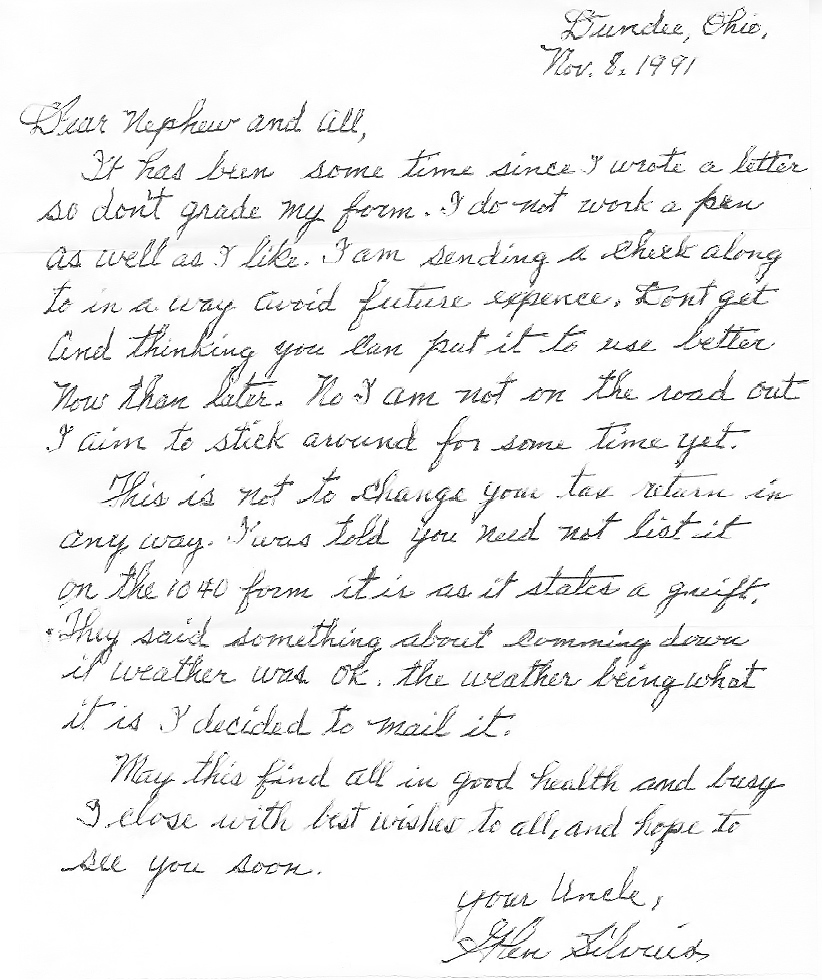
Following this brief background, I would like to share a letter which Uncle Shorty sent to me 20 years after I had entered graduate school at WVU.  At this time, I was a professor of biology at Cedarville University.  I share his letter below followed by my letter of thanks to him.  May it be a post-humus thanks to a veteran who served his country, and to a man that I consider a “rich uncle” in the truest sense of the words.

Letter from Uncle Shorty (1991):


My letter of thanks to him:

Dear Uncle Shorty,                                                                                          November 12, 1991

I got home this evening after dark at about 6:00pm.  I had just finished teaching a 3 hour lab in botany in which we were sectioning and staining Begonia stems and basswood (linden) twigs to study the stem tissues.  So it was a real encouragement to pull your letter out of the mail box.  It was quite a surprise to see the enclosed check.   This was a very generous gift to us and we want to thank you in the words of this letter, and perhaps more significantly, by our wise use of what you have given.

Brad worked two jobs this summer and is working nights now to pay on his college expenses in addition to that which we provide.  Some of this will be used to help him and to save for Mindy's college expense.  We have had a series of replacements of appliances that have worn out in recent months and are anticipating major repairs or replacement of our heat pump which is about 16 years old.  We have been praying that God would help us to know how to meet these expenses.  We have never really lacked for anything good, and I believe God has provided these essentials.  I hope you have experienced a sense of satisfaction and will be blessed by God for your kind assistance.

This is not the first time your gifts have been an encouragement to this particular nephew.  I remember my first wrist watch which was a gift from you. As I recall, you had to show me which wrist to wear it on.  Much later, I learned that it was partly by your encouragement that Dad purchased a used black Volkswagen, my first car.  Then, when I finished my graduate work at West Virginia University, you helped me to purchase some nice shirts, ties, and sweaters.  Interestingly, I still wear the two sweaters around the house that I bought at that time to teach in at University of Illinois. 

I am sure that others of your nieces and nephews could think of many ways you have helped them, too.  For my part, I just want to say that, while it was not for you to have sons or daughters of you own, you have had a large part in helping this nephew in a fatherly way.  I hope your gift will help me to do what is right in being a good husband, and good father as our two children are going through transition to adulthood.

We hope to visit you on Thanksgiving or, more likely during Christmas time.  It is a busy quarter for me with the changes in our existing science building (this summer we had to move out for installation of air conditioning), and the construction of a new addition on the north side of the building.  You would enjoy seeing this; wish you could come down and spend a few days.  It is a 3 story steel framework with brick and glass, enclosing 60,000 sq. feet for our nursing and engineering programs (mechanical and electrical). 

I think your writing is still very good ; much better than mine most of the time.   I have become spoiled by the computer, and I hope you do not think this letter any less personal because it is typed rather than handwritten.  I hope you too are well and that you are at peace with God and yourself.  Thanks for the part you have had in my life, and may God bless you.

Friday, August 17, 2012

Disintegration of the United States of America

Many would agree that America has made great strides toward ethnic integration during the past half century.  At the same time, integration of telephone, television, and other digital technology through the world wide web has produced a remarkable expansion in communications.

According to the dictionary, integration is “the process of making whole or entire.”  For an individual or part, integration is “the process of fitting in.” Thus, integration of ethnic minorities involves individuals that ‘fit into’ communities; meanwhile, the community is being “made whole or complete.”  Metaphorically, a cake baked from well stirred ingredients will have the same color and consistency throughout because the individual ingredients have been integrated.  Conversely, an integrated community or nation, would not have pockets of separation (segregation) in which minorities are excluded or at odds with the larger social-political dynamic.  Rather, each individual is given the opportunity to participate in making the community or nation complete.

In his inaugural address, January 20, 2009, Barak Obama emphasized our progress as a nation toward becoming an integrated whole (emphasis mine):

For we know that our patchwork heritage is a strength, not a weakness.  We are a nation of Christians and Muslims, Jews and Hindus, and non-believers.  We are shaped by every language and culture, drawn from every end of this Earth; and because we have tasted the bitter swill of civil war and segregation, and emerged from that dark chapter stronger and more united, we cannot help but believe that the old hatreds shall someday pass; that the lines of tribe shall soon dissolve; that as the world grows smaller, our common humanity shall reveal itself…

Inauguration of Barack Obama, January 20, 2009
Three and one-half years after the president’s inauguration, our daily news is filled with indications that we are becoming more divided as a nation.  Instead of integrating and expressing “our common humanity” around commonly held values and mutual respect for ethnic, cultural, and political diversity, we are “disintegrating” into an increasing number of factions.

A dictionary defines disintegration as-- “to break into parts; dismember; dissolve.”  Things that disintegrate do not actually “disappear.”  Rather, they break into parts too tiny for us to see, like table salt crystals that “disappear” when stirred into water.  Each salt crystal, composed of billions of precisely arranged atoms forming a latticework is “disintegrated” or “dissolved” by the water.  The tiny charged atoms escape from the lattice into the water where they begin a constant, chaotic motion.

Contributing to our current “disintegration” in America is the president’s seeming inability to achieve a bi-partisan effort to rejuvenate the economy, address the growing federal deficit, curb spiraling health care costs, and establish a workable immigration policy.  The Obama campaign, perhaps frustrated by these failed efforts, now seems to promote disagreement and division rather than unity of purpose in the midst of economic hardship. 

Let’s look closer at two evidences of “disintegration” in America-- the “contraceptive mandate” within the Patient Protection and Affordable Care Act (ObamaCare); and, the president’s push to increase government revenue through higher taxes on wealthy Americans.  Please note that both of these examples of “disintegration” stem from an absence of “integration” of principles rooted in Judeo-Christian values which historically have been interwoven through the moral and ethical fabric of individuals, families, and communities.

Kirk Cameron, in his film production, “Monumental:  In Search of America’s National Treasure,” traces the influence of Judeo-Christian faith on the founding of America.  In the 17th century, the integration of their Christian faith into daily life prompted Puritan separatists to risk great danger to escape to a little-known continent to gain the freedom to worship and practice their faith.  The influence of their covenant, expressed in the Mayflower Compact, on colonial culture over the following century and a half was instrumental in the drafting of the U.S. Constitution.

With that brief history, let’s return to our two expressions of disintegration in America.  The first relates to the “contraceptive mandate” which would exempt churches but require faith-based institutions to provide insurance coverage for contraceptives, abortifacients, and abortion-related counseling.  Many people of faith oppose this portion of ObamaCare because they see it as a threat to religious freedom. As a result, the federal government now faces 24 lawsuits.

Anthony Picarello and Michael Moses, leaders of the U.S. Conference of Catholic Bishops, summarized the moral and legal concerns of church leaders who object to the “…narrow exemption that intrusively and unlawfully carves up the religious community into those that are deemed 'religious enough' for an exemption, and those that are not.”  The idea that Americans can be divided between those who are “religious employees” and those who aren’t suggests a misunderstanding or a denial or even a disdain on the part of the current administration for what it means to “live out ones faith” or to “integrate” ones faith convictions with their personal and professional lifestyle outside of church.

There is a second area in which the “carving knife” is at work on the fabric that has held Americans together.  One can see the gleam of the knife at work when we hear talk of the “unfairness” in the tax code that supposedly favors the wealthy.   We are continually reminded that each American occupies one of three groups-- “the rich,” “the middle class,” and “the poor.”  Here is a now-famous statement by President Obama on the subject of creating and earning wealth:

If you've got a business, you didn't build that.  Somebody else made that happen.
                                – President Barack Obama, July 16, 2012 (Roanoke, VA)

President Obama appears to be suggesting that American entrepreneurs rely so much on the social, economic, and technological infrastructure that they should not mind giving more of their incomes to the government through higher taxes. The president may mean well by saying this, but his statements betray a woeful lack of integration of Judeo-Christian teaching with the entrepreneurial spirit.   Consider how the president’s challenge might sound if it were based on an understanding of biblical truth—here expressed by the Apostle Paul: 

For who regards you as superior?
What do you have that you did not receive?
And if you did receive it,
why do you boast as if you had not received it?  
-- I  Corinthians 4:7

Saint Paul’s statement, unlike the president’s, challenges successful entrepreneurs to remember that human capability to earn or create wealth has been permitted by the grace of God, and that he or she is a steward of the power and position God has granted.  Thus, the Scriptural teaching has none of the president’s tone that has led to a divisive and destructive response within our national narrative.  Instead, it credits God, not government as being ultimately responsible for any prosperity we enjoy.

A regular awareness of our dependence upon God should foster a humble stewardship that recognizes that, as we earn or create wealth, we have a responsibility to be generous and to give joyfully to others and to worthy causes.  This obligation is further underscored through another principle of Scripture expressed in the Apostle Paul’s letter to the Ephesians (emphasis mine):
He who steals must steal no longer; but rather he must labor,
performing with his own hands what is good,
so that he will have something to share with one who has need.
  
                                                                                 – Ephesians 4:28

Here, the Scriptures emphasize not only the value of hard work and earning an income; but also that we use our income as a channel of God’s provision for those in need.  Rather than President Obama’s approach to “social justice” in which the government is the agency of “wealth redistribution,” the Scriptures appeal to the hearts of people who are blessed with talents, time, and treasures to act voluntarily and generosity to share with the needy of for worthy causes.  If God’s people were to (a) recognize Who it is that has given them the abilities to gain wealth, and then (b) become committed to use their talent, time, and treasures to provide loving help (not handouts) to the needy, the resulting acts from thousands of people acting at the local level would transform individuals and our communities in much more effective ways than welfare programs from far-away Washington.

Historically, a vast number of Americans have exercised great generosity, many having done so as a result of the very faith in and gratitude toward God that we have been describing.  May this spirit be encouraged by a correct understanding of the nature of man, the proper role of government, and the responsibility of individuals to work hard and be generous toward God and neighbor.  May we not abuse the stewardship of our freedoms which have allowed us to strive together as Americans against forces that would disintegrate our families, communities, and nation.

 Prayer:   Father in Heaven, thank you for our freedom in Christ, available to whoever believes and accepts the free gift of eternal life, purchased at the priceless cost of Jesus’ shed blood on the cross for us while we were yet sinners; guaranteed by Christ’s resurrection from the dead, and affirmed by His gift of the Holy Spirit.   Thank you for endowing us, as affirmed in the U.S. Constitution, with certain unalienable Rights, that among these are Life, Liberty and the pursuit of Happiness. — That to secure these rights, You have seen fit to allow …Governments [to be] instituted among Men, deriving their just powers from the consent of the governed….  How blessed we are that America has been founded on principles from Your Word,  and as a result has achieved what no other nation in history has in the way of religious freedom and the accompanying social and cultural successes.  America has been and still is an “exceptional nation.”   Thank You for our leaders who recognize Your authority, and their individual accountability, first to You and Your Word, and then to their constituency.  Grant wisdom to President Obama and to all elected officials and the justices who serve in the courts at every level.  Give these “civil servants” courage to reject political expediency or personal gain for the sake of what honors You and what is best for the individuals, families, and communities of this great land.  As a result, may we continue to have the freedom to labor, to worship and serve You, and to demonstrate Christ’s love to others both at home and abroad.  Finally, help us to understand the respective roles of government and of each individual citizen and not to confuse the two lest we become more and more a nation of entitlement leading to obsession with “our rights” at the expense of striving as faithful stewards to be fruitful and generous spirits that offer assistance to those who need help to become what God intends them to be.    Amen.