Wednesday, November 17, 2021

Seven Daily Meditations for Thanksgiving

Since 1863 when President Abraham Lincoln declared it a national holiday, Thanksgiving has provided Americans an opportunity to thank God for His many blessings and providential care.  When celebrated according to its historic purpose, Thanksgiving stands in sharp contrast to its neighbors on the calendar, Halloween and Christmas.  Thanksgiving invites us to resist the typical holiday buying and selling; and instead,  simply gather with loved ones to “give thanks” for the spiritual and material blessings we already have.

Although Thanksgiving should make few demands upon us, it has become increasingly commercialized—think “
Black Friday.”  Maybe you are among those who try to make Thanksgiving a time to practice contentment and personal renewal of a spirit of thankfulness.   And, like many, you could use some spiritual guidance in these efforts.

This month,
Oikonomia provides a series of “one-a-day, Thanksgiving meditations” based on the great Thanksgiving hymn, “Thanks to God for My Redeemer,” with lyrics written by August Storm (1891).  Each daily meditation is accompanied by Scripture from the Bible intended to help users prepare mentally and spiritually to offer genuine thanksgiving to God.  We hope you will return to this website each day to read and meditate on truths that foster a thankful heart.

November 18: “Thanks to God for My Redeemer”
[Click graphic to read lyrics.]
[Listen to Hymn? Go
HERE.]

Consider
:  When someone performs a good deed for us or gives us a gift, we want to express our thankfulness.  Jesus Christ gave the “world’s greatest gift”—He gave Himself as a sacrifice for sin on His cross of Calvary (John 3: 16)!  According to Titus 2: 14, Jesus gave Himself for us to redeem us from all wickedness and to purify for Himself a people that are His very own, eager to do what is good (NIV).  Hebrews 2: 14-15 (NLT) explains how it became possible for Jesus, through His incarnation, to “set us free:” Because God’s children are human beings—made of flesh and blood—the Son also became flesh and blood.  For only as a human being could he die, and only by dying could he break the power of the devil, who had the power of death.  Only in this way could he set free all who have lived their lives as slaves to the fear of dying.  Jesus can set us free from both our bondage to lawlessness (sin) and from the penalty of our sin (death; eternal separation from God).

Response:   If you have accepted Christ as God’s Gift of salvation by faith, then you know the One who is both the central Cause of true thankfulness and the worthiest Object of our thankfulness.  According to Psalm 107: 1-2 and Titus 2: 14 (above), how can those whom God has redeemed express their thankfulness?  How will you express your thankfulness to God today?  [To learn more about how you can be redeemed, see “Thanksgiving Every Day” below.]

Nov.
 19: “Thanks for All Thou Dost Provide”

[Listen to Hymn? Go HERE.]
Consider
:  Yesterday, we focused on God’s greatest Gift, His Son Jesus Christ our Redeemer.  When we accept by faith the ransom payment that Jesus Christ made with His life, we are not only set free from sin and death; but we are adopted by God as one of His children (John 1: 12; Romans 8: 10-17).  Amazingly, God becomes our loving Heavenly Father!  Just as God wants our redemption from sin and its penalty to relieve us of worry about our eternal destiny, so He wants our adoption to relieve us of worry about our daily material needs (Matthew 6: 25-33).  Just as our good Heavenly Father provides for His other creatures, so He provides “all the rest” that we need.  An amazing truth!  James, a half-brother of Jesus, wrote the following: Every good thing given and every perfect gift is from above, coming down from the Father of lights, with whom there is no variation nor shifting shadow (James 1: 17).  Message:  God is a perfect Father.  He gives us “every good thing and perfect gift,” He does not change in character, nor do His purposes change in the slightest. 
Response:  Take a few minutes to read (or sing) the lyrics of the hymn again.   What “good things” does the hymn writer include?  For which of these will you give thanks today? 

Nov. 20: “Thanks for Pain
                 and Thanks for Pleasure”

[
Listen to Hymn? Go HERE.]
Consider
:  Stanza #2 of “Thanks to God for Our Redeemer” describes the familiar conditions of our lives in a fallen world in which we experience both “pain and pleasure:”
Thanks for prayers that Thou hast answered,
Thanks for what Thou dost deny!
Thanks for storms that I have weathered,
Thanks for all Thou dost supply!
Thanks for pain and thanks for pleasure,
Thanks for comfort in despair!


Most of us are well acquainted with both pain and pleasure, sorrow and joy.  In fact, during the year prior to their first Thanksgiving celebration in the New World (1621), the Pilgrims lost 49 out of the original 102 passengers who had crossed the Atlantic.  Four hundred years later, many of us have grieved at the sickness and loss of family and friends during the COVID-19 pandemic.  T
he Bible invites us to “give thanks” for both the pain and the pleasure.  Our hymn writer himself was afflicted with severe back pain at age 37 which remained with him.
Response:  Read or sing the hymn again.  Which words remind you of hard times you have endured.  Meditate on Scriptures like James 1: 2-4 and Romans 8: 14-28, and ask God to inspire you to give thanks for His work in your life through your “hard times.”  Pray for family and friends who are going through hard times during this holiday season.


November 21: “Thanks for Pain and Thanks
                           for Pleasure”
(continued)

Consider:  Yesterday, we considered that God allows both pain and pleasure; and still, He commands us in every thing give thanks: for this is the will of God in Christ Jesus concerning you (1 Thessalonians 5: 18).  One of my brothers in Christ, named Bill, who is now in a rest home, has taught me that no matter how bad our situation, we can always find those who have it worse than us.  For example, this Thanksgiving it may be hard for us to thank God for an illness, or the death of a loved one, or the economic and political turmoil that we face in America.  But when we remember the outright threats of religious persecution faced by Christians in nations like China, India, Afghanistan, and Haiti, we should respond by praying for the persecuted church and for missionaries who are bringing the Gospel of Christ into difficult places.  A spirit of thanksgiving helps us in our trials and motivates us to pray for our brethren who suffer greatly. Meditate on the Scriptures from Hebrews 12: 28 to 13: 3.  Here’s a portion:  Therefore, since we are receiving a kingdom that cannot be shaken, let us be thankful, and so worship God acceptably with reverence and awe… Keep on loving one another as brothers and sisters.  Continue to remember those in prison as if you were together with them in prison, and those who are mistreated as if you yourselves were suffering.
Response:  According to God’s Word, we are to give thanks for both pain and pleasure because we can depend upon our Father in Heaven to use these “good gifts” to mature us (James 1: 2-4).  Will you join with us and pray for our brothers and sisters in Christ in nations where persecution is harsh?   Pray using the Scriptures cited in today’s devotional.

November 22:
“Thanks for prayers that Thou hast answered,
  Thanks for what Thou dost deny!”

Consider
:  The past two days have focused on pain and pleasure.  Sometimes we bring pain upon ourselves when we refuse to accept God’s answer to our prayers.  Romans 1: 21 describes people who, even though they knew God, they did not honor Him as God or give thanks, but they became futile in their speculations, and their foolish heart was darkened.  On the other hand, we can choose to make Thanksgiving a time to reflect on how God has provided for and blessed us during the previous year.  Ephesians 5: 20 urges us to give thanks always for all things to God the Father in the name of our Lord Jesus Christ.  Here, God commands us to be thankful for answered prayers whether He answers by granting, delaying, or denying our requests.  Psalm 84: 11 declares, For the LORD God is a sun and shield; The LORD gives grace and glory; No good thing does He withhold from those who walk uprightly.
Response:  Is your relationship with God such that you honor and thank Him regardless of whether He answers your prayers with a Yes, a No, or a Not Now?  Why not take time today to list ways God has answered your prayers this past year, and then sincerely thank Him?

November 23: “Thanks for times now but a memory…”
Consider
:  God has equipped us with minds capable of remembering things. God’s gift of memory is intended to help us grow as a result of both “good” and “bad” experiences.  Each of us carry both good and bad memories.  Good memories of times with dear family and friends of the past are treasures we can keep with us and give thanks to God for them.  Sometimes God helps us to see that a “bad memory” can eventually lead to a good outcome in which we grow in godly grace and character.  I know a man whose hip was shattered when he was hit by a car.  But the resulting pain, the weakened and handicapped condition, and the experience of learning dependence on others caused him to draw closer to God whose purposes became evident throughout the experience.  [See HERE for more details.]  Jeremiah, “the weeping prophet” who bore God’s grief for a rebellious nation of Israel wrote
(Lamentations 3:21-24),
This I recall to my mind,
Therefore I have hope.
The Lord’s lovingkindnesses indeed never cease,
For His compassions never fail.
They are new every morning;
Great is Your faithfulness
.
Response:  Pause now and devote time to remembering specific happenings or people from this past year that have influenced you in a particular way.  Then, thank God for them and consider how you might respond further.

November 24: “Thanks for Jesus by my side!”
Consider
: 
Have you ever thought what it means to have “Jesus by my side?”  In John 14: 16-17 we can read Jesus’s words to His confused disciples:  I will ask the Father, and He will give you another Helper, that He may be with you forever; that is the Spirit of truth, whom the world cannot receive, because it does not see Him or know Him, but you know Him because He abides with you and will be in you.  If by faith, you have invited Jesus to be your Savior, you are a redeemed child of God the Father.  As an obedient Christ-follower, you no longer have Jesus simply “by your side,” He abides in you, and you in Him (John 15: 4-5).  Think of that!  You have the offer of an intimate relationship with the LORD (Jehovah), the “eternally existent One” who is active in past, present, and future without change (James 1: 17).
Response:  On this, the eve of Thanksgiving, return to our hymn and reread or sing the lyrics, watching particularly for words or phrases that relate to “time.”  Thank God for His faithfulness in the past which is “but a memory.” Thank Him for the present “heavenly peace with Thee;” and, for “Hope in the tomorrow, Thanks through all eternity!” [Listen to Hymn? Go HERE.]

November 25: Have a Blessed Thanksgiving
Consider
:  We hope our one-a-day devotional meditations have inspired your thankfulness and helped you to prepare for a blessed Thanksgiving Day.  A great way to begin this Thanksgiving is to read Psalm 100 and then respond in prayer with a personal expression of your thankfulness for His character and provisions. 

If you are still looking for some fun and learning activities for yourself and loved ones who may be gathering today, visit Oikonomia, November 21, 2018 which offers “Thanksgiving Topics for Your Table.”
Response:  Enter into his gates with thanksgiving, and into his courts with praise: be thankful unto him, and bless his name. – Psalm 100: 4  [Listen to Hymn? Go HERE.]

Thanksgiving Every Day!
When a person invites Jesus Christ to become his or her Savior and humbly yields to His lordship, every day can be a day of thanksgiving, even in days of trouble and pain.  If you would like to know more about the Life transformed and filled by God’s Holy Spirit, please check out this booklet online, entitled “Have You Made the Wonderful Discovery of the Spirit-filled Life?” [See online booklet HERE.] This helpful booklet explains how you can yield the "throne" of your life to God and find peace with Him as your Father in Heaven.  Through God's Spirit dwelling in you, you can learn to see the world and your life priorities from God's perspective.   If you have additional questions, comments, or would like to share your story, we’d love to hear from you.  Just post a “Comment” below or e-mail me at silviusj@gmail.edu

Saturday, October 23, 2021

Vaccination: A Voice for Personal Choice

Our Declaration of Independence states,

We hold these truths to be self-evident, that all men are created equal, that they are endowed by their Creator with certain unalienable Rights, that among these are Life, Liberty and the pursuit of Happiness.

Inalienable Rights
According to the Legal Dictionary, inalienable rights are “personal rights held by an individual which are not bestowed by law, custom, or belief, and which cannot be taken or given away, or transferred to another person.”  According to the U.S. Constitution, inalienable rights “cannot be taken away by legislation, as they are beyond the control of a government, being naturally given to every individual at birth, and that these rights are retained throughout life.”  

“The founding fathers intended the government of the new nation to have the sole charge of protecting the inalienable rights of its citizens, and made that clear as they stated:  That to secure these rights, Governments are instituted among Men, deriving their just powers from the consent of the governed…  While there is not a specific list of rights that are considered inalienable in the Constitution, there are some rights that are generally accepted as natural rights of man.”  The list of inalienable rights from the Legal Dictionary is extensive, and the following are but a few:

•  To act in self-defense
•  To own private property
•  To work and enjoy the fruits of one’s labor
•  To move freely within the county or to another country
•  To worship or refrain from worshipping by a freely-chosen religion
•  To be secure in one’s home
•
  To think freely

Today, our rights and freedoms as Americans are being threatened by both elected leaders and unelected bureaucrats who seem to be more and more out of touch with the intent of our Founding Fathers and of the long-held beliefs of their constituents.  Perhaps their wealth and financial security has led many politicians to disregard economic realities when they propose trillion-dollar legislation for “infrastructure” while further undermining our “economic infrastructure.”  Or, maybe it is their protection by walls and security personnel that causes them to disregard the importance of national borders and law enforcement.  Whatever the case, it has never been clearer that our freedoms are being threatened and will disappear entirely unless we present a well-reasoned defense of our faith, rights, and moral obligations.  [Read more about this concern in the article,  ” See HERE.]

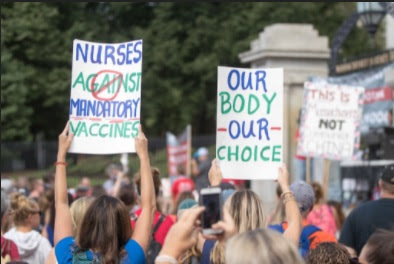
Inalienable rights such as those listed above imply the freedom of the individual to choose within the limits of legal code.  One such “right to choose,” that regarding our personal health needs, has traditionally been granted to each adult individual based on recommendations of their physician or other medical experts. However, the development of vaccines as a strategy against the COVID-19 virus and its variants is being used to justify overriding our personal right-to-choose whether or not to be vaccinated based on our private doctor-patient relationship.  Vaccine mandates by certain employers are causing Americans to choose between being vaccinated or losing their source of income and related benefits of employment.

We should note that the concern of many Americans about COVID vaccines is not generally about whether or not the vaccine is a reasonable choice to protect one’s health.  Those who believe vaccination will protect them from the virus should be free to choose to be vaccinated; and then, not fear infection from either vaccinated or unvaccinated individuals.  The real concern and even fear on the part of many Americans is the loss of patient-doctor privacy and the freedom of each individual to choose what they allow into their bodies.

A Rationale for Exemption
If you are among those considering how to express your conviction about not being vaccinated, you should know that my friend, John, has composed a detailed statement in support of his appeal for an exemption.  He has made this statement available so others can use it as a resource, not word for word, but as a starting point to be modified to better express their own personal rationale which they can defend:

To whom it may concern,

I’m writing to inform you that I cannot take the COVID-19 vaccine due to my personal and sincerely held religious beliefs.  My faith in God is my most treasured possession.  Therefore, honoring Jesus Christ by being obedient to what I feel called to do regarding this vaccine is of utmost importance to me.  My religious belief, observance, and practice is that of a follower of Jesus Christ and I base my moral decisions on my understanding of the Bible, both Old and New Testaments.  I have several sincerely held beliefs that prohibit me from ever taking this vaccine and I’ll list them below:

1 – I believe life is precious because it is a gift from God (For example: Genesis 2:7 & Gen 1:27). I don’t believe I can do anything that condones or benefits from the shedding of innocent blood.  God made it clear that shedding of blood is one of the things he hates (e.g. Proverbs 6: 16-19).  I also believe that every human being was knit together in the womb by God himself (Psalms 139:13-14). Therefore, I think abortion is murder; and therefore, I would never knowingly put anything in my body that was derived from aborted fetal cells. I also could not knowingly put anything in my body that was developed using aborted fetal cells or tissue in the testing process.  Over the years I have stopped using products that I later found out used fetal cell tissue in the development like Bayer Aspirin and Preparation-H. I feel that to knowingly use or ingest any product developed using the blood or tissue of a murdered human being would be to condone (or profit) of the killing itself.

2 – Since I believe that God fearfully and wonderfully made me and that he did not make a mistake (For example: Psalms 139:13-14). I don’t believe that I could take any product that deliberately changed or modified my DNA or RNA as that would be rejecting what God did when he created me. It would be telling my God that I need to take something to fix the code of my body and His creation.

3 – I also feel my body is a temple that God Himself started dwelling in the day I confessed my sin and asked Jesus to forgive me (For example: see John 3:16, Romans 10:9-13, Ezekiel 36:26-27, 1 Corinthians 6:19-20, etc.). I am admonished in 1 Corinthians 6:19-20 to glorify God in my body and treat His temple (my body) with respect by not intentionally doing anything to or with my body that would harm it.  As a practicing Christian who believes that my body is the Temple of the Holy Spirit, I do not smoke cigarettes, smoke marijuana, take illegal drugs, commit adultery, or participate in any activity I deem immoral. This includes ingesting anything I believe to be harmful to my temple, including certain vaccines – particularly those that are widely reported to cause harmful side-effects, no matter how rare. To insist that I degrade my body – the Temple of the Holy Spirit – is an infringement upon my religious beliefs.

4 – Lastly, I believe that the Holy Spirit will convict me of things that would be a sin for me to do or what would be the will of my Father in heaven. (For example: John 16:8, Galatians 5:16-25, 1 Corinthians 2:11-16). I have spent much time in prayer about this vaccine and asked the Lord for wisdom and guidance. He has made it clear to me in my reading of Scripture and in my spirit as he speaks to me through the Holy Spirit that lives in me that I should not get this vaccine.

My right to not be coerced into denying my faith, beliefs, and convictions under God are fully protected rights. Title VII of the Civil Rights Act of 1974 makes it clear that it is “illegal to discriminate against someone on the basis of race, color, religion, national origin, or sex” and it further states that employers must “reasonably accommodate applicants' and employees' sincerely held religious practices”.  The US Constitution fully restricts the US Congress (this would extend to all agencies such as OSHA) from infringing on religious freedom at all when it clearly states, “Congress shall make no law respecting an establishment of religion, or prohibiting the free exercise thereof.

I affirm that everything I attest to above is my personally and sincerely held religious conviction. All that I have expressed above is a true and legitimate conviction based on my understanding of the whole Bible and my personal communion with my God.  I, therefore, respectfully decline any COVID vaccine.

John Oscar Bellamy  III  ___________________

Signature of Pastor, as witness  ___________________
_

Care to Comment?
There is much confusion today regarding the COVID virus and vaccination.  We obviously don't have all the answers.  However, reasoned and civil dialog can be very helpful. Please feel free to use the "Comment" space below to insert your questions or add your comments. We'd like to hear from you.  Or, you can e-mail us at silviusj@gmail.com.

Friday, October 22, 2021

Brokenness to Boldness: A Tribute

In 2022, if we live to celebrate our birthdays, both Abby and I will mark the three-quarter-century point in our lives.  We have been married for more than two-thirds of our lives.  During this time, through both joys and trials, we have grown in love and appreciation for each other, thanks to God’s grace, the enduring love of our family, and the friendships we have with others.

In this blog, we want to highlight one of the friendships that has been very special to us for the past 45 years. This particular friend’s life story is not unique, but it reminds us of the life of the Apostle Paul who lived over 2,000 years ago.  Although these two men are separated by millennia of time, both were transformed through crisis which opened their hearts within finite time to receive the Eternal Joy of Heaven, God’s Spirit.

Both our friend and “St. Paul” we're very accomplished men, committed to excellence in their respective fields.  But when crisis came and led them to brokenness, both our friend and Paul were humbled enough to turn to God and receive “spiritual eyes” of faith.  As a result, they repented and reordered their lives with God’s help through His Word.  Before sharing the story of our friend, let’s consider the early life of the Apostle Paul.

Apostle Paul:  Crisis to Conversion
According to Paul’s account of his early life, he was born a Jew and named Saul of Tarsus (Philippians 3).  Saul became a highly educated Jewish leader, a Pharisee steeped in religion.   Upon hearing of a newly emerging cult known as “The Way” (Acts 9:2; 22:4), founded upon the Good News of the death and resurrection of Jesus Christ, Saul used his authority to harass and jail members of The Way, known as “Christians.”

According to Acts 6, Saul eventually participated in stoning to death a prominent Christian named Stephen because of His faith.  On that fateful day, Saul heard Stephen’s powerful testimony of faith in Christ (Acts 7).  Then, he held the garments of others while they hurled stones at Stephen, leading to his death as the first Christian martyr.  The last words Saul and the others would have heard from Stephen was, “Lord, do not hold this sin against them!”   Saul’s experience of Stephen’s martyrdom left an indelible imprint on his mind (Acts 22: 20) and set the stage for a major crisis in his life.

Not long after the stoning of Stephen, while Saul was on the road to Damascus with warrants for the arrest of more Christ-followers, he was blinded by an extremely bright light (Acts 9: 3).  Here, Saul encountered the Risen Christ whom he realized he had been persecuting (Acts 9: 4-18).  During this encounter, Saul became blind and yielded his life to Christ who called him in the power of the Spirit into a new life of service as the Apostle Paul.  Paul’s powerful testimony of his conversion to Christianity is recorded in Acts 22: 4-21 and 26: 11-32.

In the two millennia since the Apostle Paul’s conversion and his “missionary journeys” to spread the Gospel of Jesus Christ into Asia and Europe, millions of people around the world have surrendered their lives to Jesus Christ.  Like Paul, many came to Christ during a crisis of awareness that led them to turn in faith to God.  Our friend’s life is a testimony of one such conversion.

Our Happy Reunion
Recently, Abby and I were privileged to visit the home of our friend in Maryland, where we spent parts of two days with him, his wife, and their two daughters.  We have chosen not to reveal their names, considering that our friend would prefer that God receive all the glory from what you are about to read.  What follows is a brief biographical sketch of his life, followed by some memorable points from our conversation.

When Abby and I arrived at our friend and family’s home in Bowie, MD, their younger daughter welcomed us and we enjoyed several blessed hours of conversation with the family, friends, and their aid who lovingly joined in like a member of the family.  We had not been together with my friend and his wife since 2015, and had not seen the daughters since the 1980’s when our family moved from Bowie to Cedarville, OH.  Between times, except for occasional visits, we had maintained our friendship through letters, phone, and internet.  So, this was a blessed reunion.

After some light-hearted catching-up, our friend focused his conversation with me on two of his principal reasons for meaning and purpose in his life.  First, is his wife and beloved helpmate of 61 years; and their two daughters, each accomplished in their careers and each of whom he is very proud.  The love we observed between our friend and his wife, and between them and their daughters was very God-honoring.

Second, our friend places great value on the lives of the unborn and others who are helpless to defend themselves.  So, he has been very active as a volunteer in the
Maryland Right to Life (MDRTL) organization.  His background as a physicist with NASA has honed his organizational and computer networking skills, and he has devoted tireless hours to spreading the Pro-Life message through meetings and internet connections.  We discussed the MDRTL 2021 Maryland General Assembly “Legislative Wrap-Up” which highlights the efforts and successes of the MDRTL in influencing pro-life policy through the 441st session of the Assembly.  Out of 53 bills that posed a threat to human life, MDRTL was successful in helping to defeat 30 of them!  [For more detailed information on the progress of MDRTL, go HERE.]

Our Friend’s Crisis to Conversion

The following morning, our friend greeted us with a very unselfish statement. He said that he had been speaking with the Lord earlier that morning and realized that he should want Abby and I to enjoy our time and our trip.  So, he had decided not to dominate our time and conversation for the morning.  His words clearly revealed an answer to our prayers, and the prayers of our family and our friends in Wooster.  While we expected and wanted our conversation to include our interests and passions for good causes such as sanctity of human life, we also wanted to talk about the challenges in our personal lives.  Indeed, we had chosen to visit because both our friend and his wife had reached their 90’s this year and were now experiencing deteriorating health.

Our conversation became very spiritual when our friend confided that every morning, he battles against spiritual attacks against his own self-worth.  The attack focuses on his past neglect of his family, especially his sister Leah who had once lived with them. Because of his busy career as a physicist with NASA, he spent long hours at his office, consumed by the fact that a large number of Ph.D. scientists were depending on his expertise.  In the early 1970’s, Leah died suddenly, and our friend blamed himself.  To use his words, "God blew up my life.”  Then, through many difficult years, God showed me that I could not put my life back together again without turning to Him."  His emotional breakdown caused him to leave NASA and enter several decades of spiritual and emotional rehabilitation.

Then, our friend opened up very specifically to discuss how he reacted to his sister's death. Although he blames himself for not being there for her, he has not sensed others blaming him. Our conversation led to my own assertion of how much we need God in times like that.  I shared the words of Jesus from John 14: 1:  "Do not let your hearts be troubled...."  We discussed how we can choose not to let our hearts be troubled.   In John 14: 2-6, we read how Jesus has gone before us to provide a way.  Like Thomas (v. 5), when we are lost and don't know the way, we can turn to Jesus for comfort—i.e. using God’s truth to fortify our faith.  In fact, Jesus said, " I am the way, the truth, and the life, no one comes to the Father but through me."   Jesus is the Good Shepherd (John 10), the fulfillment of what David described so beautifully in Psalm 23, “The LORD is my shepherd, I shall not want….”

Our friend’s response to these Scriptures was very reflective and convicting. He said, “For many years, I treated God as if he were nothing, and worthless.  When my sister died, it was as if God had exploded my life into many pieces.  I couldn’t cope with it by myself.  Just when I thought all was hopeless, God came into my life and helped me find meaning and purpose again.  Now, in my spiritual battles, I claim the power of God’s Holy Spirit and the cleansing blood that Jesus shed on His cross for me.”  Then, our friend added that putting his life back together has been a long and difficult process.

This past June, on his 90th birthday, our friend had written in an e-mail message, “I enjoyed our [recent] phone conversation. Thank you.  Being valued by God-sent people like you and Abby heals and comforts my injured spirit more than I can easily say… God does fill in the gaps of missing formation of the soul.” 

God’s “Kingdom Engineers”
Jesus taught His followers to approach our Father in reverent prayer.   He said, Pray then, in this way:
Our Father who is in Heaven,
Hallowed be Thy Name.
Thy Kingdom come, Thy will be done,
On earth as it is in Heaven
.

Our friend’s spiritual healing coincides with his vision of using his God-given ability as a scientist and computer programmer to “bring the harmony of God’s Kingdom to Earth.”  By this, he means to serve as a “Kingdom Engineer” on behalf of the Pro-Life movement.  In this role, I see our friend as a steward of both his scientific expertise and God’s love, mercy, and grace.  Our friend elaborates on his perceived role: 

“There is so much Design in nature that it seems to many people that there IS a system designer, a loving God.  I believe that we Christians are on Earth to work to reveal that Harmony to Mankind.  In my opinion, anyone who works to further the purposes of God’s Kingdom on Earth using system science could be called a “Kingdom Engineer.”

To apply his passion for protection of the unborn, our friend has used the internet to stir up, in his words, “a God-centered Voice of the People to be heard by elected lawmakers at all levels of government.  Resources that, when connected can accomplish that Voice are as follows:
1) God’s Word
2) an unmistakable spiritual calling to lift up the helpless
3) guidance from inspired clergy
4) boots on the ground (faith-centered people) to accomplish that calling
5) the internet to provide united (hence effective) action by faith-centered people
6) a government that responds to the voice of the people.

For many years, our friend has been motivated by his love for God and by his passion to promote the “God-centered Voice of the People” on behalf of human life through internet contacts with grass-roots groups. 

Admittedly, I once questioned our friend’s theology and motivation, given that it is easy for us to fall into earning merit in the eyes of God by performing “works of righteousness.”  However, I believe our friend understands that, in the words of Titus 3: 5 (emphasis mine), God saved us, not on the basis of deeds which we did in righteousness, but in accordance with His mercy, by the washing of regeneration and renewing by the Holy Spirit.  In an e-mail in which our friend sent on Christmas, 2017, he included this paraphrase of Acts 10: 43: "Of Him [Jesus] all the prophets bear witness that through His Name everyone who believes in Him [whoever trusts in and relies on Him, accepting Him as Savior and Messiah] receives forgiveness of sins.” Neither is there salvation in any other: for there is none other name under heaven given among men, whereby we must be saved (Acts 4: 12).

Naturally, our friend would shy away from any comparison of himself with the Apostle Paul even though it is evident that both men came to faith in Jesus Christ through crisis and conversion.  Yet although Paul’s life sets a pretty high standard for any of us to match, all who are “born again” in Christ have access to the same power that Paul relied upon.  Therefore, I believe that both my friend and I can relate to Paul’s testimony and pray that God will help us live with the same passion for Christ that empowered this Apostle who wrote:

But whatever things were gain to me, those things I have counted as loss for the sake of Christ. More than that, I count all things to be loss in view of the surpassing value of knowing Christ Jesus my Lord, for whom I have suffered the loss of all things, and count them but rubbish so that I may gain Christ, and may be found in Him, not having a righteousness of my own derived from the Law, but that which is through faith in Christ, the righteousness which comes from God on the basis of faith, that I may know Him and the power of His resurrection and the fellowship of His sufferings, being conformed to His death; in order that I may attain to the resurrection from the dead.  Not that I have already obtained it or have already become perfect, but I press on so that I may lay hold of that for which also I was laid hold of by Christ Jesus (Philippians 3: 7-12).

Eternal Joy Invaded Time
When Christians meaningfully celebrate Christmas and Easter, these “holy-days” are like a set of bookends around the earthly Life and Mission of God’s Messiah, Jesus Christ.  At Christmas, we remember the Eternal God becoming incarnate, conceived by the Holy Spirit and born of the Virgin Mary into finite time.  For a relatively brief time, Jesus showed us by Word and example the love, mercy, and righteousness of His Father, the Almighty God.  Then, as Easter reminds us, Jesus willingly surrendered His Life as a holy sacrifice for sin for all who would surrender their prideful self-righteousness and accept by faith His righteous Gift of salvation.  The Apostle Paul wrote that Jesus died for our sins according to the Scriptures, and that He was buried, and that He was raised on the third day according to the Scriptures (1 Corinthians 15: 3-4).  As our friend has said, “God has paid the price of the ticket to heaven, why not accept it and be ready to go?”

God’s Gift of His Son for our sins, bookended by Christmas and Easter, represents a period in which God’s Eternal Joy invaded time in bodily form.
  As Abby and I made our way over the Appalachian Mountains and back to Wooster, we rehearsed our experiences of the loving friendships we had renewed there in a cozy cape cod home in Bowie, MD.  The reality of our ages and the health considerations of our friend and his wife caused us to cherish the relatively few hours we had been together.  Our conversations, so intimate and forthright, were focused on eternal values.  It truly seemed that God blessed our sweet fellowship, our sharing of Scriptures, and our prayers together with His very presence.  Indeed, for those moments together with our friends, once again we sensed that “Eternal Joy Entered Time.”

How About You?
We have shared how two men’s lives were changed through crisis, leading them to respond to God’s eternal truth and grace.  Stories like these can inspire us to be better human beings or simply to face our daily grind.  But the lives show us that God calls us to receive something more!  More than “toughing it out in trials” or simply trying “to be a better person.”  Thankfully, God meets us in our trials and invites us to allow our lives to be transformed into His image and plan.

If you would like to know more about the Life transformed and filled by God’s Holy Spirit, please check out this booklet online, entitled “Have You Made the Wonderful Discovery of the Spirit-filled Life?” [See online booklet HERE.] This helpful booklet explains how you can yield the "throne" of your life to God and find peace with Him as your Father in Heaven.  Through God's Spirit dwelling in you, you can learn to see the world and your life priorities from God's perspective.   If you have additional questions, comments, or would like to share your story, We’d love to hear from you.  Just post a “Comment” below or e-mail me at silviusj@gmail.edu

Saturday, September 11, 2021

Realizing Our Identity and Freedom

The 9/11 attack on America 20 years ago by al-Queda, the Islamist multi-national terrorist group, has changed our nation and our lives.  Our identity as Americans, how we see ourselves as a nation and as individuals, has been permanently altered.  At the same time, our freedom to safely come and go has become more restricted.

On this 9/11 day of remembrance, many of us are asking ourselves basic questions about the state of our world and our future as a nation. We are no less vulnerable to attack than we were 20 years ago; we may be more vulnerable.
  And, more personally, the question of our individual identity—of how we see ourselves and our purpose for living in this uncertain world.  Our identity and our reputation are priceless possessions that depend on another priceless gift--our freedom.

Our Identity and Freedom
Speaking of how we view ourselves, our granddaughter discovered a way to see herself in the mirror from multiple angles by orienting the mirrors of our bathroom vanity cabinets.  We were amazed at this duplication of her cute face.  We also realized there is another lesson we can learn from “looking in the mirror.”

No matter how many mirrors we place around us, we cannot ultimately see our own face or whole body in complete three-dimensional fashion.
  At the same time, others can easily view us in three dimensions from head to toe.  But, in spite of the fact that others can see us in a more real way than we can see ourselves, they too face a limitation.  Others cannot know us to the extent that we know ourselves.  Yet having a limited knowledge of us does not stop others from forming an identify for us in their minds based on what they can see and know about us.

Our family, friends, employer, businesses, and government agencies all have informal and formal ways of identifying us from a wealth of data that has accumulated since our birth.  It is in our best interest to keep private many of our most personal thoughts and personal data such as credit card numbers, account passwords, and health records.  A fundamental part of individual freedom is the right to have some measure of control over what others can see and know about us.  Otherwise, in today’s world, our private information can fall into the hands of the wrong people.  Our personal identity is one of our most valuable possessions.

Besides threats to the security of our personal information, in recent years we have observed increasing threats from those who might misrepresent us, group us into categories, or limit our freedom based on subjective norms.  As we said, even though others can look directly into our faces and eyes, they cannot know our inner thoughts, motives, health history, and values apart from our words and actions.  Yet, today we are increasingly confronted with voices and policies that pretend to know who we are, how we think, what we believe, what is best for us, and how we ought to behave.  This notion is reaching full bloom through the evolving governmental policies aimed at “protecting us” during the COVID-19 pandemic.


Loss of Identity and Freedom
Imagine you are traveling on an interstate highway and decide to take an off-ramp.  You proceed to a “Stop” sign and make a right turn to enter a detour for road construction.  Within a quarter mile, you are stopped at what appears to be a highway checkpoint.  An officer dressed in a dark green uniform asks you for your identification.  You hand him your driver license which he keeps but does not acknowledge it as an official ID.  You reach in the glovebox for vehicle registration, but the officer is not impressed.  Additional attempts with credit cards, insurance card, and social security card do not convince the officer that you are really—You!  You suddenly experience what it would be like to lose your identity, and with it, your freedom.

Does this sound a bit far-fetched and futuristic?  Another conspiracy theory?  Many Americans would answer “Yes.”  But we need only to watch the daily news to see evidence of how a gradual progression of government policies can lead to an outright loss of our freedom.  For example, the news from Australia is revealing how a formerly democratic government is becoming an authoritarian state (See
HERE.)

“But wait,” you say. 
“We live in America under the Constitution, the Bill of Rights, First Amendment, law and order, and due process.  Life in my neighborhood goes on pretty much as it has for decades.  I trust our mayor, law enforcement officials, school board, and my doctor.”

But what about the larger world in which these officials and agencies must function—your state and federal government?  Let’s consider two recent and ongoing developments that seemingly allow state and federal governments to justify policies that are restricting our freedoms.  The first is the increasing pressure from the U.S. Government to achieve universal vaccination against the COVID-19 virus.

Vaccination Passports
During the past 50 years, we became familiar with the claim, "It's my body, and no one should be telling me what I can or cannot do."  The pro-choice movement has rested squarely upon this claim in their successful effort to overturn government restrictions on abortion.  Many of us are opposed to abortion on the grounds that it terminates the development of a human life that began at conception.   At the same time, we ought to be “pro-choice” regarding our right to make decisions in consultation with our doctor in the best interest of our health.  So, with respect to the COVID-19 pandemic, we are not anti-vaccination.  We are simply “anti-coerced vaccination.”

In August, Defense Secretary Lloyd Austin announced that the body of each man and woman in the military will be subjected to "his choice" regarding vaccination.  Austin’s choice is that all will be vaccinated regardless of preference or whether they have natural immunity from prior infection.

Writing in
The Federalist (See HERE), Josiah Lippincott calls Secretary Austin’s mandate an “ethical abomination.  He explains, “Mandatory medical procedures violate the natural right to bodily autonomy.”  He adds, “True bodily autonomy means just that: the ability to unilaterally control what is injected, inserted, or altered in one’s body. This right is not inherently religious. One should not have to hold certain beliefs in order to control one’s health.”

Lippincott cites specific federal court cases to support his claim that, “Control over one’s own body is the basis of all freedom. If the government can mandate vaccines in the name of health and welfare, then it can mandate other procedures as well. It can erode the right to autonomy and independence in the most intimate spheres of life.”

The Federal Government’s COVID vaccination requirements just became more coercive this week.
  President Biden’s plan took aim at the nearly 40% of Americans who are not fully vaccinated (See HERE.).  Over 80 million workers will be required to either be vaccinated or subject themselves to weekly COVID testing.

Meanwhile, according to a recent
Washington Post-ABC News poll, “only 16% of unvaccinated workers would get the shot if required.  Thirty-five percent would request a medical or religious exemption; and, 42% would quit their job…  If a medical or religious exemption were not available, 72% said they would quit the job…”  Many Americans are not anti-vaccine; they simply oppose the use of coercion through penalties, fear, and shaming while watching their freedom being taken away.  In hopes of finding clarity amid the confusion, many are looking to science to light the way.

Where Is the “Good Science?”
Readers of Oikonomia know that we frequently emphasize the importance of “good science” (See HERE for “Follow the Science. But Who’s Driving It?”).  More than ever, we need good science characterized by individual and professional ethics expressed through careful research, objective peer review, freely available and unbiased reporting, and healthy civil discourse as a basis for good policy making.  When one or more of these links are weakened, many important questions go unanswered or are wrongly answered.  The result is confusion, frustration, and threats to our well-being.  Here are a few of the questions still needing honest answers:

1.   Can we know the who, what, where behind the 2019 outbreak of
      SARS-CoV-2 (COVID-19)?

2.   What are the best therapeutics and preventive approaches
       (
e.g. masks) against COVID?
3.   What did we learn as a nation from the apparent failure
      of a complete lockdown approach?

4.   Will the current vaccination approach protect us or simply create
      new COVID variants?

5.   What is the risk/benefit ratio for a policy of forced universal
       vaccination?

6.   Why does Dr. Robert Malone, principal inventor of mRNA vaccine
       technology, and other 
experts have serious concerns about the
       COVID vaccines?  (See video
HERE.)

Answers to most or all of these questions are available or obtainable.  But the answers are often obscured or confused by political and media bias. For example, answers to question #5 above are already available from statistics collected by our armed forces.  Defense Secretary Austin’s decision to require universal vaccination for our armed forces should be assessed in light of these data.  According to Lippincott, “COVID-19 poses very little risk to our armed forces. Out of 2 million active-duty troops, fewer than three dozen have died of COVID in the last 18 months. For perspective, 900 service members die per year from all causes.”

Good science is also shedding critical light on the policy of requiring universal vaccination of college students.  In April of this year, Cornell University began mandating vaccination of all university students, faculty, and staff with only limited exemption for religious and medical reasons.  According to statistics reported in The College Fix (See HERE), this fall, Cornell boasted a 95% vaccination rate.  However, the first week of classes in 2021 revealed 322 positive COVID cases (1.19% positivity rate) compared to 59 cases (0.2% positivity) in 2020. 

The Cornell data raise questions about the effectiveness of both vaccination and face masks.  And, there don’t appear to be hidden factors that skew the results.  Students were required to wear masks both years—no variable there.  Nor was number of COVID tests a variable.  In fact, the number of tests was greater in 2020 (28,951) than in 2021 (27,103)!  In all, the Cornell data suggest that shrinking the percentage of unvaccinated individuals to 5% combined with a face mask requirement did not lessen the already low incidence of COVID infection. 

If the Cornell data are representative of how vaccines and face masks serve our younger demographic on our campuses, we should ask, “Where is the scientific basis for disrupting the lives of our children and young adults?”  According to data reported The Telegraph, “Teenage boys are six times more likely to suffer from heart problems from the vaccine than be hospitalized from Covid-19.”  Meanwhile, in Israel where vaccination rate is over 80%, COVID cases are spiking.  Although vaccines appear to reduce the already low COVID mortality, there is increasing evidence that vaccines may offer less effective and less prolonged protection from infection by COVID and subsequent viral variants.

Obviously, the issues surrounding COVID are complex, and we cannot determine the best path for ourselves and our families without good science, good counsel from our personal physician, and above all the precious freedom to make the best choices for our particular health needs.  Which raises the question of whether we are being selfish if we ask for the freedom to choose what is best for our individual lives.

Who Is Being Selfish?
Freedom that is so cherished by many Americans is being threatened by overreaching governmental policies.  Personal freedom of choice is also being threatened in a more subtle and insidious way—by inciting resentment and rejection in our social interactions.  For example, those who wear masks and/or who are vaccinated are encouraged to look and speak with disdain toward those who chose not to wear masks or be vaccinated. 

According to  Lippincott, “Some mandatory vaccination activists argue that refusing to receive a COVID shot is equivalent to murder, since an unvaccinated person might spread the illness. This is dangerous logic. Treating healthy people like biohazards is a recipe for stripping away all of their rights.”  Lippincott drives his point further by referring to what has happened in Australia as a stark warning to all of us: “If you start treating your fellow citizens like disease vectors, you end up with the globe as a hospital gulag.  [In this context, Americans should realize from what is happening in Australia, and wake up to what is happening in our country.]  The Australian government has gone as far as removing children from their parents to quarantine them. Medical martial law and the biomedical security state are incompatible with human freedom.”

Attack on Our Identity
Let’s return to our scenario in which we imagined we were stopped by a guard at a highway checkpoint who questioned our identity and confiscated our personal ID’s. Next, the official orders you to follow signs to “Temporary Parking” where you discover over a dozen cars with their drivers and passengers waiting inside.  Disturbed by this turn of events, you begin to feel fearful when you notice two other officers, dressed in similar dark green uniforms removing the license plates from the parked cars.  Soon, another officer approaches your car, captures a photo of your face, and generates a plastic armband which he attaches to your wrist.  Then, you are ordered to get out of your car and to join a line of others who are making their way to a drab, windowless building nearby.

If our imaginary scenario still sounds too futuristic, we need only to realize that on this very 9/11, many people in Afghanistan whose identity, if connected to the United States, will cause them to lose their freedom, and possibly their lives.  Meanwhile, we have seen evidence that the COVID pandemic is being used by governments from America to Australia to usurp power over our individual lives in the name of making decisions that are best for our protection.  In the process, Americans are told to find comfort behind their masks and jabs while listening to an endless babble from leaders that change their recommendations almost daily. 

We live in a more unsettled world which makes us less patient and more fearful.  Family and friends are divided over whether or not masks and vaccinations are effective and understood well enough to trust.  Whereas, some voices call us selfish for not being masked and vaccinated, other voices from believers in Critical Theory claim that they can look us in the face and easily assign an identity to us based on our looks and behavior. 

As we said in the introduction, our personal identity and reputation is a priceless treasure.  Anyone who seeks to steal or diminish our identity is committing a great theft against us.  Those who aspire to Critical Theory (See “Celebrating and Conserving Our Freedoms” click HERE) seek to divide us into groups labeled the oppressed and the oppressors.  There are no winners in this insidious and hateful view of mankind.  The oppressed are taught they are miserable victims of injustice at the hands of the oppressors.  And, the oppressors are taught to bow in shame and guilt for possessing the abilities and opportunities that have helped them to achieve a fulfilling role in society.

To which of these groups, the oppressed and the oppressors, do you belong?  For most of us, it is clear that neither of these labels are a fair assessment of who we are.  But what if we lacked the protections of our Constitution, rule of law, due process, and an accurate understanding of American history and values?  These protections and leaders who value them are the only effective deterrents against the advancement of Critical Theory into our schools, colleges, industries, and government.  However, there is one more Person that has a great deal to say about our identity—God Himself.

Knowing Our True Identity
On September 11, 2001, as the Twin Towers were crumbling into clouds of dust, the bodies of hundreds of people perished, leaving only memories of each of their lives.  Today, most of us cannot relate to the emotions of family and friends who lost loved ones on this tragic day so suddenly, and without being able to say “Goodbye” or even to have the body of their loved one over which to grieve.  Yet, the persons they were in spirit, the personal identity of each one, is known and remembered by God.

When we ask questions about our identity, about “who I am,” our answers are often personal, subjective, and different from the answers of others who know us.  But God’s answer to “who I am” is also personal but not subjective or inaccurate.  God, or Jehovah, the Great “I AM,” has perfect knowledge of “who I am.” My true identity is found in relationship with Him.  His Word, the Bible, reveals His knowledge of me—how I was dead in my trespasses and sin; and, how faith in His great love and power, God called me to die to my sin and shame, identifying with the death of His Son Jesus Christ, and then, caused me to be born again, raised in the likeness of Christ’s resurrection and in victory over sin and death (Romans 6: 3-11; 8: 5-11).

We can be robbed of our identity and political freedom like many are being robbed of these today in countries like Australia, China, North Korea, and Afghanistan.  But if by faith, we have found new life and identity in personal relationship with Jesus Christ, we are reminded each day of “who I am” in the love of the “Great I AM.”  When we choose to feed daily from the bread of His Word in the Scriptures, we receive the Truth in words of love and assurance that speak to our hearts. 

On this 9/11, we remember the tragedy of the attack on America.  We must also remember that the identity, freedom, and hope of America depends upon the individual responsibility and dependence of her people upon the providence and salvation through faith in God.

You may be anxious and confused, or unable to identify how you are feeling.  Be assured that God is in control and He knows and loves each of us.  Maybe the most intimate revelation in Scripture that speaks of God’s knowledge of each of us as persons is recorded in Psalm 139.  We close this article with a prayer on this day of remembrance that readers will be encouraged that our true identity is known by a loving God who daily pursues us to have a personal relationship with us.  His gift of True Freedom in Christ is available to all of us who will repent of our own sin and accept the gift of this Freedom and Identity in Him.  Psalm 139 begins:

LORD, You have searched me and known me.
You know when I sit down and when I get up;
You understand my thought from far away.
You scrutinize my path and my lying down,
And are acquainted with all my ways.
Even before there is a word on my tongue,
Behold, LORD, You know it all.
You have encircled me behind and in front,
And placed Your hand upon me.
Such knowledge is too wonderful for me;
It is too high, I cannot comprehend it.

Search me, God, and know my heart;
Put me to the test and know my anxious thoughts;
And see if there is any hurtful way in me,
And lead me in the everlasting way.  – Psalm 129: 1-6; 23-24