Wednesday, June 20, 2018

A New Hunger for Rules We Hated?

In those days* there was no king in Israel. 
Everyone did what was right in his own eyes.
   *1300-1050 BC  -- Book of Judges 21: 25 ESV

I am a member of the high school graduating class of 1965.  The 1960’s greeted us baby-boomers with the Beatles, the Beach Boys, sporty cars, and many opportunities and invitations to become breakers of moral and social rules.


Now that I am in my seventies, I have lived through the transition from the “modern” to the “postmodern” era.  During the modern era which included the Renaissance, the Protestant Reformation, and the scientific revolution, many believed that all major truth claims about reality could be harmonized through the lens of the natural sciences and mathematics.  Revelatory truth from a supreme creator God was supplanted by a belief in the supremacy of human reason.  Many accepted humanity as being the most highly evolved species on the Darwinian tree of life, destined to transform the natural world into a utopia.

Then, in the 1960’s, the rule-breaking baby boomers “matured” into post-modern “thinkers” of the 1970’s and 1980’s.  This period saw major upheavals in the global economy (Think “oil.”), growing environmental deterioration (Think “endangered species.”), and a loss of confidence that America was a rightful leader on the world stage (Think “Vietnam.”).  Our society began to move away from a respect for time-honored virtues to a rejection of rules which were viewed as stifling of individual freedom. 

Postmodernists dismissed the notion that truth is a “transcendent, timeless, universal absolute that is present everywhere and applicable everywhere (Matt and Rachel Taylor).”  Instead, postmodernists consider truth claims as relative to the community to which each individual belongs (e.g. national, tribal, or ethnic).  A virtuous person is defined as one who is tolerant of people in other communities who may define truth differently and does not to use personal truth claims to wield power over other individuals or groups.

Today, the USA is divided and confused for want of truth and structure for life.  We see evidence of moral relativism in many of the controversial issues that divide our nation—gender and reproductive rights, attitudes toward law enforcement, national sovereignty, immigration reform, religious liberty, freedom of speech, and right to bear arms.  In many cases, political pressures combined with legal and moral ambiguities have caused much distress and even death to people normally protected by objective legislation and law enforcement.

But a strange thing is happening on the way down the path of postmodernism and moral relativism—many are beginning to hunger for “rules for life.”  Books are popping up that are offering just that.  Jordan B. Peterson has authored 12 Rules for Life: An Antidote to Chaos (Random House Canada, 2018).   His YouTube video with the same title boasts 1.5 million views.  In the Foreward to 12 Rules for Life,  Norman Doidge, MD, and author of The Brain That Changes Itself offers his explanation for the sudden interest in rules, particularly among millennials:

…what [Peterson] is saying meets a deep and unarticulated need.  And that is because alongside our wish to be free of rules, we all search for structure.

Doidge continues:  The hunger among many younger people for rules, or at least guidelines, is greater today for good reason. In the West at least, millennials are living through a unique historical situation. They are, I believe, the first generation to have been so thoroughly taught two seemingly contradictory ideas about morality, simultaneously-- at their schools, colleges and universities, by many in my own generation.  This contradiction has left them at times disoriented and uncertain, without guidance and, more tragically, deprived of riches they don't even know exist.


The first idea or teaching is that morality is relative, at best a personal “value judgment.” Relative means that there is no absolute right or wrong in anything; instead, morality and the rules associated with it are just a matter of personal opinion or happenstance, “relative to” or “related to” a particular framework, such as one's ethnicity, one's upbringing, or the culture or historical moment one is born Into.  It's nothing but an accident of birth.  According to this argument (now a creed), history teaches that religions, tribes, nations, and ethnic groups tend to disagree about fundamental matters, and always have.  Today the postmodernist left makes the additional claim that one group's morality is nothing but its attempt to exercise power over another group.  So the decent thing to do-- once it becomes apparent how arbitrary your and your society’s “ moral values” are-- is to show tolerance for people who think differently, and who come from different (diverse) backgrounds.  That emphasis on tolerance is so paramount that for many people one of the worst character flaws a person can have is to be “judgemental.” And since we don't know right from wrong, or what is good just about the most inappropriate thing an adult can do is give a young person advice about how to live.


And so a generation has been raised untutored in what was once called, aptly, “practical wisdom,” which guided previous generations.  Millennials, often told they have received the finest education available anywhere, have actually suffered a form of serious intellectual and moral neglect. The relativists of my generation and Jordan’s, many of whom became their professors, chose to devalue thousands of years of human knowledge about how to acquire virtue, dismissing it as passé, not relevant or even oppressive. They were so successful at it that the very word “virtue” sounds out of date, and someone using it appears anachronistically moralistic and self-righteous.

Norman Doidge concludes his Foreward to 12 Rules for Life with a hopeful assessment of the millennial generation:

One might think that a generation that has heard endlessly, from their more ideological teachers, about the rights, rights, rights that belong to them, would object to being told that they would do better to focus instead on taking responsibility. Yet this generation, many of whom were raised in small families by hyper protective parents, on soft surface playgrounds, and then taught in universities with safe places where they don't have to hear things they don't want to-- schooled to be risk-averse-- has among it, now millions who feel stultified by this underestimation of their potential resilience and who have embraced Jordan's message that each individual has ultimate responsibility to bear; that if one wants to live a full life, one first sets one's own house in order
(Peterson’s Rule #1); and only then can one sensibly aim to take on bigger responsibilities.


If it were only Jordan Peterson’s book on rules, we might be guilty of overestimating the human yearning for rules and structure deep within the soul.  But, now a second new book is drawing much attention.  HarperCollins has just released 9 Rules of Engagement: A Military Brat’s Guide to Life and Success (2018) by Emmy award-winning Fox News anchor, Harris Faulkner.  Again, Faulkner’s rules rest upon the same, unapologetic challenge to her readers as expressed by Peterson--take responsibility for your lives.

Finally, allow me to refer you to a third example of a major personality who is offering “rules for life.”  I offer this example with a warning that the rules come in a format that is more informal and somewhat vulgar.  This week, Chris Pratt, star of Jurassic World: Fallen Kingdom and Parks and Recreation, received the coveted Generation Award at the 2018 MTV Music and TV Awards.  Pratt, a professing Christian, used the occasion of his acceptance to share some advice with fans by what he calls his “9 Rules Speech."  Pratt’s rules include:  breathe, care for your soul, pray, God is real.

I was encouraged to see these three significant personalities emerge upon the world stage to offer “rules for life” based on a foundation with two important principles.  First, each of us must take individual responsibility for our choices in life; and second, we are responsible to a Being that is more holy and powerful than we are—one Who has revealed the basis for moral standards that are intended to lend structure and fulfillment to life.

The Judeo-Christian Scriptures provide the sorrowful commentary of individuals and societies that have gone adrift in moral relativism as described in Judges 21: 25, quoted at the beginning of this article.  But the Scriptures also include individuals and societies that experienced joy and God’s blessing because they accepted His offer such as is stated in Deuteronomy 30: 19:

Today I have given you the choice between life and death, between blessings and curses. Now I call on heaven and earth to witness the choice you make. Oh, that you would choose life, so that you and your descendants might live!

Today, through His Word, the Bible, and through many other voices, God still calls us to repent, humble ourselves, and live by His moral commands in the power of His Holy Spirit.  The responsibility is ours to choose Life.

How About You?  You may have read this article and are left with a sense of confusion, uncertainty, and even fear.  If you have never encountered the “Good News” or Gospel, let me help.   The “Good News” is summarized in an outline called “Steps to Peace with God” which explains God’s love, our predicament (sin and separation from God), what Jesus has done to address our predicament, and what you can do by faith to receive God’s righteousness (right standing with a Holy God).  If you have additional questions or comments, I’d love to hear from you.  Just post a “Comment” below or e-mail me at silviusj@cedarville.edu

Sunday, June 17, 2018

Remembering My Dad on Father’s Day

Today, I thank God for my father, Bert Silvius (1908-1987).  Dad's formal schooling ended following his completion of the 8th grade.  However, he continued to read and learn on his own and became an accomplished farmer, horticulturist, and community leader.  He lived his entire life near Dundee, Ohio. 


Unlike me, dad did not have the blessing of a loving, affirming father.  Dad was the eldest of three sons who lived to reach adulthood (an older brother died at a young age).  Yet dad was the least favored by his father. 

When I reached early adolescence, I became aware of some of the tensions in our family.  It was not uncommon for my dad to receive verbal abuse from my grandpa.  Yet, he continued to show respect toward his father because he had learned to commit himself to his Heavenly Father for wisdom and comfort.

Dad served for many years as Sunday School Superintendent at our church, Dundee Methodist Church.  Part of his preparation each week was to write out a prayer which he would then use to lead those in attendance before we divided into our classes.  On April 19, 1964, his prayer, entitled “Family Tensions” contained these words:
 
May all of us come to understand that right living alone ‘exalts a family,’ that only in Thy will can peace and harmony abound.   Help us to live together as people who have been forgiven a great debt—help us to be gentle, walking softly with one another.  Help us to be understanding lest we shall add to the world’s sorrow.

Help us to stand for what is right, not because it may yield dividends later, but because it is right now.  Help us to be as anxious that the rights of others shall be recognized as we are that our own shall be established.  Help us to be as eager to forgive as we are to be forgiven.   God help us all to be ministers of mercy and ambassadors of kindness for Jesus’ sake, in Whose name we pray.  Amen


Thank you, Dad, for your love for me and your faithful testimony as a husband, father, farmer, and community leader.  Thank you for giving me my first glimpse of the nature of God by demonstrating in your life the character qualities of unconditional love, respect for authority, patience, perseverance, and a great love of learning about God and His creation.  On this Father’s Day, I thank you, and I thank my Heavenly Father for the gift of you as my earthly father.  I also thank God for the assurance that, because of your faith in God’s Son, Jesus Christ,  I will one day be with you again.  

Happy Father’s Day, dad.

Tuesday, June 5, 2018

Religious Liberty in Our Culture of Moral Relativism

Yesterday, the United States Supreme Court, in a 7-2 decision, sided with Jack Phillips, a Colorado baker and evangelical Christian who refused to provide a wedding cake for a same-sex couple because of his religious opposition to same-sex marriage.   The High Court in effect ruled that states must retain the right to protect same-sex couples from discrimination, but that religious liberty must also be considered and protected.

Jack Phillips, "the baker"
Although the 7-2 decision looks like a resounding victory for religious liberty, the Supreme Court decision is regarded as “narrow.”  As Adam Liptak writes in The New York Times:

The court’s decision was narrow, and it left open the larger question of whether a business can discriminate against gay men and lesbians based on rights protected by the First Amendment. 

My friend and former colleague, Dr. Mark Caleb Smith, Associate Professor of Political Science and the Director of the Center for Political Studies at Cedarville University cautions that while the Court did side with “the baker,” it “did so only in a limited fashion.”  Smith, who teaches courses including “American Politics” and “Constitutional Law” at Cedarville, writes as follows in his blog article, Much Ado About Something? SCOTUS sides with Evangelical Baker:

Kennedy's ruling does NOT deal with the nature of the Colorado law, nor does it touch on similarly situated business owners within the industry. So, you can argue, I think reasonably, that the Court did not address the major issues surrounding the basic conflict between religious liberty and same-sex marriage or LGBTQ rights. The Court did not examine the nature of the religious liberty claim per se, at least outside of the sincerity of Phillips' beliefs. The Court did not establish the extent to which religious liberty is a legitimate foundation for Phillips' decision. And, when the Court did look at some hypotheticals, it did not get too specific. Kennedy notes that surely pastors would have protection against being forced to conduct ceremonies, but beyond that Kennedy does not tread.

This Supreme Court decision is important to all who are concerned with First Amendment rights.  But in today’s culture of moral relativism, it is not easy to strike a balance between protections of religious liberties and same-sex marriage rights without making government the chief moral conscience of America.  After all, submission to righteous moral convictions based God’s standards cannot come from court rulings or congressional legislation any more than one can be made right (i.e. righteous) with God by trying to obey the Ten Commandments. 

What then is the answer to the challenge of protecting religious liberty in a culture in which moral practices like same-sex marriage are perceived as being in violation of Judeo-Christian religious teachings?  I believe the answer is not more government or better Supreme Court decisions.  Instead, the answer is to build stronger families, churches, schools, and communities.

Many people today are searching for their own personal identity without the benefit of a stable home life in the presence of both biological parents.  Even with two loving parents, many children do not receive moral teachings at home or from dedicated teachers, a church family, or a stable community.  For this reason, many pre-adolescents remain confused about who they are or their origin, purpose, and destination.  Not surprising, many also have difficulty finding their own gender identity. 

It is essential and right that adults pay more attention to children, both in our own families and beyond; to find ways to show love to them that they often do not find in their own homes.  There are ways for adults such as myself who are retired to do this in a safe setting.  For example, hundreds of children here in Wayne County are now given exposure to Christian education through so-called “breakaway” programs.  These programs are set up with school administrations to allow students the option of using released-time or after-school time to receive biblical instruction.  Those who work in breakaway programs have many stories of how “hungry” many of the children are for Bible teaching in a setting in which they are appreciated and loved.

There is much hope for our nation in spite of the difficulty we face in protecting First Amendment rights in a moral relativistic culture.  That hope rests in spiritual revival in our individual lives and in our homes and churches which will then influence our schools, communities, and government.  On this day of fasting and prayer in our church, I pray that my life will direct a few others around me to find that personal encounter with the Risen Christ who came as He declared in Luke 4: 18-19, to proclaim release to the captives, and recovery of sight to the blind, to set free those who are oppressed, and to proclaim the favorable year of the lord.”

For More Information:
For those who wish to read in more detail Dr. Smith’s expert analysis of the Supreme Court’s ruling, I recommend that you read his complete analysis.  If you would like to know more about how you can find true meaning and purpose through faith in Jesus Christ, you will find a short presentation of the Gospel (“Good News”) summarized in an outline from the Billy Graham Association called “Steps to Peace with God.” The outline explains God’s love, our predicament (sin and separation from God), what Jesus has done to address our predicament, and what you can do by faith to receive God’s righteousness (right standing with God).  If you have additional questions or comments, I’d love to hear from you.  Just post a “Comment” below or e-mail me at silviusj@cedarville.edu     

Tuesday, May 15, 2018

Evolution Theory Has a “Secret Sex Problem”

During the century and a half since the publication of Charles Darwin's On the Origin of Species, many books have been written on the subject of the origin of life.  Some provide an in-depth technical treatment of evolution but attract a relatively small audience.  Others treat evolution as “strictly science.” In so doing, they ignore or dismiss the fact that evolution has philosophical and moral ramifications that influence how we define our purpose and destiny in life.  Still other writers present religious attacks on science.  They ignore or dismiss the fact that science has a legitimate role in explaining how genetics and natural selection allow populations to adapt to gradual changes in their environment.


Today, if you would like to get your hands on a book that provides a solid critique of evolution while also being understandable and enjoyable to read, let me recommend one for you.  Darwin’sSecret Sex Problem: Exposing Evolution’s Fatal Flaw—The Origin of Sex (Westbow Press, 2018), by F. LaGard Smith*, combines sound scientific logic, a thorough understanding of the biology of sexuality, and the author’s unique blend of humor to uncover what is perhaps the “greatest secret of sexuality”—that Darwinian evolution cannot account for the origin of SEX!

Allow me to entice you into obtaining a copy by mentioning a few reasons why Darwin’s Secret Sex Problem will be excellent reading for researchers, teachers, pastors, laypersons, and anyone else who enjoys curling up to read a witty, engaging page-turner about a topic that is never far from the minds of any of us.  After all, we are all sexual beings and if you have followed what has been published about sexuality in the past fifty years or so, you know how influential views of origins and sexuality are on the formation of our worldview.  Specifically, philosophical naturalism and its offspring, including Darwinism and genetic determinism, have had a major influence on worldview formation with respect to human origins, sexuality, marriage, and personhood.  Professor Smith’s stated reason for authoring Darwin’s Secret Sex Problem is based on his concern over the “wide-ranging ramifications of evolutionary thinking.”

Darwin’s Secret Sex Problem is different from most books about evolution in at least three ways.  First, to his credit, Professor Smith clearly distinguishes the legitimate scientific theories of population genetics and natural selection which attempt to account for micro-evolutionary changes (or, what Smith calls “’little-e’ evolution” or “bounded evolution” within recognized taxonomic classes of organisms) from macro-evolutionary changes (or, what Smith calls “microbe-to-man evolution,” or “Big-E” Evolution).  Many writers fail to make this distinction.  Instead, they build out of the shadows of ambiguity what only appears to be a strong case for “Big-E” Evolution (unverifiable scientifically) on a foundation of “little-e” evolution (verifiable and within narrow limits).  Professor Smith argues that latter cannot account for “microbe-to-man evolution.”

As a second unique and wise approach, Smith has chosen to ignore “…religious assumptions altogether and [introduce] a fresh, powerful argument solely from within the realm of science.”  Instead of using biblical revelation to counter Darwinian claims, Professor Smith uses Darwin’s own logic to challenge Darwinian evolution head-on with a scientifically logical argument. 

You may recall that Darwin offered an “admission” of potential vulnerability in his theory of descent with modification through natural selection (“Big-E Evolution”).  “Darwin’s admission,” as stated in his own words:  If it could be demonstrated that any complex organ existed, which could not possibly have been formed by numerous, successive, slight modifications, my theory would absolutely break down (Darwin, 1859).

Professor Smith’s clear challenge to “Darwin’s admission” is to expose Darwin’s Secret Sex Problem with this daunting question:  How could asexual (non-sexual) replication have evolved by natural selection into fully-gendered sexual reproduction?   In other words, how can asexual replication deliver the genetic variation necessary for natural selection to act upon in order to form the complex mechanisms and behavior necessary for sexual reproduction?

It follows, according to Smith’s direct challenge to Darwin, that if there is indeed an unbridgeable gap between non-gendered asexual replication and male/female sexual reproduction, then that Achilles’ heel is the fatal undoing of microbe-to-man evolution.

A third unique feature of Darwin’s Secret Sex Problem is best captured in the words of Dr. Geoff Barnard, retired reproductive endocrinologist, Cambridge University.  Dr. Barnard describes the book’s author as “a non-specialist whose careful research demonstrates that he understands the crucial issues surrounding evolution’s fatal sex problem, and who has a remarkable ability to communicate complex concepts to a broad audience.” 

I was also impressed immediately at LaGard Smith’s ability to insert wholesome humor, helpful analogies, and illustrations to make the technical science aspects inviting and clear to the reader.  Still, parents may want to provide some age-suitable guidance.  Here’s a sample of how Smith addresses some specifics of how the first sexual forms might have arisen by evolution:

When it comes to having sex, there’s always a first time.  This particular “first time” must be a prototype life form fully capable of “having sex” and thereafter “sexually reproducing.”  We’re not talking here about human sexuality, complete with all the external and internal apparatus we normally take for granted.  We’re talking about the ability to produce a “male” and a “female” (don’t rush past that not-so-minor detail!) who “mate sexually” (don’t take that for granted!) and then reproduce in a radically different (even counter-intuitive) way from any and every form of sexual replication that previously might have been in play.  So, it’s not just one “first time,” but three “first times”—somewhere along the line “all at the same time. And “all in the same place.”  That’s a huge ask!

Even the chapter headings and section titles are inviting.  Here are a few examples:

“When the Dog Doesn’t Bark”
”Extinction of an Unfit Paradigm”
“X and WHY Chromosomes”
“Hox Genes, or Hoax Genes?”
“Not Even the Sexiest Asexual Could Ever Be Sexual”
“When the Church Buried Darwin…A Case Study in Compromise”

Darwin’s Secret Sex Problem has already received strongly favorable reviews on Amazon.com.  For example, “Cookeville Reviewer” submitted this helpful review:

For the honest seeker of truth, whether a skeptic or a believer, this writing by LaGard Smith will make one wrestle with his/her preconceived notions about origins, particularly the origin of sexual reproduction. It is even-handed, yet challenging. It is fair, yet fearless. Thoroughly and vigorously researched, it is an open and well organized discussion of the tenuous assumptions that humans--whether religious, scientific, or both--make regarding Darwin's Grand Theory of Evolution.  It successfully reveals what Darwin himself said would be the undoing of his theory, that sexual reproduction "could not possibly have been formed by numerous, successive, slight modifications." Then, if that is not enough, theistic evolution is shown to be, though perhaps entertained by scientist/believers of good intention as an honorable compromise of science and religion, rather an idea that pays homage to flawed science to give support to flawed religion.  If you are an honest reader, this book will not disappoint, and it will illuminate. Its goal is to encourage knowledge of the truth.

Professor Smith provides over 300 reference citations, a helpful index, and a glossary of biological terms, defined at an understandable level for anyone who has had a good secondary level or introductory college biology course. 

Now I’m finished and will dismiss you to go purchase a copy of Darwin’s Secret Sex Problem:  Exposing Evolution’s Fatal Flaw—The Origin of Sex.  And, please pass this review on to your friends who will thank you for the referral.
---------------
* F. LaGard Smith is a retired law professor, having taught for 27 years at Pepperdine University School of Law in Malibu, California; then, 5 years as Scholar in Residence for Christian Studies at Lipscomb University in Nashville, Tennessee.  Prof. Smith retired after 2 years at Liberty University School of Law and 4 years at Faulkner University's Jones School of Law in Montgomery, Alabama.  He is author of over 30 books.

Sunday, May 6, 2018

Tribute to a Virtuous Mother

Marietta Moser, my mother by marriage, was born in Loudon, TN on August 9, 1926 to John E. and Alva Mae Bright.  She was “born again” at age 14 when she surrendered her life to become a follower of Jesus Christ.  After World War II, Marietta married Ralph Donald Moser, and bore him seven lovely daughters including the eldest, my wife, Alvadell “Abby” (Moser) Silvius.  

When Alvadell and I were married in 1969, “Mom” accepted me and influenced my life as if I was her own son.  For this reason, I soon found it fitting to call her "Mom."  She has been a steady, loving, encouragement to me for the past 50 years.


Ralph and Marietta Moser with seven daughters (~1963)
Marietta loved her husband, her seven daughters, her 41 grandchildren, and her 17 great-grandchildren.  Her life of 91 years was a virtuous life--full of the good fruit which resulted from her decision as a girl to invite Christ to be her Lord and Savior.  Her growth and maturity in Christ came as she learned to feed her soul from regular times in God's Word to participate in regular worship and service in her church, Amsterdam Community Church of God.  The best words I can find to describe Marietta are from Galatians 5: 22-23 which states, "...the Holy Spirit produces this kind of fruit in our lives-- love, joy, peace, patience, kindness, goodness, faithfulness, gentleness, and self-control."

Marietta was disciplined to feed upon God's Word daily.
Proverbs 31: 28-29 speaks of the virtuous woman as follows:

Her children rise up and bless her; Her husband also, and he praises her, saying:
Many daughters have done nobly, But you excel them all.

During the final week before her death, on Sunday, April 29,  we were blessed to be with her for two separate days.  On the prior Tuesday, we remained at her bedside, comforting her with lots of smiles, encouraging words, and the holding of her hands. Although she was very weak, at one point she looked squarely at the ceiling, raised her arm straight up, and held both her arm and her gaze fixed upward in peaceful expression.  Her actions were so determined yet undisturbed by our presence that, after a short while, it seemed natural for me to ask her, “Mom, are you seeing something that we don’t see?”  She gave no visible or audible response, but, God only knows, she may have received an assurance from her Creator along the lines of Psalm 23: 4 that she had just recited with my help earlier that day:

Even though I walk through the valley of the shadow of death, I fear no evil, for You are with me; Your rod and Your staff, they comfort me.

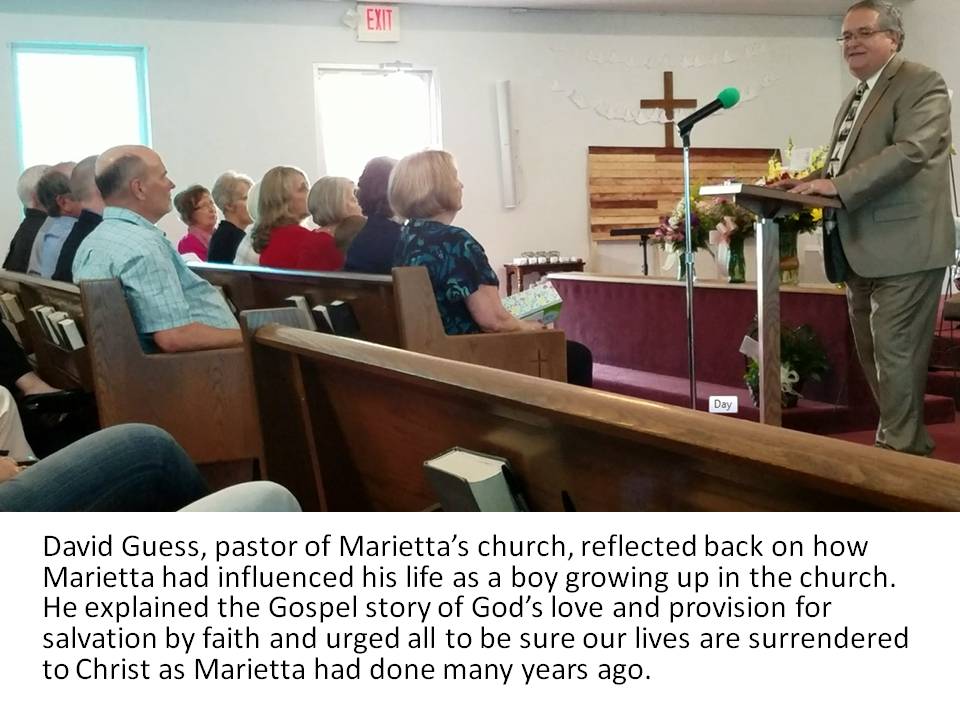
The memorial service for "Mom/Grandma Moser" was a time for tears but mostly a time for celebration of her life.  She was a wonderful woman, and we were blessed to remember her virtuous life in Christ as we gathered with family and friends at her church in Amsterdam, Ohio. 

We are glad to share two YouTube links which will allow those of you who wish to learn more of our tribute to Marietta Moser.  First, we provide the following link to a series of slides recounting Marietta's life and her love for God and family:  "Celebrating the Life of Marietta Moser."  Second, you may watch a video of a portion of Marietta's memorial service by clicking on the following link:  "Tributes to Marietta Moser, 1926-2018."

If you are unable to view the videos, or choose not to view them, you may wish to view the photos below which show family members giving tribute to Marietta.  E
ach photo has a brief explanatory caption.  You may click on each photo to enlarge it for better viewing.


Finally, I would like to dedicate this blog article to Marietta's three sisters whom she loved dearly: Mrs. Edna Sperry (below left behind Marietta), Mrs. Loretta (Ray) Noble (right front center with my wife, Alvadell), and Mrs. Norma (Lynn) Brumbaugh (rear center).


Tuesday, April 3, 2018

Easter Mornings Are Still Earthshaking

Needless to say, March Madness is an earthshaking tradition in the American sports world, especially among college basketball fans.  The 2018 edition has offered no shortage of upsets. Most notably this year, the #1-seeded Virginia Cavaliers were dismantled by the University of Maryland-Baltimore Campus. 

Abby and I have enjoyed this year’s March Madness in spite of the fact that Villanova, in a hard-fought effort, edged out our WVU Mountaineers in their battle for the Elite Eight.  Then, last night, Villanova ended the valiant effort of the Michigan Wolverines, our second-favorite team, in their pursuit of the national championship.

"He is not here. He has risen..." Mt. 28: 6
But, exciting as the NCAA basketball tournament was, I have been impressed this year more than ever by another earthshaking historical event—one that continues to shake our world; namely, the death and resurrection of Jesus Christ.  Just as the news in March has been filled with stories of March Madness, so the nation of Israel was set on edge two-thousand years ago when Jesus Christ died and rose again.  What’s more, Christ’s miraculous death and resurrection made headlines because of accompanying religious, political, geological, and astronomical events.

The events of that first Easter are recorded in the New Testament Scriptures by four different gospel writers—Matthew (once a despised tax collector for the Romans), Mark (who may have witnessed Jesus’ arrest in the Garden of Gethsemane), Luke (a physician), and John (formerly a fisherman).  Jesus had left no doubt in the minds of the Jewish leaders that His aim was to present Himself as God’s Messiah--i.e. Almighty God incarnated in human flesh.  He authenticated His deity by His exceptional teaching and by His miracles which reinforced His teaching of God’s truth and brought human healing—e.g. healing the physically blind while bringing the light of truth to the spiritually blind.

On the first day of Holy Week known as Palm Sunday, Jesus rode into Jerusalem on a lowly donkey.  Scholars estimate that over 3,000,000 people were in Jerusalem at this time, including many who had traveled from other parts of the Middle East to celebrate the Jewish Passover.  What’s more, all of Jerusalem and the surrounding country were on a “news alert.”    Only a few days earlier, Jesus had performed His most earthshaking miracle to date—commanding his friend Lazarus to rise and come forth from a tomb where his body had been dead and decaying for four days (John 11).  Since then, crowds had been gathering to get a glimpse of two celebrities, Jesus the healer and Lazarus the man who had come back from the dead.

The raising of Lazarus from the grave and the triumphal entry of Jesus were just the first of several events that shook the Holy City of Jerusalem on what would become the first Easter.  Each of these events would have made “headlines” then as they would have in today's world.  Below, with accompanying Scripture references, are a few of the major headlines as they might have appeared if the events surrounding the crucifixion, burial, and resurrection of Jesus had occurred during a modern week leading toward Good Friday and Easter:

Palm Sunday Edition:
Crowds Greet the ‘Son of David’ and Cry ‘Save Now’ from Roman Rule
  – Matthew 21: 1-11; Mark 11: 1-11; Luke 19: 29-44; John 12: 12-19

Friday Edition:
Morning – PILATE, the Roman Governor’s, Verdict: “I Find No Fault in This Man” -- Luke 23: 4; John 19: 4


Afternoon – Entire Region Shrouded in Darkness—Noon Until Three O’Clock -- Matthew 27: 45; Mark 15: 33; Luke 23: 44-45


Afternoon – JESUS: “It Is Finished”—Veil in Temple Torn in Two from Top to Bottom -- Matthew 27: 50; Mark 15: 37; Luke 23:46; John 19: 30


Afternoon – EARTHQUAKE!  Rocks Split and Many Tombs Opened -- Matthew 27: 51-53


Resurrection Sunday Edition: 
EARTHQUAKE and Radiant Angelic Being Opens Garden Tomb: Guards Paralyzed in Fear!
     -- Matthew 28: 1-4; Mark 16: 1-4; Luke 24: 1-2; John 20:1


Garden Tomb Found Empty! Terrified Followers Now Emboldened After Seeing Jesus
     -- Matthew 28: 5-20; Mark 16: 5-19; Luke 24: 3-53; John 20-21

"Are You the only one visiting Jerusalem and unaware of the
things which have happened here in these days?" Luke 24:19
The events that we have highlighted above as news headlines were clearly evident to a majority of people throughout the region of Jerusalem on that first Holy Week.  Amazingly, the “braking news” of the sudden darkness, earthquake and splitting of rocks, the opening of tombs, and ultimately the missing body of Jesus all became breaking news without the benefit of newspapers and internet (Luke 24: 18). The political, geological, and astronomical immensity of these events make a strong case for the historicity and reality of the death, burial, and resurrection of Jesus Christ.  Christianity is unique among all religious faiths because it is founded upon the reality of the empty tomb and the Risen Christ (e.g. read 1 Corinthians 15).

Yet there is another factor of great importance to the Christian faith. In addition to the strong case for the historical events surrounding Christ's death and Resurrection, there is the reality that each believer experiences at the time when he or she personally recognizes through the work of God's Holy Spirit their sin and their need of a Savior.  Personal pride is replaced with brokenness and we experience the joy of forgiveness as we turn toward the loving face of Christ Who forgives us and makes us a new creation (2 Corinthians 5: 17). The Risen Christ becomes our Brother Who walks with us each day through His Holy Spirit (Romans 8).  The power of God displayed on that first Easter becomes evident when each person is transformed into a New Creature in Christ through faith (Romans 10: 8-17).

For Christ-followers, the reality of the Resurrection is renewed each week  as we gather on the first day  to worship the Risen Savior and encourage one another in our faith (Hebrews 10: 23-25).  Regular practice of the spiritual disciplines of prayer, reading of Scripture , worshiping together, and witnessing what Christ does in our lives--all of these are pleasing to God Who in turn strengthens our faith and grants us hope in our triumphs and trials as we await the return of Christ.


The fresh reality of the resurrected Christ was evident to me at our Sunrise Service this Sunday as we met at the three crosses erected on a hill near our church.  Together our faith was renewed as we reread the biblical account Jesus’ resurrection and sang several hymns of our faith.  But then, we were reminded that the power that raised Jesus from the dead is still at work to transform lives.  We listened to the testimony of one of our brothers in Christ, Darrell Ketler, whom God marvelously raised from spiritual death and defeat to make him a new creature in Christ.  With his permission, I will close by sharing a link to the video recording of Darrell’s testimony of God’s work in His life. 


How About You? 
Have you ever taken time to consider the account of the life, death, and resurrection of Jesus Christ?  Do you realize how well documented it is?  God now asks each of us the question, “What will you do with this man called Jesus?”  Like I once was, you may still be confused about Who God is and what He expects of you.  God knows just what you are thinking right now.  May I invite you to examine further the claims of the “Good News” or “the Gospel?”  Let me share a short presentation of the Gospel summarized in an outline from the Billy Graham Association called “Steps to Peace with God.” The outline explains God’s love, our predicament (sin and separation from God), what Jesus has done to address our predicament, and what you can do by faith to receive God’s righteousness (right standing with a Holy God).  If you have additional questions or comments, I’d love to hear from you.  Just post a “Comment” below or e-mail me at silviusj@cedarville.edu     

Thursday, March 15, 2018

Black History 1: Correct History Brings Light

On the cold, wintry night of March 5, 1770, while resentment ran high in the American colonies because of oppressive British taxation, a group of colonials began to taunt several British soldiers guarding the Customs House in Boston.  When Hugh Montgomery, a British Private, was struck with a snowball, he fired his rifle into the rowdy crowd.  His British comrades also opened fire and a violent clash began.   When the smoke cleared, five men had been killed and three more were injured.  This deadly clash, now known as the “Boston Massacre,” became a spark to help ignite the American Revolution.

I read about the Boston Massacre in February, Black History Month, while researching the role of Black Americans in the American Revolution.  The first among five casualties that night was a man named Crispus Attucks.  Many historians list Attucks as the first man to die for the cause of American freedom. 

Crispus Attucks was a dock worker and whaler whose father was of African descent.  But it was the ethnicity of his mother, Nancy Attucks that caught my attention.  There is more to write about her in "Black History 3: "Bible and Biology Erase Racism."  But in this article, three questions will underscore the importance of seeking a good understanding of American history in order to rightly understand Black History in America. 

My first point relates to the blood of Crispus Attucks spilled on that fateful night of the Boston Massacre.  Was it any different in color than the blood of his White comrades?   Second, what made the American Revolution much more than a large-scale version of the Boston Massacre, a hate-driven, angry clash with senseless loss of life?  Finally, how can a correct rendering of the role of Black Americans and other ethnic minorities in American history help us to understand and appreciate how our Divine Creator has used the “melting pot” of ethnicities in the birth, growth, and contributions of the United States of America?

America has been called “a melting pot” of diverse ethnic groups—including Native American, European, African, and Asian—but our history offers little evidence that hard-won freedoms were actually shared with ethnic minorities.  Even today, we seem not to have grasped the important contribution of ethnic minorities in weaving the tapestry of what would become the United States of America under God’s providential hand.

In this article and in a subsequent article, I will argue that ethnic (or “racial”) strife is largely the result of people, even professing Christians like me, living in intellectual ignorance and spiritual rebellion against God’s revelation of truth—truth God is revealing through the Bible, history, and natural science.  For those who humbly study these sources of truth, understanding is the reward.   Jesus taught this principle to the Jews who listened to Him, saying:  If you continue in My word, then you are truly disciples of Mine; and you will know the truth, and the truth will make you free (John 8: 31-32).

In this article, we will discuss lessons we can learn from the historical context within which America was founded and how ethnic minorities were involved in America’s founding.  In a second article, we will consider how an objective study of biology can help us gain a new understanding of the genetic basis for ethnic diversity within the human species.  As always, finding the truth from history and from science demands that the claims of these disciplines be integrated (i.e. fitted logically and consistently into a complete whole) with what God’s revelation in the Scriptures say about the history and biology of mankind and creation.

Black History—the Context Matters

At a time when knowledge has multiplied and digital access to information has never been greater, there is no excuse for what many see as a growing ignorance of history.  Computer technology offers attractive, motivating educational aids to make learning of history fun for elementary students and adolescents.  But instead, our schools and colleges are offering watered-down courses built around controversial issues and current events with little philosophical or ethical foundation to help students understand how history influences our culture today and how history can help them to avoid repeating mistakes of the past.

Our public schools and universities are not only failing to educate our children intellectually, they are also failing to reinforce moral and ethical values—values once taught by loving parents in the home.  Historically, it was in the home that children first developed cognitive and affective thinking skills and learned to respect authority.  Children were also taught the fundamental commands that have undergirded western civilization and allowed it to excel —i.e. to love God, honor your father and mother, and to love your neighbor (Luke 10: 25-37; Ephesians 6: 2).   The love and grace of God, radiating outward from strong American families and schools has sustained the refining fire under America’s “melting pot” of ethnic diversity for more than two centuries.  And, the knowledge of history and science has provided a sense of place and purpose in time for us as biological creatures.  However, today many agree that America is suffering from several decades of broken homes and failed public education.

The effects of broken families and poor quality education have been especially devastating to the Black community.  In his Atlanta Black Star article “How America’s Lack of Historical Knowledge is Aiding Its Decline,” D. Amari Jackson quotes Gerald Horne, Chair of History and African American Studies at the University of Houston, and author of over 30 books, who claims there is a disconnect between America’s history and her citizens.  Says Horne:

Several surveys conducted over the past decade by the American Council of Trustees and Alumni (ACTA) depict a citizenry largely unaware of its eventful past.  A 2012 ACTA survey found that less than 20 percent of college graduates could identify the effect of the Emancipation Proclamation.  A 2015 survey revealed more than one-third could not place the Civil War within the correct 20-year time frame.

Horne underscores the “redemptive value of historical knowledge” as follows:

Just as a toddler reaches toward a hot stove and learns not to do it again, adults, groups and societies also learn valuable and painful lessons that improve their paths forward.  Two of the 20th century’s most impactful Black leaders, Marcus Garvey and Martin Luther King Jr., relied heavily upon their historical knowledge in forging social movements that affected the course of American history.

Unfortunately, I believe Professor Horne reveals a faulty bias and misunderstanding of American history when he claims that history studies are …commonly undermined by the false historical narratives countries adopt to advance a profit-driven, nationalistic or patriotic agenda.

Horne claims that the American Revolution, while often presented as “a fairy tale about liberty and freedom,” was actually driven by colonial patriots who wanted freedom from the influence of the abolitionist movement in Great Britain.  The empire had already abolished slavery (1772) and Americans feared that if abolition spread to America, it would undermine their profits from slave labor.  At the same time, Britain had ruled to limit colonial expansion into the western “wilderness” (1763), and this restriction in Horne’s view had the favorable effect of preventing colonists from seizing Native American lands for profit.  Two hundred years later, Horne sees the same selfish, white supremacist narrative being expressed through police brutality, disproportionate incarceration of Blacks, and harsher discipline of Black preschool children.  This history of injustices toward Blacks and other minorities, in Horne’s view, justifies Black mistrust and refusal to claim America as their beloved country or defend her against enemies.

I agree with Horne (and Jackson who generous quotes Horne), that American history was influenced by some who were driven by selfishness, lust for power, and bigotry.  But their particular view of American history ignores or omits several important factors.  

The American Experiment – Unique on Earth

First, they ignore the fact that the American experiment in government was unique in the world at the time.  Until 1776, no government in the history of human civilization had been forged in the belief that all men are created equal, that they are endowed, by their Creator, with certain unalienable Rights, that among these are Life, Liberty, and the pursuit of Happiness (from Preamble to the U.S. Declaration of Independence, 1776)?  

At the founding of the USA, democracy was largely unknown.
The Founders had literally birthed a new nation.  They had launched “a government by the people and for the people” into a very uncertain future.  At the time of its founding near the end of the 18th century, less than 1% of the world population lived under a democratic form of government, and essentially all of these people lived in the United States!  And, incidentally, those who credit the ancient Athenian democracy as being the first must remember that its function depended on a large proportion of its population living under slave labor.  Unfortunately, the new, United States of America was also infected with the blight of slavery.

The Founders’ vision was that all men would have rightful access to unalienable Rights which come from their Creator, not from government.  Yet many in the new nation, especially Blacks, remained enslaved because those in positions of authority lacked the courage or the will to end the terrible blemish of slavery.  But, we who study American history have two options: We can disrespect and condemn our forefathers for lack of resolve; or, we can realize that at the time of the American Revolution, the whole world economy was heavily addicted to a dependence upon slavery and the slave trade.  

Michael Medved, writes in his New York Times best-seller, The American Miracle,

Every nation on Earth flagrantly mistreated indigenous peoples and participated at some point in ruthless systems of slavery.  But the American desire to deserve God’s special blessing inspired movements to do better than the rest of the world and to overcome the cruelty—however halting and imperfect those attempts might have been. 

Ignorance of history creates bad judges of character.
Medved’s point brings us to a s
econd error in the worldview of both Jackson and Horne.  Both men ignore the emphasis on the spiritual dimension, virtues, and character that was emphasized by many effective Black American leaders such as Martin Luther King, Jr.  Rev. King sought to lift Black Americans to a higher standard based on Scriptural principles that emphasized God’s love instead of hate, non-violent protest against injustices, and the importance of character and virtues over skin color.  However, Jackson does not include this side of Rev. King in his article, “Examining the Movements for Civil Rights and Black Power.”  Instead, Jackson simply lumps Rev. King into a long list of Black leaders including Rosa Parks, Angela Davis, Malcolm X, and Nation of Islam, with no mention of the role of the church or the biblical narrative of hope and spiritual liberation that characterized the message of Martin Luther King. 

My third objection to the views of Jackson and Horne brings us back to my earlier emphasis on the importance of home and family, and the necessity of education in history.  There is no doubt that the roots of dysfunction in Black marriages and families can be traced back to the injustices inflicted on Blacks throughout American history.  But how do writers like Jackson and Horne hope to lift up Black Americans or any ethnic minority by placing all of American history under a dark cloud while ignoring the magnificent leadership of both Black and White Americans?

Black American History in Proper Context

Instead of constantly viewing American history with a condemning tone, radio co-host, Eric Metazas offers more constructive advice.  Metaxas recommends in an interview on the subject of
American Exceptionalism that we repent “of our racial sins as a country… [then refuse to be] trapped in this mode of negative narratives.”  I can think of two valuable benefits of presenting American history with factual accuracy combined with recognition that all of us, past and present, are fallen creatures.  As such, our best hope lies in taking seriously our responsibility to love God and to love our neighbor regardless of ethnicity or any other distinction.

First, Black Americans who distrust White Americans may be become acquainted with and learn to respect both Black American heroes and White American heroes.  Among the latter heroes are Abraham Lincoln and many in his Republican Party who sought to protect blacks newly released from slavery (called “freedman”).  In this regard, how many Black Americans have learned that soon after the end of the Civil War, in 1865, southern Blacks were already being elected to state and federal legislatures? In 1869, Joseph Rainey of South Carolina became the first Black representative in the U.S. House of Representatives; and, in 1870, Hiram Revels of Mississippi became the first Black American U.S. Senator.  Sadly, these reconstruction efforts were short-lived, and by 1876, White Democrats had regained enough political power over both White and Black members of the Republican Party in state legislatures across the South to restore white supremacy.  The era of “Jim Crow” then proceeded in earnest.

Many Black Americans are familiar with “Jim Crow” laws that, for over a century after 1876, prevented Black Americans from experiencing the freedoms White Americans enjoyed.  Then, in 1964, the U.S. Congress finally passed a Civil Rights Act.  This accomplishment was made possible by a White American, the Republican Senate Minority Leader, Everett M. Dirksen (R-IL).  Dirksen’s expert maneuvering was necessary to assist the sitting Democrat President, Lyndon B. Johnson, who would otherwise not been able to bring enough Democrat Senate votes to “seal the deal.”


If we were to look beyond our brief sketch of American history, we would learn that White Americans, Black Americans, leaders of other ethnic minorities have made positive contributions through politics, the sciences, the church, sports, and the creative arts.  Indeed, since America’s founding, men and women of many different ethnicities have stood side-by-side for rightness and goodness.  During two world wars and more recent conflicts, representatives of many ethnic minorities have fought together and spilled their blood to protect freedoms and the way of life of threatened nations on multiple continents.

To conclude our brief survey of Black American history in what I consider a proper historical context, let us return to Crispus Attucks, the first American to die in the American Revolution.  Recalling the three questions I asked at the start, we now know that the spilled blood of Crispus Attucks in the Boston Massacre was no different from the blood of his White comrades.  These men represented only the first of many ethnically diverse groups in American history to place their common destinies on the line for the sake of freedom and purpose in life.  Regarding the second question, we learned that the providential intervention of God through the preaching of His Word and subsequent spiritual revival was instrumental in preventing the leaders of the American Revolution from departing from their goal of “one nation under God.  And finally, we learned that a correct rendering of history, combined with a Spirit-driven repentance for past injustices, can set us on a positive path that recognizes our dependence on God’s providential role in stirring the people of every ethnicity to keep hot the “melting pot” of America.

Related Articles:   

Black History 2:  Reparations or Reconciliation?
Black History 3:  Bible and Biology Erase Racism