Sunday, November 24, 2024

Thanksgiving for Multiethnicity – Part 1: Our Family's Blessing

Thanksgiving season invites us to remember our blessings and give thanks to the “Giver of every good and perfect gift that comes down from above” (James 1: 17).  This Thanksgiving, we are remembering how God has gifted us, and so enriched us with a great diversity within our family and friends. 

In this blog, you will meet a few of our family members and friends whose different backgrounds have enriched our lives while sharing many of our values and hopes.  As you may soon realize, your family is probably also blessed with an ancestry rich in diversity by their geographic origin, ethnicity, culture, nationality, and customs. For our purposes here, we will lump these ways of viewing diversity in the human race under the term ethnicity.

We should note at the outset that Abby and I are blessed with multi-ethnicity in our own ancestral lineage; namely, Native American and Germanic.   Abby’s grandmother, Alva Mae Bright (above) was ¼ Cherokee.  Meanwhile, the name “Silvius” has a Roman origin.  [Listen carefully to Season 1 of The Chosen and you will hear Quintus refer to a centurion named Silvius.]  As the graphic above (Click to enlarge.) explains, because of the divergence of many different Romance languages from the Latin, it is difficult to trace the nationality of a “Silvius.”  [Read more on the name “Silvius” HERE.] How about that?  Isn’t it likely that all of us have some multiethnicity or at least "internationality" in our blood?  [Again, we are lumping these two concepts for simplicity.  Hope no one minds-- "Comment" below if you do.]

Multiethnicity of the First Thanksgiving
Speaking of our family history, we remembered that the gathering on that “first Thanksgiving” in 1621 (and again, in 1623) was also ethnically diverse.  The Pilgrims who survived their treacherous voyage across the Atlantic had faced harsh weather and limited food.  Many of them died, but providentially those who reached Plymouth Rock were saved by the good will of Tisquantum, or “Squanto,” a Native American of the Patuxet tribe of the Wampanoag confederation.  

Squanto and members of his tribe graciously assisted the Pilgrims as an interpreter to establish communication and peace with the Wampanoag’s including its chief, Massasoit.  Then, Squanto and his tribesmen assisted the Pilgrims in hunting game from the forest, obtaining seafood from the Atlantic, and growing corn and other crops.  This marvelous show of God’s providential care was the focus of that first Thanksgiving celebration.  But the backstory which centers on the life of Squanto is even more amazing.

The Pilgrims were amazed to learn that Squanto had been captured by English sailors and taken as a slave to Europe (circa. 1614).  There, he and other captured Native Americans were taught to speak English as preparation for them to be guides for explorers of the North American frontier.  A more complete account of Squanto’s life (See HERE) reveals a second time in which he was captured and transported to Europe; but this time he was purchased from the slave auction block and set free by the brothers of a local monastery.  As a free man, Squanto eventually returned again to his homeland where he became that saving grace to the Pilgrims we noted above.  Governor William Bradford recognized Squanto’s miraculous role and later wrote that he was “a special instrument sent of God for their good.”  [For additional details on the spiritual context of how God worked among the lives of the Pilgrims, see HERE; and a book Squanto and the Miracle of Thanksgiving, by Eric Metaxas, HERE.]

Multiethnicity in Our Family
Just as God’s providential hand had worked on behalf of the Pilgrims even before they arrived at Plymouth Rock, so God made prior provisions for our family that we now are realizing.  Allow us to highlight some significant ethnically diverse relationships of our early family history that facilitated and enabled the unfolding of God’s provisions for us and our children two children in future years.

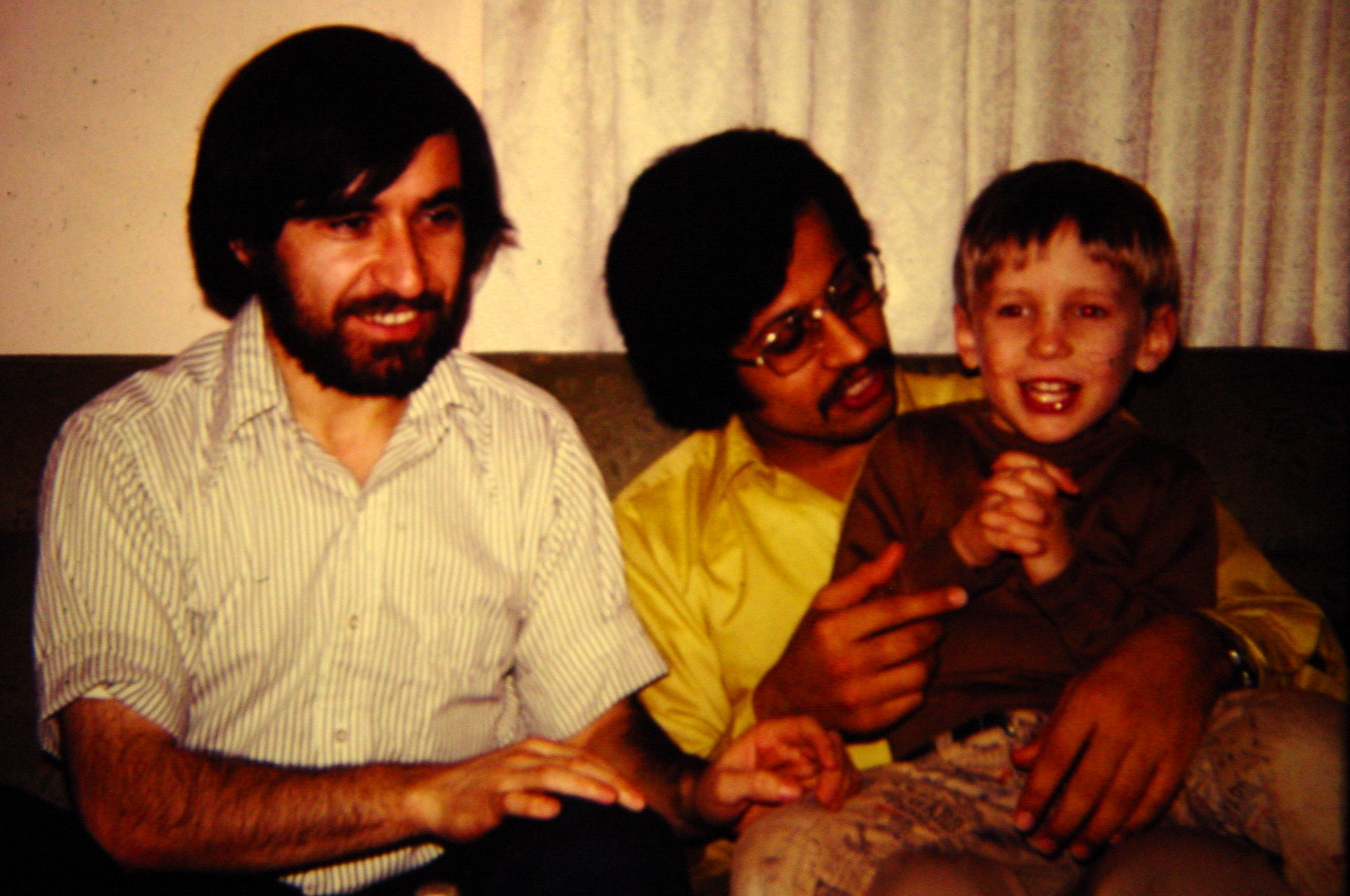
Abby and I both attended Malone College (now Malone University) where we met, became engaged, and then married after graduation, in 1969.  At Malone, we became friends with students of various ethnicities, especially African Americans and also international students from Africa.  We especially remember Brindell with whom we worshiped, occasionally studied, and enjoyed double dates eventually including the junior-senior banquet.

During the first summer after Bradley’s birth in 1970, we traveled to Kalamazoo, Michigan for graduate level courses in ecology at Western Michigan University.  While we were there, we visited various sites including the sand dunes along Lake Michigan and the Kellogg’s cereal company of Battle Creek.  This was to be the beginning of a significant role of Michigan education, geography, and sports in our family.  

One year later, the three of us moved to Morgantown, WV for my doctoral studies.  There we became friends with international students from several continents.  Two Middle Eastern graduate students, one a Muslim and the other Jewish, invited us to their apartment where they served us their favorite dishes which we thoroughly enjoyed.

Among our neighbors in the trailer court in which we resided during graduate school were Alvaro and Jane, a delightful couple from Brazil, who soon began to love and spoil Bradley.  They introduced us to their Brazilian and Mexican friends and we all went on a day-trip into the mountains of Maryland to enjoy swimming and picnicking.  Later, when we settled in Champaign-Urbana, Illinois for a lectureship in botany at the University of Illinois, Alvaro made a special effort to visit us while he was on campus attending an international conference.  Of course, Alvaro was especially delighted to see Bradley. Our daughter, Melinda was born in Urbana, IL a few months later.

Little did we know that at the same time, a little Brazilian girl named Raquel de Paula was growing up in southern Brazil, daughter of Portuguese and German parents, and would later decide to move to Michigan where our paths would meet as we will describe below.

While at the University of Illinois, I was fortunate to serve with the faculty of the Department of Botany chaired by an Indian-American plant physiologist named Govindjee.   His research on photosynthesis earned Govindjee the Lifetime Achievement Award from the International Society of Photosynthesis Research, in 2022.  

[Read Govindjee's biography HERE.  And more HERE.]  [If you recall the Calvin-Benson Cycle of photosynthesis, this interview of Andrew Benson by Govindjee may be interesting—HERE.]

Following our two years at U. of Illinois, we moved to Maryland for employment as a plant physiologist with the USDA-Agricultural Research Service in Beltsville outside Washington, DC.   As a researcher within the Light and Plant Growth Laboratory where two of my colleagues are noteworthy:  N. Jerry Chatterton was a fellow plant physiologist and bishop within the Church of Jesus Christ of Latter-Day Saints; and, Takuma Tanada, a Hawaiian-born American, was also conducting 

research, specifically on the effects of red and far-red wavelengths of light and the element boron on photomorphogenesis of plants, particularly the roots.  Mr. Tanada is recognized for the discovery of the “Tanada Effect,” named for the effect of specific light wavelengths on plant roots.  [More HERE.]  In 2011, Tanada was awarded a Congressional Gold Medal, the highest civilian award in the United States, for his assistance to the U.S. military in World War II.  He died in 2018 at age 98.

Believing that all research and no ministry to others makes John a dull boy, our lives in Maryland were greatly enriched among other family activities by our worship at Belcroft Bible Church.  There, we enjoyed our ministry to the career singles and met Ravi Waldon and Heidi Sweetman.  The two married, raised two sons, and Ravi is now a Principal at Michael Graves Architecture & Design [Click HERE.]

When we became part of the Cedarville College (now Cedarville University) faculty in 1979, it was my honor and blessing to represent the university at the Academic Council of Au Sable Institute for Environmental Studies in northern Michigan.   I was also blessed to lead numerous trips to northern Michigan with my students for field laboratory studies in environmental physiology and ecology. 

Meanwhile, Bradley was completing his high school (Cedarville H.S.), undergraduate (Cedarville University), and graduate education in mechanical engineering (Rensselaer) and settling in Michigan.  There he eventually met and married Raquel de Paula, once the little Brazilian girl we mentioned earlier.  Raquel had grown up and moved to Ann Arbor, Michigan where she was serving as a nanny.  Bradley is Founder and president of The Little Leaders Company [See HERE.] and Raquel is Project and Program Manager for the University of Michigan.

Not long after Brad and Raquel had settled in Ann Arbor, Melinda who had completed her secondary and undergrad college education in the same institutions as Bradley, married Steve Salyers of English descent, and they had three children, Caleb, Kiara, and Della Rose.  We enjoyed many visits to the Salyers home near Temperance, Michigan; and, we were blessed to worship with them at Northpoint Church of the Nazarene, pastored by Steve for eleven years.  At Northpoint, we made friends with many African Americans, Hispanics, and other brethren of European descent.

In 2012, we retired from Cedarville University and moved to Wooster, Ohio where we joined West Hill Baptist Church.  Among the new friends we met at West Hill were members of our missionary family.  Keeping our ethnic focus of this blog, I will note three families who are indigenous missionaries. Aroop and Rebecca Kumar
serve in Bangalore, India; and Daniel and Anna Telfort minister in Port au Prince, Haiti. The Kumar’s and the Telfort’s are husband-wife teams who serve in one or more local churches and teach men who are studying to be shepherding pastors.  They also reach out to individuals and families experiencing great spiritual and physical needs.  The Telfort’s work with Bibles International and Daniel has nearly completed the entire Bible in the Creole language.  

Matt and Daniela Brenner serve with Wycliffe Bible Translators in a mission to bring the Gospel to indigenous people in rural Brazil. Matt grew up near Wooster and married Daniela whose hometown is Garça, Brazil. All five of the Brenner family are "on mission," each in their unique way as anyone would testify who has spent time with them.

In recent years, Steve and Mindy’s son Caleb completed his secondary education and enlisted in the  Army National Guard where

he met Soni, an enlistee of Indian descent from Philadelphia.  Caleb and Soni married in 2019 and reside near Pittsburgh where we have enjoyed several blessed times visiting them. 

In 2022, our older granddaughter, Kiara married her best friend, John Basford, born of German and English parents. They await the arrival of their first child next year.

Marvelous Multiethnicity
So there you have it.  The family account of John and Abby Silvius, a multiethnic couple who have been blessed to meet and enjoy the friendship of a diversity of ethnicities over the years.  And, most blessed of all is that we now are part of a multiethnic family.  We look forward to celebrating Thanksgiving together this year as a family.

Of course, our earthly genealogy, wonderful as it is, has carried the curse of sin reaching all the way back to Adam and Eve.  Sad as it sounds, this fact must be reconnect with by humbly yielding to Christ whose sacrifice of His holy life in our place earned Him the right to say, I am the way, the truth, and the life, no one comes to the Father [in Heaven] but through Me. (John 14: 6). 

If you have yielded your life to the saving grace of God through Christ (Ephesians 2: 8-10), regardless of your ethnicity, you will be part of that numberless multitude described in Revelation.  We hope you are! 

The Scripture from Revelation (Right >) and the testimony below, written by a Cedarville University alum and friend of Abby and I, provide a fitting end to this blog:

“I truly believe God is glorified by this diversity of peoples and ways of living. So wonderfully unique, but all bearing His image. All of us are touched by common concerns, many are touched by crisis, but all are offered peace that passes understanding. Truly, it’s a gift.”  - Julie Titus Sanders

Where to Next?
In Part 2 of “Thanksgiving for Multiethnicity,” we will describe the workings of God in an Asian family that ministers to multiple ethnic groups and nationalities around the world.  Click HERE for Part 2.

Meanwhile, if you have questions about your relationship to Jesus Christ and wonder if you will be part of that “great multitude” described in Revelation 7 (above), why not check out “Steps to Peace with God” [Click HERE.]  We also invite you to respond in “Comments” below, or e-mail us at silviusj@gmail.com


Friday, November 1, 2024

Election 2024: What Can We Agree On?

Hello Friend.  Thank you for your recent Facebook post on the 2024 presidential election.   I agree fully with the claims in your opening paragraph as far as it relates to American government and its founding principles.  For example, you refer to our “system of government” which unusual, having survived nearly 250 years.  I decided to respond to your post in detail while hoping that we can maintain your anonymity, if you wish, while giving your thoughts and mine a larger audience.  Meanwhile, I hope to remain one of your “conservative friends.”

Protect Separation of Powers

To begin, I will assume that we can agree that a key to America's longevity is the commitment of 
our leaders to respect and maintain the “separation of powers” with three independent federal branches; namely, judicial, executive, and legislative. But sadly, the federal separation of powers has been challenged in recent years by threats leveled at Supreme Court justices who have held conservative interpretations of our Constitution—threats leveled directly at justices seated in Congress during State of the Union speeches, by rioters outside the homes of justices, and by efforts to “pack the court” with additional justices to “legislate” a liberal progressive social agenda.

There were also efforts by U.S. Court of Appeals for the District of Columbia Circuit in collaboration with the current Federal Department of Justice to remove or limit “presidential immunity from criminal prosecution for conduct alleged to involve official acts.”  [See Trump v. United States, HERE.]  Contrary to the notion that Donald Trump as president would “become a dictator,” the Supreme Court upheld “presidential immunity” which our founders had established to prevent the executive branch from becoming powerless against the encroachment by the separate powers of the legislative and judicial branches. [See SCOTUS decision HERE.] 

Therefore, in answer to those who believe Trump would “become a dictator” in his second term, couldn’t we agree that as long as our three branches of government are mutually constrained by the Constitution, there is little danger of any president literally becoming a dictator, even during situations like the recent pandemic when unprecedented powers were exerted by the federal government to control our coming and going’s.  During this time, President Trump blocked immigration from China and cooperated with Anthony Fauci in marshalling resources to prevent and treat those infected by the virus.  Interestingly, Dr. Fauci was an unelected official given great power but whose motives and recommendations in retrospect are now quite questionable.

Protect Our Borders

Next you refer to “our nation and its peoples” which to me would include a geographic area defined on the map by borders.  Historically, law enforcement of a controlled immigration system at our borders has been the basis for civic order in our nation.  As you know, our immigration system has allowed us to become a “nation of immigrants,” a rich melting pot that has welcomed the great masses of many different ethnic groups and nationalities to enter our borders—and, to enter legally with a sense of pride in becoming true citizens with opportunity to become successful through hard work as individuals who assimilate into American culture, salute our flag, learn and celebrate our history, and enjoy our customs.  But, as you know, the Biden-Harris administration threw off the controls on immigration under the Trump administration by executive order which has allowed millions to flood our borders, towns, and cities as lawbreakers, many of whom do not respect or want to adopt our American values—i.e. as you wrote, “values above all that are greater than greed or fear or resentment or revenge.” 

Comparing Performance
I also agree with the value you place on our U.S. Constitution which “prioritizes the worth of the individual, provides for free expression, opportunity, and freedom of religion.”   Assuming we can agree on these qualities and principles as being worth holding onto, the question becomes, “Which presidential ticket is the most likely one to preserve them?”  Somewhat uniquely, both opposing presidential candidates have shown us their leadership philosophy, skills, and accomplishments in their respective 4-year terms.  Of course, to judge between the Trump-Pence and Biden-Harris administrations, we need to sort through the biases of the news media (e.g. Fox News and Newsmax versus CNN and CNBC) which portray Donald Trump and Kamala Harris in different lights.  Some happenings are more difficult to interpret than others, especially because both sides have spoken rashly (e.g. Trump: “I’ll be a dictator from day one” referring to his promised reversal of Biden-Harris policies and executive orders such as the one that has incentivized millions of immigrants to cross our borders illegally; or Biden: “[Trump] supporters are garbage”). 

Personalities and campaign slogans aside, allow me to refer to several historical occurrences that are objectively defined.  For each of these, let’s ask how the two administrations compare:
1.  How many wars began under each administration?
2.  How many indictments were issued by the sitting president when a losing candidate questioned the results of the presidential election—i.e. against Hillary Clinton the loser when Trump was president versus against Donald Trump the loser when Biden-Harris were in power?
3.  How does the cost of living compare between the two administrations?
4.  How many threats to the integrity of the Supreme Court and the lives of its justices?
5.  How many efforts to defund the police and border officials?
6.  Which presidential candidate participated in fund-raising to support of those involved in burning our cities and destroying government property including memorials to our founding leaders?
7.  How many Americans and non-citizen immigrants have died from fentanyl poisoning or child trafficking under each administration?
8.  How many Americans now have the opportunity to vote in deciding at the state level the fate of unborn children?
9.  Which administration has had the lower morale, more resignations, and fewer enlistments into our military because of the division being stoked by “diversity-equity-inclusion” philosophy?
10.  Which administration has had more cities, including Aurora, CO and Springfield, OH having to deal with tens of thousands of illegals who cannot speak English or drive safely, and who struggle to adapt to American culture while themselves having left behind families now divided and disrupted?

Each of the above comparisons are measurable and can be objectively assessed.  Each one affords us with a comparison of the quality of leadership of Trump-Pence versus Biden-Harris during the respective prior presidential administrations.

Two Media Narratives: Split Nation

In spite of the contrast we see when we compare how the two administrations fared under the ten measurements above, there remains the fact that our nation is evenly split between their supporters.  (See attached statement.)  Friend, if we can agree that half of American voters support each ticket, is it fair to make the case against Trump based on reports of “what Trump might do?”  For example, when Trump mentions he may have to use the military, isn’t this part of a history of his actions as president?  Recall that he either called in the national guard or threatened to call it in when major cities were being allowed to burn (e.g. Minneapolis during Tim Walz’s term as governor of Minnesota).  Just prior to the day of the January 6 demonstrations (“insurrection”), President Trump had asked for deployment of the national guard which would likely have prevented the invasion of the capitol (Click HERE to read.]  House Speaker Nancy Palosi, whose responsibility it is to provide for capitol security now blames herself for not being more proactive [Read more HERE.]

You also mention Trump’s use of “the enemy within.”  I’m not sure how you or I would react if we were subjected to the 8-year series of attacks in which Trump’s opponents have used the legislative branch to impeach him over what turned out to be fabricated charges without supporting evidence (“Russia gate” and “Ukraine gate”).  Next, the close 2020 election that he contested (just has Hillary Clinton had done in 2016) turned out to have been influenced by the FBI which knowingly suppressed the criminal evidence in the “Hunter laptop.” Then, a night-time raid on Trump’s home followed by a series of indictments in which the Biden-Harris department of justice has colluded, followed by two assassination attempts, both  of which resulted from obvious lack of competence.  Are we and is Donald Trump right to take lightly the notion of “an enemy within?”  No matter what we imagine when we hear his claim of “the enemy within” at very least, it amounts to federal officials who are lawbreakers and they ought to be identified and brought to justice.

Finally, there is the claim that Donald Trump is a liar.  Although you have not mentioned it, Trump is also called a Fascist, a racist, and other names.  But he has claimed innocence in case after case which eventually bears out that he was telling the truth.  Meanwhile, our current president has been shown to have lied in saying that he was not part of massive influence pedaling schemes involving Hunter who may have colluded with officials from China, Ukraine, and other nations in their efforts to gain access to the Biden administration.

What Can We Agree On?

In conclusion, my friend, I hope this response conveys my understanding of the contrasts between the two 2024 presidential tickets in a well-reasoned, respectful manner.  I am glad we agree that we are blessed with a “system of government, designed by the framers nearly 250 years ago [that is the reason why] our nation and its peoples have prospered like no other on the planet.”  I am also glad that you and I “hold values above all that are greater than greed or fear or resentment or revenge; [and that our] US Constitution prioritizes the worth of the individual, provides for free expression, opportunity, and freedom of religion.”   Because of these principles and values, we and our loved ones have been able to live in freedom and pursue meaningful callings including our calling to botany and land stewardship.  I only hope that our votes will result in the election of a leader who can help preserve these values and opportunities.   I welcome your “Comment” below.

Note:  I am especially excited at the prospect of an administration that can not only restore national sovereignty and community safety through border security and due process for lawbreakers, but also one with a vision such as that offered by RFK jr who looks at “health” in a holistic manner involving environmental stewardship as a context for addressing agriculture, our medical health system, and nutrition.   I welcome your comments on this prospect as well. 

Monday, October 21, 2024

Does God Make Unlikely Choices?

National election 2024 is just around the corner, and many voters have already cast their ballot.  Meanwhile, America is deeply divided over which presidential ticket would best serve our country for the next four years.  Although there is heightened confusion due to media bias and an abundance of rancor on both sides, the platforms of Trump-Vance and Harris-Walz leave no doubt about the contrast in their respective values. 

The Trump-Vance platform defends the sanctity of human life while respecting the life of the mother and father; it supports limited government regulation, reigning in diversity-equity-inclusion (DEI) programs, supporting school choice, and protection of freedoms under the U.S. Constitution.  Trump-Vance also favors strengthening our borders and emphasizing “peace through strength” to avoid foreign wars.  We have elaborated on these and other contrasts between Trump-Vance and Harris-Walz elsewhere.  [Click HERE to read more.]

Right to Sit Out the Election?
In spite of the contrast between presidential tickets, shocking statistics from George Barna at Arizona Christian University (ACU), estimate that "as many as 41 million Christians plan to sit this election out — more than enough to hand the country’s keys to the eager and radical Left."  [Read more
HERE.]   Christians are apparently choosing not to vote either out of apathy or for one of two other reasons.  They are either confused about how to view the candidates and the issues from a biblical framework or they dislike both tickets.  

Len Munsil, president of ACU believes many Christian voters are “longing for their local church to instruct them on how to think biblically about policy and politics. They don't want to be told how to vote but they do want to know why they should vote and how to view political issues from a biblical framework." [Read more
HERE.]

Pray for our pastors to have courage to lead and inform their "sheep" who want to understand how to choose and vote wisely and consistently with biblical values.  Understandably, evangelical pastors should want to keep the message of the Gospel of salvation front and center.  However, the New Testament Scriptures commands Christ-followers to respect those in authority and to respect government which is established by God. 

During the first century AD when these Scriptures were written, Christians were ruled by unelected officials.  Now that we have the freedom and right to vote there is no excuse for not taking seriously our privilege and responsibility to cast our votes. The following Scriptures written by the Apostle Paul required of first-century Christians then, and now us today, to give attention and respect to our government leaders for a higher purpose (emphasis added):

First of all, then, I urge that entreaties and prayers, petitions and thanksgivings, be made on behalf of all men, for kings and all who are in authority, so that we may lead a tranquil and quiet life in all godliness and dignity.  This is good and acceptable in the sight of God our Savior, who desires all men to be saved and to come to the knowledge of the truth. For there is one God, and one mediator also between God and men, the man Christ Jesus, who gave Himself as a ransom for all, the testimony given at the proper time… Therefore, I want the men in every place to pray, lifting up holy hands, without wrath and dissension.  – 1 Timothy 2: 1-8

Notice that God desires all men to be saved and to come to the knowledge of the truth.  It seems obvious that Christ-followers should exercise stewardship of their freedom to vote in a way that elects men and women whose policies will sustain a society in which the Gospel can be preached and biblical values can be promoted as a way of life in America.  But what about those who say, “I don’t like either candidate!”

But I Don’t Like Either Candidate!
We have seen that God commands us to pray for all men and for kings in authority.  In Romans 13, the Apostle Paul elaborates on this command (emphasis added):   Every person is to be in subjection to the governing authorities.  For there is no authority except from God, and those which exist are established by God (v. 1)... as a minister of God to you for good (v. 4a). 

If no authority is established without God’s will, and if God’s purpose is that our leaders be those who are “ministers to us for good,” then we are responsible to use our God-given freedom to elect “good leaders.”  But you may ask, what if I see no “good” in either candidate?  To which we would reply, is there ever such a candidate who is perfect in every way, gentle, likeable, agreeable in political philosophy, etc.?  And, is our choice (or refusal to choose) consistent with the choice that God would consider “for the good” of unborn human life?  Or for the “good” for establishing law and order, legal due process, respect for our nation’s borders, and respect for those desiring immigration while protecting them from child traffickers and other consequences of being incentivized to leave their homeland and family?

We do not believe that it is violating God’s laws to vote for an imperfect candidate whose policies are the most consistent with biblical morality.  We should also consider the trajectory of the character of the candidates:  Which has demonstrated the most consistent character qualities, maturity in his or her behavior, consistent position on important policies, and experience befitting the office of President?  Beyond that, we should be careful not to withhold support for a candidate who, though not perfect, has the most God-honoring traits—e.g. love for family, for children both born and unborn, for the American people and our nation, for those in authority, and for biblical values.

Some Unlikely People God Has Chosen
Granted, we cannot be sure who God would choose.  However, the Bible provides details of a rich history of God choosing men and women from all walks of life, socioeconomic status, and political persuasion.   Read on for a few examples:

I was extremely wealthy, but I was a liar. I married a beautiful woman, but when she could not give me a son, I chose to have sex with another woman who gave me a son—and many headaches along with him.  But God patiently nurtured my faith in Him.  By His mercy and grace, God gave me another son through whom I became the “father of many nations” through my descendant, Jesus Christ (Genesis 12, 16, 21).  – Abraham

I was a trickster from birth, stole the inheritance from my twin brother, cheated my employer, and wrestled with God through most of my life.  Then, one night I literally wrestled with God until finally my hip was dislocated and I have walked with a limp ever since.  But by God’s mercy, I became humble and obedient, and He gave me a new name.  (Genesis 25, 27, 32)  – Israel (Jacob, “the deceiver.”) 

I was a prince, but also a murderer, a coward, a short-tempered man, and one who could not speak well, especially in crowds (Exodus 2, 3).  But God used me to lead a nation of several million out of slavery in Egypt.   – Moses

I was a prostitute who unknowingly welcomed some men into my home, but they only propositioned me for information.  By faith in the God of Israel, I risked my life to help them.  Then, I hung out a red ribbon which became my salvation when God’s army came to destroy my city (Joshua 2, 6).  By God’s grace and mercy, I became the great grandmother of Jesse, the father of King David.   -- Rahab

I was a shepherd, a musician, a writer, a warrior, and a king.  But I became proud of my accomplishments and stole a man’s wife, then killed him to cover up my affair.  Yet, by His rich mercy, God sent a prophet to confront me about my sin.  I repented and was forgiven (Psalm 51).  God remembered His covenant throughout my royal line until, centuries later, my descendant named Jesus was born, “King of the Jews.”  -- David

I was a heathen king of the Empire of Babylon.  I erected an idyllic image of myself and commanded the people to worship me with the threat that I would cremate anyone alive who refused—and I carried out this wicked threat.  But when I became so proud, God humbled me to the point that I became as a wild beast, my body covered with hair, my fingernails as bird claws.  I ate grass like the cattle and was humbled until God in His mercy, restored me to authority where I proclaimed that He only is the righteous Creator to whom all honor is due (Daniel 4: 34-37). –King Nebuchadnezzar

I was a despised tax collector for the Romans, named Levi.  I padded my life with stolen and undeserved excesses in monies extracted from my poor countrymen and women.  Jesus, knowing all about me, came to my tax office and said, “Follow Me.”  I got up and followed Him.  Later, God allowed me to use my gifts under the inspiration of His Holy Spirit to write what became the first gospel in the New Testament.   – Matthew

Watch video of the call of Jesus to Matthew – Click HERE

I was a Jewish leader (a Pharisee), a scholar and religious teacher.  But when I learned that an itinerant preacher had started a peaceful ‘revolution’ of sorts, I began to round up His followers, called “Christians,” and imprison them.  I even held the coats of my countrymen while they stoned to his death a Christ-follower named Stephen.  But God, “being rich in mercy,” although I was dead in my sin, made me alive with Christ and used me to spread the Gospel of Christ throughout the Roman Empire.  My message: “Christ Jesus came into the world to save sinners—and I am the worst of them (1 Timothy 1: 15)!”  – the Apostle Paul (formerly, Saul)

I was born and raised on a family farm.  My parents introduced me to God by taking my sister, brother, and I to church every Sunday.  For years, I wondered how I could be good enough to please God.  Meanwhile, I broke each one of the Ten Commandments in thought if not in action.  Then, I was introduced to the saving Gospel of Jesus Christ who died for my sin.  I still face the challenge of sin and temptation, but God has given me the power and victory over my sin nature, the grace and forgiveness I need through Christ’s shed blood when I confess my failings, and a loving family and church to encourage me along the way.  – John Silvius

Lessons from God’s Unlikely Choices

Now that you have read brief accounts of several men and women whom God chose, let’s consider a few questions: 
1)   How would you compare the character and reputation of Donald Trump or Kamala Harris to yours, especially if you had walked in their shoes during the past decade or more? 
2)   How does the character of our presidential candidates each compare to the biblical characters listed above?
3)   Does the character and personality of either or both of our presidential candidates remind you of someone in your past that you liked or disliked?
4)   Is it possible that a person who refuses to study carefully and make distinctions between the presidential candidates could be contradicting the record of how God chose men and women for His purposes in the past?   

Maybe the questions above and other questions can help us sort through our own values and past experiences and how these affect our voting preferences.  We may even discover that there are many other people besides the candidates are already making our lives difficult.  How should we respond?

Can’t stand your spouse?  
Pray for him or her.
Wondering why God hasn’t given you a better pastor? 
Pray for him and encourage him.
Don’t want your boss to “rule over you?”  
Ask God to help you know how to encourage him.
Can’t stand a presidential candidate?  
Pray for God’s work in his or her life.
Can’t bring yourself to vote for either candidate?
Pray and consider God’s purposes and “good” you might be opposing by your decision.

Remember, dear brothers and sisters, that few of you were wise in the world’s eyes or powerful or wealthy when God called you.  Instead, God chose things the world considers foolish in order to shame those who think they are wise. And he chose things that are powerless to shame those who are powerful.  God chose things despised by the world, things counted as nothing at all, and used them to bring to nothing what the world considers important. As a result, no one can ever boast in the presence of God. 
                                         – 1 Corinthians 1: 26-29

Will You Share Your Story?
How about your life story? 
Do you believe God has chosen you be a Christ-following disciple?  
Do you believe you are worthy of being chosen?  
How do you explain that God would choose you? 
For what purpose(s) has God chosen you?
What would God have you do now?

Please click on “Comments” below to share your story online, or write to me at silviusj@gmail.com.

Friday, October 18, 2024

Limits to Intimacy? 1. An Invitation

When I was in my twenties and engaged to be married, I ran across an article entitled “Are There Limits to Intimacy.”  I confess that I was intrigued by the question because, in my naïve state of mind, I was thinking of “intimacy” only in terms of sexual intimacy.  The article did touch on sexuality in marriage, but the author focused mainly on the deeper question of what fosters intimacy in any relationship—friendship, sibling, marriage, etc. 


Why the ”Intimacy Question”?
During our 55 years together, Abby and I have been blessed in our marriage and family, and in relationships with our friends. Still from time to time, the topic of “limits to intimacy” arises in our conversation, especially when we have disagreements that can jiggle our calm, or when we read the disturbing statistics about the state of relationships in our current culture.

In spite of access to social media, video calling, transportation, and loads of amusements, increasing numbers of people report feelings of isolation and loneliness.  A Harvard University survey of American adults this past Spring reported that 21% of adults in the U.S. feel lonely, with many respondents feeling disconnected from friends, family, and/or the world. They identified various factors that contribute to loneliness, as well as personal and community solutions. The data also suggest that underneath loneliness may be a troubling brew of feelings, including anxiety, depression, and a lack of meaning and purpose. 

The Harvard study is not alone in revealing the extent of loneliness in our culture.
  Therefore, the question, “Are there limits to intimacy?” becomes even more relevant.  Most of us who value relationships with other people would naturally be interested in this question.  Whether in our marriages or in our friendships with others, we want close relationships that grow and endure the test of time in spite of our sinful natures.

If there are limits to intimacy, and it is obvious there are, what are they, and how can minimizing or eliminating them produce closer, more fulfilling relationships?  If you are still reading, we will assume you are already asking these questions and thinking of some answers from your experiences.  Therefore, our approach will be to define what is meant by “intimacy” and then to raise some questions we have been asking about “limits to intimacy.”  Finally, we will invite you to share your perspectives based on your faith and experiences by using the “
Comments” link.

“Intimacy” Defined

As noted earlier, intimacy is often defined within the context of sexual relations, but its meaning is much broader.  As a noun, an intimate can mean a “close friend.”  As an adjective, intimate is used to describe the closeness of a relationship where the word means “inmost, innermost, deepest.”  Taken together, it may be said that intimacy of each member of a relationship requires investment of the whole person in mind, body, and spirit.

Psychologists often define intimacy in terms of four or five types.  For example, Dr. Judy Ho, writing in Psychology Today [Read more
HERE.], lists five (5) types of intimacy quoted as follows:

·      Physical intimacy includes physical touch (both sexual and non-sexual) such as intercourse, kissing, hugs, cuddling, sitting close together, or holding hands.

·      Emotional intimacy involves the honest sharing of your thoughts, feelings, fears, hopes, and/or dreams, and feeling heard and understood by another person.

·      Intellectual intimacy involves communicating beliefs, viewpoints, and ideas in a way that creates intellectual stimulation, curiosity, interest, and acceptance (despite possibly differing vantage points).

·      Experiential intimacy involves doing something together that creates a shared experience or allows teamwork toward a common goal.

·      Spiritual intimacy involves sharing moments that bring you a sense of awe, wonder, or acknowledgement with something bigger than yourself.

We Invite Your Comments
Below are some questions we have been asking about intimacy in relationships.  Hopefully, they will help you think more deeply about limits to intimacy.  Because we think you will want to respond in some way, here are three options from which you can choose:
1.  Ponder the Questions without commenting.  We hope you will personally gain from it.
2.  Posting Your Comment:  Make your comment(s) as concise as possible, but don’t refrain for fear you will be put down.  Your comments or questions will add important insights for others to read.  You may use your first name, or use “Anonymous.”
3.  Respond Privately:  You may contact us by e-mail using silviusj@gmail.com.  Obviously, we want to respect the privacy all who participate as well as those in our relationships by withholding actual names (or use a fictitious name if you like).

Here are the questions we offer to engage your thinking about intimacy in relationships:

1. 
Think of your closest friend.  Is your friendship growing, stable, or stagnating?  What is it that sustains your friendship and helps you to grow closer?  Or, what things currently limit your closeness?  [If your closest friend is your spouse, then your answers will be a bit different but the questions still apply.]

2.  Are there limits to the closeness or intimacy that friends or even spouses can attain?  What are hindrances to establishing intimacy between friends or spouses?

3.  What is the most fundamental ingredient to develop and sustain intimacy in any relationship?  How does a person or relationship develop this ingredient?

4.  Are there situations in a relationship in which we are justified when we decide we must refrain from a certain communication, action, or behavior toward our friend or spouse?  What is an objective source or ethical basis for justifying your decision?

5.  Is it possible to establish an intimate relationship by a social media communication alone?  If not, what elements of a genuine intimate relationship would need to be addressed by other means than social media?  Are there applications we can make from this line of reasoning to address causes of the troubling statistics on loneliness, depression, etc. we cited above?

6.  What role does a person’s spiritual life, faith, and personal worldview play in developing close, intimate relationships with others?  Would you consider the spiritual dimension as a primary or secondary ingredient in developing intimacy in your relationships?

7.  How necessary is intimate self-knowing or self-awareness to our ability to form intimate relationships with another person or persons?  What do you believe is necessary for growing in knowledge of “self?”

-----------------
Looking Ahead to Part 2:  
In Part 2 we will discuss God's provision for "perfect intimacy" between Adam and Eve, and between them and their Creator God--that is until they chose to rebel and fell under the curse of sin.  Although God is holy, powerful, and just, He is also gracious, loving, and relational.  Thankfully, through God's plan of redemption and reconciliation through His Son, Jesus Christ, He is able to restore fallen humans into loving intimacy with Him.  How does all of this influence the development of intimate human relationships today?  Watch for Part 2, in January, 2025.

Wednesday, October 9, 2024

Where Is God in Our Storms?

Many of us are asking how any good could possibly come from something as devastating as hurricane Helene or the oncoming hurricane Milton.  Many whose lives and homes have been destroyed feel powerless and helpless.  Still, with hope in God, we pray that Milton will turn away or stop in the Name of Jesus, the One who stilled the storm when He said, “Peace, Be Still.”  

We want to have faith that our prayers are heard.  But doubt creeps in, especially for the many whose lives have been so abruptly changed.  Many have asked, “If there is a God and if He is good, how can He allow bad things to happen?   It’s a good question, but there are more basic questions we should ask.

We should first ask ourselves, “What is ‘GOOD?’”  What is “good” for some may be “bad” for others, and vice versa.  “Who among us knows how to define GOOD for all who are involved?”
Most people of faith would agree that only God can do this.  God is the only One who can still the storms around us and within our anxious souls.

In the Bible we read that Job was so severely tested that he questioned God’s purpose and goodness.  Job lost most of his livestock and possessions; and then, lost his sons and daughters in a windstorm.  Job’s wife advised him to give up and blame God for the calamity.  But Job said to her, “You speak as one of the foolish women would speak. Shall we receive good from God, and shall we not receive evil?” In all this Job did not sin with his lips (Job 2: 9-10).

We can search the Book of Job in hopes of finding an answer to why God allows “bad things” to occur.  But the answer is not there.  Nor did God answer Job directly when Job asked God why he had to suffer.  Instead, God pointed Job to the evidences of His wisdom and sovereignty in creation and in sustaining His created order.  When Job heard God’s powerful message to him, he bowed down in humble adoration and
    …answered the Lord and said, 
    I know that You can do all things,
       And that no purpose of Yours can be thwarted.
  ‘Who is this that hides counsel without knowledge?’
       “Therefore I have declared that which I did not understand,
         Things too wonderful for me, which I did not know.”
  ‘Hear, now, and I will speak;
       I will ask You, and You instruct me.’
   “I have heard of You by the hearing of the ear;
       But now my eye sees You;
   Therefore I retract,
       And I repent in dust and ashes
.”

Several millennia later, James, half-brother of Jesus, reminds us of ancient Job’s sufferings:
We count those blessed who endured.
You have heard of the endurance of Job
and have seen the outcome of the Lord’s dealings,
that the Lord is full of compassion and is merciful
. – James 5: 11

Today, in the midst of suffering and loss, Christ-followers, moved with God’s compassion and  mercy are coming together to assist each other and participate in the restoration.  May each of us who are not directly affected by these storms participate in the supply of “good” from the hand of God through our supportive involvement by prayer, by giving, and by hands-on help where possible.  For those who want to provide financial assistance to recovery efforts, we recommend giving to Samaritan’s Purse 
a faith-based organization led by Franklin Graham.

God Is in Our Storms

Jesus Himself was in the stern, asleep on the cushion; and they woke Him and said to Him, “Teacher, do You not care that we are perishing?” And He got up and rebuked the wind and said to the sea, “Hush, be still.” And the wind died down and it became perfectly calm. And He said to them, “Why are you afraid? Do you still have no faith?” They became very much afraid and said to one another, “Who then is this, that even the wind and the sea obey Him?”
 - Mark 4: 38-41

F.B. Meyer wrote an encouraging message for us when we question God’s goodness and love:

“We sail the lake with Him still, and as we reach its middle waters, far from land, under midnight skies, suddenly a great storm sweeps down.  Earth and hell seem arrayed against us, and each billow threatens to overwhelm.  Then He arises from His sleep, and rebukes the winds and the waves.  His hand waves benediction and repose over the rage of the tempestuous elements.  His voice is heard above the scream of the wind in the cordage and the conflict of the billows. Peace, be still!
Can you not hear it?  And there is instantly a great calm.”
He giveth quietness.   (Job 34: 29)
        
-- F.B. Meyer (Great Verses through the Bible. Zondervan, 1966)

Add Your Word of Encouragement
We welcome you to share your words of encouragement, a comforting Scripture, or an account from your experience of how you saw God working through your time of trial.  Use the “Comment” link below to share, anonymously if you prefer; or communicate with us by e-mail:  silviusj@gmail.com